
Verwandte Artikel zu China Smart: What You Don’t Know, What You Need...
China Smart: What You Don’t Know, What You Need to Know― A Past & Present Guide to History, Culture, Society, Language - Softcover
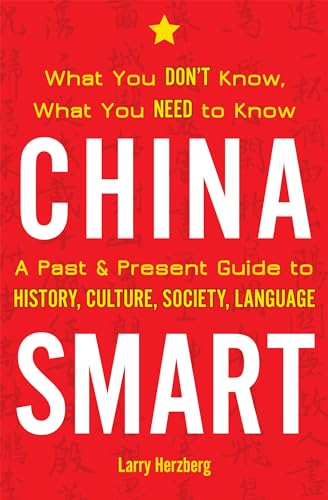
Inhaltsangabe
Essential essays on all things Chinese that inform and entertain travelers, students, and anyone working or living in China.
How is China organized politically? What are the issues that young people face in today's China? What is China doing about its problem with pollution? Is the Chinese internet like our internet? What's China's role in the world today? And how much do you know about China's great woman emperor or the Chinese explorer whose voyages may have inspired the legend of Sinbad the Sailor? What are the major Chinese holidays, their superstitions regarding numbers, and the true nature of the Chinese written language?
In nearly 60 brief essays, long-time China expert Larry Herzberg tackles important facts and myths about China, its history, people, and culture, as well as its contemporary society. Anyone dipping into this book will emerge that much smarter about China, whether visiting, conducting business, studying the language, or simply being fascinated by one of the world's greatest and most influential civilizations.
Die Inhaltsangabe kann sich auf eine andere Ausgabe dieses Titels beziehen.
Über die Autorin bzw. den Autor
Larry Herzberg studied Chinese for five years at Vanderbilt University before doing his Master's and Ph.D. work in Chinese Language and Literature at Indiana University. In 1980 he founded the Chinese Language Program at Albion College and then did the same at Calvin College in 1984. For the past three decades he has taught the Chinese language at the college level. He is author of Speak and Read Chinese and along with his wife, Qin Xue Herzberg, of China Survival Guide, Basic Patterns of Chinese Grammar, Chinese Proverbs and Popular Sayings (all from Stone Bridge Press), and A Writing Guide for Learners of Chinese (Yale University Press).
Auszug. © Genehmigter Nachdruck. Alle Rechte vorbehalten.
NOTE TO THE READER
Over the past four decades that I have taught Chinese language and culture to college students, there have been certain facts about both China’s past and present that I have found important to mention. Whether speaking about the many great inventions of the Chinese in the past, or the dramatic progress China has made very recently in areas such as solar power and high-speed rail, I discovered that few of my students knew about any of these.
In this book I have attempted to introduce to a general audience some of the most significant and fascinating aspects of both ancient and contemporary China. I have included separate articles divided into three major sections: China’s Past; Chinese Society, Culture, and Language; and China Today.
In the section on China’s past, there are short essays about everything from the history of the Great Wall and the origin of silk, porcelain, and tea to the story of the only female emperor to the history of Chinese migration to the U.S. The section on Chinese Society, Culture, and Language contains short essays that explain aspects of the culture such as the nature of the spoken as well as the written language, the various ethnic groups within China, the major holidays, and superstitions regarding numbers. The final section on China today covers topics as diverse as the recent economic miracle, the problem of pollution, gender inequality, and the rapid progress toward a cashless society.
For the most part I have deliberately avoided taking sides and wading into controversial subjects such as the perceived economic and military threat to the U.S. posed by China’s rise, or human rights abuses. Those are highly complex issues that I did attempt to examine in a 2½-hour documentary that my Chinese wife Qin and I produced in 2012, entitled The China Threat: Perception versus Reality. (See the copyright page for more information.)
What I offer instead in this little book is a glimpse into some of the defining aspects of China, either historically or in today’s world. I have tried to make it as interesting and entertaining as possible, while also providing some substantial educational value. Hopefully you will discover how much there is about China that is absolutely intriguing and worth learning about.
Larry Herzberg
Professor of Chinese
Director of Asian Studies
Calvin College
Grand Rapids, Michigan
===
CHAPTER 1
Origin of the word “China”
The word that we use in English to describe the world’s most populous country actually bears no resemblance to the term that the “Chinese” themselves use. The word “China” derives from the name of the first Chinese dynasty. The kingdom of Qin (pronounced close to the English word “chin”) defeated the rival kingdoms that were its neighbors in 221 B.C. and unified them into one country or empire. The King of Qin proclaimed himself “Qin Shi Huangdi”, the “First Emperor of the Qin”.
However, this first Chinese dynasty was by far the briefest of all Chinese dynasties. It lasted a mere fifteen years, ending only four years after the death of the First Emperor. During his eleven year reign the first Qin Emperor did have some impressive accomplishments. He undertook gigantic projects, including ordering the building and unifying of various sections of what we now call the “Great Wall of China” to protect his new country from invasion by the “barbarians” to the North. He created a massive national road system. He also standardized weights and measures and even wheel ruts across all the kingdoms that he had unified. The Chinese writing system was also standardized for the newly unified country.
However, most of this came at the expense of a great many lives. The building of the Great Wall and the national road system were only made possible through the conscripted labor of hundreds of thousands of peasants. These unfortunate men were often taken hundreds of miles from their villages to work many hard years on the frontiers of the country. A large percentage of them never returned to their families but died in these forced labor projects.
In order to avoid having anti-government scholars make comparisons of his reign with the past, the Qin Emperor ordered most existing books be burned. The only exceptions were those on astrology, divination, medicine, and agriculture, as well as those that related the history of the Kingdom of Qin. The burning of so many books of the past also served the purpose of furthering the ongoing reformation of the writing system by removing examples of variant forms of Chinese characters.
Most infamous of all was the fact that this first of world’s book-burning dictators had nearly 500 scholars buried alive for illicitly owning such classic books as the “Book of Songs” and the “Classic of History”.
Given the cruelty as well as the short-lived nature of this first dynasty, the people we call “Chinese” in later centuries never wanted to be known as the “Qin people” or have their country called the “Kingdom of Qin”. Four years after the death of the Qin Emperor, the rebel Liu Bang overthrew the Qin to establish the Han dynasty. This dynasty lasted for more than four centuries, from 206 B.C. to 220 A.D.
It was the first of several golden ages of this newly unified empire. Under Han rule, China greatly expanded its territory and power, conquering what is today northern Korea and northern Vietnam. The “Silk Route” was established to provide a trade route with Rome, the other great civilization of its time. The civil service examination system was created to select officials, based largely on the teachings of Confucius. Under Han rule, the country produced important works of history, medicine, philosophy, poetry, and politics. Artists produced glazed pottery, large stone carvings. bronze vessels, and exquisite lacquer work. Silk was woven in rich colors and creative patterns to become a major industry and a source of export trade. And it was during the Han dynasty that China invented paper, sundials, and a seismograph.
In recognition of China’s achievements of this period, the Chinese people for several millennia have referred to themselves as the Han people. The pictographs that form their writing system are called “Han characters” (“Han zi”), pronounced by the Japanese as “kanji”. Since 1911, when the last imperial dynasty was overthrown, the “Chinese” have referred to their country as 中国 (“Zhōngguó”, “the Middle Kingdom”,) and call themselves 中国人 (“Zhōngguó rén”, “people of the Middle Kingdom”). But the term “Zhōngguó” was in use even before the Qin dynasty and was used by subsequent Chinese rulers to reflect their belief that their country was the center of civilization for all the countries that surrounded it. Indeed, there is some validity to the Chinese view of themselves. After all, both Japan and Korea adopted Chinese characters for their writing systems. More than half of all the words in the spoken Japanese and Korean languages have Chinese roots. China also gave Japan and Korea, as well as Vietnam, their traditional
architecture, Buddhism, Confucian philosophy, rice cultivation, the use of chopsticks for eating, and much more.
If for the last century the Chinese have referred to their country as “Zhōngguó” and call themselves “Zhōngguó rén”, the official name of both the People’s Republic of China and the Republic of China (Taiwan) uses the term 中华...
„Über diesen Titel“ kann sich auf eine andere Ausgabe dieses Titels beziehen.
Suchergebnisse für China Smart: What You Don’t Know, What You Need...

Beispielbild für diese ISBN
China Smart: What You Don't Know, What You Need to Know? A Past & Present Guide to History, Culture, Society, Language
Anbieter: World of Books (was SecondSale), Montgomery, IL, USA
Verkäuferbewertung 5 von 5 Sternen

Zustand: Good. Item in good condition. Textbooks may not include supplemental items i.e. CDs, access codes etc. Artikel-Nr. 00067836039
Gebraucht kaufen
EUR 6,45
Versand gratis
Versand innerhalb von USA
Versand innerhalb von USA
Anzahl: 1 verfügbar
Beispielbild für diese ISBN
China Smart : What You Don't Know, What You Need to Know-- a Past and Present Guide to History, Culture, Society, Language
Anbieter: Better World Books, Mishawaka, IN, USA
Verkäuferbewertung 5 von 5 Sternen
Zustand: Very Good. Pages intact with possible writing/highlighting. Binding strong with minor wear. Dust jackets/supplements may not be included. Stock photo provided. Product includes identifying sticker. Better World Books: Buy Books. Do Good. Artikel-Nr. 57799382-6
Gebraucht kaufen
EUR 6,46
Versand gratis
Versand innerhalb von USA
Versand innerhalb von USA
Anzahl: 1 verfügbar
Beispielbild für diese ISBN
China Smart : What You Don't Know, What You Need to Know-- a Past and Present Guide to History, Culture, Society, Language
Anbieter: Better World Books, Mishawaka, IN, USA
Verkäuferbewertung 5 von 5 Sternen
Zustand: Good. Pages intact with minimal writing/highlighting. The binding may be loose and creased. Dust jackets/supplements are not included. Stock photo provided. Product includes identifying sticker. Better World Books: Buy Books. Do Good. Artikel-Nr. 39706395-6
Gebraucht kaufen
EUR 6,46
Versand gratis
Versand innerhalb von USA
Versand innerhalb von USA
Anzahl: 2 verfügbar
Beispielbild für diese ISBN
China Smart: What You Don't Know, What You Need to Know a Past & Present Guide to History, Culture, Society, Language
Anbieter: Revaluation Books, Exeter, Vereinigtes Königreich
Verkäuferbewertung 5 von 5 Sternen
Paperback. Zustand: Brand New. 248 pages. 8.00x5.00x0.50 inches. In Stock. Artikel-Nr. __1611720508
Neu kaufen
EUR 14,22
EUR 11,63 Versand
Versand von Vereinigtes Königreich nach USA
Versand von Vereinigtes Königreich nach USA
Anzahl: 2 verfügbar
Beispielbild für diese ISBN
China Smart: What You Don't Know, What You Need to Know? A Past & Present Guide to History, Culture, Society, Language
Anbieter: Ria Christie Collections, Uxbridge, Vereinigtes Königreich
Verkäuferbewertung 5 von 5 Sternen
Zustand: New. In English. Artikel-Nr. ria9781611720501_new
Neu kaufen
EUR 18,44
EUR 10,90 Versand
Versand von Vereinigtes Königreich nach USA
Versand von Vereinigtes Königreich nach USA
Anzahl: 15 verfügbar