
Verwandte Artikel zu Markets and the Environment, Second Edition (Foundations...
Markets and the Environment, Second Edition (Foundations of Contemporary Environmental Studies) - Softcover
Buch 6 von 6: Foundations of Contemporary Environmental Studies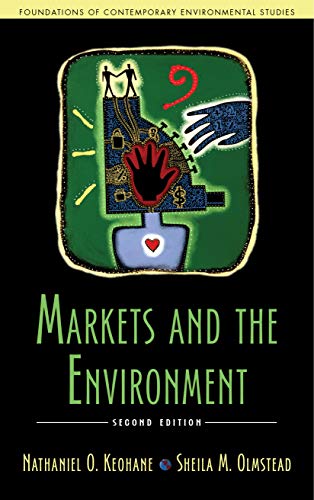
Inhaltsangabe
A clear grasp of economics is essential to understanding why environmental problems arise and how we can address them. So it is with good reason that Markets and the Environment has become a classic text in environmental studies since its first publication in 2007. Now thoroughly revised with updated information on current environmental policy and real-world examples of market-based instruments, the primer is more relevant than ever. The authors provide a concise yet thorough introduction to the economic theory of environmental policy and natural resource management. They begin with an overview of environmental economics before exploring topics including cost-benefit analysis, market failures and successes, and economic growth and sustainability. Readers of the first edition will notice new analysis of cost estimation as well as specific market instruments, including municipal water pricing and waste disposal. Particular attention is paid to behavioral economics and cap-and-trade programs for carbon. Throughout, Markets and the Environment is written in an accessible, student-friendly style. It includes study questions for each chapter, as well as clear figures and relatable text boxes. The authors have long understood the need for a book to bridge the gap between short articles on environmental economics and tomes filled with complex algebra. Markets and the Environment makes clear how economics influences policy, the world around us, and our own lives.
Die Inhaltsangabe kann sich auf eine andere Ausgabe dieses Titels beziehen.
Über die Autorin bzw. den Autor
Nathaniel O. Keohane and Sheila M. Olmstead
Auszug. © Genehmigter Nachdruck. Alle Rechte vorbehalten.
Markets and the Environment
By Nathaniel O. Keohane, Sheila M. OlmsteadISLAND PRESS
Copyright © 2016 Nathaniel O. Keohane and Sheila M. Olmstead
All rights reserved.
ISBN: 978-1-61091-607-3All rights reserved.
Contents
Preface,
Chapter 1: Introduction,
Chapter 2: Economic Efficiency and Environmental Protection,
Chapter 3: The Benefits and Costs of Environmental Protection,
Chapter 4: The Efficiency of Markets,
Chapter 5: Market Failures in the Environmental Realm,
Chapter 6: Managing Stocks: Natural Resources as Capital Assets,
Chapter 7: Stocks That Grow: The Economics of Renewable Resource Management,
Chapter 8: Principles of Market-Based Environmental Policy,
Chapter 9: The Case for Market-Based Instruments in the Real World,
Chapter 10: Market-Based Instruments in Practice,
Chapter 11: Sustainability and Economic Growth,
Chapter 12: Conclusion,
Discussion Questions,
References,
Further Reading,
CHAPTER 1
Introduction
This book is a primer on the economics of the environment and natural resources. The title, Markets and the Environment, suggests one of our central themes. An understanding of markets — why they work, when they fail, and what lessons they offer for the design of environmental policies and the management of natural resources — is central to an understanding of environmental issues. But even before we start thinking about how markets work, it is useful to begin with a more basic question: What is environmental economics?
Economics and the Environment
"Environmental economics" may seem like a contradiction in terms. Some people think that economics is just about money, that it is preoccupied with profits and economic growth and has nothing to do with the effects of human activity on the planet. Others view environmentalists as being naive about economic realities or "more concerned about animals than jobs."
Of course neither stereotype is true. Indeed, not only is "the environment" not separate from "the economy," but environmental problems cannot be fully understood without understanding basic economic concepts. Economics helps explain why firms and individuals make the decisions they do — why coal (despite generating significant local air pollution and carbon dioxide emissions) still generates almost 40 percent of electricity in the United States, or why some people drive large sport utility vehicles instead of Priuses. Economics also helps predict how those same firms and individuals will respond to a new set of incentives — for example, what investments electric utilities will make in a carbon-constrained world and how high gas prices would have to rise before people stopped buying enormous cars.
At its core, economics is the study of the allocation of scarce resources. This central focus, as much as anything else, makes it eminently suited to analyzing environmental problems. Let's take a concrete example. The Columbia and the Snake Rivers drain much of the U.S. Pacific Northwest, providing water for drinking, irrigation, transportation, and electricity generation and supporting endangered salmon populations. All these activities — including salmon preservation — provide economic benefits to the extent that people value them.
If there is not enough water to meet all those needs, then we must trade off one good thing for another (less irrigation for more fish habitat, for example). How should we as a society balance these competing claims against each other? To what lengths should we go to protect the salmon? What other valu
„Über diesen Titel“ kann sich auf eine andere Ausgabe dieses Titels beziehen.
Suchergebnisse für Markets and the Environment, Second Edition (Foundations...

Beispielbild für diese ISBN
Markets and the Environment, Second Edition (Foundations of Contemporary Environmental Studies Series)
Verlag:
Island Press (edition Second), 2016
ISBN 10: 1610916077
ISBN 13: 9781610916073
Gebraucht
Paperback
Anbieter: BooksRun, Philadelphia, PA, USA
Verkäuferbewertung 5 von 5 Sternen

Paperback. Zustand: Very Good. Second. It's a well-cared-for item that has seen limited use. The item may show minor signs of wear. All the text is legible, with all pages included. It may have slight markings and/or highlighting. Artikel-Nr. 1610916077-8-1
Gebraucht kaufen
EUR 13,71
Versand gratis
Versand innerhalb von USA
Versand innerhalb von USA
Anzahl: 2 verfügbar
Beispielbild für diese ISBN
Markets and the Environment, Second Edition (Foundations Contemporary Environmental)
Verlag:
Island Press (edition 2), 2016
ISBN 10: 1610916077
ISBN 13: 9781610916073
Gebraucht
Paperback
Anbieter: BooksRun, Philadelphia, PA, USA
Verkäuferbewertung 5 von 5 Sternen
Paperback. Zustand: Very Good. 2. It's a well-cared-for item that has seen limited use. The item may show minor signs of wear. All the text is legible, with all pages included. It may have slight markings and/or highlighting. Artikel-Nr. 1610916077-11-1
Gebraucht kaufen
EUR 13,90
Versand gratis
Versand innerhalb von USA
Versand innerhalb von USA
Anzahl: 2 verfügbar
Beispielbild für diese ISBN
Markets and the Environment, Second Edition
Verlag:
Princeton University Press, 2016
ISBN 10: 1610916077
ISBN 13: 9781610916073
Gebraucht
Paperback
Anbieter: World of Books (was SecondSale), Montgomery, IL, USA
Verkäuferbewertung 5 von 5 Sternen
Paperback. Zustand: Good. This book provides a concise introduction to the economic theory of environmental policy and natural resource management. Nathaniel Keohane and Sheila Olmstead begin with an overview of environmental economics before exploring topics including cost-benefit analysis, market failures and successes, and economic growth and sustainability. Artikel-Nr. 00109673673
Gebraucht kaufen
EUR 15,93
Versand gratis
Versand innerhalb von USA
Versand innerhalb von USA
Anzahl: 1 verfügbar
Beispielbild für diese ISBN
Markets and the Environment, Second Edition (Foundations of Contemporary Environmental Studies Series)
Anbieter: Wonder Book, Frederick, MD, USA
Verkäuferbewertung 5 von 5 Sternen
Zustand: Very Good. Very Good condition. 2nd edition. A copy that may have a few cosmetic defects. May also contain light spine creasing or a few markings such as an owner's name, short gifter's inscription or light stamp. Artikel-Nr. P03K-00106
Gebraucht kaufen
EUR 16,29
Versand gratis
Versand innerhalb von USA
Versand innerhalb von USA
Anzahl: 1 verfügbar
Beispielbild für diese ISBN
Markets and the Environment, Second Edition
Anbieter: PBShop.store UK, Fairford, GLOS, Vereinigtes Königreich
Verkäuferbewertung 5 von 5 Sternen
PAP. Zustand: New. New Book. Shipped from UK. Established seller since 2000. Artikel-Nr. WP-9781610916073
Neu kaufen
EUR 34,25
EUR 4,84 Versand
Versand von Vereinigtes Königreich nach USA
Versand von Vereinigtes Königreich nach USA
Anzahl: 2 verfügbar
Beispielbild für diese ISBN
Markets and the Environment, Second Edition
Anbieter: Revaluation Books, Exeter, Vereinigtes Königreich
Verkäuferbewertung 5 von 5 Sternen
Paperback. Zustand: Brand New. 2nd edition. 307 pages. 9.00x5.50x0.75 inches. In Stock. Artikel-Nr. __1610916077
Neu kaufen
EUR 35,92
EUR 11,63 Versand
Versand von Vereinigtes Königreich nach USA
Versand von Vereinigtes Königreich nach USA
Anzahl: 1 verfügbar
Beispielbild für diese ISBN
Markets and the Environment (Foundations of Contemporary Environmental Studies Series)
Anbieter: Majestic Books, Hounslow, Vereinigtes Königreich
Verkäuferbewertung 4 von 5 Sternen

Zustand: New. pp. 304. Artikel-Nr. 373557988
Neu kaufen
EUR 42,84
EUR 7,56 Versand
Versand von Vereinigtes Königreich nach USA
Versand von Vereinigtes Königreich nach USA
Anzahl: 3 verfügbar
Beispielbild für diese ISBN
Markets and the Environment, Second Edition (Foundations Contemporary Environmental)
Anbieter: Ria Christie Collections, Uxbridge, Vereinigtes Königreich
Verkäuferbewertung 5 von 5 Sternen
Zustand: New. In English. Artikel-Nr. ria9781610916073_new
Neu kaufen
EUR 44,59
EUR 13,13 Versand
Versand von Vereinigtes Königreich nach USA
Versand von Vereinigtes Königreich nach USA
Anzahl: 8 verfügbar
Beispielbild für diese ISBN
Markets and the Environment, Second Edition
Anbieter: Kennys Bookstore, Olney, MD, USA
Verkäuferbewertung 5 von 5 Sternen
Zustand: New. This book provides a concise introduction to the economic theory of environmental policy and natural resource management. Nathaniel Keohane and Sheila Olmstead begin with an overview of environmental economics before exploring topics including cost-benefit analysis, market failures and successes, and economic growth and sustainability. Num Pages: 304 pages, 30 illustrations. BIC Classification: KCN; RNA; RNC. Category: (G) General (US: Trade). Dimension: 142 x 223 x 19. Weight in Grams: 404. . 2016. 2nd Edition. Paperback. . . . . Books ship from the US and Ireland. Artikel-Nr. V9781610916073
Neu kaufen
EUR 64,33
EUR 9,23 Versand
Versand innerhalb von USA
Versand innerhalb von USA
Anzahl: 1 verfügbar
Beispielbild für diese ISBN
Markets and the Environment, Second Edition
Anbieter: Revaluation Books, Exeter, Vereinigtes Königreich
Verkäuferbewertung 5 von 5 Sternen
Paperback. Zustand: Brand New. 2nd edition. 307 pages. 9.00x5.50x0.75 inches. In Stock. Artikel-Nr. x-1610916077
Neu kaufen
EUR 63,04
EUR 11,63 Versand
Versand von Vereinigtes Königreich nach USA
Versand von Vereinigtes Königreich nach USA
Anzahl: 2 verfügbar