
Verwandte Artikel zu Completing Our Streets: The Transition to Safe and...
Inhaltsangabe
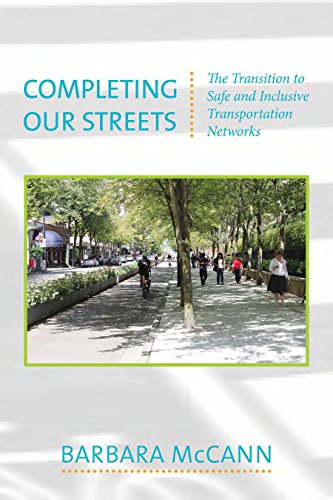
Across the country, communities are embracing a new and safer way to build streets for everyone—even as they struggle to change decades of rules, practice, and politics that prioritize cars. They have discovered that changing the design of a single street is not enough: they must upend the way transportation agencies operate. Completing Our Streets begins with the story of how the complete streets movement united bicycle riders, transportation practitioners and agencies, public health leaders, older Americans, and smart growth advocates to dramatically re-frame the discussion of transportation safety. Next, it explores why the transportation field has been so resistant to change—and how the movement has broken through to create a new multi-modal approach.
In Completing Our Streets, Barbara McCann, founder of the National Complete Streets Coalition, explains that the movement is not about street design. Instead, practitioners and activists have changed the way projects are built by focusing on three strategies: reframe the conversation; build a broad base of political support; and provide a clear path to a multi-modal process. McCann shares stories of practitioners in cities and towns from Charlotte, North Carolina to Colorado Springs, Colorado who have embraced these strategies to fundamentally change the way transportation projects are chosen, planned, and built.
The complete streets movement is based around a simple idea: streets should be safe for people of all ages and abilities, whether they are walking, driving, bicycling, or taking the bus. Completing Our Streets gives practitioners and activists the strategies, tools, and inspiration needed to translate this idea into real and lasting change in their communities.
Die Inhaltsangabe kann sich auf eine andere Ausgabe dieses Titels beziehen.
Über die Autorin bzw. den Autor
Barbara McCann
Auszug. © Genehmigter Nachdruck. Alle Rechte vorbehalten.
Completing Our Streets
The Transition to Safe and Inclusive Transportation Networks
By Barbara McCannISLAND PRESS
Copyright © 2013 Barbara McCann
All rights reserved.
ISBN: 978-1-61091-431-4All rights reserved.
Contents
Preface,
Acknowledgments,
Introduction,
Chapter 1. Why We Build Incomplete Streets,
Chapter 2. How the Complete Streets Movement Succeeds,
Chapter 3. Closing the Gap between Policy and Practice,
Chapter 4. Process over Projects: Changing How Decisions Are Made,
Chapter 5. Looking for Every Opportunity,
Chapter 6. Practitioners as Champions,
Chapter 7. Answering a Loaded Question: How Much Do Complete Streets Cost?,
Chapter 8. The Balancing Act: Setting Priorities for Different Users,
Chapter 9. Expanding Complete Streets,
Appendix A: Case Study Finder,
Appendix B: Complete Streets Resources,
Endnotes,
Selected Bibliography,
Index,
CHAPTER 1
Why We Build Incomplete Streets
THE FUNDAMENTAL PHILOSOPHY behind the Complete Streets movement can seem painfully obvious: roads should be safe for everyone traveling along them. But the history, political standing, habits, and orientation of the transportation industry in the United States have made it extraordinarily difficult for any policy movement to shift the way transportation projects are planned and built.
The United States is still living with the reverberations of the engineering triumph of the interstate highway system—a network of forty-seven thousand miles of limited-access freeways that knit the country together in the 1950s and 1960s. Solving the design and safety challenges in creating this network set an orientation that persists to this day in US transportation planning, construction, and management.
That orientation is focused on solving problems by building roads that expanded the capacity for automobile travel. The interstate era did begin with a policy, the Federal Aid Highway Act of 1956. But the policy was driven by a project-focused vision: build a freeway network. The policy simply lined up all the systems to do so.
One of the first ways it did this was to turn this massive project over to the experts at the state departments of transportation (DOTs), and ever since, state highway departments have wielded considerable influence in Washington, DC, as well as in their own state capitals and small towns. They gained credibility with the spectacular success of the interstates they were building—and with the commonly held view that road building is a technical pursuit, best left to engineers. When engineers talk about how to relieve congestion and improve safety, elected officials still defer to their judgment. Their political independence has also been assured by how much money they control. At the federal level and in most states, gas taxes are dedicated to transportation, so the agencies have been insulated from the annual budgetary push and pull in the state legislature. The steady funding stream has also meant state and local departments could make a big difference in elected officials' districts, by filling potholes and delivering favored road projects. Road construction companies sometimes enjoy cozy relationships with agency leaders and top politicians. State agencies also tend to exert outsized influence on the politically fractured Metropolitan Planning Organizations (MPOs) that help decide how federal transportation dollars will be spent in urban areas.
Transportation industry leaders grew used to steady support from politicians for the clearly stated mission of tackling pavement maintenance, traffic congestion, and motorist safety. For decades, politicians' most predictable role was participation in the annual ritual affirming the release of the Texas Transportation Institute's congestion rankings, particularly its calculation of the billions of dollars purportedly lost by Americans sitting in traffic. The politicians usually made vows to keep building roads to solve the problem.
The Modal Divide
Another factor at work is the habit of building projects that are specific to a single method of travel. The transportation sector regards each mode as a separate entity, requiring separate programming, funding, and facilities. Administrative structures and funding are almost always divided by mode. The federal structure in place today is a case in point and influences the organization of the state and local agencies that receive its money. The US Department of Transportation is largely defined by the separate modal agencies that were brought under its umbrella in 1967, including the Federal Highway Administration (FHWA) and Federal Transit Administration. They receive separate funding allocations and have separate policies—and are even under the jurisdiction of separate Senate committees. The nonmotorized modes—bicycling and walking—have not been important enough to rate their own administration or funding stream, but they maintain a clearly separate identity. The FHWA houses a small Bicycle/Pedestrian Program, and designated bicycle/pedestrian coordinator positions are required in each state DOT.
Follow the money, and you'll find a long history of clearly separated federal funding streams for highways, transit, and other uses. Until recently, almost all federal surface transportation dollars came from the gas tax, with revenues growing right alongside the steady increase in the amount of driving. Highway proponents fought any "diversion" of these Highway Trust Fund revenues for uses that did not directly benefit motorists. And the "highway" money is structured in a way that ensures that investments focus on moving cars. In order to access federal dollars, every jurisdiction in the country must classify its roads by the "functional classification" system, which defines roads solely by the amount and type of traffic they carry and divides them into arterial (major) streets, collector streets, or local streets. This system sets up rigid expectations about how high a "Level of Service" should be provided on different road types—with high service defined as fast, free-flowing traffic. This requirement has proven a barrier to places that would like to more finely tune their road network to serve public transportation, nonmotorized users, and the residences and businesses alongside the road.
After gas tax revenues soared in the 1960s, 1970s, and 1980s, Congress made a policy change and transit began receiving about 20 percent of these funds starting in the 1980s. Transit dollars pay for buses and rail infrastructure (and a little bit for operations). Cities and advocates began to push for an even more diverse transportation infrastructure, and the federal transportation law passed in 1991 brought a measure of reform; its name was, after all, the Intermodal Surface Transportation Efficiency Act (commonly known as ISTEA, pronounced "iced tea"). Projects that served other needs were allowed access to the ever-growing pie of Highway Trust Fund revenues, although on a modest scale. Among other changes, the authorization set aside funding for projects that could help improve air quality, as well as a small set-aside for "Transportation Enhancements," with about half of those funds spent on bicycle or pedestrian projects.
But while ISTEA made changes to transportation funding that allowed a more multimodal approach, it didn't require any change in the systems created to deliver new roads or to maintain old ones. Most states were able to add new programs without disturbing decades of...
„Über diesen Titel“ kann sich auf eine andere Ausgabe dieses Titels beziehen.
Suchergebnisse für Completing Our Streets: The Transition to Safe and...

Beispielbild für diese ISBN
Completing Our Streets: The Transition to Safe and Inclusive Transportation Networks
Anbieter: ThriftBooks-Dallas, Dallas, TX, USA
Verkäuferbewertung 5 von 5 Sternen

Paperback. Zustand: Good. No Jacket. Pages can have notes/highlighting. Spine may show signs of wear. ~ ThriftBooks: Read More, Spend Less. Artikel-Nr. G1610914317I3N00
Gebraucht kaufen
EUR 7,79
Versand gratis
Versand innerhalb von USA
Versand innerhalb von USA
Anzahl: 1 verfügbar
Beispielbild für diese ISBN
Completing Our Streets: The Transition to Safe and Inclusive Transportation Networks
Anbieter: Wonder Book, Frederick, MD, USA
Verkäuferbewertung 5 von 5 Sternen
Zustand: Very Good. Signed Copy . Inscribed by author on title page. Artikel-Nr. R11OS-00227
Gebraucht kaufen
EUR 12,37
Versand gratis
Versand innerhalb von USA
Versand innerhalb von USA
Anzahl: 1 verfügbar
Beispielbild für diese ISBN
Completing Our Streets
Anbieter: Majestic Books, Hounslow, Vereinigtes Königreich
Verkäuferbewertung 4 von 5 Sternen

Zustand: New. pp. 224. Artikel-Nr. 58608757
Neu kaufen
EUR 26,21
EUR 7,68 Versand
Versand von Vereinigtes Königreich nach USA
Versand von Vereinigtes Königreich nach USA
Anzahl: 1 verfügbar
Beispielbild für diese ISBN
Completing Our Streets
Anbieter: Romtrade Corp., STERLING HEIGHTS, MI, USA
Verkäuferbewertung 5 von 5 Sternen
Zustand: New. This is a Brand-new US Edition. This Item may be shipped from US or any other country as we have multiple locations worldwide. Artikel-Nr. ABBB-202475
Beispielbild für diese ISBN
Completing Our Streets The Transition to Safe and Inclusive Transportation Networks
Anbieter: Revaluation Books, Exeter, Vereinigtes Königreich
Verkäuferbewertung 5 von 5 Sternen
Paperback. Zustand: Brand New. 2nd edition. 224 pages. 9.25x6.50x0.50 inches. In Stock. Artikel-Nr. 1610914317
Neu kaufen
EUR 50,74
EUR 41,35 Versand
Versand von Vereinigtes Königreich nach USA
Versand von Vereinigtes Königreich nach USA
Anzahl: 1 verfügbar