
Verwandte Artikel zu Repacking Your Bags: Lighten Your Load for the Good...
Inhaltsangabe
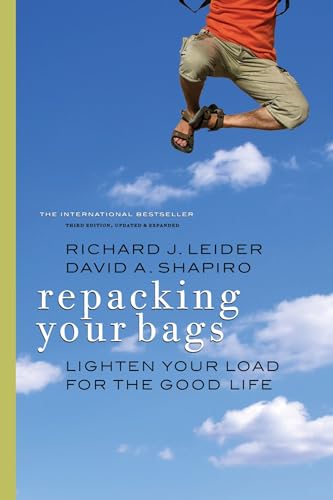
Revised and updated: The classic guide to "unpacking" your physical, emotional, and intellectual baggage and "repacking" for the journey ahead.
Richard Leider and David Shapiro define the good life as “living in the place you belong, with the people you love, doing the right work, on purpose.” But with longer lifespans, technological advancements, and economic shifts, the particulars of this definition are bound to change over time—which mean most of us will need to periodically reimagine our lives.
In this wise and practical guide, Leider and Shapiro help you weigh all that you're carrying, leverage what helps you live well, and let go of those burdens that merely weigh you down. This third edition has been revised with new stories and practices to help you repack your four critical “bags” (place, relationship, work, and purpose); identify your gifts, passions, and values; and plan your journey, no matter where you are in life.
Die Inhaltsangabe kann sich auf eine andere Ausgabe dieses Titels beziehen.
Über die Autorin bzw. den Autor
Richard J. Leider is founder of the Inventure Group and is consistently rated as one of the top executive coaches in the world. He is a senior fellow at the University of Minnesota’s Center for Spirituality and Healing and author or coauthor of seven other books.
David A. Shapiro is a faculty member at Cascadia Community College and the education director of the Northwest Center for Philosophy for Children. He is author or coauthor of four other books.
Auszug. © Genehmigter Nachdruck. Alle Rechte vorbehalten.
What Is the Good Life?
In the Woody Allen movie, Midnight in Paris, Owen Wilson plays Gil, a successful Hollywood screenwriter visiting Paris with his fiancé, Inez. Gil, who is struggling to complete his first novel, falls in love with the city, and fantasizes about moving there, a prospect Inez, who can hardly wait to get back to Southern California, considers just silly romantic nonsense.
Although Inez’s dismissal of Gil’s dream is a symptom of deeper problems in their relationship, she has a point. Because it’s not even contemporary Paris that Gil adores — not the Paris of the 21st century — rather, he has fallen in love with a dream: Paris of the 1920s, the Paris of Ernest Hemingway, F. Scott and Zelda Fitzgerald, Gertrude Stein, and the whole Lost Generation of Americans who made the City of Lights their home after World War I.
In fact, so powerfully does Gil long for this time that one night, to his surprise and consternation, he is magically transported back to that world: he is picked up at midnight by Scott and Zelda and taken in a limousine to a party, where he meets such luminaries as Cole Porter, Josephine Baker, and of course, Hemingway himself. At first, understandably, he can’t believe what is happening, but eventually, he comes to accept that it’s real, and is thrilled by his good fortune.
The next night, he invites Inez to accompany him, but she tires and goes home before the magical limousine appears. When it does, at midnight, Gil goes off alone into the past, and Hemingway takes him to the salon of Gertrude Stein, who to Gil’s delight, agrees to read and critique his novel. He meets Salvador Dali and Pablo Picasso, and most significantly, makes the acquaintance of a beautiful young woman, Adriana, Picasso’s muse and lover. We come to know that her relationship with the famous artist is tumultuous and certain to end badly, soon. But for Gil, it is love at first sight; he can’t get her out of his mind, even when he returns, in the morning, to his contemporary life.
Gil makes up excuses to Inez so he can keep going back to the past. And what transpires is that he comes to see his life there, back in the 1920s, as his “real” life. So desperately has he wanted to live a life that wasn’t his own, a life that he has glamorized as more beautiful, more poetic, more meaningful than the one he has made for himself, that, soon, he has fully embraced that world, so much so that he wants to stay there always.
He begins an affair with Adriana, who, as predicted, has been dumped by Picasso. They share their hopes and dreams, Gil revealing his belief that Paris of the 1920s is the perfect world, the time and place where art, culture, and society reached their apex. Adriana, by contrast, contends that it was Paris of La Belle Epoque, the time of Impressionism and Art Nouveau, when the city was at its apogee.
And indeed, so fervent is her desire for that lost time, that one night, as she and Gil stroll along, a horse-drawn carriage appears and transports them back to a café in Montmartre, circa 1870, where they meet the famous painters Claude Monet and Henri de Toulouse-Lautrec. Unfortunately for Gil, Adriana decides to remain back in her idealized Paris; she bids Gil adieu and he returns to the present, once and for all.
Although he is saddened by the break-up, he arrives at a new and profound understanding of himself and his life. He realizes that in his desire to escape the present and flee to an image of a world he believed to be better than his own, he was reaching for something ephemeral and ultimately, unreal. He was imagining himself to be someone he wasn’t, trying desperately to fit into a place that, in the end, he didn’t belong. In short, he was being inauthentic, or to put it another way, he was striving for a version of the good life that wasn’t really his own.
Back in the present, he decides to stay in Paris after all, break off his engagement with Inez (with whom he realizes he has little in common), and pursue his true passion of novel-writing, even if it turns out to be less profitable than being a Hollywood hack.
As the film ends, we see Gil striking up an acquaintance with an attractive woman he has met briefly in an antiquities shop during his time in contemporary Paris. We don’t know how their relationship will unfold — and neither does Gil — but we get a sense that whatever happens to our hero, it will spring from the true core of his character, and an authentic expression of who he really is.
Over the years, we’ve met many people who are in the same place as Gil was during his sojourn into the past. They seem like they’re not really living their real lives. They’re reaching for a vision of a lost world, one they’re trying to grasp by adopting a lifestyle that isn’t their own. It’s as if by embracing someone else’s conception of how life should be led, they’ll discover for themselves the life they want. But as a result, they never quite feel fully at home with themselves. They feel dull — and dulled. They feel trapped, insulated. They “go through the motions” of living, but there’s no life in their lives.
We hear their dissatisfaction expressed in a several different ways:
• “I’m so busy these days. I don’t know how to have fun any more.”
• Or, “I wish my life was different, like a character in a movie or on TV.”
• Or, “It’s just the same thing day after day. I never do anything that’s fun.”
That’s not quite true. Many of these people have lots of fun. They’ve got their garages filled with all kinds of fun stuff: golf clubs, jet skis, mountain bikes, you name it. In fact, for many of them, “fun” has become an addiction. But as with most addictive substances, people build up a tolerance to it. So despite all the “fun” people have, they’re still not happy.
What’s really missing is a sense of joy. People find that they no longer feel authentic joy in living, despite all the fun stuff they have or do. And this is the case whether they’re male or female, young or old, rich or poor, or at any stage of life.
What’s happened to people is that they’ve lost a delicate, but critical, component of aliveness and well-being: they’ve lost their uniqueness, their authenticity. It happens to many of us as we grow up and make our way in the world. We fit in. We see how other people survive and adopt their strategies to preserve our jobs, our incomes, and our relationships. Swept along by the myriad demands of day-to-day living, we stop making choices of our own. Or even realizing that we have choices to make.
We lose the wonderful weird edges that define us. We cover up the eccentricities that make us unique. Alfred Adler, the great 20th century psychologist and educator, considered these eccentricities a vital part of a happy and fulfilling lifestyle. Ironically, the very term he coined — “lifestyle” — has come to imply something almost entirely opposite to eccentricity. These days it suggests a pre-configured package formatted for easy consumption. “Lifestyle” now refers to things that we buy; someone else’s idea of what we need to be happy. But is anyone really satisfied with these mass-marketed ideas of happiness? Is anyone really nourished by a life that isn’t authentic?
Why Do We Feel So Bad?
Everywhere we look, we see people pursuing happiness, as if it’s something they could capture and cage. But pinning happiness down only destroys it. It’s too wild for that —...
„Über diesen Titel“ kann sich auf eine andere Ausgabe dieses Titels beziehen.
Suchergebnisse für Repacking Your Bags: Lighten Your Load for the Good...

Beispielbild für diese ISBN
Repacking Your Bags: Lighten Your Load for the Good Life
Verlag:
Berrett-Koehler Publishers, 2012
ISBN 10: 1609945492
ISBN 13: 9781609945497
Gebraucht
Softcover
Anbieter: World of Books (was SecondSale), Montgomery, IL, USA
Verkäuferbewertung 5 von 5 Sternen

Zustand: Good. Item in good condition. Textbooks may not include supplemental items i.e. CDs, access codes etc. Artikel-Nr. 00108990127
Gebraucht kaufen
EUR 5,35
Versand gratis
Versand innerhalb von USA
Versand innerhalb von USA
Anzahl: 1 verfügbar
Beispielbild für diese ISBN
Repacking Your Bags: Lighten Your Load for the Good Life
Verlag:
Berrett-Koehler Publishers, 2012
ISBN 10: 1609945492
ISBN 13: 9781609945497
Gebraucht
Paperback
Anbieter: ThriftBooks-Reno, Reno, NV, USA
Verkäuferbewertung 5 von 5 Sternen
Paperback. Zustand: Very Good. No Jacket. May have limited writing in cover pages. Pages are unmarked. ~ ThriftBooks: Read More, Spend Less. Artikel-Nr. G1609945492I4N00
Gebraucht kaufen
EUR 5,94
Versand gratis
Versand innerhalb von USA
Versand innerhalb von USA
Anzahl: 1 verfügbar
Beispielbild für diese ISBN
Repacking Your Bags: Lighten Your Load for the Good Life
Verlag:
Berrett-Koehler Publishers, 2012
ISBN 10: 1609945492
ISBN 13: 9781609945497
Gebraucht
Paperback
Anbieter: ThriftBooks-Atlanta, AUSTELL, GA, USA
Verkäuferbewertung 5 von 5 Sternen
Paperback. Zustand: Very Good. No Jacket. May have limited writing in cover pages. Pages are unmarked. ~ ThriftBooks: Read More, Spend Less. Artikel-Nr. G1609945492I4N00
Gebraucht kaufen
EUR 5,95
Versand gratis
Versand innerhalb von USA
Versand innerhalb von USA
Anzahl: 1 verfügbar
Beispielbild für diese ISBN
Repacking Your Bags: Lighten Your Load for the Good Life
Verlag:
Berrett-Koehler Publishers, 2012
ISBN 10: 1609945492
ISBN 13: 9781609945497
Gebraucht
Paperback
Anbieter: ThriftBooks-Atlanta, AUSTELL, GA, USA
Verkäuferbewertung 5 von 5 Sternen
Paperback. Zustand: Very Good. No Jacket. Former library book; May have limited writing in cover pages. Pages are unmarked. ~ ThriftBooks: Read More, Spend Less. Artikel-Nr. G1609945492I4N10
Gebraucht kaufen
EUR 5,95
Versand gratis
Versand innerhalb von USA
Versand innerhalb von USA
Anzahl: 1 verfügbar
Beispielbild für diese ISBN
Repacking Your Bags: Lighten Your Load for the Good Life
Verlag:
Berrett-Koehler Publishers, 2012
ISBN 10: 1609945492
ISBN 13: 9781609945497
Gebraucht
Paperback
Anbieter: ThriftBooks-Dallas, Dallas, TX, USA
Verkäuferbewertung 5 von 5 Sternen
Paperback. Zustand: Very Good. No Jacket. May have limited writing in cover pages. Pages are unmarked. ~ ThriftBooks: Read More, Spend Less. Artikel-Nr. G1609945492I4N00
Gebraucht kaufen
EUR 5,95
Versand gratis
Versand innerhalb von USA
Versand innerhalb von USA
Anzahl: 1 verfügbar
Beispielbild für diese ISBN
Repacking Your Bags : Lighten Your Load for the Good Life
Verlag:
Berrett-Koehler Publishers, Incorporated, 2012
ISBN 10: 1609945492
ISBN 13: 9781609945497
Gebraucht
Softcover
Anbieter: Better World Books, Mishawaka, IN, USA
Verkäuferbewertung 5 von 5 Sternen
Zustand: Good. Former library copy. Pages intact with minimal writing/highlighting. The binding may be loose and creased. Dust jackets/supplements are not included. Includes library markings. Stock photo provided. Product includes identifying sticker. Better World Books: Buy Books. Do Good. Artikel-Nr. 7846133-6
Gebraucht kaufen
EUR 6,01
Versand gratis
Versand innerhalb von USA
Versand innerhalb von USA
Anzahl: 1 verfügbar
Beispielbild für diese ISBN
Repacking Your Bags : Lighten Your Load for the Good Life
Verlag:
Berrett-Koehler Publishers, Incorporated, 2012
ISBN 10: 1609945492
ISBN 13: 9781609945497
Gebraucht
Softcover
Anbieter: Better World Books: West, Reno, NV, USA
Verkäuferbewertung 5 von 5 Sternen
Zustand: Very Good. Former library copy. Pages intact with possible writing/highlighting. Binding strong with minor wear. Dust jackets/supplements may not be included. Includes library markings. Stock photo provided. Product includes identifying sticker. Better World Books: Buy Books. Do Good. Artikel-Nr. 10036411-6
Gebraucht kaufen
EUR 6,01
Versand gratis
Versand innerhalb von USA
Versand innerhalb von USA
Anzahl: 1 verfügbar
Beispielbild für diese ISBN
Repacking Your Bags: Lighten Your Load for the Good Life
Verlag:
Berrett-Koehler Publishers, 2012
ISBN 10: 1609945492
ISBN 13: 9781609945497
Gebraucht
Softcover
Anbieter: Wonder Book, Frederick, MD, USA
Verkäuferbewertung 5 von 5 Sternen
Zustand: Very Good. Very Good condition. 3rd edition. A copy that may have a few cosmetic defects. May also contain light spine creasing or a few markings such as an owner's name, short gifter's inscription or light stamp. Artikel-Nr. E08A-05608
Gebraucht kaufen
EUR 6,24
Versand gratis
Versand innerhalb von USA
Versand innerhalb von USA
Anzahl: 1 verfügbar
Foto des Verkäufers
Repacking Your Bags: Lighten Your Load for the Good Life: Lighten Your Load for the Good Life (AGENCY/DISTRIBUTED)
Verlag:
Berrett-Koehler Publishers, 2012
ISBN 10: 1609945492
ISBN 13: 9781609945497
Gebraucht
paperback
Anbieter: WeBuyBooks, Rossendale, LANCS, Vereinigtes Königreich
Verkäuferbewertung 5 von 5 Sternen
paperback. Zustand: Like New. Most items will be dispatched the same or the next working day. An apparently unread copy in perfect condition. Dust cover is intact with no nicks or tears. Spine has no signs of creasing. Pages are clean and not marred by notes or folds of any kind. Artikel-Nr. rev4125106831
Gebraucht kaufen
EUR 2,22
EUR 6,98 Versand
Versand von Vereinigtes Königreich nach USA
Versand von Vereinigtes Königreich nach USA
Anzahl: 1 verfügbar
Beispielbild für diese ISBN
Repacking Your Bags: Lighten Your Load for the Good Life: Lighten Your Load for the Good Life (AGENCY/DISTRIBUTED)
Verlag:
Berrett-Koehler Publishers, 2012
ISBN 10: 1609945492
ISBN 13: 9781609945497
Gebraucht
Paperback
Anbieter: WorldofBooks, Goring-By-Sea, WS, Vereinigtes Königreich
Verkäuferbewertung 5 von 5 Sternen
Paperback. Zustand: Very Good. The book has been read, but is in excellent condition. Pages are intact and not marred by notes or highlighting. The spine remains undamaged. Artikel-Nr. GOR005876903
Gebraucht kaufen
EUR 3,47
EUR 6,54 Versand
Versand von Vereinigtes Königreich nach USA
Versand von Vereinigtes Königreich nach USA
Anzahl: 2 verfügbar