
Verwandte Artikel zu Transformative Scenario Planning: Working Together...
Inhaltsangabe
“Take[s] scenario planning to a new level, beyond the confines of business strategy, to deal with wider social and economic issues.”—Vince Cable, former Secretary of State for Business, UK
People who are trying to solve tough economic, social, and environmental problems often find themselves frustratingly stuck. They can’t solve their problems in their current context, which is too unstable or unfair or unsustainable. They can’t transform this context on their own—it’s too complex to be grasped or shifted by any one person or organization or sector. And the people whose cooperation they need don’t understand, agree with, or trust them…or each other.
Transformative scenario planning is a powerful new methodology for dealing with these challenges. It enables us to transform ourselves and our relationships and thereby the systems of which we are a part. At a time when divisions within and among societies are causing so many people to get stuck and to suffer, it offers hope—and a proven approach—for moving forward together.
Praise for Adam Kahane’s books
“Thought-provoking discourse on handling difficult situations.”—Publishers Weekly
“Profound . . . a wise way to negotiate our toughest group, community, and societal challenges.”—William Ury, New York Times–bestselling coauthor of Getting to Yes
Die Inhaltsangabe kann sich auf eine andere Ausgabe dieses Titels beziehen.
Über die Autorin bzw. den Autor
Adam Kahane had pioneered the development and use of transformative scenario planning throughout the Americas, Europe, the Middle East, Africa, and Australia. He is a partner in the Cambridge, Massachusetts, office of Reos Partners and an associate fellow at the Saïd Business School of the University of Oxford.
Auszug. © Genehmigter Nachdruck. Alle Rechte vorbehalten.
An Invention Born of Necessity
ON A LOVELY FRIDAY AFTERNOON in September 1991, I arrived at the Mont Fleur conference center in the mountains of the wine country outside of Cape Town. I was excited to be there and curious about what was going to happen. I didn’t yet realize what a significant weekend it would turn out to be.
THE SCENARIO PLANNING METHODOLOGY MEETS THE SOUTH AFRICAN TRANSFORMATION
The year before, in February 1990, South African president F. W. de Klerk had unexpectedly announced that he would release Nelson Mandela from 27 years in prison, legalize Mandela’s African National Congress (ANC) and the other opposition parties, and begin talks on a political transition. Back in 1948, a white minority government had imposed the apartheid system of racial segregation and oppression on the black majority, and the 1970s and 1980s had seen waves of bloody confrontation between the government and its opponents. The apartheid system, labeled by the United Nations a “crime against humanity,” was the object of worldwide condemnation, protests, and sanctions.
Now de Klerk’s announcement had launched an unprecedented and unpredictable process of national transformation. Every month saw breakthroughs and breakdowns: declarations and demands from politicians, community activists, church leaders, and businesspeople; mass demonstrations by popular movements and attempts by the police and military to reassert control; and all manner of negotiating meetings, large and small, formal and informal, open and secret.
South Africans were excited, worried, and confused. Although they knew that things could not remain as they had been, they disagreed vehemently and sometimes violently over what the future should look like. Nobody knew whether or how this transformation could happen peacefully.
Professors Pieter le Roux and Vincent Maphai, from the ANC-aligned University of the Western Cape, thought that it could be useful to bring together a diverse group of emerging national leaders to discuss alternative models for the transformation. They had the idea that the scenario planning methodology that had been pioneered by the multinational oil company Royal Dutch Shell, which involved systematically constructing a set of multiple stories of possible futures, could be an effective way to do this. At the time, I was working in Shell’s scenario planning department at the company’s head office in London. Le Roux asked me to lead the meetings of his group, and I agreed enthusiastically. This is how I came to arrive at Mont Fleur on that lovely Friday afternoon.
My job at Shell was as the head of the team that produced scenarios about possible futures for the global political, economic, social, and environmental context of the company. Shell executives used our scenarios, together with ones about what could happen in energy markets, to understand what was going on in their unpredictable business environment and so to develop more robust corporate strategies and plans. The company had used this adaptive scenario planning methodology since 1972, when a brilliant French planning manager named Pierre Wack constructed a set of stories that included the possibility of an unprecedented interruption in global oil supplies. When such a crisis did in fact occur in 1973, the company’s swift recognition of and response to this industry-transforming event helped it to rise from being the weakest of the “Seven Sisters” of the international oil industry to being one of the strongest. The Shell scenario department continued to develop this methodology, and over the years that followed, it helped the company to anticipate and adapt to the second oil crisis in 1979, the collapse of oil markets in 1986, the fall of the Soviet Union, the rise of Islamic radicalism, and the increasing pressure on companies to take account of environmental and social issues.1
I joined Shell in 1988 because I wanted to learn about this sophisticated approach to working with the future. My job was to try to understand what was going on in the world, and to do this I was to go anywhere and talk to anyone I needed to. I learned the Shell scenario methodology from two masters: Ged Davis, an English mining engineer, and Kees van der Heijden, a Dutch economist who had codified the approach that Wack invented. In 1990, van der Heijden was succeeded by Joseph Jaworski, a Texan lawyer who had founded the American Leadership Forum, a community leadership development program that was operating in six US cities. Jaworski thought that Shell should use its scenarios not only to study and adapt to the future but also to exercise its leadership to help shape the future. This challenged the fundamental premise that our scenarios needed to be neutral and objective, and it led to lots of arguments in our department. I was torn between these two positions.
Wack had retired from Shell in 1980 and started to work as a consultant to Clem Sunter, the head of scenario planning for Anglo American, the largest mining company in South Africa. Sunter’s team produced two scenarios of possible futures for the country as an input to the company’s strategizing: a “High Road” of negotiation leading to a political settlement and a “Low Road” of confrontation leading to a civil war and a wasteland.2 In 1986, Anglo American made these scenarios public, and Sunter presented them to hundreds of audiences around the country, including de Klerk and his cabinet, and Mandela, at that time still in prison. These scenarios played an important role in opening up the thinking of the white population to the need for the country to change.
Then in 1990, de Klerk, influenced in part by Sunter’s work, made his unexpected announcement. In February 1991 (before le Roux contacted me), I went to South Africa for the first time for some Shell meetings. On that trip I heard a joke that crystallized the seemingly insurmountable challenges that South Africans faced, as well as the impossible promise of all their efforts to address these challenges together. “Faced with our country’s overwhelming problems,” the joke went, “we have only two options: a practical option and a miraculous option. The practical option would be for all of us to get down on our knees and pray for a band of angels to come down from heaven and solve our problems for us. The miraculous option would be for us to talk and work together and to find a way forward together.” South Africans needed ways to implement this miraculous option.
THE MONT FLEUR SCENARIO EXERCISE
Necessity is the mother of invention, and so it was the extraordinary needs of South Africa in 1991 that gave birth to the first transformative scenario planning project.3 Le Roux and Maphai’s initial idea was to produce a set of scenarios that would offer an opposition answer to the establishment scenarios that Wack and Sunter had prepared at Anglo American and to a subsequent scenario project that Wack had worked on with Old Mutual, the country’s largest financial services group. The initial name of the Mont Fleur project was “An Alternative Scenario Planning Exercise of the Left.”
When le Roux asked my advice about how to put together a team to construct these scenarios, I suggested that he include some “awkward sods”: people who could prod the team to look at the South African situation from challenging alternative perspectives. What le Roux and his coorganizers at the university did then was not to compose the team the way we did at Shell—of staff from their own organization—but instead to include current and potential leaders from across the whole of the emerging South African social-political-economic system. The organizers’ key inventive...
„Über diesen Titel“ kann sich auf eine andere Ausgabe dieses Titels beziehen.
Suchergebnisse für Transformative Scenario Planning: Working Together...

Beispielbild für diese ISBN
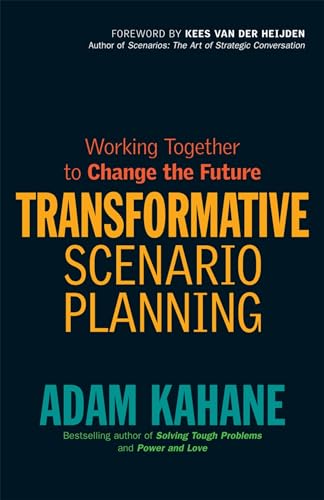
Transformative Scenario Planning: Working Together to Change the Future
Verlag:
Berrett-Koehler Publishers, 2012
ISBN 10: 1609944909
ISBN 13: 9781609944902
Gebraucht
Softcover
Anbieter: World of Books (was SecondSale), Montgomery, IL, USA
Verkäuferbewertung 5 von 5 Sternen

Zustand: Good. Item in good condition. Textbooks may not include supplemental items i.e. CDs, access codes etc. Artikel-Nr. 00110028039
Gebraucht kaufen
EUR 5,50
Versand gratis
Versand innerhalb von USA
Versand innerhalb von USA
Anzahl: 3 verfügbar
Beispielbild für diese ISBN
Transformative Scenario Planning: Working Together to Change the Future
Verlag:
Berrett-Koehler Publishers, 2012
ISBN 10: 1609944909
ISBN 13: 9781609944902
Gebraucht
Softcover
Anbieter: World of Books (was SecondSale), Montgomery, IL, USA
Verkäuferbewertung 5 von 5 Sternen
Zustand: Acceptable. Item in Acceptable condition. Textbooks may not include supplemental items i.e. CDs, access codes etc. Artikel-Nr. 00109698722
Gebraucht kaufen
EUR 5,50
Versand gratis
Versand innerhalb von USA
Versand innerhalb von USA
Anzahl: 1 verfügbar
Beispielbild für diese ISBN
Transformative Scenario Planning: Working Together to Change the Future
Verlag:
Berrett-Koehler Publishers, 2012
ISBN 10: 1609944909
ISBN 13: 9781609944902
Gebraucht
Paperback
Anbieter: ThriftBooks-Reno, Reno, NV, USA
Verkäuferbewertung 5 von 5 Sternen
Paperback. Zustand: Good. No Jacket. Pages can have notes/highlighting. Spine may show signs of wear. ~ ThriftBooks: Read More, Spend Less. Artikel-Nr. G1609944909I3N00
Gebraucht kaufen
EUR 5,96
Versand gratis
Versand innerhalb von USA
Versand innerhalb von USA
Anzahl: 1 verfügbar
Beispielbild für diese ISBN
Transformative Scenario Planning: Working Together to Change the Future
Verlag:
Berrett-Koehler Publishers, 2012
ISBN 10: 1609944909
ISBN 13: 9781609944902
Gebraucht
Paperback
Anbieter: ThriftBooks-Dallas, Dallas, TX, USA
Verkäuferbewertung 5 von 5 Sternen
Paperback. Zustand: Fair. No Jacket. Readable copy. Pages may have considerable notes/highlighting. ~ ThriftBooks: Read More, Spend Less. Artikel-Nr. G1609944909I5N00
Gebraucht kaufen
EUR 5,96
Versand gratis
Versand innerhalb von USA
Versand innerhalb von USA
Anzahl: 1 verfügbar
Beispielbild für diese ISBN
Transformative Scenario Planning: Working Together to Change the Future
Verlag:
Berrett-Koehler Publishers, 2012
ISBN 10: 1609944909
ISBN 13: 9781609944902
Gebraucht
Paperback
Anbieter: ThriftBooks-Phoenix, Phoenix, AZ, USA
Verkäuferbewertung 5 von 5 Sternen
Paperback. Zustand: Good. No Jacket. Pages can have notes/highlighting. Spine may show signs of wear. ~ ThriftBooks: Read More, Spend Less. Artikel-Nr. G1609944909I3N00
Gebraucht kaufen
EUR 5,96
Versand gratis
Versand innerhalb von USA
Versand innerhalb von USA
Anzahl: 1 verfügbar
Beispielbild für diese ISBN
Transformative Scenario Planning: Working Together to Change the Future
Verlag:
Berrett-Koehler Publishers, 2012
ISBN 10: 1609944909
ISBN 13: 9781609944902
Gebraucht
Paperback
Anbieter: ThriftBooks-Dallas, Dallas, TX, USA
Verkäuferbewertung 5 von 5 Sternen
Paperback. Zustand: Good. No Jacket. Former library book; Pages can have notes/highlighting. Spine may show signs of wear. ~ ThriftBooks: Read More, Spend Less. Artikel-Nr. G1609944909I3N10
Gebraucht kaufen
EUR 5,96
Versand gratis
Versand innerhalb von USA
Versand innerhalb von USA
Anzahl: 1 verfügbar
Beispielbild für diese ISBN
Transformative Scenario Planning: Working Together to Change the Future
Verlag:
Berrett-Koehler Publishers, 2012
ISBN 10: 1609944909
ISBN 13: 9781609944902
Gebraucht
Paperback
Anbieter: ThriftBooks-Atlanta, AUSTELL, GA, USA
Verkäuferbewertung 5 von 5 Sternen
Paperback. Zustand: Good. No Jacket. Pages can have notes/highlighting. Spine may show signs of wear. ~ ThriftBooks: Read More, Spend Less. Artikel-Nr. G1609944909I3N00
Gebraucht kaufen
EUR 5,96
Versand gratis
Versand innerhalb von USA
Versand innerhalb von USA
Anzahl: 1 verfügbar
Beispielbild für diese ISBN
Transformative Scenario Planning: Working Together to Change the Future
Verlag:
Berrett-Koehler Publishers, 2012
ISBN 10: 1609944909
ISBN 13: 9781609944902
Gebraucht
Paperback
Anbieter: ThriftBooks-Dallas, Dallas, TX, USA
Verkäuferbewertung 5 von 5 Sternen
Paperback. Zustand: Good. No Jacket. Pages can have notes/highlighting. Spine may show signs of wear. ~ ThriftBooks: Read More, Spend Less. Artikel-Nr. G1609944909I3N00
Gebraucht kaufen
EUR 5,96
Versand gratis
Versand innerhalb von USA
Versand innerhalb von USA
Anzahl: 2 verfügbar
Beispielbild für diese ISBN
Transformative Scenario Planning: Working Together to Change the Future
Verlag:
Berrett-Koehler Publishers, 2012
ISBN 10: 1609944909
ISBN 13: 9781609944902
Gebraucht
Paperback
Anbieter: ThriftBooks-Atlanta, AUSTELL, GA, USA
Verkäuferbewertung 5 von 5 Sternen
Paperback. Zustand: Very Good. No Jacket. May have limited writing in cover pages. Pages are unmarked. ~ ThriftBooks: Read More, Spend Less. Artikel-Nr. G1609944909I4N00
Gebraucht kaufen
EUR 5,96
Versand gratis
Versand innerhalb von USA
Versand innerhalb von USA
Anzahl: 1 verfügbar
Beispielbild für diese ISBN
Transformative Scenario Planning : Working Together to Change the Future
Verlag:
Berrett-Koehler Publishers, Incorporated, 2012
ISBN 10: 1609944909
ISBN 13: 9781609944902
Gebraucht
Softcover
Anbieter: Better World Books, Mishawaka, IN, USA
Verkäuferbewertung 5 von 5 Sternen
Zustand: Good. Former library copy. Pages intact with minimal writing/highlighting. The binding may be loose and creased. Dust jackets/supplements are not included. Includes library markings. Stock photo provided. Product includes identifying sticker. Better World Books: Buy Books. Do Good. Artikel-Nr. 15392974-6
Gebraucht kaufen
EUR 8,34
Versand gratis
Versand innerhalb von USA
Versand innerhalb von USA
Anzahl: 1 verfügbar