
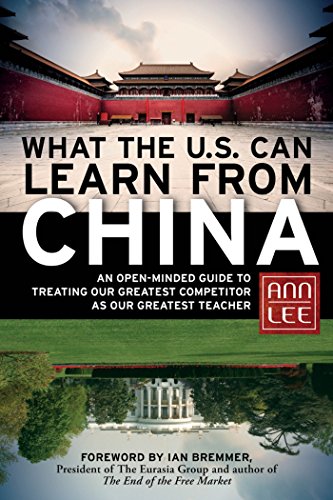
What the U.S. Can Learn from China: An Open-Minded Guide to Treating Our Greatest Competitor as Our Greatest Teacher - Hardcover
Inhaltsangabe
The author examines what China can teach the U.S. in education, economic policy, foreign policy, strategic planning, and politics.
While America reeled from the 2008 financial crisis, a high unemployment rate, and a surge in government debt, China’s economy was the second largest in the world, and many predict it will surpass the United States’. President Obama called China’s rise “a Sputnik moment”—will America seize this moment or continue to treat China as its scapegoat?
Mainstream media and the U.S. government regularly target China as a threat. Rather than viewing China’s power, influence, and contributions to the global economy in a negative light, Ann Lee asks, what can America learn from its competition?
Why did China recover so quickly after the global economic meltdown? What accounts for China’s extraordinary growth, despite one of the highest corporate tax rates in the world? How does the Chinese political system avoid partisan rancor but achieve genuine public accountability? From education to governance to foreign aid, Lee details the policies and practices that have made China a global power and then isolates the ways the United States can use China’s enduring principles to foster much-needed change at home.
This is no whitewash. Lee is fully aware of China’s shortcomings, particularly in the area of human rights. She has relatives who suffered during the Cultural Revolution. But by overemphasizing our differences with China, the United States stands to miss a vital opportunity. Filled with sharp insights and thorough research, What the U.S. Can Learn from China is Lee’s rallying cry for a new approach at a time when learning from one another is the key to surviving and thriving.
“Ann Lee’s What the U.S. Can Learn from China is a rare achievement in today’s examinations of U.S.-China relations: it supplements an already sophisticated analysis with a deep cultural understanding that is richly valuable and laudably objective. Ann’s ability to ask the tough questions helps Americans to understand China better and China to see itself clearer.” —Nancy Yao Maasbach, executive director, Yale-China Association
“This book sparkles on literally every page with surprising insights and crucial information that everybody in America—and China—simply must become acquainted with or be reminded of. Whether it be about education, culture, politics and economics, or business, Ms. Lee has much, much more to teach both Americans and Chinese than any of us knew that we had yet to learn.” —Robert Hockett, Professor of Financial and International Economic Law, Cornell University
Die Inhaltsangabe kann sich auf eine andere Ausgabe dieses Titels beziehen.
Über die Autorin bzw. den Autor
Ann Lee is a professor of finance and economics at New York University and a senior fellow with the public policy think tank Demos. Fluent in Mandarin and Cantonese, she was a visiting graduate economics professor at Peking University in 2008. She has also been an investment banker at Bankers Trust and Alex. Brown & Sons and a partner at two multibillion-dollar hedge fund firms. Her work has appeared in publications such as the Financial Times, the Wall Street Journal, Newsweek, Forbes, and Businessweek, and she regularly guests on CNBC, Fox Business, Bloomberg, CNN, NPR, and many other television and radio stations.
Auszug. © Genehmigter Nachdruck. Alle Rechte vorbehalten.
INTRODUCTION
A New Year’s Resolution
Never doubt that a small group of thoughtful,
committed citizens can change the world, indeed
it is the only thing that ever has. —MARGARET MEAD
AS INDIVIDUALS, WE ARE NOT QUITE SATISFIED with ourselves most of the time. We are keenly aware of our shortcomings and try to make resolutions to correct them. Whether it is to lose weight, quit smoking, or address some other personal issue, we know we will fail unless we work hard to achieve our goals, stay focused, and remain committed to success for however long it takes to materialize.
As a nation, we have had a similar process. Throughout history, various constituencies that were not content with the status quo have coalesced to create political movements to change national policy. When the United States had to resolve an internal contradiction between the Constitutional rights of life, liberty, and the pursuit of happiness and the institution of slavery, abolitionists in the 19th century were prepared to fight to their death for what they believed. Similarly, the women’s suffrage movement in the early 20th century lasted almost two decades before the right to vote was granted to women.
Today, the United States faces another moment of discontent. What some labeled malaise under the Carter years—the slow erosion of the American Dream for most citizens—culminated into a financial crisis of global proportions in 2008.
This crisis in turn has morphed not only into a domestic economic crisis with government adding trillions of dollars to its debt and persistent high unemployment, but also into crises of governance and of confidence. Americans are frustrated by the state of current political dysfunction and have palpable anxiety that it cannot be fixed. The clear mandate Obama had with his 2008 election landslide was challenged two years into his presidency after the Congressional elections when Republicans took over majority leadership in the House. Americans have begun to suspect that neither party can deliver on their promises to represent their interests and have made their displeasure known through Gallup polls, Tea Parties, and even renouncements of U.S. citizenship.
While a great polarization of interests does divide the country, I believe it is less about Republicans versus Democrats and more about the haves versus the have-nots. The haves want to continue outsourcing labor to developing countries and see booming financial markets through continued lax financial regulation while the have-nots want a job with a decent wage and a future where their children have a fair chance at improving their lives. How these disparate priorities get resolved will have profound implications for growth and movement in the American domestic economy. Feelings of apprehension and uncertainty over these outcomes underscore the common worry that the nation may not maintain its competitive edge.
These worries couldn’t come at a worse time; America has been suffering from the worst economic situation since the Great Depression while elsewhere around the globe, more people are demanding a share of the economic prosperity that America has enjoyed for decades.6 Understandably, many Americans feel threatened by all this new competition from the developing world. On one side, China, boasting a population of over a billion low-wage workers, has absorbed most of the dirty manufacturing jobs that have long left America. India also has absorbed many American jobs, but mostly in the service sector like customer-service call centers, computer software programming, and even legal work where Indians can perform the same services as skilled Americans but at a fraction of the cost. Job insecurity has gripped most working Americans, and their fear has spawned anti-China rhetoric and anti-immigration legislation.7
China has become a convenient scapegoat for American economic problems. American ethnic prejudice, as documented in Iris Chang’s book, The Chinese in America: A Narrative History, combined with envy for China’s recent successes—such as the resumption of strong economic growth shortly after the 2008 financial crisis—and a perceived lack of democracy make China an easy target. I use perceived because I explain in chapter 3 that the current set of Chinese leaders formulate policies with the greater public interest in mind. China bashing has become almost a contact sport on television with both left- and right-wing commentators trying to outbash each other with China aspersions. Even Michael Lewis, author of The Big Short, satirically noted this phenomenon in his opinion piece titled “All You Need to Know about Why Things Fell Apart.”8 Such negative rhetoric fuels more complaining and misunderstanding rather than productive problem solving.
Unlike foreign channels such as the British Broadcasting Corporation (BBC), American mainstream media mostly air American-centric views without devoting equal time to thoughtful discussions from foreign perspectives, perspectives that might shed light on subjects less familiar to Americans. But Americans are capable of inspired action that rises above media tirades. Throughout history, Americans have consistently united to meet challenges at the darkest hours—working collectively on the war effort during World War II and turning out in droves to volunteer aid after 9/11. More recently, the television show 60 Minutes reported that in 2011 American families welcomed newly homeless neighbors into their homes, while foreclosures swept the country.
Today, Americans may face one of the most challenging tests of will. The challenge is not as simple and straightforward as facing an enemy like the Soviet Union during the Cold War. Rather, the challenge to America is how our nation will coexist in a world of rising powers and diminishing natural resources, both of which may threaten our chosen way of life. As developing nations around the world continue their unrelenting drive to improve their economic fortunes, can the United States blaze a trail that will lead to peaceful and sustainable outcomes? Some, myself included, worry that the West, particularly America, will fall behind in an increasingly competitive and unpredictable future. President Obama has called China’s economic and technological rise the new Sputnik moment, and former Speaker of the House Newt Gingrich articulated that technological supremacy by China would amount to a “potentially catastrophic threat” to Americans.9 These worries have begun to generate some innovative policy proposals such as those announced by the Department of Energy to invest in clean energy research, but action has not been as forthcoming, and much more needs to be done. The problems will require practical solutions, metaphysical reflections on America’s evolving identity, and national resolve for meeting these challenges.
At a minimum, America must become more competitive than in the recent past across the board. With more challengers, supremacy will be a more difficult position to defend. Though America’s military is second to none, it would be unwise to unduly rely on it to maintain America’s superpower status. Rather, America must strengthen its diverse portfolio of capabilities, because even with its military force, it is impossible to control everything everywhere all the time; nor should it try.
America is arguably at an inflection point in its role as a global empire.10 The financial crisis has uncovered weaknesses in our financial system and regulatory oversight that were formerly thought of as strengths, and its reputation internationally as a land of opportunity is being questioned more aggressively. At the same time, the consensus for a march forward is hard to find. Although America remains...
„Über diesen Titel“ kann sich auf eine andere Ausgabe dieses Titels beziehen.
Weitere beliebte Ausgaben desselben Titels

Suchergebnisse für What the U.S. Can Learn from China: An Open-Minded...

Beispielbild für diese ISBN
What the U.S. Can Learn from China: An Open-Minded Guide to Treating Our Greatest Competitor as Our Greatest Teacher
Verlag:
Berrett-Koehler Publishers, 2012
ISBN 10: 1609941241
ISBN 13: 9781609941246
Gebraucht
Hardcover
Anbieter: World of Books (was SecondSale), Montgomery, IL, USA
Verkäuferbewertung 5 von 5 Sternen

Zustand: Very Good. Item in very good condition! Textbooks may not include supplemental items i.e. CDs, access codes etc. Artikel-Nr. 00075573326
Gebraucht kaufen
EUR 4,83
Versand gratis
Versand innerhalb von USA
Versand innerhalb von USA
Anzahl: 2 verfügbar
Beispielbild für diese ISBN
What the U.S. Can Learn from China: An Open-Minded Guide to Treating Our Greatest Competitor as Our Greatest Teacher
Verlag:
Berrett-Koehler Publishers, 2012
ISBN 10: 1609941241
ISBN 13: 9781609941246
Gebraucht
Hardcover
Anbieter: World of Books (was SecondSale), Montgomery, IL, USA
Verkäuferbewertung 5 von 5 Sternen
Zustand: Good. Item in good condition. Textbooks may not include supplemental items i.e. CDs, access codes etc. Artikel-Nr. 00099517017
Gebraucht kaufen
EUR 4,83
Versand gratis
Versand innerhalb von USA
Versand innerhalb von USA
Anzahl: 1 verfügbar
Beispielbild für diese ISBN
What the U. S. Can Learn from China : An Open-Minded Guide to Treating Our Greatest Competitor As Our Greatest Teacher
Verlag:
Berrett-Koehler Publishers, Incorporated, 2012
ISBN 10: 1609941241
ISBN 13: 9781609941246
Gebraucht
Hardcover
Erstausgabe
Anbieter: Better World Books, Mishawaka, IN, USA
Verkäuferbewertung 5 von 5 Sternen
Zustand: Good. 1st Edition. Former library copy. Pages intact with minimal writing/highlighting. The binding may be loose and creased. Dust jackets/supplements are not included. Includes library markings. Stock photo provided. Product includes identifying sticker. Better World Books: Buy Books. Do Good. Artikel-Nr. 5449396-6
Gebraucht kaufen
EUR 5,87
Versand gratis
Versand innerhalb von USA
Versand innerhalb von USA
Anzahl: 1 verfügbar
Beispielbild für diese ISBN
What the U. S. Can Learn from China : An Open-Minded Guide to Treating Our Greatest Competitor As Our Greatest Teacher
Verlag:
Berrett-Koehler Publishers, Incorporated, 2012
ISBN 10: 1609941241
ISBN 13: 9781609941246
Gebraucht
Hardcover
Erstausgabe
Anbieter: Better World Books, Mishawaka, IN, USA
Verkäuferbewertung 5 von 5 Sternen
Zustand: Very Good. 1st Edition. Former library copy. Pages intact with possible writing/highlighting. Binding strong with minor wear. Dust jackets/supplements may not be included. Includes library markings. Stock photo provided. Product includes identifying sticker. Better World Books: Buy Books. Do Good. Artikel-Nr. 1541041-75
Gebraucht kaufen
EUR 5,87
Versand gratis
Versand innerhalb von USA
Versand innerhalb von USA
Anzahl: 2 verfügbar
Beispielbild für diese ISBN
What the U.S. Can Learn from China: An Open-Minded Guide to Treating Our Greatest Competitor as Our Greatest Teacher
Verlag:
Berrett-Koehler Publishers, 2012
ISBN 10: 1609941241
ISBN 13: 9781609941246
Gebraucht
Hardcover
Anbieter: ThriftBooks-Dallas, Dallas, TX, USA
Verkäuferbewertung 5 von 5 Sternen
Hardcover. Zustand: Good. No Jacket. Pages can have notes/highlighting. Spine may show signs of wear. ~ ThriftBooks: Read More, Spend Less. Artikel-Nr. G1609941241I3N00
Gebraucht kaufen
EUR 14,44
Versand gratis
Versand innerhalb von USA
Versand innerhalb von USA
Anzahl: 1 verfügbar
Beispielbild für diese ISBN
What the U.S. Can Learn from China
Verlag:
Berrett-Koehler Publishers, 2012
ISBN 10: 1609941241
ISBN 13: 9781609941246
Gebraucht
Hardcover
Anbieter: Hamelyn, Madrid, M, Spanien
Verkäuferbewertung 5 von 5 Sternen
Zustand: Muy bueno. : En este libro, Ann Lee explora las políticas y prácticas que han impulsado a China como potencia global, identificando lecciones valiosas que Estados Unidos puede aplicar para fomentar el cambio interno. Lee analiza el rápido crecimiento económico de China, su sistema político y su enfoque en la economía real, ofreciendo una perspectiva equilibrada que reconoce tanto los logros como las deficiencias del país asiático. Este análisis ofrece una nueva perspectiva en un momento en que el aprendizaje mutuo es crucial para el progreso global. EAN: 9781609941246 Tipo: Libros Categoría: Otros Título: What the U.S. Can Learn from China Autor: Ann Lee Editorial: Berrett-Koehler Publishers Idioma: en Páginas: 288 Formato: tapa dura. Artikel-Nr. Happ-2023-05-11-d68a27d2
Gebraucht kaufen
EUR 6,11
EUR 12,99 Versand
Versand von Spanien nach USA
Versand von Spanien nach USA
Anzahl: 1 verfügbar
Beispielbild für diese ISBN
What the U.S. Can Learn from China: An Open-Minded Guide to Treating Our Greatest Competitor as Our Greatest Teacher: An Open-Minded Guide to Treating . as Our Greatest Teacher (AGENCY/DISTRIBUTED)
Verlag:
Berrett-Koehler Publishers, 2012
ISBN 10: 1609941241
ISBN 13: 9781609941246
Gebraucht
Paperback
Anbieter: WorldofBooks, Goring-By-Sea, WS, Vereinigtes Königreich
Verkäuferbewertung 5 von 5 Sternen
Paperback. Zustand: Very Good. The book has been read, but is in excellent condition. Pages are intact and not marred by notes or highlighting. The spine remains undamaged. Artikel-Nr. GOR007335038
Gebraucht kaufen
EUR 19,09
EUR 6,46 Versand
Versand von Vereinigtes Königreich nach USA
Versand von Vereinigtes Königreich nach USA
Anzahl: 1 verfügbar
Beispielbild für diese ISBN
What the U.S. Can Learn from China: An Open-Minded Guide to Treating Our Greatest Competitor as Our Greatest Teacher: An Open-Minded Guide to Treating . as Our Greatest Teacher (AGENCY/DISTRIBUTED)
Anbieter: Kennys Bookstore, Olney, MD, USA
Verkäuferbewertung 5 von 5 Sternen
Zustand: New. Num Pages: 300 pages, Illustrations. BIC Classification: 1FPC; 1KBB; JPSL; KC. Category: (P) Professional & Vocational. Dimension: 234 x 163 x 25. Weight in Grams: 526. . 2012. hardcover. . . . . Books ship from the US and Ireland. Artikel-Nr. V9781609941246
Neu kaufen
EUR 34,44
EUR 9,01 Versand
Versand innerhalb von USA
Versand innerhalb von USA
Anzahl: 15 verfügbar
Beispielbild für diese ISBN
What the U.s. Can Learn from China: An Open-minded Guide to Treating Our Greatest Competitor As Our Greatest Teacher
Anbieter: Revaluation Books, Exeter, Vereinigtes Königreich
Verkäuferbewertung 5 von 5 Sternen
Hardcover. Zustand: Brand New. 1st edition. 288 pages. 9.25x6.25x1.00 inches. In Stock. Artikel-Nr. 1609941241
Neu kaufen
EUR 46,82
EUR 14,43 Versand
Versand von Vereinigtes Königreich nach USA
Versand von Vereinigtes Königreich nach USA
Anzahl: 1 verfügbar
Foto des Verkäufers
What the U.S. Can Learn from China: An Open-Minded Guide to Treating Our Greatest Competitor as Our Greatest Teacher
Anbieter: moluna, Greven, Deutschland
Verkäuferbewertung 5 von 5 Sternen
Zustand: New. Ann Lee is a professor of finance and economics at New York University and a senior fellow with the public policy think tank Demos. Fluent in Mandarin and Cantonese, she was a visiting graduate economics professor at Peking University in 2008. She has also . Artikel-Nr. 596408867
Neu kaufen
EUR 30,06
EUR 48,99 Versand
Versand von Deutschland nach USA
Versand von Deutschland nach USA
Anzahl: Mehr als 20 verfügbar