
Verwandte Artikel zu The Biggest Loser Quick & Easy Cookbook: Simply...
The Biggest Loser Quick & Easy Cookbook: Simply Delicious Low-calorie Recipes to Make in a Snap - Softcover
Buch 2 von 2: Biggest Loser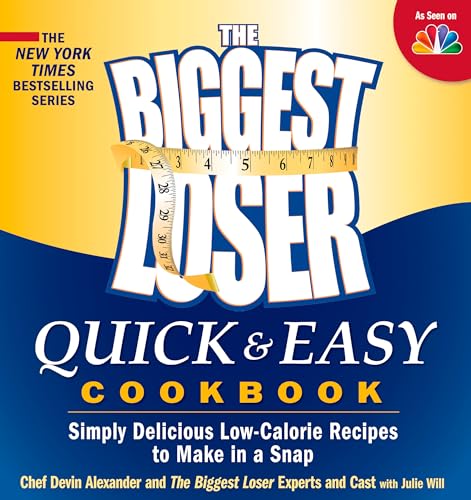
Inhaltsangabe
The first cookbook in the bestselling Biggest Loser series to focus on fast, simple meals that you can eat on the go, The Biggest Loser Quick & Easy Cookbook by Chef Devin Alexander and The Biggest Loser Experts and Cast with Julie Will will feature more than 75 easy recipes with 20 minutes of prep time or less, accompanied by beautiful 4-color photography. The book will also provide an overview of The Biggest Loser eating plan; include five 20 minute workouts with tips on how to burn the most calories in the least amount of time, offer healthy cooking and baking tips and techniques as well as shopping lists and pantry basics; and as always, will feature tips from the trainers and contestants on time-saving techniques for fitting healthy meals into busy schedules.
The 75 quick and easy recipes will include such categories as breakfast on the double, speedy soups and sandwiches, throw-together salads and sides, mains in minutes, lickety-split sweet bites, and more. Sample recipes include:
Asparagus & Chicken Apple Sausage Scramble
Sausage Feta Pepper Breakfast Bake
Blanca Arugula Pizza
Monkey Trail Mix
Caprese Burger
Cold Dumpling Salad
Garlic & Herb Mac & Cheese
Spicy Cayenne Corn on the Cob
Coffee Crusted Chopped Steak
Philly Cheese Steak Pizza
Crispy Pesto Cod
Meyer Lemon Seared Scallops
Chocolate Raspberry Dreamers
Honey Nut Apple Butter Rice Cakes
Die Inhaltsangabe kann sich auf eine andere Ausgabe dieses Titels beziehen.
Über die Autorin bzw. den Autor
New York Times bestselling author Devin Alexander has shared her secrets for unbelievably decadent-tasting foods through frequent appearances on such national TV shows as The TODAY Show, Fox & Friends, Good Morning America, and The View, and has also appeared on Discovery Health, HGTV, USA, Style Network and others. Devin's advice has also appeared in more than 100 magazine articles, including Prevention, Women's Health, Runners World, Shape, USA Today, Parade, Bon Appetite, and Health to name a few. Devin is currently the host of "Healthy Decadence with Devin Alexander" in FitTv.
She is the author of The Biggest Loser Cookbook, The Biggest Loser Family Cookbook, The Biggest Loser Dessert Cookbook, The Biggest Loser Flavors of the World, Fast Food Fix, The Most Decadent Diet Ever, and I Can't Believe It's Not Fattening.
Auszug. © Genehmigter Nachdruck. Alle Rechte vorbehalten.
1
The Biggest Loser Eating Plan
"I wish I could, but I just don't have the time."
These days, it's become an all-too-common refrain. Whether we're talking about going to the grocery store, cooking healthy meals, working out, or simply sitting down to the dinner table with our families, most of us have such busy schedules that it can feel impossible to carve out any time for a healthy lifestyle.
Why are we so busy all the time? Well, for starters, many Americans are feeling the pressure to work longer hours than ever before to pay for the rising costs of living expenses, to save for retirement, or simply to ensure that they keep their jobs. Between working and caring for our families, many of us feel too exhausted or stressed out at the end of the day to even think about cooking dinner or consider going to the gym.
But when we don't take the time to take care of ourselves, we're not conserving our time or our money. As we all know by now, obesity is closely linked to many life-threatening diseases, such as type 2 diabetes, high blood pressure, heart disease, and some cancers. When we don't nourish our bodies with wholesome foods, get enough sleep, and stay active, we put ourselves at an elevated risk for developing health problems that are expensive to treat and can not only diminish the quality of our lives, but take years off of them.
In the pages that follow, you'll learn the basics of The Biggest Loser eating plan and exercise guidelines. While sustainable weight loss is a slow and steady process that requires hard work and discipline, just 20 minutes a day can make a real difference in your overall health. Sure, there will be days when the thought of making dinner feels too overwhelming. That's why Chef Devin has provided meal ideas you can throw together in just a few minutes, with a little planning ahead. When you map out a week's worth of meals in advance, shop accordingly on the weekends, and keep your refrigerator stocked with healthy ingredients, "not enough time" will no longer be an excuse to eat poorly.
Think about it: In less than 20 minutes a day, you can change the quality of your life. You're worth the investment.
Counting Calories
Yes, it's important to count calories. Why? Because one £d is made of 3,500 calories, and in order to shave off some £ds, you have decrease the amount of calories you take in through food and increase the amount of calories you burn through exercise.
Joe Mitchell SEASON 12
It's not about burning yourself out and going crazy at the gym. It's all about keeping a good, steady burn and keeping your heart rate up. Also, don't forget to incorporate weight training. Muscles burn more calories than fat and will help you lose weight.
A calorie is a measurement of how much energy the food you eat provides for your body. You need energy to fuel physical activity as well as all metabolic processes, from maintaining your heartbeat to digesting your meals. Only four components of the food you eat supply calories: protein and carbohydrates (4 calories per gram), alcohol (7 calories per gram), and fat (9 calories per gram). Vitamins, minerals, fiber, and water do not contain calories.
Keep in mind that the quality of the calories you eat is just as important as the quantity you take in. Some calories provide fuel for your workouts, keep you feeling energized, and help your body stay healthy. Other calories (often referred to as "empty calories") don't really provide any benefits-- in fact, they can make you feel tired, sluggish, and hungrier than you were before you ate. The Biggest Loser plan will show you how to fuel your body with the nutrients and energy it needs to lose weight and maintain overall health.
Season 5's Neill Harmer says he likes to think of calories as a daily allowance. "Let's say you have 2,000 calories to spend per day. If you drink that iced latte with whipped cream and chocolate, you just spent a BIG part of your allowance on something that really wasn't needed. Spend calories wisely."
The Biggest Loser plan helps you determine the exact calorie intake you require to meet your individual weight-loss goals. If you weigh 150 £ds or more, the simple calculation below will allow you to determine how many calories you should aim to eat each day. If you weigh less than 150 £ds, talk to a doctor about an appropriate calorie budget for your needs.
Calorie Budget:
Your present weight x 7 = total daily calorie budget
As you lose weight, you'll need to continually reassess and reduce your calorie budget, in order to keep losing weight and break through plateaus. As you know from watching the show, The Biggest Loser contestants lose a lot of weight during their first few weeks at the Ranch. But after they've been at the Ranch for a little while and have less weight left to lose, they must readjust their calorie budgets and increase the intensity and duration of their workouts to keep losing.
All of the contestants have a daily homework assignment: At the end of the day, they tally up the total number of calories they consumed throughout the day. If they ate more calories than their budget calls for, it's up to them to burn off the extra calories by getting in one last workout, going for a walk, or doing a few laps in the pool.
Planning Your Calories
Once you've determined your daily calorie budget, the next step is to plan your meals and snacks accordingly. On The Biggest Loser plan, it's recommended that you eat three meals and two snacks each day. Parceling out your calories throughout the day ensures that you'll stay full and keep your blood sugar level stable. It will also prevent you from feeling deprived, keep you energized for exercise, and help you establish a regular pattern of eating that helps counter impulse eating and bingeing.
"At first, I had to work to get all of my meals in," recalls Season 8 winner Danny Cahill. "I wasn't used to eating healthy foods, but I quickly realized that nutritious food was way more satisfying than the fast food I had been eating. Eating healthy throughout the day kept my energy level up, and I felt fueled for my workouts."
Use the simple calculations below to determine how to best allocate your calorie budget throughout the day. In this example, the calorie budget is 1,800--yours may be more or less, depending on your goal and starting weight.
Calorie Budget = 1,800
1,800 / 4 = 450
450 / 2 = 225
So for each meal--breakfast, lunch, and dinner--the calorie budget is 450. For each snack, the calorie budget is 225.
This calculation is just a starting point. You can create any distribution of calories that works for you and keeps you feeling satisfied. Season 5 winner Ali Vincent has a strategy that works for her: "I always eat within half an hour of waking up to jump-start my metabolism. Then I eat every 3 to 4 hours, be it a meal or a snack. I think this is just as important for me as exercise," she says.
If you go to the gym in the morning and require a bigger breakfast to fuel your workout, feel free to shift your calorie load toward the beginning of the day. Or if you work out just before dinner, you might want to have a bigger snack before the gym and a smaller dinner afterward. Create a distribution of calories that works for you. The important thing is to plan ahead and stay within your calorie budget. As Season 7's Nicole Brewer wisely advises, "Planning will save you. Prepare your snacks and meals ahead of time, and always have them with you."
To understand your body's hunger signals and how to interpret them, see The Biggest Loser Hunger Scale on the opposite page.
Planning Meals and Snacks
As Nicole says, planning is an essential component of successful weight loss. The times when you are likely to be the most...
„Über diesen Titel“ kann sich auf eine andere Ausgabe dieses Titels beziehen.
Suchergebnisse für The Biggest Loser Quick & Easy Cookbook: Simply...

Beispielbild für diese ISBN
The Biggest Loser Quick & Easy
Anbieter: World of Books (was SecondSale), Montgomery, IL, USA
Verkäuferbewertung 5 von 5 Sternen

Zustand: Acceptable. Item in acceptable condition! Textbooks may not include supplemental items i.e. CDs, access codes etc. Artikel-Nr. 00096634206
Gebraucht kaufen
EUR 3,75
Versand gratis
Versand innerhalb von USA
Versand innerhalb von USA
Anzahl: 3 verfügbar
Beispielbild für diese ISBN
The Biggest Loser Quick & Easy
Anbieter: World of Books (was SecondSale), Montgomery, IL, USA
Verkäuferbewertung 5 von 5 Sternen
Zustand: Good. Item in good condition. Textbooks may not include supplemental items i.e. CDs, access codes etc. Artikel-Nr. 00097701839
Gebraucht kaufen
EUR 3,75
Versand gratis
Versand innerhalb von USA
Versand innerhalb von USA
Anzahl: 13 verfügbar
Beispielbild für diese ISBN
The Biggest Loser Quick & Easy
Anbieter: World of Books (was SecondSale), Montgomery, IL, USA
Verkäuferbewertung 5 von 5 Sternen
Zustand: Good. Item in good condition. Textbooks may not include supplemental items i.e. CDs, access codes etc. Artikel-Nr. 00090683421
Gebraucht kaufen
EUR 3,95
Versand gratis
Versand innerhalb von USA
Versand innerhalb von USA
Anzahl: 14 verfügbar
Beispielbild für diese ISBN
The Biggest Loser Quick & Easy Cookbook: Simply Delicious Low-calorie Recipes to Make in a Snap
Verlag:
Rodale Books (edition 1), 2011
ISBN 10: 1609614232
ISBN 13: 9781609614232
Gebraucht
Paperback
Anbieter: BooksRun, Philadelphia, PA, USA
Verkäuferbewertung 5 von 5 Sternen
Paperback. Zustand: Very Good. 1. It's a well-cared-for item that has seen limited use. The item may show minor signs of wear. All the text is legible, with all pages included. It may have slight markings and/or highlighting. Artikel-Nr. 1609614232-11-6
Gebraucht kaufen
EUR 4,79
Versand gratis
Versand innerhalb von USA
Versand innerhalb von USA
Anzahl: 1 verfügbar
Beispielbild für diese ISBN
The Biggest Loser Quick & Easy Cookbook: Simply Delicious Low-calorie Recipes to Make in a Snap
Verlag:
Rodale Books (edition 1), 2011
ISBN 10: 1609614232
ISBN 13: 9781609614232
Gebraucht
Paperback
Anbieter: BooksRun, Philadelphia, PA, USA
Verkäuferbewertung 5 von 5 Sternen
Paperback. Zustand: Fair. 1. The item might be beaten up but readable. May contain markings or highlighting, as well as stains, bent corners, or any other major defect, but the text is not obscured in any way. Artikel-Nr. 1609614232-7-1
Gebraucht kaufen
EUR 4,91
Versand gratis
Versand innerhalb von USA
Versand innerhalb von USA
Anzahl: 1 verfügbar
Beispielbild für diese ISBN
The Biggest Loser Quick and Easy Cookbook : Simply Delicious Low-Calorie Recipes to Make in a Snap
Verlag:
Potter/Ten Speed/Harmony/Rodale, 2011
ISBN 10: 1609614232
ISBN 13: 9781609614232
Gebraucht
Softcover
Erstausgabe
Anbieter: Better World Books, Mishawaka, IN, USA
Verkäuferbewertung 5 von 5 Sternen
Zustand: Good. 1st Edition. Pages intact with minimal writing/highlighting. The binding may be loose and creased. Dust jackets/supplements are not included. Stock photo provided. Product includes identifying sticker. Better World Books: Buy Books. Do Good. Artikel-Nr. 4651619-6
Gebraucht kaufen
EUR 6,21
Versand gratis
Versand innerhalb von USA
Versand innerhalb von USA
Anzahl: 1 verfügbar
Beispielbild für diese ISBN
The Biggest Loser Quick and Easy Cookbook : Simply Delicious Low-Calorie Recipes to Make in a Snap
Verlag:
Potter/Ten Speed/Harmony/Rodale, 2011
ISBN 10: 1609614232
ISBN 13: 9781609614232
Gebraucht
Softcover
Erstausgabe
Anbieter: Better World Books, Mishawaka, IN, USA
Verkäuferbewertung 5 von 5 Sternen
Zustand: Very Good. 1st Edition. Former library copy. Pages intact with possible writing/highlighting. Binding strong with minor wear. Dust jackets/supplements may not be included. Includes library markings. Stock photo provided. Product includes identifying sticker. Better World Books: Buy Books. Do Good. Artikel-Nr. 9140950-75
Gebraucht kaufen
EUR 6,21
Versand gratis
Versand innerhalb von USA
Versand innerhalb von USA
Anzahl: 1 verfügbar
Beispielbild für diese ISBN
The Biggest Loser Quick and Easy Cookbook : Simply Delicious Low-Calorie Recipes to Make in a Snap
Verlag:
Potter/Ten Speed/Harmony/Rodale, 2011
ISBN 10: 1609614232
ISBN 13: 9781609614232
Gebraucht
Softcover
Erstausgabe
Anbieter: Better World Books: West, Reno, NV, USA
Verkäuferbewertung 5 von 5 Sternen
Zustand: Good. 1st Edition. Pages intact with minimal writing/highlighting. The binding may be loose and creased. Dust jackets/supplements are not included. Stock photo provided. Product includes identifying sticker. Better World Books: Buy Books. Do Good. Artikel-Nr. 4651619-6
Gebraucht kaufen
EUR 6,21
Versand gratis
Versand innerhalb von USA
Versand innerhalb von USA
Anzahl: 1 verfügbar
Beispielbild für diese ISBN
The Biggest Loser Quick and Easy Cookbook : Simply Delicious Low-Calorie Recipes to Make in a Snap
Verlag:
Potter/Ten Speed/Harmony/Rodale, 2011
ISBN 10: 1609614232
ISBN 13: 9781609614232
Gebraucht
Softcover
Erstausgabe
Anbieter: Better World Books: West, Reno, NV, USA
Verkäuferbewertung 5 von 5 Sternen
Zustand: Very Good. 1st Edition. Pages intact with possible writing/highlighting. Binding strong with minor wear. Dust jackets/supplements may not be included. Stock photo provided. Product includes identifying sticker. Better World Books: Buy Books. Do Good. Artikel-Nr. 5012221-6
Gebraucht kaufen
EUR 6,21
Versand gratis
Versand innerhalb von USA
Versand innerhalb von USA
Anzahl: 1 verfügbar
Beispielbild für diese ISBN
The Biggest Loser Quick & Easy Cookbook: Simply Delicious Low-calorie Recipes to Make in a Snap
Anbieter: Wonder Book, Frederick, MD, USA
Verkäuferbewertung 5 von 5 Sternen
Zustand: Very Good. Very Good condition. With remainder mark. A copy that may have a few cosmetic defects. May also contain light spine creasing or a few markings such as an owner's name, short gifter's inscription or light stamp. Artikel-Nr. P11J-01592
Gebraucht kaufen
EUR 6,28
Versand gratis
Versand innerhalb von USA
Versand innerhalb von USA
Anzahl: 1 verfügbar