
Inhaltsangabe
What Our Last Words Reveal About Life, Death, and the Afterlife
A person’s end-of-life words often take on an eerie significance, giving tantalizing clues about the ultimate fate of the human soul. Until now, however, no author has systematically studied end-of-life communication by using examples from ordinary people. When her father became terminally ill with cancer, author Lisa Smartt began transcribing his conversations and noticed that his personality underwent inexplicable changes. Smartt’s father, once a skeptical man with a secular worldview, developed a deeply spiritual outlook in his final days ― a change reflected in his language. Baffled and intrigued, Smartt began to investigate what other people have said while nearing death, collecting more than one hundred case studies through interviews and transcripts. In this groundbreaking and insightful book, Smartt shows how the language of the dying can point the way to a transcendent world beyond our own.
Die Inhaltsangabe kann sich auf eine andere Ausgabe dieses Titels beziehen.
Über die Autorin bzw. den Autor
Lisa Smartt, MA, is a linguist, educator, and poet. She founded the Final Words Project, an ongoing study devoted to collecting and interpreting the mysterious language at the end of lives. She lives in Athens, Georgia.
Auszug. © Genehmigter Nachdruck. Alle Rechte vorbehalten.
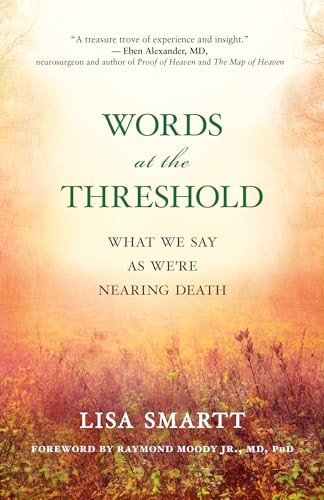
Words at the Threshold
What We Say As We're Nearing Death
By Lisa SmarttNew World Library
Copyright © 2017 Lisa Smartt
All rights reserved.
ISBN: 978-1-60868-460-1All rights reserved.
Contents
FOREWORD BY RAYMOND MOODY JR., MD, PHD,
INTRODUCTION Words at the Threshold What Our Final Conversations Tell Us,
CHAPTER ONE Transcribing the Mystery Following the Sacred Path of Final Words,
CHAPTER TWO No Words for It Language Changes as We Approach the Threshold,
CHAPTER THREE Metaphors of the Momentous Before We Die, We Announce a Big Event,
CHAPTER FOUR I Leave You with These Words Travel Metaphors Speak of a Coming Voyage,
CHAPTER FIVE Repetition, Repetition, Repetition Intensified Language in Our Last Days,
CHAPTER SIX Nonsense or a New Sense? Making Meaning out of Unintelligible Language at the End of Life,
CHAPTER SEVEN Words between the Worlds Descriptions of Visions and Visitations before Dying,
CHAPTER EIGHT Lullabies and Good-Byes Is Our First and Final Language Unspoken?,
CHAPTER NINE I'll Call You When I Get There After-Death Communication,
CONCLUSION Hearing Is Healing A Few Final Words,
Acknowledgments,
Notes,
Index,
About the Author,
CHAPTER 1
Transcribing the Mystery
Following the Sacred Path of Final Words
There is so much so in sorrow.
— My father's final words
Imagine you have reached the end of your life. Your beloveds stand at your bedside. You look into their eyes and prepare to speak. It is a moment to heal wounds, express love unsaid, and share your view from the threshold. It is a sacred time, when all of life is concentrated into those final breath-filled syllables.
What do you see?
What do you feel?
What are your final words?
Very little has been written about final words other than what is found in anthologies and websites that quote the clever exit lines of the famous. They include accounts of conversations like that of comedian Bob Hope with his wife, who, alarmed by her husband's rapid decline, told him: "Bob, we never made arrangements for your burial. Where do you want to be buried, honey? We have to figure this out. Where do you want to be buried?"
His response, typical of his dry wit: "Surprise me!"
As is often the case with last words, Hope's were true to character.
The awe-filled exclamation of Apple's Steve Jobs — "Oh, wow! Oh, wow! Oh, wow!" — is an example of the intensified language we hear at the threshold and is true to the personality of the inspired innovator. Another well-known pioneer, Thomas Edison, emerged from a coma as he was dying, opened his eyes, looked upward, and said, "It is very beautiful over there." As you will see, his words were representative of those of others who have stared out from the threshold. Many other final words have been chronicled, from Karl Marx's "Go on, get out! Last words are for fools who haven't said enough!" to Emily Dickinson's "I must go in, for the fog is rising."
Chaz Ebert, wife of celebrity critic Roger Ebert, shared a detailed account of her husband's last words, in Esquire in 2013:
That week before Roger passed away, I would see him and he would talk about having visited this other place. I thought he was hallucinating. I thought they were giving him too much medication. But the day before he passed away, he wrote me a note: "This is all an elaborate hoax." I asked him, "What's a hoax?" And he was talking about this world, this place. He said it was all an illusion. I thought he was just confused. But he was not confused. He wasn't visiting heaven, not the way we think of heaven. He described it as a vastness that you can't even imagine. It was a place where the past, present, and future were happening all at once.
These remarkable words were read with fascination by people throughout the country — and have the authentic complexity of the words I have heard at the bedsides of those I have researched. However, the authenticity of less contemporaneous reports of the last words of famous figures is at times questionable. Ray Robinson, who compiled Famous Last Words, Fond Farewells,Deathbed Diatribes, and Exclamations upon Expiration, notes in the introduction to his book: "I've come to appreciate the difficulty of authenticating so-called exit lines, since witnesses are often too distraught or confused to remember things accurately, or simply choose to edit or improve the remarks for the sake of posterity."
However, for the rest of us who are not celebrities, our last words go unedited and unrecorded in time. And yet all of us are given a platform before dying. Every day, compelling last words are spoken — and they are rarely as simple or clever as what we might find between the covers of books and magazines. Many final words are less literal, less intelligible, and more enigmatic — and their complexity makes them even more remarkable.
Sanctified Language at the End of Life
Our final words deeply reflect who we are and what most matters to us. It is as if the lens of our Creator is magnified and all that we are is in close view. As I discuss in later chapters, even those who have been in a coma and those who have not communicated in years may speak just before they die, to advise, forgive, love, or even to leave friends and family with mysterious phrases, such as "It's not that," "The pronoun is all wrong," "I left the money in the third drawer down," or a simple "Thank you. I love you."
Buddhists believe that reflecting upon what might be our last words can deepen our acceptance of life's impermanence and remind us to savor the present moment. In Buddhist and Hindu belief systems it has been a tradition for the dying to offer parting words of wisdom. Some Buddhist monks have even composed poems in their final moments. Those who are dying are often perceived as having access to truths and revelations not available to those who are living. In anthologies of days gone by, deathbed conversions were documented, and final words acted as testaments to an almighty God and the existence of angels. End-of-life confessionsoffered people a chance to repent sins and beg forgiveness. Final words are still considered a golden seal upon our lives, like a stamp that sums up all our deeds and days and lets those around us know what we believe in and what really matters.
Those who are on their deathbeds seem to have a kind of privileged connection to God, or Source, or all of creation. Some might ask, "Why do we assume final words to be somehow closer to God's truth?" And that is a good question. A large amount of literature answers this in spiritual terms: when we approach death, we are returning to Source, and our thoughts and words are therefore elevated because of this shift in dimension. The findings of the Final Words Project suggest that this may, indeed, be true.
Among those I interviewed for the book is the Reverend Cari Rush Willis, a chaplain who works on death row and in a hospice. She shared her perspective about the enigmatic words we hear from the dying: "People at the end of their lives have one foot in heaven and one foot on earth." She shared an example of a care-home director who asked for her help because one of the Alzheimer's patients kept requesting assistance in finding his passport. Willis explained to the director that the patient did not have a physical problem that needed to be solved but a spiritual one that needed to be heard. She repeated to me her conversation with the...
„Über diesen Titel“ kann sich auf eine andere Ausgabe dieses Titels beziehen.
Suchergebnisse für Words at the Threshold: What We Say as We're Nearing...

Beispielbild für diese ISBN
Words at the Threshold: What We Say as We're Nearing Death
Anbieter: World of Books (was SecondSale), Montgomery, IL, USA
Verkäuferbewertung 5 von 5 Sternen

Zustand: Very Good. Item in very good condition! Textbooks may not include supplemental items i.e. CDs, access codes etc. Artikel-Nr. 00102959022
Gebraucht kaufen
EUR 5,30
Versand gratis
Versand innerhalb von USA
Versand innerhalb von USA
Anzahl: 1 verfügbar
Beispielbild für diese ISBN
Words at the Threshold: What We Say as We're Nearing Death
Anbieter: World of Books (was SecondSale), Montgomery, IL, USA
Verkäuferbewertung 5 von 5 Sternen
Zustand: Good. Good condition ex-library book with usual library markings and stickers. Artikel-Nr. 00102876803
Gebraucht kaufen
EUR 5,30
Versand gratis
Versand innerhalb von USA
Versand innerhalb von USA
Anzahl: 1 verfügbar
Beispielbild für diese ISBN
Words at the Threshold: What We Say as We're Nearing Death
Anbieter: ThriftBooks-Dallas, Dallas, TX, USA
Verkäuferbewertung 5 von 5 Sternen
Paperback. Zustand: Good. No Jacket. Pages can have notes/highlighting. Spine may show signs of wear. ~ ThriftBooks: Read More, Spend Less. Artikel-Nr. G1608684601I3N00
Gebraucht kaufen
EUR 5,65
Versand gratis
Versand innerhalb von USA
Versand innerhalb von USA
Anzahl: 1 verfügbar
Beispielbild für diese ISBN
Words at the Threshold: What We Say as We're Nearing Death
Anbieter: ThriftBooks-Reno, Reno, NV, USA
Verkäuferbewertung 5 von 5 Sternen
Paperback. Zustand: Very Good. No Jacket. May have limited writing in cover pages. Pages are unmarked. ~ ThriftBooks: Read More, Spend Less. Artikel-Nr. G1608684601I4N00
Gebraucht kaufen
EUR 5,65
Versand gratis
Versand innerhalb von USA
Versand innerhalb von USA
Anzahl: 1 verfügbar
Beispielbild für diese ISBN
Words at the Threshold: What We Say as We're Nearing Death
Anbieter: ThriftBooks-Dallas, Dallas, TX, USA
Verkäuferbewertung 5 von 5 Sternen
Paperback. Zustand: Very Good. No Jacket. May have limited writing in cover pages. Pages are unmarked. ~ ThriftBooks: Read More, Spend Less. Artikel-Nr. G1608684601I4N00
Gebraucht kaufen
EUR 5,65
Versand gratis
Versand innerhalb von USA
Versand innerhalb von USA
Anzahl: 2 verfügbar
Beispielbild für diese ISBN
Words at the Threshold: What We Say as We're Nearing Death
Anbieter: ThriftBooks-Phoenix, Phoenix, AZ, USA
Verkäuferbewertung 5 von 5 Sternen
Paperback. Zustand: Very Good. No Jacket. May have limited writing in cover pages. Pages are unmarked. ~ ThriftBooks: Read More, Spend Less. Artikel-Nr. G1608684601I4N00
Gebraucht kaufen
EUR 5,65
Versand gratis
Versand innerhalb von USA
Versand innerhalb von USA
Anzahl: 1 verfügbar
Beispielbild für diese ISBN
Words at the Threshold: What We Say as We're Nearing Death
Anbieter: ThriftBooks-Atlanta, AUSTELL, GA, USA
Verkäuferbewertung 5 von 5 Sternen
Paperback. Zustand: Very Good. No Jacket. May have limited writing in cover pages. Pages are unmarked. ~ ThriftBooks: Read More, Spend Less. Artikel-Nr. G1608684601I4N00
Gebraucht kaufen
EUR 5,65
Versand gratis
Versand innerhalb von USA
Versand innerhalb von USA
Anzahl: 2 verfügbar
Beispielbild für diese ISBN
Words at the Threshold: What We Say as We're Nearing Death
Anbieter: ThriftBooks-Reno, Reno, NV, USA
Verkäuferbewertung 5 von 5 Sternen
Paperback. Zustand: Good. No Jacket. Pages can have notes/highlighting. Spine may show signs of wear. ~ ThriftBooks: Read More, Spend Less. Artikel-Nr. G1608684601I3N00
Gebraucht kaufen
EUR 5,65
Versand gratis
Versand innerhalb von USA
Versand innerhalb von USA
Anzahl: 1 verfügbar
Beispielbild für diese ISBN
Words at the Threshold: What We Say as We're Nearing Death
Anbieter: ThriftBooks-Atlanta, AUSTELL, GA, USA
Verkäuferbewertung 5 von 5 Sternen
Paperback. Zustand: Good. No Jacket. Pages can have notes/highlighting. Spine may show signs of wear. ~ ThriftBooks: Read More, Spend Less. Artikel-Nr. G1608684601I3N00
Gebraucht kaufen
EUR 5,65
Versand gratis
Versand innerhalb von USA
Versand innerhalb von USA
Anzahl: 1 verfügbar
Beispielbild für diese ISBN
Words at the Threshold : What We Say As We're Nearing Death
Anbieter: Better World Books, Mishawaka, IN, USA
Verkäuferbewertung 5 von 5 Sternen
Zustand: Good. Pages intact with minimal writing/highlighting. The binding may be loose and creased. Dust jackets/supplements are not included. Stock photo provided. Product includes identifying sticker. Better World Books: Buy Books. Do Good. Artikel-Nr. 16561597-6
Gebraucht kaufen
EUR 6,49
Versand gratis
Versand innerhalb von USA
Versand innerhalb von USA
Anzahl: 1 verfügbar