
Verwandte Artikel zu Bouncing Back: Rewiring Your Brain for Maximum Resilience...
Inhaltsangabe
Winner of the 2013 Books for a Better Life Acorda Wellness Award and the 2014 Silver Nautilus Book Award
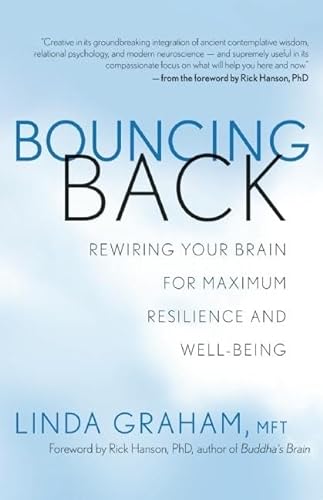
Resilience is the ability to face and handle life’s challenges, whether everyday disappointments or extraordinary disasters. While resilience is innate in the brain, over time we learn unhelpful patterns, which then become fixed in our neural circuitry. But science is now revealing that what previously seemed hardwired can be rewired, and Bouncing Back shows us how. With powerful, time-tested exercises, Linda Graham guides us in rebuilding our core well-being and disaster-proofing our brains.
Die Inhaltsangabe kann sich auf eine andere Ausgabe dieses Titels beziehen.
Über die Autorin bzw. den Autor
Linda Graham, MFT, is a marriage and family therapist, mindfulness teacher, and expert on the neuroscience of human relationships who trains other clinicians in applying neuroscience in their work.
Auszug. © Genehmigter Nachdruck. Alle Rechte vorbehalten.
Bouncing Back
Rewiring Your Brain for Maximum Resilience and Well-Being
By Linda GrahamNew World Library
Copyright © 2013 Linda Graham
All rights reserved.
ISBN: 978-1-60868-129-7All rights reserved.
Contents
List of Exercises,
Foreword by Rick Hanson, PhD,
INTRODUCTION What Resilience Is and How We Rewire Our Brains to Recover It,
PART ONE How the Brain Develops Resilience — or Doesn't,
CHAPTER ONE How the Brain's Strategies of Resilience Become Wired In,
CHAPTER TWO How the Wiring In of Resilience Can Go Awry,
PART TWO Harnessing the Brain's Neuroplasticity to Recover Your Resilience,
CHAPTER THREE Using Mindfulness to Foster Self-Awareness and Flexible Responses,
CHAPTER FOUR Using Empathy to Create Connections and Self-Acceptance,
CHAPTER FIVE Five Additional Practices That Accelerate Brain Change,
CHAPTER SIX Self-Directed Neuroplasticity,
PART THREE Recovering Resilience through Resonant Relationships,
CHAPTER SEVEN How Bonding and Belonging Nourish Resilience,
CHAPTER EIGHT Creating Inner Security and Confidence,
CHAPTER NINE Developing Relational Intelligence,
PART FOUR Keep Calm and Carry On: Recovering Resilience through Resources of the Body,
CHAPTER TEN Losing and Recovering Our Equilibrium,
CHAPTER ELEVEN Recovering Our Balance through the Body,
CHAPTER TWELVE Developing Somatic Intelligence,
PART FIVE Recovering Resilience through Emotional Well-Being,
CHAPTER THIRTEEN How Neuroscience Is Revolutionizing Our Thinking about Feelings,
CHAPTER FOURTEEN How Positive Emotions Build Resilience,
CHAPTER FIFTEEN Developing Emotional Intelligence,
PART SIX Shift Happens: Recovering Resilience through Reflection and Response Flexibility,
CHAPTER SIXTEEN Using Reflection to Identify Options,
CHAPTER SEVENTEEN Shifting Gears: Modifying Our Patterns of Response,
CHAPTER EIGHTEEN Discerning Wise Choices and Responding Flexibly,
PART SEVEN Recovering Resilience through Simply Being,
CHAPTER NINETEEN Resting in the Wisdom of Being,
PART EIGHT Launching into a More Resilient Life,
CHAPTER TWENTY Moving Resilience beyond the Personal Self,
Acknowledgments,
Endnotes,
Index,
About the Author,
CHAPTER 1
How the Brain's Strategies of Resilience Become Wired In
What lies behind us and what lies before us are tiny matters compared to what lies within us.
— Ralph Waldo Emerson
My next-door neighbor has a big, affectionate, 125-pound malamute named Barney and an eight-year-old granddaughter who adores him. One day, as Samantha was arriving to visit, I watched her run up to Barney to give him a hug. Barney responded exuberantly, licking her face profusely. He was simply greeting her with affection, but Samantha clearly wasn't prepared for such rough-and-tumble love: she burst into tears.
As I witnessed Samantha's distress, I immediately felt a sympathetic response in my own body, as you may have felt in yours — a rush of "Oh, no!" I went to comfort Samantha with a hug and a quick wipe of her face with my sweatshirt. Then I held a bewildered Barney at bay while Samantha's mom came outside for a more thorough wash-down with a wet washcloth and clean towel.
With her mom's soothing words of "There, there," Samantha quickly calmed down, wiped a tear from her cheek, then took her mom's hand and walked over to Barney to start again. Her mom showed her how to hold her hand out and let Barney lick that first. After that, they both patted the top of Barney's head, then Samantha slowly moved toward Barney and gave him a hug. His tail wagged exuberantly, but there was no more face washing.
As you may have noticed, Samantha learned several resilient coping strategies from her mom in this encounter with Barney. She learned that receiving support from others could help her calm down, and she learned how to approach the big dog in a confident, competent way that didn't overexcite him. Her brain immediately encoded those lessons in her neural circuits for future reference.
Resilience, like all innate capacities in the brain, develops as the brain processes or learns from experience and translates or encodes that learning into its neural circuitry. Because resilience is all about surviving and thriving, our brains begin to learn and encode lessons about coping strategies that keep us alive and safe from the very beginning of brain development. Some responses to "safe" and "dangerous" even begin in utero.
In this chapter we will examine how learning from experience is translated or encoded in our brains through the interaction of two powerful mechanisms of brain functioning. The first is conditioning: broadly speaking, how the brain learns and stabilizes our conditioned patterns of response through repeated experience. The second is neuroplasticity: how the brain remains flexible in order to change that encoding, learning or unlearning patterns of response, growing new neurons, and connecting them in new circuits. Conditioning and neuroplasticity work together as the brain develops and matures. Much of this work occurs in the prefrontal cortex of the brain. I call this structure of executive functioning in the brain the CEO of resilience because it guides the encoding process and integrates the work of other brain structures that use both conditioning and neuroplasticity to help us learn from our experiences in the first place and rewire that learning later if need be.
When our conditioning goes well, especially early in our lives, we build a solid neural foundation for resilience in the brain. The "rules" encoded in our neural circuitry allow us to respond skillfully and adaptively to the outer hiccups and hurricanes of our lives that trigger agitation or distress within. The brain structures that perform the encoding are stable, yet flexible enough to learn new coping strategies. They buffer us against the effects of external stressors and traumas later in life. And that's true for many of us, much of the time.
However, our conditioning — the wiring of our neural circuitry as we learn from experience — sometimes goes awry. When this happens, we can find ourselves stuck in negative, dysfunctional response patterns that leave us feeling ineffective and miserable and more vulnerable to stressors and traumas. We may refrain from pushing back to assert our needs, watching someone else get the promotion we worked hard for. We may avoid opening the envelope from an insurance company or doctor, afraid of bad news, only to discover a month later that the enclosed letter was no big deal. When encoded early enough in our development, these patterns can even derail the maturation of the brain itself. Chapter 2 explores how and why such glitches in our learning may arise.
With an understanding of how our brains develop, we can forgive ourselves for finding it hard to rewire those early coping strategies if they failed to become fully established, leaving us floundering in a "neural swamp," or if they became rigid, leaving us stuck in "neural cement." When we know how to choose specific experiences to deliberately rewire our brains for better coping, we can fully recover our capacities for resilience and even strengthen the brain structures themselves that encode the new strategies. Neuroscientists have proved irrefutably that you can teach an old dog new tricks; you can even heal the dog — or the brain — when necessary....
„Über diesen Titel“ kann sich auf eine andere Ausgabe dieses Titels beziehen.
Suchergebnisse für Bouncing Back: Rewiring Your Brain for Maximum Resilience...

Beispielbild für diese ISBN
Bouncing Back: Rewiring Your Brain for Maximum Resilience and Well-Being
Anbieter: World of Books (was SecondSale), Montgomery, IL, USA
Verkäuferbewertung 5 von 5 Sternen

Paperback. Zustand: Very Good. Winner of the 2013 Books for a Better Life Acorda Wellness Award and the 2014 Silver Nautilus Book Award Resilience is the ability to face and handle life's challenges, whether everyday disappointments or extraordinary disasters. While resilience is innate in the brain, over time we learn unhelpful patterns, which then become fixed in our neural circuitry. But science is now revealing that what previously seemed hardwired can be rewired, and Bouncing Back shows us how. With powerful, time-tested exercises, Linda Graham guides us in rebuilding our core well-being and disaster-proofing our brains. Artikel-Nr. 00107591664
Gebraucht kaufen
EUR 3,82
Versand gratis
Versand innerhalb von USA
Versand innerhalb von USA
Anzahl: 1 verfügbar
Beispielbild für diese ISBN
Bouncing Back: Rewiring Your Brain for Maximum Resilience and Well-Being
Anbieter: World of Books (was SecondSale), Montgomery, IL, USA
Verkäuferbewertung 5 von 5 Sternen
Zustand: Good. Item in good condition. Textbooks may not include supplemental items i.e. CDs, access codes etc. Artikel-Nr. 00097879432
Gebraucht kaufen
EUR 3,82
Versand gratis
Versand innerhalb von USA
Versand innerhalb von USA
Anzahl: 10 verfügbar
Beispielbild für diese ISBN
Bouncing Back: Rewiring Your Brain for Maximum Resilience and Well-Being
Verlag:
New World Library (edition 4.9.2013), 2013
ISBN 10: 1608681297
ISBN 13: 9781608681297
Gebraucht
Paperback
Anbieter: BooksRun, Philadelphia, PA, USA
Verkäuferbewertung 5 von 5 Sternen
Paperback. Zustand: Very Good. 4.9.2013. It's a well-cared-for item that has seen limited use. The item may show minor signs of wear. All the text is legible, with all pages included. It may have slight markings and/or highlighting. Artikel-Nr. 1608681297-8-1
Gebraucht kaufen
EUR 5,95
Versand gratis
Versand innerhalb von USA
Versand innerhalb von USA
Anzahl: 1 verfügbar
Beispielbild für diese ISBN
Bouncing Back : Rewiring Your Brain for Maximum Resilience and Well-Being
Anbieter: Better World Books, Mishawaka, IN, USA
Verkäuferbewertung 5 von 5 Sternen
Zustand: Good. Former library copy. Pages intact with minimal writing/highlighting. The binding may be loose and creased. Dust jackets/supplements are not included. Includes library markings. Stock photo provided. Product includes identifying sticker. Better World Books: Buy Books. Do Good. Artikel-Nr. 8448509-75
Gebraucht kaufen
EUR 6,33
Versand gratis
Versand innerhalb von USA
Versand innerhalb von USA
Anzahl: 1 verfügbar
Beispielbild für diese ISBN
Bouncing Back : Rewiring Your Brain for Maximum Resilience and Well-Being
Anbieter: Better World Books: West, Reno, NV, USA
Verkäuferbewertung 5 von 5 Sternen
Zustand: Very Good. Pages intact with possible writing/highlighting. Binding strong with minor wear. Dust jackets/supplements may not be included. Stock photo provided. Product includes identifying sticker. Better World Books: Buy Books. Do Good. Artikel-Nr. 12839645-6
Gebraucht kaufen
EUR 6,33
Versand gratis
Versand innerhalb von USA
Versand innerhalb von USA
Anzahl: 1 verfügbar
Beispielbild für diese ISBN
Bouncing Back : Rewiring Your Brain for Maximum Resilience and Well-Being
Anbieter: Better World Books, Mishawaka, IN, USA
Verkäuferbewertung 5 von 5 Sternen
Zustand: Fine. Used book that is in almost brand-new condition. May contain a remainder mark. Better World Books: Buy Books. Do Good. Artikel-Nr. 15605820-20
Gebraucht kaufen
EUR 6,33
Versand gratis
Versand innerhalb von USA
Versand innerhalb von USA
Anzahl: 1 verfügbar
Beispielbild für diese ISBN
Bouncing Back : Rewiring Your Brain for Maximum Resilience and Well-Being
Anbieter: Better World Books, Mishawaka, IN, USA
Verkäuferbewertung 5 von 5 Sternen
Zustand: Good. Pages intact with minimal writing/highlighting. The binding may be loose and creased. Dust jackets/supplements are not included. Stock photo provided. Product includes identifying sticker. Better World Books: Buy Books. Do Good. Artikel-Nr. 5415336-6
Gebraucht kaufen
EUR 6,33
Versand gratis
Versand innerhalb von USA
Versand innerhalb von USA
Anzahl: 4 verfügbar
Beispielbild für diese ISBN
Bouncing Back: Rewiring Your Brain for Maximum Resilience and Well-Being
Anbieter: Wonder Book, Frederick, MD, USA
Verkäuferbewertung 5 von 5 Sternen
Zustand: Good. Good condition. A copy that has been read but remains intact. May contain markings such as bookplates, stamps, limited notes and highlighting, or a few light stains. Artikel-Nr. H05A-04748
Gebraucht kaufen
EUR 6,40
Versand gratis
Versand innerhalb von USA
Versand innerhalb von USA
Anzahl: 2 verfügbar
Beispielbild für diese ISBN
Bouncing Back: Rewiring Your Brain for Maximum Resilience and Well-Being
Anbieter: Wonder Book, Frederick, MD, USA
Verkäuferbewertung 5 von 5 Sternen
Zustand: Very Good. Very Good condition. A copy that may have a few cosmetic defects. May also contain light spine creasing or a few markings such as an owner's name, short gifter's inscription or light stamp. Artikel-Nr. C04C-04075
Gebraucht kaufen
EUR 6,40
Versand gratis
Versand innerhalb von USA
Versand innerhalb von USA
Anzahl: 2 verfügbar
Beispielbild für diese ISBN
Bouncing Back: Rewiring Your Brain for Maximum Resilience and Well-Being
Anbieter: ThriftBooks-Reno, Reno, NV, USA
Verkäuferbewertung 5 von 5 Sternen
Paperback. Zustand: Very Good. No Jacket. May have limited writing in cover pages. Pages are unmarked. ~ ThriftBooks: Read More, Spend Less. Artikel-Nr. G1608681297I4N00
Gebraucht kaufen
EUR 6,75
Versand gratis
Versand innerhalb von USA
Versand innerhalb von USA
Anzahl: 1 verfügbar