
Verwandte Artikel zu Field Notes on Democracy: Listening to Grasshoppers
Inhaltsangabe
"Gorgeously wrought...pitch-perfect prose...In language of terrible beauty, she takes India's everyday tragedies and reminds us to be outraged all over again."—Time Magazine
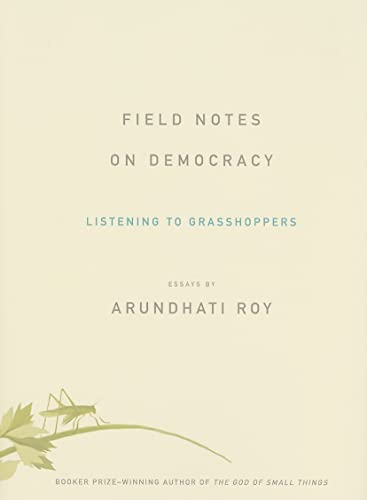
Combining fierce conviction, deft political analysis, and beautiful writing, this is the essential new book from Arundhati Roy.
This series of essays examines the dark side of democracy in contemporary India. It looks closely at how religious majoritarianism, cultural nationalism, and neo-fascism simmer just under the surface of a country that projects itself as the world's largest democracy.
Roy writes about how the combination of Hindu Nationalism and India's neo-liberal economic reforms, which began their journey together in the early 1990s, are now turning India into a police state.
She describes the systematic marginalization of religious and ethnic minorities, the rise of terrorism, and the massive scale of displacement and dispossession of the poor by predatory corporations. She also offers a brilliant account of the August 2008 uprising of the people of Kashmir against India's military occupation and an analysis of the November 2008 attacks on Mumbai.
Field Notes on Democracy tracks the fault-lines that threaten to destroy India's precarious democracy and send shockwaves through the region and beyond.
Praise for Field Notes on Democracy:
"In her searing account of the actual practice of the world's largest democracy, Arundhati Roy calls for 'factual precision' alongside of the 'real precision of poetry.' Remarkably, she combines those achievements to a degree that few can hope to approach. Roy shows in painful detail how the beneficiaries of the highly admired 10 percent growth rate are enjoying a 'new secessionism,' leaving the great majority languishing in poverty and despair, with malnutrition reaching the same levels as sub-Saharan Africa. As surveillance and state terror extend, all under the guise of flourishing democracy, India is becoming 'a nation waiting to be accused,' a nation where a confession extracted under torture can lead to the brink of nuclear war, and where 'fascism's firm footprint has appeared' in ways reminiscent of the early years of Nazism. Most chilling of all is that much of the grim portrait is all too familiar in the West. Roy asks whether our shriveled forms of democracy will be 'the endgame of the human race'—and shows vividly why this is a prospect not to be lightly dismissed." —Noam Chomsky
"After so much celebratory salesmanship about India the 'emerging market,' Roy draws us into India the actual country, peeling away the gloss until we are confronted with perhaps the most challenging question of our time: who and what are we willing to sacrifice in the name of development? Roy is one of the most confident and original thinkers of our time."
—Naomi Klein
"The notion of Democracy and the pleading for human compassion first came together in Sophocles and the Greek tragedies. More than two thousand years later we live under an economic world tyranny of unprecedented brutality, which depends upon the systematic abuse of words like Democracy or Progress. Arundhati Roy, the direct descendant of Antigone, resists and denounces all tyrannies, pleads for their victims, and unflinchingly questions the tragic. Reflect with her on the answers she receives from the political world today." —John Berger
Arundhati Roy is a world-renowned Indian author and global justice activist. From her celebrated Booker Prize–winning novel The God of Small Things to her prolific output of writing on topics ranging from climate change to war, the perils of free-market development in India, and the defense of the poor, Roy's voice has become indispensable to millions seeking a better world.
Die Inhaltsangabe kann sich auf eine andere Ausgabe dieses Titels beziehen.
Über die Autorin bzw. den Autor
Arundhati Roy studied architecture in New Delhi, where she now lives. She is the author of the novel The God of Small Things, for which she received the 1997 Booker Prize. The novel has been translated into forty languages worldwide. She has written several non-fiction books, including Field Notes on Democracy: Listening to Grasshoppers and Capitalism: A Ghost Story, published by Haymarket Books.
Auszug. © Genehmigter Nachdruck. Alle Rechte vorbehalten.
Field Notes on Democracy
Listening to GrasshoppersBy Arundhati RoyHaymarket Books
Copyright © 2009 Arundhati RoyAll right reserved.
ISBN: 978-1-608460-24-3
Contents
Map of India.............................................................................ixIntroduction Democracy's Failing Light...................................................1One Democracy: Who's She When She's at Home?.............................................30Two How Deep Shall We Dig?...............................................................50Three "And His Life Should Become Extinct"...............................................68Four Breaking the News...................................................................100Five Custodial Confessions, the Media, and the Law.......................................113Six Baby Bush, Go Home...................................................................118Seven Animal Farm II: In Which George Bush Says What He Really Means.....................120Eight Scandal in the Palace..............................................................128Nine Listening to Grasshoppers: Genocide, Denial, and Celebration........................141Ten Azadi................................................................................169Eleven Nine Is Not Eleven (And November Isn't September).................................184Twelve The Briefing......................................................................202Glossary.................................................................................211Sources..................................................................................216Notes....................................................................................219Index....................................................................................245
Chapter One
Democracy: Who's She When She's at Home?
Last night a friend from Vadodara called. Weeping. It took her fifteen minutes to tell me what the matter was. It wasn't very complicated. Only that a friend of hers, Sayeeda, had been caught by a mob. Only that her stomach had been ripped open and stuffed with burning rags. Only that after she died, someone carved "OM" on her forehead.
Precisely which Hindu scripture preaches this?
Prime Minister A. B. Vajpayee justified this as part of the retaliation by outraged Hindus against Muslim "terrorists" who burned alive fifty-eight Hindu passengers on the Sabarmati Express in Godhra. Each of those who died that hideous death was someone's brother, someone's mother, someone's child. Of course they were. Which particular verse in the Koran required that they be roasted alive?
The more the two sides try and call attention to their religious differences by slaughtering each other, the less there is to distinguish them from one another. They worship at the same altar. They're both apostles of the same murderous god, whoever he is. In an atmosphere so vitiated, for anybody, and in particular the prime minister, to arbitrarily decree exactly where the cycle started is malevolent and irresponsible.
Right now we're sipping from a poisoned chalice-a flawed democracy laced with religious fascism. Pure arsenic.
What shall we do? What can we do?
We have a ruling party that's hemorrhaging. Its rhetoric against terrorism, the passing of the Prevention of Terrorism Act (POTA), the saber-rattling against Pakistan (with the underlying nuclear threat), the massing of almost a million soldiers on the India-Pakistan border on hair-trigger alert and, most dangerous of all, the attempt to communalize and falsify school history textbooks-none of this has prevented it from being humiliated in election after election. Even its old party trick-the revival of the plans to replace the destroyed mosque in Ayodhya with the Ram Mandir-didn't quite work out. Desperate, it has now turned for succor to the state of Gujarat.
Gujarat, the only major state in India to have a Bharatiya Janata Party (BJP) government, has for some years been the petri dish in which Hindu fascism has been fomenting an elaborate political experiment. In March 2002, the initial results were put on public display.
Within hours of the Godhra outrage, a meticulously planned pogrom was unleashed against the Muslim community. It was led from the front by the Hindu nationalist Vishwa Hindu Parishad (VHP) and the Bajrang Dal. Officially the number of dead is eight hundred. Independent reports put the figure as high as two thousand.
More than one hundred and fifty thousand people, driven from their homes, now live in refugee camps. Women were stripped, gang-raped; parents were bludgeoned to death in front of their children. Two hundred and forty shrines and one hundred and eighty mosques were destroyed. In Ahmedabad, the tomb of Wali Gujarati, the founder of the modern Urdu poem, was demolished and paved over in the course of a night. The tomb of the musician Ustad Faiyaz Ali Khan was desecrated and wreathed in burning tires. Arsonists burned and looted shops, homes, hotels, textiles mills, buses, and private cars belonging to Muslims. Tens of thousands of Muslims have lost their jobs.
A mob surrounded the house of former Congress MP Ehsan Jaffri. His phone calls to the director general of police, the police commissioner, the chief secretary, the additional chief secretary (home) were ignored. The mobile police vans around his house did not intervene. The mob dragged Ehsan Jaffri out of his house, and dismembered him.
Of course, it's only a coincidence that Jaffri was a trenchant critic of Gujarat's chief minister, Narendra Modi, during his campaign for the Rajkot Assembly by-election in February.
Across Gujarat, thousands of people made up the mobs. They were armed with petrol bombs, guns, knives, swords, and tridents. Apart from the VHP and Bajrang Dal's usual lumpen constituency, there were Dalits and Adivasis who were brought in buses and trucks. Middle-class people participated in the looting. (On one memorable occasion a family arrived in a Mitsubishi Lancer.) There was a deliberate, systematic attempt to destroy the economic base of the Muslim community. The leaders of the mob had computer-generated cadastral lists marking out Muslim homes, shops, businesses, and even partnerships. They had mobile phones to coordinate the action. They had trucks loaded with thousands of gas cylinders, hoarded weeks in advance, which they used to blow up Muslim commercial establishments. They had not just police protection and police connivance, but also covering fire.
While Gujarat burned, our prime minister was on MTV promoting his new poems. (Reports say cassettes have sold a hundred thousand copies.) It took him more than a month-and two vacations in the hills-to make it to Gujarat. When he did, shadowed by the chilling Modi, he gave a speech at the Shah Alam refugee camp. His mouth moved, he tried to express concern, but no real sound emerged except the mocking of the wind whistling through a burned, bloodied, broken world. Next we knew, he was bobbing around in a golf cart, striking business deals in Singapore.
The killers still stalk Gujarat's streets. For weeks the lynch mob was the arbiter of the routine affairs of daily life: who can live where, who can say what, who can meet whom, and where and when. Its mandate expanded from religious affairs and property disputes to family altercations and the planning and allocation of water resources (which is why Medha Patkar of the Narmada Bachao Andolan was...
„Über diesen Titel“ kann sich auf eine andere Ausgabe dieses Titels beziehen.
Suchergebnisse für Field Notes on Democracy: Listening to Grasshoppers

Beispielbild für diese ISBN
Field Notes on Democracy: List
Anbieter: World of Books (was SecondSale), Montgomery, IL, USA
Verkäuferbewertung 5 von 5 Sternen

Zustand: Very Good. Item in very good condition! Textbooks may not include supplemental items i.e. CDs, access codes etc. Artikel-Nr. 00105853362
Gebraucht kaufen
EUR 4,50
Versand gratis
Versand innerhalb von USA
Versand innerhalb von USA
Anzahl: 1 verfügbar
Beispielbild für diese ISBN
Field Notes on Democracy: Listening to Grasshoppers
Anbieter: Wonder Book, Frederick, MD, USA
Verkäuferbewertung 5 von 5 Sternen
Zustand: Very Good. Very Good condition. Very Good dust jacket. A copy that may have a few cosmetic defects. May also contain light spine creasing or a few markings such as an owner's name, short gifter's inscription or light stamp. Artikel-Nr. M04E-01621
Gebraucht kaufen
EUR 6,40
Versand gratis
Versand innerhalb von USA
Versand innerhalb von USA
Anzahl: 1 verfügbar
Beispielbild für diese ISBN
Field Notes on Democracy : Listening to Grasshoppers
Anbieter: Better World Books, Mishawaka, IN, USA
Verkäuferbewertung 5 von 5 Sternen
Zustand: Good. Former library copy. Pages intact with minimal writing/highlighting. The binding may be loose and creased. Dust jackets/supplements are not included. Includes library markings. Stock photo provided. Product includes identifying sticker. Better World Books: Buy Books. Do Good. Artikel-Nr. 5414783-75
Gebraucht kaufen
EUR 7,18
Versand gratis
Versand innerhalb von USA
Versand innerhalb von USA
Anzahl: 1 verfügbar
Beispielbild für diese ISBN
Field Notes on Democracy: Listening to Grasshoppers
Anbieter: Roundabout Books, Greenfield, MA, USA
Verkäuferbewertung 4 von 5 Sternen

hardcover. Zustand: Very Good. Condition Notes: Clean, unmarked copy with some edge wear. Good binding. Dust jacket included if issued with one. We ship in recyclable American-made mailers. 100% money-back guarantee on all orders. Artikel-Nr. 1780959
Gebraucht kaufen
EUR 9,57
Versand gratis
Versand innerhalb von USA
Versand innerhalb von USA
Anzahl: 1 verfügbar
Beispielbild für diese ISBN
Field Notes on Democracy: Listening to Grasshoppers
Verlag:
HAYMARKET BOOKS 09.2009., 2009
ISBN 10: 160846024X
ISBN 13: 9781608460243
Gebraucht
Hardcover
Anbieter: Bücherbazaar, Eggenstein, Deutschland
Verkäuferbewertung 5 von 5 Sternen
hardcover. Zustand: Sehr gut. Auflage: Illustriert. 253 Seiten Mit altersbedingten Lager- und Gebrauchsspuren. E-K58 Sprache: Englisch Gewicht in Gramm: 450. Artikel-Nr. 145468
Gebraucht kaufen
EUR 15,90
EUR 45,00 Versand
Versand von Deutschland nach USA
Versand von Deutschland nach USA
Anzahl: 1 verfügbar