
Verwandte Artikel zu The Attacking Ocean: The Past, Present, and Future...
Inhaltsangabe
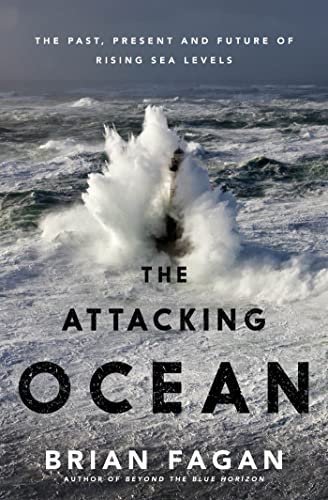
The past fifteen thousand years--the entire span of human civilization--have witnessed dramatic sea level changes, which began with rapid global warming at the end of the Ice Age, when sea levels were more than 700 feet below modern levels. Over the next eleven millennia, the oceans climbed in fits and starts. These rapid changes had little effect on those humans who experienced them, partly because there were so few people on earth, and also because they were able to adjust readily to new coastlines.
Global sea levels stabilized about six thousand years ago except for local adjustments that caused often quite significant changes to places like the Nile Delta. So the curve of inexorably rising seas flattened out as urban civilizations developed in Egypt, Mesopotamia, and South Asia. The earth's population boomed, quintupling from the time of Christ to the Industrial Revolution. The threat from the oceans increased with our crowding along shores to live, fish, and trade.
Since 1860, the world has warmed significantly and the ocean's climb has speeded. The sea level changes are cumulative and gradual; no one knows when they will end. The Attacking Ocean, from celebrated author Brian Fagan, tells a tale of the rising complexity of the relationship between humans and the sea at their doorsteps, a complexity created not by the oceans, which have changed but little. What has changed is us, and the number of us on earth.
Die Inhaltsangabe kann sich auf eine andere Ausgabe dieses Titels beziehen.
Über die Autorin bzw. den Autor
Brian Fagan is emeritus professor of anthropology at the University of California, Santa Barbara. He is the author of Beyond the Blue Horizon, Elixir, the Los Angeles Times bestseller Cro-Magnon, and the New York Times bestseller The Great Warming, and many other books, including Fish on Friday, The Long Summer, and The Little Ice Age. He has decades of experience at sea and is the author of several titles for sailors, including the widely praised Cruising Guide to Central and Southern California. He lives in Santa Barbara, CA.
Auszug. © Genehmigter Nachdruck. Alle Rechte vorbehalten.
The Attacking Ocean
The Past, Present, and Future of Rising Sea Levels
By Brian FaganBLOOMSBURY PRESS
Copyright ©2013 Brian Fagan
All rights reserved.
ISBN: 978-1-60819-692-0All rights reserved.
Contents
| Preface.................................................................... | xiii |
| Author's Note.............................................................. | xxi |
| 1. Minus One Hundred Twenty-Two Meters and Climbing........................ | 1 |
| MILLENNIA OF DRAMATIC CHANGE............................................... | |
| 2. Doggerland.............................................................. | 23 |
| 3. Euxine and Ta-Mehu...................................................... | 38 |
| 4. "Marduk Laid a Reed on the Face of the Waters".......................... | 53 |
| CATASTROPHIC FORCES........................................................ | |
| 5. "Men Were Swept Away by Waves".......................................... | 71 |
| 6. "The Whole Shoreline Filled"............................................ | 87 |
| 7. "The Abyss of the Depths Was Uncovered"................................. | 100 |
| 8. "The Whole Is Now One Festering Mess"................................... | 113 |
| 9. The Golden Waterway..................................................... | 127 |
| 10. "Wave in the Harbor"................................................... | 144 |
| CHALLENGING INUNDATIONS.................................................... | |
| 11. A Right to Subsistence................................................. | 163 |
| 12. The Dilemma of Islands................................................. | 175 |
| 13. "The Crookedest River in the World".................................... | 192 |
| 14. "Here the Tide Is Ruled, by the Wind, the Moon and Us"................. | 209 |
| Epilogue................................................................... | 225 |
| Acknowledgments............................................................ | 239 |
| Notes...................................................................... | 241 |
| Index...................................................................... | 257 |
Excerpt
CHAPTER 1
Minus One HundredTwenty-Two Metersand Climbing
On October 28, 2012, Hurricane Sandy, the largest Atlantic hurricaneon record, came ashore in New Jersey. Sandy's assault and sea surgebrought the ocean into neighborhoods and houses, inundated parkinglots and tunnels, turned parks into lakes. When it was all over and thewater receded, a huge swath of the Northeast American coast lookedlike a battered moonscape. Only Hurricane Katrina, which devastatedNew Orleans in 2005, was more costly. Katrina, with its gigantic seasurge, had been a wake-up call for people living on low-lying coasts, butthe disaster soon receded from the public consciousness. Sandy struck inthe heart of the densely populated Northeastern Corridor of the UnitedStates seven years later and impacted the lives of millions of people.The storm was an epochal demonstration of the power of an attackingocean to destroy and kill in a world where tens of millions of people liveon coastlines close to sea level. This time, people really sat up and tooknotice in the face of an extreme weather event of a type likely to be morecommonplace in a warmer future. As this book goes to press, a seriousdebate about rising sea levels and the hazards they pose for humanitymay have finally begun—but perhaps not.
Sandy developed out of a tropical depression south of Kingston, Jamaica,on October 22. Two days later, it passed over Jamaica, then overCuba and Haiti, killing seventy-one people, before traversing the Bahamas.Come October 28, Sandy strengthened again, eventually makinglandfall about 8 kilometers southwest of Atlantic City, New Jersey,with winds of 150 kilometers an hour. By then, Sandy was not only anunusually large hurricane but also a hybrid storm. A strong Arctic airpattern to the north forced Sandy to take a sharp left into the heavypopulated Northeast when normally it would have veered into the openAtlantic and dissipated there. The blend produced a super storm with awind diameter of 1,850 kilometers, said to be the largest since 1888,when far fewer people lived along the coast and in New York. Unfortunately,the tempest also arrived at a full moon with its astronomical hightides. Sandy was only a Category 1 hurricane, but it triggered a majornatural disaster partly because it descended on a densely populatedseaboard where thousands of houses and other property lie within afew meters of sea level. Imagine the destruction a Category 5 stormwould have wrought—something that could happen in the future.
The scale of destruction was mind-boggling. Sandy brought torrentialdownpours, heavy snowfall, and exceptionally high winds to anarea of the eastern United States larger than Europe. Over one hundredpeople died in the affected states, forty of them in New York City. Thestorm cut off electricity for days for over 4.8 million customers in 15states and the District of Columbia, 1,514,147 of them in New Yorkalone. Most destructive of all, a powerful, record-breaking 4.26-metersea surge swept into New York Harbor on the evening of October 29.The rising waters inundated streets, tunnels, and subways in Lower Manhattan,Staten Island, and elsewhere. Fires caused by electrical explosionsand downed power wires destroyed homes and businesses, over onehundred residences in the Breezy Point area of Queens alone. Even theGround Zero construction site was flooded. Fortunately, the authoritieshad advance warning. In advance of the storm, all public transit systemswere shut down, ferry ser vices were suspended, and airports closed untilit was safe to fly. All major bridges and tunnels into the city were closed.The New York Stock Exchange shut down for two days. Initial recoverywas slow, with shortages of gasoline causing long lines. Rapid transitsystems slowly restored ser vice, but the damage caused by the stormsurge in lower Manhattan delayed reopening of critical links for days.
The New Jersey Shore, an iconic vacation area in the Northeast, sufferedworst of all. For almost 150 years, people from hot, crowded citieshave flocked to the Shore to lie on its beaches, families often going to thesame place for generations. They eat ice cream and pizza, play in arcadesonce used by their grandparents, drink in bars, and go to church.The Shore could be a seedy place, fraught with racial tensions, andsometimes crime and violence, but there was always something foreverybody, be they a wealthy resident of a mansion, a contestant in a MissAmerica pageant, a reality TV actor, a skinny-dipper, or a musician.Bruce Springsteen grew up along the Shore and his second album featuredthe song "4th of July, Asbury Park (Sandy)," an ode to a girl ofthat name and the Shore. "Sandy, the aurora is rising behind us; the pierlights our carnival life forever," he sang. The words have taken on newmeaning since the hurricane came.
Fortunately, the residents were warned in advance of the storm. Theywere advised to evacuate their homes as early as October 26. Two dayslater, the order became mandatory. New Jersey...
„Über diesen Titel“ kann sich auf eine andere Ausgabe dieses Titels beziehen.
Suchergebnisse für The Attacking Ocean: The Past, Present, and Future...

Beispielbild für diese ISBN
The Attacking Ocean: The Past, Present, and Future of Rising Sea Levels
Anbieter: World of Books (was SecondSale), Montgomery, IL, USA
Verkäuferbewertung 5 von 5 Sternen

Zustand: Acceptable. Item in acceptable condition! Textbooks may not include supplemental items i.e. CDs, access codes etc. Artikel-Nr. 00104714670
Gebraucht kaufen
EUR 4,58
Versand gratis
Versand innerhalb von USA
Versand innerhalb von USA
Anzahl: 1 verfügbar
Beispielbild für diese ISBN
The Attacking Ocean: The Past, Present, and Future of Rising Sea Levels
Anbieter: World of Books (was SecondSale), Montgomery, IL, USA
Verkäuferbewertung 5 von 5 Sternen
Zustand: Good. Item in good condition. Textbooks may not include supplemental items i.e. CDs, access codes etc. Artikel-Nr. 00106095916
Gebraucht kaufen
EUR 4,58
Versand gratis
Versand innerhalb von USA
Versand innerhalb von USA
Anzahl: 1 verfügbar
Beispielbild für diese ISBN
The Attacking Ocean: The Past, Present, and Future of Rising Sea Levels
Verlag:
Bloomsbury Publishing PLC, 2013
ISBN 10: 1608196925
ISBN 13: 9781608196920
Gebraucht
Hardcover
Anbieter: ThriftBooks-Dallas, Dallas, TX, USA
Verkäuferbewertung 5 von 5 Sternen
Hardcover. Zustand: Very Good. No Jacket. Former library book; May have limited writing in cover pages. Pages are unmarked. ~ ThriftBooks: Read More, Spend Less. Artikel-Nr. G1608196925I4N10
Gebraucht kaufen
EUR 6,28
Versand gratis
Versand innerhalb von USA
Versand innerhalb von USA
Anzahl: 1 verfügbar
Beispielbild für diese ISBN
The Attacking Ocean: The Past, Present, and Future of Rising Sea Levels
Anbieter: Wonder Book, Frederick, MD, USA
Verkäuferbewertung 5 von 5 Sternen
Zustand: Good. Good condition. Very Good dust jacket. A copy that has been read but remains intact. May contain markings such as bookplates, stamps, limited notes and highlighting, or a few light stains. Artikel-Nr. T06D-02289
Gebraucht kaufen
EUR 6,41
Versand gratis
Versand innerhalb von USA
Versand innerhalb von USA
Anzahl: 1 verfügbar
Beispielbild für diese ISBN
The Attacking Ocean : The Past, Present, and Future of Rising Sea Levels
Verlag:
Bloomsbury Publishing USA, 2013
ISBN 10: 1608196925
ISBN 13: 9781608196920
Gebraucht
Hardcover
Erstausgabe
Anbieter: Better World Books, Mishawaka, IN, USA
Verkäuferbewertung 5 von 5 Sternen
Zustand: Good. 1st Edition. Former library copy. Pages intact with minimal writing/highlighting. The binding may be loose and creased. Dust jackets/supplements are not included. Includes library markings. Stock photo provided. Product includes identifying sticker. Better World Books: Buy Books. Do Good. Artikel-Nr. 4154769-6
Gebraucht kaufen
EUR 6,73
Versand gratis
Versand innerhalb von USA
Versand innerhalb von USA
Anzahl: 1 verfügbar
Beispielbild für diese ISBN
The Attacking Ocean : The Past, Present, and Future of Rising Sea Levels
Verlag:
Bloomsbury Publishing USA, 2013
ISBN 10: 1608196925
ISBN 13: 9781608196920
Gebraucht
Hardcover
Erstausgabe
Anbieter: Better World Books: West, Reno, NV, USA
Verkäuferbewertung 5 von 5 Sternen
Zustand: Good. 1st Edition. Former library copy. Pages intact with minimal writing/highlighting. The binding may be loose and creased. Dust jackets/supplements are not included. Includes library markings. Stock photo provided. Product includes identifying sticker. Better World Books: Buy Books. Do Good. Artikel-Nr. 4154769-6
Gebraucht kaufen
EUR 6,73
Versand gratis
Versand innerhalb von USA
Versand innerhalb von USA
Anzahl: 1 verfügbar
Beispielbild für diese ISBN
The Attacking Ocean : The Past, Present, and Future of Rising Sea Levels
Verlag:
Bloomsbury Publishing USA, 2013
ISBN 10: 1608196925
ISBN 13: 9781608196920
Gebraucht
Hardcover
Erstausgabe
Anbieter: Better World Books, Mishawaka, IN, USA
Verkäuferbewertung 5 von 5 Sternen
Zustand: Very Good. 1st Edition. Former library copy. Pages intact with possible writing/highlighting. Binding strong with minor wear. Dust jackets/supplements may not be included. Includes library markings. Stock photo provided. Product includes identifying sticker. Better World Books: Buy Books. Do Good. Artikel-Nr. 4189361-75
Gebraucht kaufen
EUR 6,73
Versand gratis
Versand innerhalb von USA
Versand innerhalb von USA
Anzahl: 1 verfügbar
Beispielbild für diese ISBN
Attacking Ocean
Verlag:
Bloomsbury Press, 2013
ISBN 10: 1608196925
ISBN 13: 9781608196920
Gebraucht
Hardcover
Erstausgabe
Anbieter: Muse Book Shop, DeLand, FL, USA
Verkäuferbewertung 5 von 5 Sternen
Hardcover. Zustand: As New. Zustand des Schutzumschlags: As New. 1st Edition. Artikel-Nr. 90902723
Gebraucht kaufen
EUR 13,75
EUR 6,23 Versand
Versand innerhalb von USA
Versand innerhalb von USA
Anzahl: 1 verfügbar