
Verwandte Artikel zu The Finkler Question
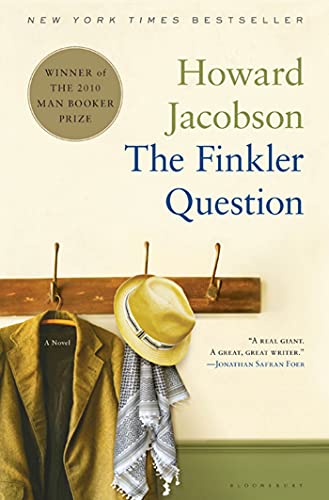
Inhaltsangabe
"He should have seen it coming. His life had been one mishap after another. So he should have been prepared for this one..."
Julian Treslove, a professionally unspectacular and disappointed BBC worker, and Sam Finkler, a popular Jewish philosopher, writer and television personality, are old school friends. Despite a prickly relationship and very different lives, they've never quite lost touch with each other - or with their former teacher, Libor Sevick, a Czechoslovakian always more concerned with the wider world than with exam results.
Now, both Libor and Finkler are recently widowed, and with Treslove, his chequered and unsuccessful record with women rendering him an honorary third widower, they dine at Libor's grand, central London apartment.
It's a sweetly painful evening of reminiscence in which all three remove themselves to a time before they had loved and lost; a time before they had fathered children, before the devastation of separations, before they had prized anything greatly enough to fear the loss of it. Better, perhaps, to go through life without knowing happiness at all because that way you had less to mourn? Treslove finds he has tears enough for the unbearable sadness of both his friends' losses.
And it's that very evening, at exactly 11:30pm, as Treslove hesitates a moment outside the window of the oldest violin dealer in the country as he walks home, that he is attacked. After this, his whole sense of who and what he is will slowly and ineluctably change.
The Finkler Question is a scorching story of exclusion and belonging, justice and love, aging, wisdom and humanity. Funny, furious, unflinching, this extraordinary novel shows one of our finest writers at his brilliant best.
Die Inhaltsangabe kann sich auf eine andere Ausgabe dieses Titels beziehen.
Über die Autorin bzw. den Autor
An award-winning writer and broadcaster, Howard Jacobson was born in Manchester, brought up in Prestwich and was educated at Stand Grammar School in Whitefield, and Downing College, Cambridge, where he studied under F. R. Leavis. He lectured for three years at the University of Sydney before returning to teach at Selwyn College, Cambridge. His novels include The Mighty Walzer (winner of the Bollinger Everyman Wodehouse Prize), Kalooki Nights (longlisted for the Man Booker Prize) and, most recently, the highly acclaimed The Act of Love. Howard Jacobson lives in London.
Auszug. © Genehmigter Nachdruck. Alle Rechte vorbehalten.
THE FINKLER QUESTION
A NovelBy Howard JacobsonBLOOMSBURY
Copyright © 2010 Howard JacobsonAll right reserved.
ISBN: 978-1-60819-642-5
Chapter One
1He should have seen it coming.
His life had been one mishap after another. So he should have been prepared for this one.
He was a man who saw things coming. Not shadowy premonitions before and after sleep, but real and present dangers in the daylit world. Lamp posts and trees reared up at him, splintering his shins. Speeding cars lost control and rode on to the footpath leaving him lying in a pile of torn tissue and mangled bones. Sharp objects dropped from scaffolding and pierced his skull.
Women worst of all. When a woman of the sort Julian Treslove found beautiful crossed his path it wasn't his body that took the force but his mind. She shattered his calm.
True, he had no calm, but she shattered whatever calm there was to look forward to in the future. She was the future.
People who see what's coming have faulty chronology, that is all. Treslove's clocks were all wrong. He no sooner saw the woman than he saw the aftermath of her — his marriage proposal and her acceptance, the home they would set up together, the drawn rich silk curtains leaking purple light, the bed sheets billowing like clouds, the wisp of aromatic smoke winding from the chimney — only for every wrack of it — its lattice of crimson roof tiles, its gables and dormer windows, his happiness, his future — to come crashing down on him in the moment of her walking past.
She didn't leave him for another man, or tell him she was sick of him and of their life together, she passed away in a perfected dream of tragic love — consumptive, wet-eyelashed, and as often as not singing her goodbyes to him in phrases borrowed from popular Italian opera.
There was no child. Children spoilt the story.
Between the rearing lamp posts and the falling masonry he would sometimes catch himself rehearsing his last words to her — also as often as not borrowed from the popular Italian operas — as though time had concertinaed, his heart had smashed, and she was dying even before he had met her.
There was something exquisite to Treslove in the presentiment of a woman he loved expiring in his arms. On occasions he died in hers, but her dying in his was better. It was how he knew he was in love: no presentiment of her expiry, no proposal.
That was the poetry of his life. In reality it had all been women accusing him of stifling their creativity and walking out on him.
In reality there had even been children.
But beyond the reality something beckoned.
On a school holiday in Barcelona he paid a gypsy fortune-teller to read his hand.
'I see a woman,' she told him.
Treslove was excited. 'Is she beautiful?'
'To me, no,' the gypsy told him. 'But to you ... maybe. I also see danger.'
Treslove was more excited still. 'How will I know when I have met her?'
'You will know.'
'Does she have a name?'
'As a rule, names are extra,' the gypsy said, bending back his thumb. 'But I will make an exception for you because you are young. I see a Juno — do you know a Juno?'
She pronounced it 'Huno'. But only when she remembered.
Treslove closed one eye. Juno? Did he know a Juno? Did anyone know a Juno? No, sorry, no, he didn't. But he knew a June.
'No, no, bigger than June.' She seemed annoyed with him for not being able to do bigger than June. 'Judy ... Julie ... Judith. Do you know a Judith?'
Hudith.
Treslove shook his head. But he liked the sound of it — Julian and Judith. Hulian and Hudith Treslove.
'Well, she's waiting for you, this Julie or Judith or Juno ... I do still see a Juno.'
Treslove closed his other eye. Juno, Juno ...
' How long will she wait?' he asked.
'As long as it takes you to find her.' Treslove imagined himself looking, searching the seven seas. 'You said you see danger. How is she dangerous?'
He saw her rearing up at him, with a knife to his throat — Addio, mio bello, addio.
'I did not say it was she who was dangerous. Only that I saw danger. It might be you who is dangerous to her. Or some other person who is dangerous to both of you.'
'So should I avoid her?' Treslove asked.
She shuddered a fortune-teller's shudder. 'You cannot avoid her.'
She was beautiful herself. At least in Treslove's eyes. Emaciated and tragic with gold hooped earrings and a trace, he thought, of a West Midlands accent. But for the accent he would have been in love with her.
She didn't tell him anything he didn't already know. Someone, something, was in store for him.
Something of more moment than a mishap.
He was framed for calamity and sadness but was always somewhere else when either struck. Once, a tree fell and crushed a person walking just a half a yard behind him. Treslove heard the cry and wondered whether it was his own. He missed a berserk gunman on the London Underground by the length of a single carriage. He wasn't even interviewed by the police. And a girl he had loved with a schoolboy's hopeless longing — the daughter of one of his father's friends, an angel with skin as fine as late-summer rose petals and eyes that seemed forever wet — died of leukaemia in her fourteenth year while Treslove was in Barcelona having his fortune told. His family did not call him back for her final hours or even for the funeral. They did not want to spoil his holiday, they told him, but the truth was they did not trust his fortitude. People who knew Treslove thought twice about inviting him to a deathbed or a burial.
So life was still all his to lose. He was, at forty-nine, in good physical shape, had not suffered a bruise since falling against his mother's knee in infancy, and was yet to be made a widower. To his knowledge, not a woman he had loved or known sexually had died, few having stayed long enough with him anyway for their dying to make a moving finale to anything that could be called a grand affair. It gave him a preternaturally youthful look — this unconsummated expectation of tragic event. The look which people born again into their faith sometimes acquire.
2
It was a warm late-summer's evening, the moon high and skittish. Treslove was returning from a melancholy dinner with a couple of old friends, one his own age, one much older, both recently made widowers. For all the hazards of the streets, he had decided to walk a little around a part of London he knew well, mulling over the sadness of the night in retrospect, before taking a cab home.
A cab, not a Tube, though he lived only a hundred yards from a Tube station. A man as fearful as Treslove of what might befall him above ground was hardly going to venture beneath it. Not after the close shave with the gunman.
'How unutterably sad,' he said, not quite aloud. He meant the death of his friends' wives and the death of women generally. But he was also thinking of the men who had been left alone, himself included. It is terrible to lose a woman you have loved, but it is no less a loss to have no woman to take into your arms and cradle before tragedy strikes ...
'Without that, what am I for?' he asked himself, for he was a man who did not function well on his own.
He passed the BBC, an institution for which he had once worked and cherished idealistic hopes...
„Über diesen Titel“ kann sich auf eine andere Ausgabe dieses Titels beziehen.
Suchergebnisse für The Finkler Question

Beispielbild für diese ISBN
The Finkler Question
Verlag:
Bloomsbury Publishing Plc, 2010
ISBN 10: 1608196429
ISBN 13: 9781608196425
Gebraucht
Hardcover
Anbieter: World of Books (was SecondSale), Montgomery, IL, USA
Verkäuferbewertung 5 von 5 Sternen

Hardback. Zustand: Good. He should have seen it coming. His life had been one mishap after another. So he should have been prepared for this one. Julian Treslove, a professionally unspectacular and disappointed BC worker, and Sam Finkler, a popular Jewish philosopher, writer and television personality, are old school friends. Despite a prickly relationship and very different lives, they've never quite lost touch with each other - or with their former teacher, Libor Sevick, a Czechoslovakian always more concerned with the wider world than with exam results. Now, both Libor and Finkler are recently widowed, and with Treslove, his chequered and unsuccessful record with women rendering him an honorary third widower, they dine at Libor's grand, central London apartment. It's a sweetly painful evening of reminiscence in which all three remove themselves to a time before they had loved and lost; a time before they had fathered children, before the devastation of separations, before they had prized anything greatly enough to fear the loss of it. Better, perhaps, to go through life without knowing happiness at all because that way you had less to mourn? Treslove finds he has tears enough for the unbearable sadness of both his friends' losses. And it's that very evening, at exactly 11:30pm, as Treslove hesitates a moment outside the window of the oldest violin dealer in the country as he walks home, that he is attacked. After this, his whole sense of who and what he is will slowly and ineluctably change. The Finkler Question is a scorching story of exclusion and belonging, justice and love, aging, wisdom and humanity. Funny, furious, unflinching, this extraordinary novel shows one of our finest writers at his brilliant best. Artikel-Nr. 00103314879
Gebraucht kaufen
EUR 4,73
Versand gratis
Versand innerhalb von USA
Versand innerhalb von USA
Anzahl: 2 verfügbar
Beispielbild für diese ISBN
The Finkler Question : A Novel
Verlag:
Bloomsbury Publishing USA, 2010
ISBN 10: 1608196429
ISBN 13: 9781608196425
Gebraucht
Hardcover
Anbieter: Better World Books, Mishawaka, IN, USA
Verkäuferbewertung 5 von 5 Sternen
Zustand: Good. Former library copy. Pages intact with minimal writing/highlighting. The binding may be loose and creased. Dust jackets/supplements are not included. Includes library markings. Stock photo provided. Product includes identifying sticker. Better World Books: Buy Books. Do Good. Artikel-Nr. 6040615-6
Gebraucht kaufen
EUR 6,29
Versand gratis
Versand innerhalb von USA
Versand innerhalb von USA
Anzahl: 3 verfügbar
Beispielbild für diese ISBN
The Finkler Question: A Novel
Anbieter: ThriftBooks-Atlanta, AUSTELL, GA, USA
Verkäuferbewertung 5 von 5 Sternen
Hardcover. Zustand: Fair. No Jacket. Readable copy. Pages may have considerable notes/highlighting. ~ ThriftBooks: Read More, Spend Less. Artikel-Nr. G1608196429I5N00
Gebraucht kaufen
EUR 7,17
Versand gratis
Versand innerhalb von USA
Versand innerhalb von USA
Anzahl: 1 verfügbar
Beispielbild für diese ISBN
The Finkler Question: A Novel
Anbieter: ThriftBooks-Atlanta, AUSTELL, GA, USA
Verkäuferbewertung 5 von 5 Sternen
Hardcover. Zustand: Very Good. No Jacket. May have limited writing in cover pages. Pages are unmarked. ~ ThriftBooks: Read More, Spend Less. Artikel-Nr. G1608196429I4N00
Gebraucht kaufen
EUR 7,17
Versand gratis
Versand innerhalb von USA
Versand innerhalb von USA
Anzahl: 1 verfügbar
Beispielbild für diese ISBN
The Finkler Question: A Novel
Anbieter: ThriftBooks-Atlanta, AUSTELL, GA, USA
Verkäuferbewertung 5 von 5 Sternen
Hardcover. Zustand: Good. No Jacket. Former library book; Pages can have notes/highlighting. Spine may show signs of wear. ~ ThriftBooks: Read More, Spend Less. Artikel-Nr. G1608196429I3N10
Gebraucht kaufen
EUR 7,17
Versand gratis
Versand innerhalb von USA
Versand innerhalb von USA
Anzahl: 1 verfügbar
Beispielbild für diese ISBN
The Finkler Question: A Novel
Anbieter: ThriftBooks-Dallas, Dallas, TX, USA
Verkäuferbewertung 5 von 5 Sternen
Hardcover. Zustand: Good. No Jacket. Former library book; Pages can have notes/highlighting. Spine may show signs of wear. ~ ThriftBooks: Read More, Spend Less. Artikel-Nr. G1608196429I3N10
Gebraucht kaufen
EUR 7,17
Versand gratis
Versand innerhalb von USA
Versand innerhalb von USA
Anzahl: 1 verfügbar
Beispielbild für diese ISBN
The Finkler Question (First U.S. Hardcover Edition)
Verlag:
Bloomsbury USA, New York, 2010
ISBN 10: 1608196429
ISBN 13: 9781608196425
Gebraucht
Hardcover
Erstausgabe
Anbieter: Dan Pope Books, West Hartford, CT, USA
Verkäuferbewertung 5 von 5 Sternen
Hardcover. Zustand: Fine. Zustand des Schutzumschlags: Fine. 1st Edition. Bloomsbury, New York, 2010. First U.S. Hardcover edition. First printing. Hardbound. Fine in a fine jacket. A clean tight copy, with price ($25) intact on front jacket flap. Comes with archival-quality mylar jacket protector. This is the first hardcover edition in the U.S., originally published by same publisher in a trade paperback edition. They released the hardcover edition after the author won the Booker Prize for this novel. Artikel-Nr. Fiction-J-02
Gebraucht kaufen
EUR 45,47
EUR 3,97 Versand
Versand innerhalb von USA
Versand innerhalb von USA
Anzahl: 1 verfügbar