
Verwandte Artikel zu What Color Is Your Parachute?: A Practical Manual for...
What Color Is Your Parachute?: A Practical Manual for Job-Hunters and Career-Changers - Softcover
Buch 6 von 19: What Color Is Your Parachute?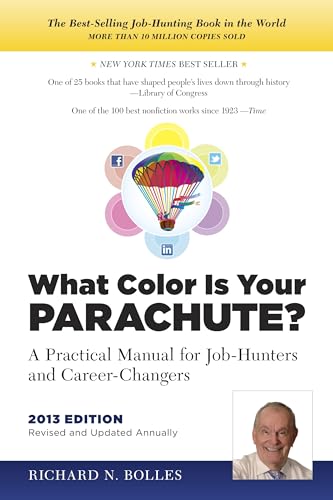
Inhaltsangabe
The world's most popular job-search book is updated for 2013 to tailor its long-trusted guidance with up-to-the-minute information and advice for today's job-hunters and career-changers.
Career expert Richard (“Dick”) N. Bolles has now written forty-one books all with the same title: What Color Is Your Parachute? A Practical Manual for Job-Hunters and Career-Changers. In order to tailor his authoritative guide to the current job- market, Bolles not only updates the book each year, but he also reconceives it, reinvents it, and rewrites it, so that one year’s edition is often vastly different from the year before. This is the case with the 2013 edition. Inventions in the book this year include a brand-new transferable skills grid, a novel way to discover what fields you would most like to work in, and a revamped version of his famed self-inventory instrument, the Flower Exercise.
What Color Is Your Parachute? is the world’s most popular job-hunting guide, and it has helped millions discover their unique gifts, skills, and interests. This has allowed them to land a job even in hard times, and to create for themselves a new, interesting, and inspiring career and life.
With fresh insights into resumes, networking, interviewing, salary negotiation, entrepreneurship, and social media, What Color Is Your Parachute? has everything you need to dust off your motivation and find your dream job.
From the Hardcover edition.
Die Inhaltsangabe kann sich auf eine andere Ausgabe dieses Titels beziehen.
Über die Autorin bzw. den Autor
RICHARD N. BOLLES has led the job-search field for more than 40 years. A member of Mensa and the Society for Human Resource Management, he has been the keynote speaker at hundreds of conferences. Bolles holds a bachelor's degree cum laude in physics from Harvard University, a master's degree from General Theological (Episcopal) Seminary in New York City, and three honorary doctorates. He lives in the San Francisco Bay Area.
Auszug. © Genehmigter Nachdruck. Alle Rechte vorbehalten.
Chapter 1: How to Find Hope
It is a strange world we find ourselves in, these days. Old rules are being rewritten. Things are changing that we never thought would change. Events are happening that we thought we would never see. Things we used to take for granted, now are vanishing. Things don’t work the way they used to. And here we are, trying to plot a new course for our life, still needing help with the essential question of our existence:
Where do I go from here with my life?
Maybe things are going well in our lives, right now. Or maybe they’re not. We may have a life that is unfolding just as we’d hoped. Or our lives may have turned into a nightmare, and we have no idea how we’re going to get out of our present predicament. Never mind. So long as we have hope, we’ll be all right. The one thing we must not be is hopeless. So, it must be hope that we seek, above and before all else; the only question is, how do we find it? Well, there are four keys.
The First Key to Finding Hope
Experts have discovered, over the years, what is the absolute minimum for finding Hope. And it is just this: Hope depends upon taking care that we have at least two alternatives, in every situation we find ourselves, and with every task confronting us.
Not just one way to describe ourselves, but two ways, at least.
Not deciding upon just one career, but two careers, at least.
Not getting trained or retrained for just one kind of job, but two different kinds of jobs, at least.
Not just one way to hunt for a job, but two ways, at least.
Not hunting just for one job, but two jobs, at least.
Not going after just one size company, but two sizes, at least, small or large.
Not just choosing one place where we really would like to find work, but two places, at least.
Not finding just one way to approach a place that interests us, but two different ways, at least.
Not securing just one job offer, but two job offers, at least.
And so on. And so forth.
To have only one plan, one option, in any situation, is a sure recipe for despair. I’ll give you a simple example. In a study of 100 job-hunters who were using only one method to hunt for a job, typically 51 abandoned their search by the second month. That’s more than half of them. They lost Hope. On the other hand, of 100 job-hunters who were using two or more different ways of hunting for a job, typically only 31 of them abandoned their search by the second month. That’s less than one-third of them. The latter kept going because they had Hope.
And so this truth should always be on your mind: In order to never become hopeless, you want to be sure that in every situation you find yourself, you’re not putting all your eggs in just one basket. You must determine to always have at least two alternatives, in every challenge you are facing, that you may overcome—and live what the ancients called “a victorious life.”
The Second Key to Finding Hope
In any situation, no matter how much we may feel we are at the mercy of vast forces out there, that are totally beyond our control, we can always find something that is within our control, however small, and work on that.
To illustrate my point, some years ago, when I was doing a lot of counseling, not just about careers, a friend of mine asked me if I would be willing to see someone he knew. Her name was Mary. She had been diagnosed with multiple sclerosis, or MS. She had been to a wide range of medical specialists: neurologist, psychologist, internist, you name it. They all had declared there was nothing they could do to help her with the disease. My friend said, “Would you see her?” “Sure,” I said, “but I’m not sure there’s anything I can do.”
The next day my friend brought her over. She walked very stiffly up the front sidewalk, came in, sat down, and after exchanging a few pleasantries, I got down to business. “Mary,” I said, “what is multiple sclerosis?” “I don’t know,” she said, in a dull, emotionless voice. “Well then,” I said, “that makes us even; because I don’t know, either. But here’s what I propose. I’m sure that a huge proportion of whatever MS is, is out of your control. There’s nothing you can do about it. But that proportion can’t be 100 percent. There’s got to be some proportion—let’s say it’s even just 2 percent, or 5 percent—that is within your control. We could work on that. Do you want to begin that journey?” She said yes. Over the next few weeks she improved, and finally was free of all symptoms (typical of the disease for a spell, but this lasted for a very long time), and now—free of all stiffness—she became a model on 57th Street in New York City.
So it is, that in any situation you find yourself, no matter how overwhelmed you may feel, no matter how much you may feel you’re at the mercy of things that are just beyond your control, some part of it is within your control: 2 percent, 5 percent, who knows? There is always something you can work on. And often, changing that little bit results in changing a whole lot. Maybe not as dramatic a change as with Mary; but change nonetheless.
Above all else, it gives you Hope. I am not as powerless as I thought.
This certainly applies to any time we are out of work, particularly if it drags on and on. To paraphrase what I said to Mary, but now I’m talking to those of you who are job-hunters or career-changers: I’m sure that a huge proportion of the situation you are facing, is out of your control. There’s nothing you can do about it. But that proportion can’t be 100 percent. There’s got to be some proportion—let’s say it’s even just 2 percent—that is within your control. Determine to find what that is. Then throw all your energies into working on it. Who knows what a difference that may make!
[Oh, by the way, some examples of what is within your control: getting more sleep; drinking more water (we usually need more water than we think we do); walking more; reading the book 14,000 Things to Be Happy About1; doing the Flower Exercise (chapter 5, here), learning to become more observant of the world around you; listening harder to other people; getting into a supportive community with other job-hunters; reading this book twice; rethinking your job-hunt; talking more to successful job-hunters, asking them what they did, step by step, to find work. And, like that.]
The Third Key to Finding Hope
Assume that nothing that happens to us is just senseless and meaningless, including being out of work for a long time. In the context of our total life, it will eventually turn out to have meaning.
I recall a talk I heard many years ago, that made a deep and lasting impression on me. It was a doctor speaking; a doctor turned researcher, as it happened. He was reporting on a study that some colleagues had made of Healing, at the hospital where he worked in New York City. They had long known that some people healed faster than others, but now they wanted to find out why. I cannot cite the study; I lost track of it, over the years. But I can tell you what I remember.
As I recall, they searched through their records of discharged patients to find matched pairs: essentially two people of the same age, with the same background, the same basic health record, who had undergone the same...
„Über diesen Titel“ kann sich auf eine andere Ausgabe dieses Titels beziehen.
Weitere beliebte Ausgaben desselben Titels

Suchergebnisse für What Color Is Your Parachute?: A Practical Manual for...

Beispielbild für diese ISBN
What Color Is Your Parachute? 2013: A Practical Manual for Job-Hunters and Career-Changers
Anbieter: World of Books (was SecondSale), Montgomery, IL, USA
Verkäuferbewertung 5 von 5 Sternen

Zustand: Good. Item in good condition. Textbooks may not include supplemental items i.e. CDs, access codes etc. Artikel-Nr. 00030677982
Gebraucht kaufen
EUR 3,38
Versand gratis
Versand innerhalb von USA
Versand innerhalb von USA
Anzahl: 2 verfügbar
Beispielbild für diese ISBN
What Color Is Your Parachute? 2013: A Practical Manual for Job-Hunters and Career-Changers
Anbieter: World of Books (was SecondSale), Montgomery, IL, USA
Verkäuferbewertung 5 von 5 Sternen
Zustand: Good. Item in good condition. Textbooks may not include supplemental items i.e. CDs, access codes etc. Artikel-Nr. 00082505177
Gebraucht kaufen
EUR 3,89
Versand gratis
Versand innerhalb von USA
Versand innerhalb von USA
Anzahl: 1 verfügbar
Beispielbild für diese ISBN
What Color Is Your Parachute? 2013: A Practical Manual for Job-Hunters and Career-Changers
Anbieter: World of Books (was SecondSale), Montgomery, IL, USA
Verkäuferbewertung 5 von 5 Sternen
Zustand: Very Good. Item in very good condition! Textbooks may not include supplemental items i.e. CDs, access codes etc. Artikel-Nr. 00099357238
Gebraucht kaufen
EUR 3,89
Versand gratis
Versand innerhalb von USA
Versand innerhalb von USA
Anzahl: 1 verfügbar
Beispielbild für diese ISBN
What Color Is Your Parachute? 2013
Anbieter: BooksRun, Philadelphia, PA, USA
Verkäuferbewertung 5 von 5 Sternen
Zustand: Fair. The item might be beaten up but readable. May contain markings or highlighting, as well as stains, bent corners, or any other major defect, but the text is not obscured in any way. Artikel-Nr. 1607741474-7-1
Gebraucht kaufen
EUR 5,35
Versand gratis
Versand innerhalb von USA
Versand innerhalb von USA
Anzahl: 1 verfügbar
Beispielbild für diese ISBN
What Color Is Your Parachute? 2013 : A Practical Manual for Job-Hunters and Career-Changers
Anbieter: Better World Books, Mishawaka, IN, USA
Verkäuferbewertung 5 von 5 Sternen
Zustand: Good. Rev Upd. Pages intact with minimal writing/highlighting. The binding may be loose and creased. Dust jackets/supplements are not included. Stock photo provided. Product includes identifying sticker. Better World Books: Buy Books. Do Good. Artikel-Nr. 1538322-6
Gebraucht kaufen
EUR 6,10
Versand gratis
Versand innerhalb von USA
Versand innerhalb von USA
Anzahl: 1 verfügbar
Beispielbild für diese ISBN
What Color Is Your Parachute? 2013 : A Practical Manual for Job-Hunters and Career-Changers
Anbieter: Better World Books, Mishawaka, IN, USA
Verkäuferbewertung 5 von 5 Sternen
Zustand: Very Good. Rev Upd. Pages intact with possible writing/highlighting. Binding strong with minor wear. Dust jackets/supplements may not be included. Stock photo provided. Product includes identifying sticker. Better World Books: Buy Books. Do Good. Artikel-Nr. GRP82559831
Gebraucht kaufen
EUR 6,10
Versand gratis
Versand innerhalb von USA
Versand innerhalb von USA
Anzahl: 1 verfügbar
Beispielbild für diese ISBN
What Color Is Your Parachute? 2013: A Practical Manual for Job-Hunters and Career-Changers
Anbieter: Wonder Book, Frederick, MD, USA
Verkäuferbewertung 5 von 5 Sternen
Zustand: Good. Good condition. A copy that has been read but remains intact. May contain markings such as bookplates, stamps, limited notes and highlighting, or a few light stains. Bundled media such as CDs, DVDs, floppy disks or access codes may not be included. Artikel-Nr. S21D-02215
Gebraucht kaufen
EUR 6,17
Versand gratis
Versand innerhalb von USA
Versand innerhalb von USA
Anzahl: 1 verfügbar
Beispielbild für diese ISBN
What Color Is Your Parachute? 2013: A Practical Manual for Job-Hunters and Career-Changers
Anbieter: Wonder Book, Frederick, MD, USA
Verkäuferbewertung 5 von 5 Sternen
Zustand: Very Good. Very Good condition. 2013 edition. Revised and Updated Annually. A copy that may have a few cosmetic defects. May also contain light spine creasing or a few markings such as an owner's name, short gifter's inscription or light stamp. Artikel-Nr. X11D-00083
Gebraucht kaufen
EUR 6,17
Versand gratis
Versand innerhalb von USA
Versand innerhalb von USA
Anzahl: 1 verfügbar
Beispielbild für diese ISBN
What Color Is Your Parachute? 2013: A Practical Manual for Job-Hunters and Career-Changers
Anbieter: ThriftBooks-Dallas, Dallas, TX, USA
Verkäuferbewertung 5 von 5 Sternen
Paperback. Zustand: Good. No Jacket. Pages can have notes/highlighting. Spine may show signs of wear. ~ ThriftBooks: Read More, Spend Less. Artikel-Nr. G1607741474I3N00
Gebraucht kaufen
EUR 6,48
Versand gratis
Versand innerhalb von USA
Versand innerhalb von USA
Anzahl: 1 verfügbar
Beispielbild für diese ISBN
What Color Is Your Parachute? 2013: A Practical Manual for Job-Hunters and Career-Changers
Verlag:
Ten Speed Press 14/08/2012, 2012
ISBN 10: 1607741474
ISBN 13: 9781607741473
Gebraucht
Softcover
Anbieter: AwesomeBooks, Wallingford, Vereinigtes Königreich
Verkäuferbewertung 5 von 5 Sternen
Zustand: Very Good. This book is in very good condition and will be shipped within 24 hours of ordering. The cover may have some limited signs of wear but the pages are clean, intact and the spine remains undamaged. This book has clearly been well maintained and looked after thus far. Money back guarantee if you are not satisfied. See all our books here, order more than 1 book and get discounted shipping. . Artikel-Nr. 7719-9781607741473
Gebraucht kaufen
EUR 4,23
EUR 4,80 Versand
Versand von Vereinigtes Königreich nach USA
Versand von Vereinigtes Königreich nach USA
Anzahl: 5 verfügbar