
Verwandte Artikel zu How to Write It, Third Edition: A Complete Guide to...
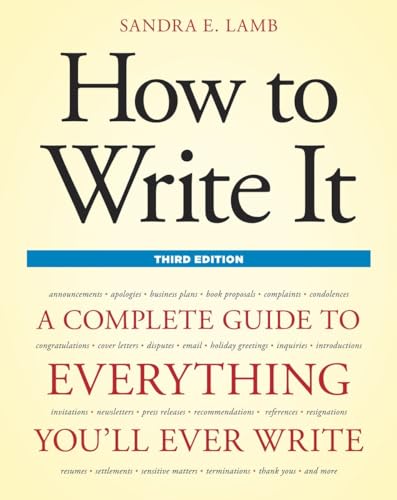
How to Write It, Third Edition: A Complete Guide to Everything You'll Ever Write (How to Write It: Complete Guide to Everything You'll Ever Write) - Softcover
Inhaltsangabe
Write personal and professional communications with clarity, confidence, and style.
How to Write It is the essential resource for eloquent personal and professional self-expression. Award-winning journalist Sandra E. Lamb transforms even reluctant scribblers into articulate wordsmiths by providing compelling examples of nearly every type and form of written communication.
Completely updated and expanded, the new third edition offers hundreds of handy word, phrase, and sentence lists, precisely crafted sample paragraphs, and professionally designed document layouts. How to Write It is a must-own for students, teachers, authors, journalists, bloggers, managers, and anyone who doesn’t have time to wade through a massive style guide but needs a friendly desk reference.
Die Inhaltsangabe kann sich auf eine andere Ausgabe dieses Titels beziehen.
Über die Autorin bzw. den Autor
Sandra E. Lamb was a technical writer, editor, and ghost writer before launching her career as a writing teacher. She has guided many diverse groups to greater eloquence, from the American National Cattlewomen’s Association to the American Society of Journalists and Authors. Lamb is the author of Personal Notes and Write the Right Words. For more information, visit www.sandralamb.com.
Auszug. © Genehmigter Nachdruck. Alle Rechte vorbehalten.
3: ANNOUNCEMENT
An announcement may be good news or bad news, but the form itself is consistent: Get the reader’s attention, then give him or her the single message you want to communicate. Be direct, focused, brief, and timely.
ETIQUETTE
Give very careful consideration to the reader when the announcement contains emotional or very personal content. Sometimes your announcement may be of a delicate nature, and in that case require the civility of a human moment—a face-to-face delivery. Use great discretion when this is the case.
DECIDE TO WRITE
Announcements are suitable for many of the events and changes in our lives:
• Change of address
• Anniversary: wedding or business
• Birth or adoption
• Personal life event: graduation, wedding, marital separation, divorce, retirement, or death
• Employee change: resignation, firing, promotion, transfer, special achievement, new employees, job opening
• Opening a business, branch office, or store
• Business changes: new business name, price changes, product recall, new programs, products, policies, hours, practices, contracts, organization buyout, merger, bankruptcy, expansion, acquisition, company layoff, downsizing, closing, or record sales
• Seminars, workshops, or conferences
• Open house for home, business, or school
• Bad news of some sort
THINK ABOUT CONTENT
• Ask yourself who, what, when, where, why, and how to help focus the information you want to communicate and to ensure you make it complete.
• State the information in order of importance.
• Be direct, brief, and concise.
• Check the prescribed format of different kinds of announcements.
• Emphasize the goodwill aspects of your news. If your company is changing working hours, for example, emphasize the greater convenience for employees and customers.
• Use the “need-to-know” guideline in making your announcement. Who needs to know your news?
• When it’s appropriate, emphasize the reasons for your news to promote understanding and goodwill.
ELIMINATE WRONG MESSAGES
• An announcement should supply complete, basic information. Leave out lengthy explanations or extraneous facts. Even when the announcement is a hybrid—combined with a sales message, for example—the format and style should strengthen the single message.
• Don’t let employees hear or read your organizational information from an outside source first.
• Don’t put off a bad news announcement. It is usually best that your bad news be received directly from you rather than from another source. If nothing else, announce the basic news and state that full information will follow.
CONSIDER ANNOUNCEMENT TYPES
• A personal name change is announced by stating that, as of (date) the person formerly known as (name) will be known as (name). No explanation is needed, but written notes to friends and colleagues are desirable.
• Graduation announcements are usually formal and printed but certainly may be handwritten. This announcement has evolved because space at graduation ceremonies is now restricted to only a few invitations per graduate. Send only to close family members and friends. This announcement may be sent with an invitation to a graduation party. “No gifts, please” may be written in the lower left-hand corner.
• Engagement announcements can be handwritten or printed and should be sent to relatives and friends. Because of the rich tradition of this announcement in our culture, a special section has been devoted to it (see page 26; also see Wedding & Engagement Correspondence, page 82).
• Wedding announcements are often printed in a prescribed format. They may also be personal letters or notes (see Wedding & Engagement Correspondence, page 82).
• Birth or adoption announcements are usually made by both parents to friends and relatives. The announcements may be selected either before the birth, and then the final information phoned in after the birth, or commercial cards with blanks may be purchased and then filled in and sent out. Include the infant’s sex; birth date (and time, if you wish) or age (if adopted); parents’ full names; siblings’ names (if you like); and an expression of happiness. Parents may also send an announcement to newspapers and other publications that print this information.
Example:
Roger and Brenda Dell of 344 South Parker Road, Littleton, are delighted to announce the birth of a son, Jared, on August 12, 2007, at Littleton Hospital. They have one daughter, Meredith, four. Mrs. Dell is the former Miss Brenda Sales.
When the couple has been divorced before the birth, the announcement is made by the mother, in the name she now uses. Widowed women may use “Sally and the late Paul Davidson.” A single mother should use her chosen title and name. In all cases, personal announcements are in the best taste. Personal birth and adoption announcements should also be sent to close colleagues and work associates.
• Retirement announcements are especially important when the retiree is a doctor, dentist, or other professional. These announcements are usually combined with the announcement of the person taking over the practice or any other changing business information. Printed announcements with a good-news emphasis are important here.
• A death in the family is difficult at best. The immediate family must notify other relatives and friends by telephone and ask that they notify others. If funeral arrangements have been made, this information can be given, eliminating the need for another round of calls. The next step is notifying the attorney of the deceased. Written announcements generally take a number of forms:
> An announcement may be arranged by the funeral home, or a paid newspaper notice may be placed.
> An obituary may be written by newspaper staff. Usually the information is verified by a close family member. Information generally included is the complete name of the deceased (including the original family name), date of death, date of birth or age at the time of death, address at the time of death, names of immediate family members and place of residence, hours and location where friends may call on the family, place and time of the funeral, whether the funeral is private, and frequently a request that any contributions be given to a charity (often designated) instead of flowers being sent to the funeral home.
> A news article describing the achievements and contributions of the deceased may be written by newspaper staff and/or a family representative.
> Printed announcements may be sent to colleagues and/or out-of-town acquaintances.
> Handwritten notes may be sent to out-of-town relatives, friends, and acquaintances.
...
„Über diesen Titel“ kann sich auf eine andere Ausgabe dieses Titels beziehen.
Suchergebnisse für How to Write It, Third Edition: A Complete Guide to...

Beispielbild für diese ISBN
How to Write It, Third Edition: A Complete Guide to Everything You'll Ever Write
Anbieter: World of Books (was SecondSale), Montgomery, IL, USA
Verkäuferbewertung 5 von 5 Sternen

Paperback. Zustand: Good. Write personal and professional communications with clarity, confidence, and style. How to Write It is the essential resource for eloquent personal and professional self-expression. Award-winning journalist Sandra E. Lamb transforms even reluctant scribblers into articulate wordsmiths by providing compelling examples of nearly every type and form of written communication. Completely updated and expanded, the new third edition offers hundreds of handy word, phrase, and sentence lists, precisely crafted sample paragraphs, and professionally designed document layouts. How to Write It is a must-own for students, teachers, authors, journalists, bloggers, managers, and anyone who doesn't have time to wade through a massive style guide but needs a friendly desk reference. Artikel-Nr. 00101689760
Gebraucht kaufen
EUR 4,07
Versand gratis
Versand innerhalb von USA
Versand innerhalb von USA
Anzahl: 16 verfügbar
Beispielbild für diese ISBN
How to Write It, Third Edition: A Complete Guide to Everything You'll Ever Write
Anbieter: World of Books (was SecondSale), Montgomery, IL, USA
Verkäuferbewertung 5 von 5 Sternen
Paperback. Zustand: Fair. Write personal and professional communications with clarity, confidence, and style. How to Write It is the essential resource for eloquent personal and professional self-expression. Award-winning journalist Sandra E. Lamb transforms even reluctant scribblers into articulate wordsmiths by providing compelling examples of nearly every type and form of written communication. Completely updated and expanded, the new third edition offers hundreds of handy word, phrase, and sentence lists, precisely crafted sample paragraphs, and professionally designed document layouts. How to Write It is a must-own for students, teachers, authors, journalists, bloggers, managers, and anyone who doesn't have time to wade through a massive style guide but needs a friendly desk reference. Artikel-Nr. 00108522952
Gebraucht kaufen
EUR 4,07
Versand gratis
Versand innerhalb von USA
Versand innerhalb von USA
Anzahl: 2 verfügbar
Beispielbild für diese ISBN
How to Write It, Third Edition: A Complete Guide to Everything You'll Ever Write
Anbieter: World of Books (was SecondSale), Montgomery, IL, USA
Verkäuferbewertung 5 von 5 Sternen
Paperback. Zustand: Very Good. Write personal and professional communications with clarity, confidence, and style. How to Write It is the essential resource for eloquent personal and professional self-expression. Award-winning journalist Sandra E. Lamb transforms even reluctant scribblers into articulate wordsmiths by providing compelling examples of nearly every type and form of written communication. Completely updated and expanded, the new third edition offers hundreds of handy word, phrase, and sentence lists, precisely crafted sample paragraphs, and professionally designed document layouts. How to Write It is a must-own for students, teachers, authors, journalists, bloggers, managers, and anyone who doesn't have time to wade through a massive style guide but needs a friendly desk reference. Artikel-Nr. 00109974615
Gebraucht kaufen
EUR 4,07
Versand gratis
Versand innerhalb von USA
Versand innerhalb von USA
Anzahl: 3 verfügbar
Foto des Verkäufers
How to Write It, Third Edition: A Complete Guide to Everything You'll Ever Write (How to Write It: Complete Guide to Everything You'll Ever Write)
Anbieter: Dream Books Co., Denver, CO, USA
Verkäuferbewertung 5 von 5 Sternen
Zustand: acceptable. This copy has clearly been enjoyedâ"expect noticeable shelf wear and some minor creases to the cover. Binding is strong, and all pages are legible. May contain previous library markings or stamps. Artikel-Nr. DBV.160774032X.A
Gebraucht kaufen
EUR 4,17
Versand gratis
Versand innerhalb von USA
Versand innerhalb von USA
Anzahl: 2 verfügbar
Foto des Verkäufers
How to Write It, Third Edition: A Complete Guide to Everything You'll Ever Write (How to Write It: Complete Guide to Everything You'll Ever Write)
Anbieter: Dream Books Co., Denver, CO, USA
Verkäuferbewertung 5 von 5 Sternen
Zustand: good. Gently used with minimal wear on the corners and cover. A few pages may contain light highlighting or writing, but the text remains fully legible. Dust jacket may be missing, and supplemental materials like CDs or codes may not be included. May be ex-library with library markings. Ships promptly! Artikel-Nr. DBV.160774032X.G
Gebraucht kaufen
EUR 4,35
Versand gratis
Versand innerhalb von USA
Versand innerhalb von USA
Anzahl: 2 verfügbar
Beispielbild für diese ISBN
How to Write It, Third Edition: A Complete Guide to Everything You'll Ever Write (How to Write It: Complete Guide to Everything You'll Ever Write)
Verlag:
Ten Speed Press (edition Revised), 2011
ISBN 10: 160774032X
ISBN 13: 9781607740322
Gebraucht
Paperback
Anbieter: BooksRun, Philadelphia, PA, USA
Verkäuferbewertung 5 von 5 Sternen
Paperback. Zustand: Very Good. Revised. It's a well-cared-for item that has seen limited use. The item may show minor signs of wear. All the text is legible, with all pages included. It may have slight markings and/or highlighting. Artikel-Nr. 160774032X-11-1
Gebraucht kaufen
EUR 5,61
Versand gratis
Versand innerhalb von USA
Versand innerhalb von USA
Anzahl: 1 verfügbar
Beispielbild für diese ISBN
How to Write It: A Complete Guide to Everything You'll Ever Write
Anbieter: ThriftBooks-Atlanta, AUSTELL, GA, USA
Verkäuferbewertung 5 von 5 Sternen
Paperback. Zustand: Fair. No Jacket. Readable copy. Pages may have considerable notes/highlighting. ~ ThriftBooks: Read More, Spend Less. Artikel-Nr. G160774032XI5N00
Gebraucht kaufen
EUR 5,99
Versand gratis
Versand innerhalb von USA
Versand innerhalb von USA
Anzahl: 1 verfügbar
Beispielbild für diese ISBN
How to Write It: A Complete Guide to Everything You'll Ever Write
Anbieter: ThriftBooks-Dallas, Dallas, TX, USA
Verkäuferbewertung 5 von 5 Sternen
Paperback. Zustand: Fair. No Jacket. Readable copy. Pages may have considerable notes/highlighting. ~ ThriftBooks: Read More, Spend Less. Artikel-Nr. G160774032XI5N00
Gebraucht kaufen
EUR 5,99
Versand gratis
Versand innerhalb von USA
Versand innerhalb von USA
Anzahl: 1 verfügbar
Beispielbild für diese ISBN
How to Write It: A Complete Guide to Everything You'll Ever Write
Anbieter: ThriftBooks-Phoenix, Phoenix, AZ, USA
Verkäuferbewertung 5 von 5 Sternen
Paperback. Zustand: Fair. No Jacket. Readable copy. Pages may have considerable notes/highlighting. ~ ThriftBooks: Read More, Spend Less. Artikel-Nr. G160774032XI5N00
Gebraucht kaufen
EUR 5,99
Versand gratis
Versand innerhalb von USA
Versand innerhalb von USA
Anzahl: 1 verfügbar
Beispielbild für diese ISBN
How to Write It: A Complete Guide to Everything You'll Ever Write
Anbieter: ThriftBooks-Reno, Reno, NV, USA
Verkäuferbewertung 5 von 5 Sternen
Paperback. Zustand: Fair. No Jacket. Readable copy. Pages may have considerable notes/highlighting. ~ ThriftBooks: Read More, Spend Less. Artikel-Nr. G160774032XI5N00
Gebraucht kaufen
EUR 5,99
Versand gratis
Versand innerhalb von USA
Versand innerhalb von USA
Anzahl: 1 verfügbar