
Verwandte Artikel zu Folkloresque: Reframing Folklore in a Popular Culture...
Inhaltsangabe
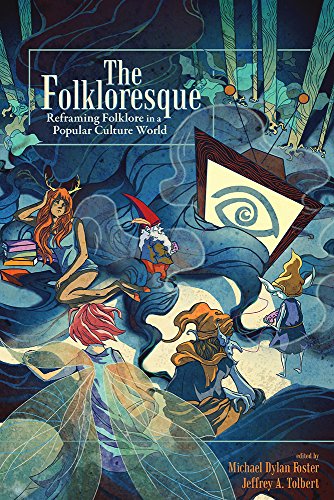
This volume introduces a new concept to explore the dynamic relationship between folklore and popular culture: the “folkloresque.” With “folkloresque,” Foster and Tolbert name the product created when popular culture appropriates or reinvents folkloric themes, characters, and images. Such manufactured tropes are traditionally considered outside the purview of academic folklore study, but the folkloresque offers a frame for understanding them that is grounded in the discourse and theory of the discipline.
Fantasy fiction, comic books, anime, video games, literature, professional storytelling and comedy, and even popular science writing all commonly incorporate elements from tradition or draw on basic folklore genres to inform their structure. Through three primary modes—integration, portrayal, and parody—the collection offers a set of heuristic tools for analysis of how folklore is increasingly used in these commercial and mass-market contexts.
The Folkloresque challenges disciplinary and genre boundaries; suggests productive new approaches for interpreting folklore, popular culture, literature, film, and contemporary media; and encourages a rethinking of traditional works and older interpretive paradigms.
Contributors: Trevor J. Blank, Chad Buterbaugh, Bill Ellis, Timothy H. Evans, Michael Dylan Foster, Carlea Holl-Jensen, Greg Kelley, Paul Manning, Daniel Peretti, Gregory Schrempp, Jeffrey A. Tolbert
Die Inhaltsangabe kann sich auf eine andere Ausgabe dieses Titels beziehen.
Über die Autorin bzw. den Autor
Michael Dylan Foster is associate professor of folklore and East Asian languages and cultures at Indiana University. He is the author of Pandemonium and Parade: Japanese Monsters and the Culture of Yokai, The Book of Yokai: Mysterious Creatures of Japanese Folklore, and numerous articles on folklore, literature, and media.
Jeffrey A. Tolbert is assistant professor of American Studies at Penn State Harrisburg. His research focuses on supernatural belief, and his dissertation examines belief and the landscape in contemporary Ireland. His broader research interests include folklore and popular culture, especially video games, and supernatural traditions in new/digital media, such as the Slender Man Internet phenomenon.
Auszug. © Genehmigter Nachdruck. Alle Rechte vorbehalten.
The Folkloresque
Reframing Folklore in a Popular Culture World
By Michael Dylan Foster, Jeffrey A. TolbertUniversity Press of Colorado
Copyright © 2016 University Press of Colorado
All rights reserved.
ISBN: 978-1-60732-417-1All rights reserved.
Contents
Acknowledgments,
Introduction: The Challenge of the Folkloresque Michael Dylan Foster,
SECTION 1: INTEGRATION,
Introduction Jeffrey A. Tolbert,
1 The Folkloresque Circle: Toward a Theory of Fuzzy Allusion Michael Dylan Foster,
2 Folklore, Intertextuality, and the Folkloresque in the Works of Neil Gaiman Timothy H. Evans,
3 Pixies' Progress: How the Pixie Became Part of the Nineteenth-Century Fairy Mythology Paul Manning,
4 Comics as Folklore Daniel Peretti,
SECTION 2: PORTRAYAL,
Introduction Jeffrey A. Tolbert,
5 A Deadly Discipline: Folklore, Folklorists, and the Occult in Fatal Frame Jeffrey A. Tolbert,
6 They Say Éamon Kelly Was Ireland's Greatest Storyteller Chad Buterbaugh,
7 "New-Minted from the Brothers Grimm": Folklore's Purpose and the Folkloresque in The Tales of Beedle the Bard Carlea Holl-Jensen and Jeffrey A. Tolbert,
SECTION 3: PARODY,
Introduction Jeffrey A. Tolbert,
8 Giving the "Big Ten" a Whole New Meaning: Tasteless Humor and the Response to the Penn State Sexual Abuse Scandal Trevor J. Blank,
9 "The Joke's on Us": An Analysis of Metahumor Greg Kelley,
10 The Fairy-telling Craft of Princess Tutu: Metacommentary and the Folkloresque Bill Ellis,
11 Science and the Monsterological Imagination: Folkloristic Musings on David Toomey's Weird Life Gregory Schrempp,
About the Authors,
Index,
CHAPTER 1
The Folkloresque Circle
Toward a Theory of Fuzzy Allusion
MICHAEL DYLAN FOSTER
Undoubtedly something was lost in the translation; watching the parade of wild things flutter, stomp and crawl though the bathhouse will make you wonder what each represents in Japanese mythology. (At one point it's as if every item in the Japanese Sanrio line of toys has come to life.) The cultural weight that the picture bears partly explains why this was the biggest hit ever in Japan, outpacing "Titanic."
— Elvis Mitchell, New York Times
In 2001, Studio Ghibli released a film called Sen to Chihiro no kamikakushi, written and directed by master animator Miyazaki Hayao. It was a blockbuster hit, grossing more than any previous film in Japanese history. In 2002 a translated version was released by Disney with the title Spirited Away and it promptly won the Golden Bear at the 2002 Berlin International Film Festival and the Oscar for Best Animated Feature at the seventy-fifth Academy Awards in 2003. The critical and popular success of Spirited Away marks not only a watershed moment in the international recognition of the anime genre but also raises provocative questions about the relationship between folklore and popular culture. As the above quotation from the New York Times review of the film makes explicit, on this side of the Pacific Spirited Away was received as a glorious expression of an enigmatic folkloric tradition ("Japanese mythology") full of "cultural weight." At the same time, the parenthetical aside about Sanrio also suggests that Japanese "mythology" may be all but indistinguishable from (globalized) commercial culture.
It is not my intention here to completely unpack the dynamics of this film; rather, I want to use it as a springboard for contemplating the relationship between folklore and popular culture. In particular, I explore the folkloresque as a form of integration that provides insight into any number of popular cultural (and literary) texts. As suggested in the introduction of this volume, the folkloresque can be thought of as the popular, vernacular, folk conception of folklore. A folkloresque text draws on folklore in an often (but not always) conscious manner, using an association with folklore to sell itself, both literally and figuratively, within a commercial venue. Many popular culture products fit into this broad matrix, deploying folklore in a wide variety of ways. In this essay I examine one of these ways, specifically, how allusion to folkloric motifs, characters, and tale types can give a work the semblance of being based on "real" folklore even when there is no direct link with specific referents in a given tradition. Such works operate through a sort of elusive allusion, as it were, or what I call "fuzzy allusion."
This is the case with Spirited Away, and one reason for its critical and popular success both domestically and internationally. In order to flesh out these dynamics, I also briefly introduce the way folklore is used in a different Studio Ghibli film, Heisei tanuki gassen pompoko (1994), known in English as Pom Poko, which directly references beliefs, images, and narratives readily recognizable to most Japanese audiences. Comparing Pom Poko with Spirited Away provides insight into differences between direct reference to folklore in a creative narrative and the folkloresque operation of fuzzy allusion.
It is hard to pin down in words the quality of seeming to be based on folklore that characterizes the folkloresque within popular culture; in the pages that follow I explore a number of metaphors for thinking through this problem. Finally, however, I argue that the very processes involved in the generation of both folklore and the folkloresque are deeply interrelated. While the two can be seen as distinct, they ultimately work in a Möbius strip — like fashion, so that today's folkloresque may become tomorrow's folklore, which in turn supplies the folkloresque of the day after tomorrow. However commercial a folkloresque product may be, it is created through allusion and integration in a process remarkably similar to that by which folklore itself emerges.
ANIMATING FOLKLORE
Animated film (anime in Japanese) is a particularly rich vehicle for representing folklore, in part because it allows for the portrayal of physical transformation in a more visually dynamic way than does live-action film or, for that matter, oral or written narrative (see Ortabasi 2013, 257 — 60). In 1988, Studio Ghibli, the most internationally successful anime company, released a film called Tonari no Totoro (My Neighbor Totoro) that tapped into a folkloric nostalgia that would go on to inform many of director Miyazaki Hayao's later films — and which sets the stage for the discussion of the folkloresque that follows.
My Neighbor Totoro concerns a family that moves to the countryside, where the youngest daughter interacts with the natural world, most notably portrayed in the guise of Totoro, a gigantic and charmingly plump creature with perky ears. In many ways, Totoro has the hallmarks of a "traditional" Japanese spirit; it is intimated in the film that the creature is linked to the pristine natural environment and can be seen only by children, who are themselves innocent and pure. There is, as the New Yorker notes, "a gentle hint of Shintoism in all this" (Talbot 2005, 68). Indeed, with his portrayal of Totoro and other spirits, Miyazaki seems to reference Japanese folklore and religion, drawing on traditional animistic beliefs about the natural environment. But just as the nostalgic world created in My Neighbor Totoro only distantly references its setting in mid- twentieth-century Japan, so too the folkloric allusions connect only vaguely to the Japanese animistic world — nothing more than a "gentle hint." There is in fact no such creature as a totoro in Japanese folk belief; even the moniker totoro is likely derived from "troll" rather than from any direct referent within the Japanese countryside. My Neighbor Totoro is exemplary of a technique Miyazaki would continue to employ in his work, an emplacement of invented situations and characters into a nostalgically configured landscape and imagined folkloric habitus in a way that seems to "blend Japanese mythology with modern psychological realism" (Talbot 2005, 64 — 65).
The film exemplifies one way in which folklore informs contemporary cultural production, the mode I call folkloresque integration. To better explore this mode and others, I propose a very simple typology, or rather a continuum with three focal points or touchstones, through which to categorize how popular cultural products employ folklore: (1) version or adaptation, (2) precise allusion (folklorism), and (3) fuzzy allusion (folkloresque integration). I suggest these points for heuristic purposes because they represent three distinct but related (and overlapping) modes through which folkloric materials and motifs are repurposed and remixed. I concentrate here on the latter two by comparing Pom Poko with Spirited Away. Although my examples are drawn specifically from film, the loose typology I set out in this essay pertains to all popular culture and literary productions that are informed by folklore.
VERSION/ADAPTATION
First, there is the filmic version or cinematic adaptation of a folk narrative. Disney's 1950 production of Cinderella is an example of this, an explicit remediation of Charles Perrault's earlier literary version of ATU510A. We might argue that a filmic version fits a definition of folklorism that "assumes that modernity has extracted folklore from its 'original' state and placed it into a 'foreign' context" (Smidchens 1999, 53). Without confronting questions of "original" and "foreign" and "context," I stress only that we should consider this a (relatively) recent version of ATU510A because it demonstrates a recognizable consistency with earlier texts, both literary and oral, and in this case explicitly expresses allegiance to one (Perrault). Just as screenplays may be based on novels or short stories, so filmic renderings of folk narratives are adaptations for a different medium. Whether we call them remediations, retellings, or re-creations, the prefix "re" emphasizes the notion of again-ness: these narratives have, in some recognizably consistent way, been told before.
PRECISE ALLUSION ([POM POKO)
Another node in this typology, one step removed from version/adaptation, is a form of creative usage of folklore I call precise allusion. This modality might be characterized as a form of folklorism/folklorismus in which "visually and aurally striking or aesthetically pleasing folk materials" are "extracted from their initial contexts and put to new uses for different, often larger audiences" (Bendix 1997, 337). In this case, theme, characters, plot, and other elements of a given folk narrative or belief system are used within an original storyline. Very recent examples include Red Riding Hood (2011), Snow White and the Huntsman (2012), and Maleficent (2014), all of which borrow motifs from tradition but use them in ways different from the tales they explicitly reference. These are original narratives, though the characters and their background are familiar. One pleasure of such films — indeed, the conceit around which many of them are based — is the excitement of seeing how familiar characters or plot twists are creatively reinterpreted in defamiliarizing ways. A common method for doing this is to show a well-worn tale from the perspective of either the antagonist or a minor character. Maleficent, for example, was recently described by one critic as "a divertingly different rethink of an awfully old story" (Dargis 2014). It is not the againness of these tellings that is primary here but rather the freshness of their construction: the originality of perspective and character, even as older motifs and tale types are explicitly referenced.
To better illustrate this form of folklorism, I focus on the 1994 Studio Ghibli production Pom Poko. Directed by Takahata Isao, the film follows a community of tanuki — "raccoon dogs" as they are labeled in English — mammals found throughout Japan and other parts of East Asia. Tanuki are real animals, but in Japan they have also long had a reputation as shape-shifting supernatural creatures. In folktales and legends they appear as fun-loving and mischievous (and occasionally murderous) tricksters. Among their distinguishing features is a set of gargantuan testicles they use to perform many of their transformations. Although it is difficult to generalize about any folkloric creature, the prevailing tanuki image since at least the middle of the Edo period (ca. 1600 — 1868) is of a somewhat bumbling, saké-swilling hedonist — at once a troublemaker and a symbol of fertility and fortune.
Pom Poko takes this deep-seated cultural knowledge as a given for its viewers, and places its protagonists within the specific historical and economic context of the late 1960s, a period of rapid economic growth and (sub)urbanization. A group of tanuki is living in the Tama Hills on the outskirts of Tokyo, where humans are planning to build a new suburb. Desperate to protect their native home from the spread of human civilization, the older tanuki teach the magic of the old days to the younger tanuki so that together they can create illusions and roadblocks to stop construction. As metonyms of the disappearing natural environment, the tanuki invoke their traditional shape-shifting talents in a battle against humans that has a deep ecological and political subtext.
The film is fictional, of course, but it takes place in real historical time in a real geographical setting. It also invokes "real" folklore: we watch the younger tanuki undertaking a kind of basic training in the tactics of shape shifting, learning to perform a range of transformations familiar from folktales and legends (and artwork based on these folktales and legends). Takahata also shows bumbling characters, able only to half transform, a direct reference to the widely distributed "Bunbuku chagama" (The Lucky Teapot) tale, in which a tanuki manages only to half sustain its transformation into a teapot. In one of the final scenes of Pom Poko, the tanuki collectively create a gigantic illusion of a parade of demons marching through the new human development; the animated imagery here replicates iconic images from a number of extant picture scrolls.
All these references point directly to specific referents outside the film. They are precise allusions. A teapot with a head and tail sticking out is not a random expression of tanuki ineptitude but a reference to "The Lucky Teapot" — a reference most Japanese viewers (including children) would understand. In a sense, this is a form of folklorism in which identifiable characters, motifs, and narratives from a shared tradition are placed within a new medium and narrative; it is a "rewriting of premodern tanuki lore through sustained sourcing, transplantation, and transformation of familiar iconography" (Ortabasi 2013, 272). Takahata strategically deploys folklore in Pom Poko to make a political environmentalist critique of modern Japan. But even as the film reinterprets folklore, putting specific themes and motifs in original juxtaposition, it preserves (and draws on) the direct relationship of these references to the world outside the film: allusions are precise and identifiable. The film is not an adaptation or a new version but a creative "resituating" of folklore (de Caro and Jordan 2004).
In literary criticism, allusion has long been characterized as a rhetorical device by which an author makes reference to an earlier text. Gregory Machacek (2007, 525) argues that allusion, as a form of "diachronic intertextuality," can be divided into two distinct types: "phraseological appropriation" and "learned or indirect reference" (526). The first of these is a kind of quotational practice, an explicit and recognizable borrowing that "incorporate[s] a snippet of someone else's language into the flow of one's own" (525). When a tanuki character in Pom Poko only half transforms into a teapot, this is a "phraseological appropriation" from "The Lucky Teapot" folktale: it is a precise allusion to an identifiable set of texts.
FUZZY ALLUSION ([SPIRITED AWAY)
In comparison, the third touchstone on the continuum demonstrates what Machacek describes as "learned or indirect reference." I call this fuzzy allusion. When the source being referenced is folkloric, then the product is a folkloresque text characterized by a process of integration. The product of this process is not a version of a known narrative, nor a remediation, nor even a set of motifs presented in a new format or in unusual juxtaposition. Rather, it is a wholly new creation that is not based on a specific tradition but — and this is what makes it folkloresque — alludes to folkloric elements in a generalized and imprecise way. There is, as it were, an unmistakable odor (Iwabuchi 2002, 27). It smells of folklore, but we can't locate the particular sources of the odor. This is not to say there are no associated referents, but there are no direct correlations; indexical relations are lacking, or at least extremely vague.
I first conceived of the notion of the folkloresque in 2005 when I was asked to give a talk about the folklore in Spirited Away. I struggled fruitlessly to identify clear referents outside the text. And yet, even as I watched the film, something about it seemed familiar; I felt this story had been told before, that the motifs and even the plot itself were from some earlier version of something. Through a subtle incorporation and integration of elements from a number of folkloric traditions, the film projects an aura of "authenticity": it seems somehow based on folklore or like folklore. It is, in a word, folkloresque.
(Continues...)
Excerpted from The Folkloresque by Michael Dylan Foster, Jeffrey A. Tolbert. Copyright © 2016 University Press of Colorado. Excerpted by permission of University Press of Colorado.
All rights reserved. No part of this excerpt may be reproduced or reprinted without permission in writing from the publisher.
Excerpts are provided by Dial-A-Book Inc. solely for the personal use of visitors to this web site.
„Über diesen Titel“ kann sich auf eine andere Ausgabe dieses Titels beziehen.
Suchergebnisse für Folkloresque: Reframing Folklore in a Popular Culture...

Beispielbild für diese ISBN
Folkloresque
Verlag:
Univ of Chicago behalf of UP Colorado, 2015
ISBN 10: 1607324172
ISBN 13: 9781607324171
Neu
PAP
Anbieter: PBShop.store US, Wood Dale, IL, USA
Verkäuferbewertung 5 von 5 Sternen

PAP. Zustand: New. New Book. Shipped from UK. Established seller since 2000. Artikel-Nr. CX-9781607324171
Beispielbild für diese ISBN
The Folkloresque
Verlag:
Univ of Chicago behalf of UP Colorado, 2015
ISBN 10: 1607324172
ISBN 13: 9781607324171
Neu
PAP
Anbieter: PBShop.store UK, Fairford, GLOS, Vereinigtes Königreich
Verkäuferbewertung 5 von 5 Sternen
PAP. Zustand: New. New Book. Shipped from UK. Established seller since 2000. Artikel-Nr. CX-9781607324171
Neu kaufen
EUR 29,86
EUR 4,88 Versand
Versand von Vereinigtes Königreich nach USA
Versand von Vereinigtes Königreich nach USA
Anzahl: 14 verfügbar
Beispielbild für diese ISBN
Folkloresque: Reframing Folklore in a Popular Culture World
Anbieter: Ria Christie Collections, Uxbridge, Vereinigtes Königreich
Verkäuferbewertung 5 von 5 Sternen
Zustand: New. In English. Artikel-Nr. ria9781607324171_new
Neu kaufen
EUR 38,94
EUR 13,25 Versand
Versand von Vereinigtes Königreich nach USA
Versand von Vereinigtes Königreich nach USA
Anzahl: Mehr als 20 verfügbar
Beispielbild für diese ISBN
The Folkloresque: Reframing Folklore in a Popular Culture World
Anbieter: Revaluation Books, Exeter, Vereinigtes Königreich
Verkäuferbewertung 5 von 5 Sternen
Paperback. Zustand: Brand New. 1st edition. 272 pages. 9.00x6.00x0.50 inches. In Stock. Artikel-Nr. x-1607324172
Neu kaufen
EUR 52,13
EUR 11,73 Versand
Versand von Vereinigtes Königreich nach USA
Versand von Vereinigtes Königreich nach USA
Anzahl: 2 verfügbar
Foto des Verkäufers
The Folkloresque : Reframing Folklore in a Popular Culture World
Verlag:
Univ Of Chicago Behalf Of UP Colorado Nov 2015, 2015
ISBN 10: 1607324172
ISBN 13: 9781607324171
Neu
Taschenbuch
Anbieter: AHA-BUCH GmbH, Einbeck, Deutschland
Verkäuferbewertung 5 von 5 Sternen
Taschenbuch. Zustand: Neu. Neuware - This volume introduces a new concept to explore the dynamic relationship between folklore and popular culture: the 'folkloresque.' With 'folkloresque,' Foster and Tolbert name the product created when popular culture appropriates or reinvents folkloric themes, characters, and images. Such manufactured tropes are traditionally considered outside the purview of academic folklore study, but the folkloresque offers a frame for understanding them that is grounded in the discourse and theory of the discipline. Fantasy fiction, comic books, anime, video games, literature, professional storytelling and comedy, and even popular science writing all commonly incorporate elements from tradition or draw on basic folklore genres to inform their structure. Through three primary modes-integration, portrayal, and parody-the collection offers a set of heuristic tools for analysis of how folklore is increasingly used in these commercial and mass-market contexts. The Folkloresque challenges disciplinary and genre boundaries; suggests productive new approaches for interpreting folklore, popular culture, literature, film, and contemporary media; and encourages a rethinking of traditional works and older interpretive paradigms. Contributors: Trevor J. Blank, Chad Buterbaugh, Bill Ellis, Timothy H. Evans, Michael Dylan Foster, Carlea Holl-Jensen, Greg Kelley, Paul Manning, Daniel Peretti, Gregory Schrempp, Jeffrey A. Tolbert. Artikel-Nr. 9781607324171
Neu kaufen
EUR 52,62
EUR 35,00 Versand
Versand von Deutschland nach USA
Versand von Deutschland nach USA
Anzahl: 2 verfügbar
Foto des Verkäufers
FOLKLORESQUE THE
Verlag:
Utah State University Press, 2015
ISBN 10: 1607324172
ISBN 13: 9781607324171
Neu
Kartoniert / Broschiert
Anbieter: moluna, Greven, Deutschland
Verkäuferbewertung 5 von 5 Sternen
Kartoniert / Broschiert. Zustand: New. Artikel-Nr. 31552352
Neu kaufen
EUR 41,32
EUR 48,99 Versand
Versand von Deutschland nach USA
Versand von Deutschland nach USA
Anzahl: Mehr als 20 verfügbar