
Verwandte Artikel zu When Someone You Love Is Bipolar: Help and Support...
Inhaltsangabe
When bipolar disorder afflicts the person you love, you suffer too. How have other couples learned to manage the relationship strains caused by this illness? What can you do to provide your partner with truly helpful nurturance and support? No one cares more deeply about these questions than Dr. Cynthia Last, a highly regarded therapist/researcher who also has bipolar disorder. Sharing stories and solutions from her own experience and the couples she has treated, Dr. Last offers heartfelt, practical guidance for getting through the out-of-control highs and the devastating lows--together. Learn how you can help your spouse come to terms with a bipolar diagnosis, get the most out of treatment, and reduce or prevent future mood episodes, while also taking care of yourself.
Die Inhaltsangabe kann sich auf eine andere Ausgabe dieses Titels beziehen.
Über die Autorin bzw. den Autor
Cynthia G. Last, PhD, is a clinical psychologist in private practice in Boca Raton, Florida. She has served on the faculties of the University of Pittsburgh School of Medicine and Nova Southeastern University, and is internationally known for her research on the diagnosis and treatment of psychological disorders. The author or editor of 13 books, Dr. Last has been widely quoted and interviewed in the media. She lives with her husband of more than 20 years, Barry M. Rubin.
Auszug. © Genehmigter Nachdruck. Alle Rechte vorbehalten.
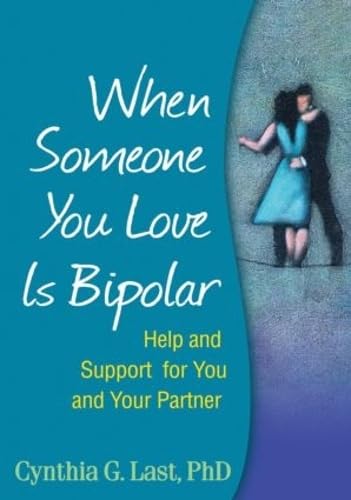
When Someone You Love Is Bipolar
Help and Support for You and Your Partner
By Cynthia G. LastThe Guilford Press
Copyright © 2009 Cynthia G. Last
All rights reserved.
ISBN: 978-1-60623-124-1All rights reserved.
Contents
Cover,
Title Page,
Copyright,
Foreword,
Acknowledgments,
Introduction,
1 Does Someone You Love Have Bipolar Disorder?,
2 What You Can Expect: The Course of Bipolar Illness,
3 "It's Not Me!": When Your Partner is in Denial,
4 What You Need to Know about Your Partner's Treatment,
5 You, Your Loved One, and the Doctors: The Team Approach to Getting and Staying Well,
6 Helping Your Partner Stick with Medication,
7 Other Things You and Your Partner Can Do to Prevent Mood Episodes,
8 Strategies for Dealing with the Ups Together,
9 Strategies for Dealing with the Downs Together,
10 Taking Care of Yourself and Your Relationship,
Resources,
About the Author,
Index,
About Guilford Publications,
From the Publisher,
CHAPTER 1
Does Someone You Love Have Bipolar Disorder?
Shelly is extremely worried about her fiancé, Peter, who has just been diagnosed with bipolar disorder. For the past couple of months he's been acting very strange, like a person she doesn't even know. His mood changes at the drop of a hat: one minute he's really cheerful and boisterous, the next irritable and angry and picking fights with her. He's hardly been sleeping, too, but instead of being exhausted he says he feels "wired" and that his thoughts are rushing through his head. Shelly believes this must be true because Peter is speaking really fast and tripping over his words; she can't even get a word in edgewise.
Shelly knows that Peter has had depressions in the past, but what he's going through now doesn't look like depression. What does it mean that Peter has "bipolar disorder"? Shelly thought they'd get married and have children one day, but now she's really concerned about their future.
Bipolar can be a very scary word, especially when it's used to describe someone you love. I know because as a psychologist I diagnose the illness in my practice and see the reactions of people and their families. I also know because my husband and I have had to hear the word applied to me.
When I was first told that I had bipolar disorder, I reacted with shock and disbelief. "I'm a manic–depressive?" I incredulously asked my doctor. "How is that possible? I have a husband, a career, and friends. There must be some mistake." But there was no mistake. My husband was equally stunned but, as is typical for him in the face of adversity, put on a brave face. Still, he couldn't hide the fact that, like Shelly, he was worried for our future.
Having diagnosed and treated bipolar disorder for so many years, it never ceases to amaze me how I "missed" my own diagnosis. I put the word missed in quotation marks because, in all honesty, I think I really did know what was going on with me; I just didn't want to face it. After all, nobody—including psychologists—wants to have bipolar disorder. But after years of blaming situations and other people for my mood swings, I finally had to face the undeniable truth—it was me, or rather my illness, that was to blame.
Externalizing blame is a way bipolar people try to make sense of what's happening to them. And it's also one of the reasons so many people with this illness go undiagnosed. They insist nothing is wrong with them and then refuse to see a mental health professional. Your partner even may say, "It's not me that has the problem; it's you!"
But you know it's not you. In fact, if you're like many spouses and partners of bipolar people, you have a temperament or personality type that's very different from the bipolar experience. If I had to put forth an educated guess (a guess based on 25 years of experience with bipolar people and their mates), I'd say that you're a fairly even-keeled, predictable person by nature, one who tends to "minimize" things as opposed to overreacting. Essentially you likely are, if you will, the proverbial calm in the middle of the storm. You also, if you are like a lot of the mates of bipolar individuals whom I've met, a "caregiver," a person who derives satisfaction from taking care of others. These qualities—your steadfastness and caregiving nature—may be partly why your mate picked you as a partner. It also may be partly why you picked your mate: you found your partner's personality exciting and the relationship offered you an opportunity to express your nurturing side.
But I don't mean to overgeneralize. It's true that opposites don't always attract. You may, in fact, have been drawn to your partner's lively temperament because it resembles, in some ways, your own. In that case, if your partner is just moving into a depressed phase for the first time, you may feel like you've been blindsided, neither able nor willing to deal with the downside of mood swings.
Living with and loving somebody who has bipolar disorder is a daunting task. You may be the type of person who has the emotional strength to readily take on the difficulties that bipolar disorder presents. Or maybe you don't view yourself as particularly strong, steadfast, or as a natural nurturer; right now you just feel overwhelmed and confused. Either way, I expect that no one has given you guidance in how best to meet the challenges you've been handed.
Fortunately, because of both my professional and personal experience with this illness, I'm in a position to help. In this book I offer a wealth of practical strategies and suggestions for you to use at times when you want to help your mate but just don't know how, as well as emotional support for you during times when you just don't feel up to the task. But before getting to this, the very first step is to make sure your loved one really does have bipolar disorder and that the type of bipolar disorder has been identified correctly.
No one welcomes a diagnosis of bipolar disorder. It's a serious illness that has the potential to devastate individuals and wreak havoc in families. But if your loved one does have the illness, your opportunity to have the life you both want so badly rests on getting—and accepting (see Chapter 3)—the diagnosis.
Although it can feel like your life is over, being diagnosed with bipolar disorder really is a beginning. It's the beginning of making sense of the emotional roller coaster ride your loved one has been on, and it's the beginning of getting help—the right kind of help—for the illness. That's what happened for my husband and me, and it's what I expect will happen for you and your partner too.
Normal and Abnormal Moods
Manic–depressive illness—as bipolar disorder originally was called—was first described in the late 1800s by Emil Kraepelin, a German psychiatrist. If you've seen the movie Mr. Jones with Richard Gere, you have a good idea of Kraepelin's conceptualization of the disorder. The film shows a young man, untreated for his bipolar disorder, having ups and downs at the farthest ends of the continuum—suicidal depressions and psychotic (out of touch with reality) manias.
While the movie contains a good enactment of severe, psychotic manic–depressive illness, our understanding of the disorder today is much broader than this. The thinking now is that there is a spectrum of bipolar disorders that includes different forms of the illness,...
„Über diesen Titel“ kann sich auf eine andere Ausgabe dieses Titels beziehen.
Suchergebnisse für When Someone You Love Is Bipolar: Help and Support...

Beispielbild für diese ISBN
When Someone You Love Is Bipolar: Help and Support for You and Your Partner
Anbieter: ThriftBooks-Dallas, Dallas, TX, USA
Verkäuferbewertung 5 von 5 Sternen

Hardcover. Zustand: Very Good. No Jacket. Former library book; May have limited writing in cover pages. Pages are unmarked. ~ ThriftBooks: Read More, Spend Less. Artikel-Nr. G1606231243I4N10
Gebraucht kaufen
EUR 27,54
Versand gratis
Versand innerhalb von USA
Versand innerhalb von USA
Anzahl: 1 verfügbar
Beispielbild für diese ISBN
When Someone You Love Is Bipolar: Help and Support for You and Your Partner
Anbieter: ThriftBooks-Atlanta, AUSTELL, GA, USA
Verkäuferbewertung 5 von 5 Sternen
Hardcover. Zustand: Very Good. No Jacket. Former library book; May have limited writing in cover pages. Pages are unmarked. ~ ThriftBooks: Read More, Spend Less. Artikel-Nr. G1606231243I4N10
Gebraucht kaufen
EUR 27,54
Versand gratis
Versand innerhalb von USA
Versand innerhalb von USA
Anzahl: 1 verfügbar
Beispielbild für diese ISBN
When Someone You Love Is Bipolar : Help and Support for You and Your Partner
Verlag:
Guilford Publications, 2009
ISBN 10: 1606231243
ISBN 13: 9781606231241
Gebraucht
Hardcover
Erstausgabe
Anbieter: Better World Books: West, Reno, NV, USA
Verkäuferbewertung 5 von 5 Sternen
Zustand: Very Good. 1st Edition. Former library copy. Pages intact with possible writing/highlighting. Binding strong with minor wear. Dust jackets/supplements may not be included. Includes library markings. Stock photo provided. Product includes identifying sticker. Better World Books: Buy Books. Do Good. Artikel-Nr. 8970823-6
Gebraucht kaufen
EUR 29,15
Versand gratis
Versand innerhalb von USA
Versand innerhalb von USA
Anzahl: 1 verfügbar
Beispielbild für diese ISBN
When Someone You Love Is Bipolar : Help and Support for You and Your Partner
Verlag:
Guilford Publications, 2009
ISBN 10: 1606231243
ISBN 13: 9781606231241
Gebraucht
Hardcover
Erstausgabe
Anbieter: Better World Books, Mishawaka, IN, USA
Verkäuferbewertung 5 von 5 Sternen
Zustand: Good. 1st Edition. Former library copy. Pages intact with minimal writing/highlighting. The binding may be loose and creased. Dust jackets/supplements are not included. Includes library markings. Stock photo provided. Product includes identifying sticker. Better World Books: Buy Books. Do Good. Artikel-Nr. 5401162-6
Gebraucht kaufen
EUR 29,15
Versand gratis
Versand innerhalb von USA
Versand innerhalb von USA
Anzahl: 1 verfügbar