
Verwandte Artikel zu Useful Research: Advancing Theory and Practice
Inhaltsangabe
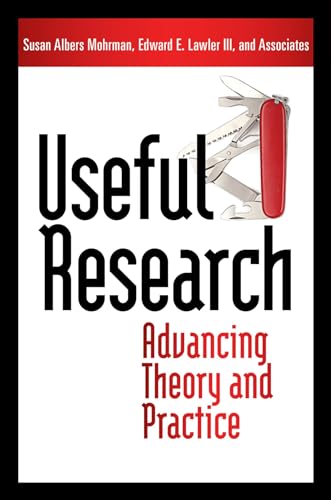
For decades there has been an ongoing, at times heated, debate over how relevant to real-world concerns organizational research should be. The contributors to this book deviate from the orthodoxy of traditional positivistic research, arguing that the true test of whether knowledge is useful to practice is not whether it is rigorous but whether it is rigorous and results in improved organizational effectiveness.
The contributors were selected for their demonstrated ability to conduct useful research and their distinguished academic careers. Part I features researchers who describe the choices they make and the tactics they employ to ensure that their work advances both theory and practice. In part II, five highly respected researchers reflect on how they were able to have a broad impact on practice and still maintain academic rigor. Part III describes pathways to bring academic knowledge to practice—working with consultancies, executive PhD programs, OD specialists, and professional associations, as well as framing academic concepts in ways that are attention grabbing, memorable, and credible to practitioners. Part IV looks at the prospects for doing useful research in traditional academic settings like business schools and publishing it in peer-reviewed journals. Finally, Part V sums up the themes of the book and the challenges and opportunities facing researchers who aspire to do research that advances both theory and practice.
Die Inhaltsangabe kann sich auf eine andere Ausgabe dieses Titels beziehen.
Über die Autorin bzw. den Autor
Susan Albers Mohrman is a senior research scientist at the University of Southern California’s Center for Effective Organizations in the Marshall School of Business. She directs the organization design program at CEO.
Edward E. Lawler III is Distinguished Professor of Business at the University of Southern California’s Marshall School of Business and founder and director of the university’s Center for Effective Organizations. BusinessWeek proclaimed him one of the top six gurus in the field of management.
Auszug. © Genehmigter Nachdruck. Alle Rechte vorbehalten.
Introduction
SUSAN ALBERS MOHRMAN
AND EDWARD E. LAWLER III
THE PURPOSE OF THIS BOOK is to provide frameworks and evidence-based guidance to scholars interested in doing research that advances both academic knowledge and practice. For us, and for many of the contributors to this book, this topic has been a career-long concern. We believe that the contribution of research to organizational practice is of critical importance in a world where organizations of all kinds are shaping the future and fundamentally impacting the quality of life and the health of societies.
Dual-impact research has been the mission of the Center for Effective Organizations (CEO) at the University of Southern California’s (USC’s) Marshall School of Business since its founding in 1979. In 1983, we held a workshop of prominent organization and management researchers that resulted in an edited book, Doing Research That Is Useful for Theory and Practice (Lawler et al., 1985; reissued with a new foreword and introduction in 1999). Authors wrote chapters, discussed and refined their ideas about useful research at the workshop, and then revised their chapters for the book. Researchers were invited to be part of this project based on their doing research that was useful to theory and practice. The express purpose of that book was to demonstrate the legitimacy and importance of dual-purpose research.
Useful Research: Advancing Theory and Practice revisits the topic of research that is useful for theory and practice. Once again, we assembled prominent researchers, including some authors from the original book. Our purpose was to reexamine this important topic, this time focusing on what has been learned about how to do dual-purpose research. Again, researchers wrote chapters for a workshop, this time held on December l, 2009. Their chapters were then revised for this book to reflect the exchange that occurred during the workshop.
Today, doing research that addresses theory and practice is not the predominant orientation of the fields of management and organizational sciences. If anything, it is less a focus than it was in 1983. There are, however, beacons of hope as a number of leading scholars are intentionally and successfully conducting research that is significantly impacting management and organizations. There have been and continue to be periodic eruptions of voiced concern about the need for research to have a greater impact. Some of these have come from leading scholars such as Sara Rynes, Denise Rousseau, Don Hambrick, and others who have been highly successful in careers based on traditional research. Recently there have been a number of special journal issues and conferences on the topic, and many proposals and initiatives that are intended to bridge the relevance gap between management research and practice have been made. In his 2010 Presidential Address to the Academy of Management, Jim Walsh pointed out that more than half of the last 16 presidents of the Academy have used the occasion of their presidential addresses to emphasize the importance of doing research that contributes to practice, and have decried the lack of impact of prevailing research approaches.
The seemingly low impact of these waves of concern about bridging the gap between research and practice testifies to how deep seated the experienced conflicts are between rigor and relevance, theory and practice, career concerns and societal contribution. A dull murmur in the 1990s about the need for relevance has turned into a more strident advocacy of relevance to practice. Nevertheless, journals remain predominantly oriented toward the status quo, top-level business schools seem unconcerned that their research faculty do not carry out useful research, and entry-level organizational and management researchers continue to publish primarily or exclusively in the traditional research journals. There is a great chasm between the advocates of bridging the gap and the behavior of the many researchers who do not even try to do so and who do not believe it is an important or legitimate issue.
Recounting what is known about the nature of the gap between research and practice is not the major purpose of this book. Others have done so already. Rather, our purpose is to identify and describe research strategies and approaches that simultaneously advance academic and practical knowledge. We believe that research can lead to improvements in practice as well as advances in theoretical understanding. Academic knowledge is advanced when scientific theories, frameworks, and models accurately reflect and lead to greater understanding, explanation, and prediction of individual and organizational behavior. Practical knowledge is advanced when research enables organizations to carry out their purposes more effectively. In our view, the test of whether knowledge is useful to practice is not whether it is “theoretically” impactful—but whether it is actually used and results in improved practice.
The focus of this book is more on the challenge of linking research to practice than on the challenge of linking research to the advancement of theoretical knowledge. This choice should not be taken as a statement that all is well with respect to the latter. Indeed, many advocates of reducing the gap between theory and practice believe that a root cause of the lack of impact of research on practice is that research has not sufficiently advanced theoretical understanding.
Both Andrew Van de Ven (2007) and William Starbuck (2006) have compellingly described the methodological pitfalls of rigorous positivistic research that lead to a false complacency that such research is enhancing the understanding of organizations. They and others (e.g., Daft & Lewin, 2008) have described the tendency for research studies to become increasingly narrow and therefore unable to elucidate complex organizational phenomena. Starbuck has questioned whether our attempts to examine a representative sample to find average relationships through variance-based analyses are in any way informative to organizations that aspire to be excellent. Ongoing debates pit various methodological preferences and perspectives against one another, but these debates among research paradigms are not a major focus of this book. Instead, our focus is on how to do dual-purpose research.
In the opening chapter, we set the stage by discussing the mission of organizational researchers to do research that contributes to theory and practice. We believe that mission stems directly from the societal importance of organizations as well as from the role of professional schools. We examine different perspectives on what this mission means for the practice of and the practitioners of organizational research. We argue that impact can be achieved through a number of research approaches and ways of connecting to practice, and that all are necessary in today’s turbulent environment when the very nature of organizations and organizing is experiencing a fundamental change.
The authors in Part I were invited to write chapters because they are carrying out research with the purposes of generating academic knowledge and enabling more effective practice. They describe the choices they make and the tactics they employ in order to accomplish these goals.
Amy C. Edmondson describes her evolving research program at the Harvard Business School’s Technology and Operations Unit. She has been looking at the relationship of various team dynamics to outcomes such as medical error rates and quality in health care settings. She stresses the benefits to theory development as well as to practice that come from doing problem-focused research, spending time in the field, and working across boundaries.
Susan Albers Mohrman and Allan M. Mohrman, Jr. describe the longitudinal,...
„Über diesen Titel“ kann sich auf eine andere Ausgabe dieses Titels beziehen.
Suchergebnisse für Useful Research: Advancing Theory and Practice

Beispielbild für diese ISBN
Useful Research: Advancing Theory and Practice
Verlag:
Berrett-Koehler Publishers, 2011
ISBN 10: 1605096008
ISBN 13: 9781605096001
Gebraucht
Hardcover
Anbieter: World of Books (was SecondSale), Montgomery, IL, USA
Verkäuferbewertung 5 von 5 Sternen

Zustand: Good. Item in good condition. Textbooks may not include supplemental items i.e. CDs, access codes etc. Artikel-Nr. 00105101862
Gebraucht kaufen
EUR 6,17
Versand gratis
Versand innerhalb von USA
Versand innerhalb von USA
Anzahl: 1 verfügbar
Beispielbild für diese ISBN
Useful Research: Advancing Theory and Practice
Verlag:
Berrett-Koehler Publishers, 2011
ISBN 10: 1605096008
ISBN 13: 9781605096001
Gebraucht
Hardcover
Anbieter: Anybook.com, Lincoln, Vereinigtes Königreich
Verkäuferbewertung 5 von 5 Sternen
Zustand: Good. This is an ex-library book and may have the usual library/used-book markings inside.This book has hardback covers. Clean from markings. In good all round condition. Please note the Image in this listing is a stock photo and may not match the covers of the actual item,850grams, ISBN:9781605096001. Artikel-Nr. 9726948
Gebraucht kaufen
EUR 30,58
EUR 15,41 Versand
Versand von Vereinigtes Königreich nach USA
Versand von Vereinigtes Königreich nach USA
Anzahl: 1 verfügbar
Beispielbild für diese ISBN
Useful Research: Advancing Theory and Practice: Advancing Theory and Practice (AGENCY/DISTRIBUTED)
Anbieter: Kennys Bookstore, Olney, MD, USA
Verkäuferbewertung 5 von 5 Sternen
Zustand: New. Discusses the legitimacy and importance of conducting useful research to benefit both theory and practice in the field of organizational and management research. This book examines how useful research can be achieved. It goes beyond advocacy, theoretical debate, and restatements of the problem to focus on the types of research methods. Num Pages: 450 pages. BIC Classification: KJT. Category: (P) Professional & Vocational. Dimension: 235 x 162 x 29. Weight in Grams: 756. . 2011. hardcover. . . . . Books ship from the US and Ireland. Artikel-Nr. V9781605096001
Neu kaufen
EUR 58,09
EUR 9,37 Versand
Versand innerhalb von USA
Versand innerhalb von USA
Anzahl: 15 verfügbar