
Verwandte Artikel zu Infinite Possibility: Creating Customer Value on the...
Inhaltsangabe
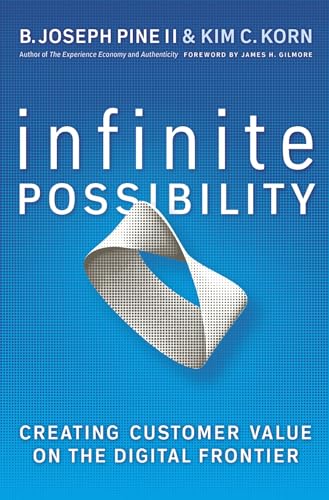
Discover how to provide experiences for your customers that combine the real with the virtual.
Joseph Pine and Jim Gilmore’s classic The Experience Economy identified a seismic shift in the business world: to set yourself apart from your competition, you need to stage experiences—memorable events that engage people in inherently personal ways. But as consumers increasingly experience the world through their digital gadgets, companies still only scratch the surface of technology-infused experiences. So Pine and coauthor Kim Korn show you how to create new value for your customers with offerings that fuse the real and the virtual.
Think of the Xbox Kinect, which combines virtual video games with a powerful physical dimension—you play by moving your own body; new apps that, when you point your smartphone camera at a real street, overlay digital information about the scene onto the image; and virtual dashboards that track the real world, moment by moment.
Digital technology offers limitless opportunities—you really can create anything you want—but real-world experiences have a richness that virtual ones do not. So how can you use the best of both? How do you make sense of such infinite possibility? What kinds of experiences can you create? Which ones should you offer?
Pine and Korn provide a profound new tool geared to exploring and exploiting the digital frontier. They delineate eight different realms of experience encompassing various aspects of Reality and Virtuality and, using scores of examples, show how innovative companies operate within and across each realm to create extraordinary customer value.
Follow them out onto the digital frontier to discover the opportunities that abound for your business.
“This book will inspire out-of-the-box thinking for anyone looking to do it differently or better. Infinite Possibility is a must-read and a great vision for technology intersecting with our five senses to create experiences consumers will want.” —Gary Shapiro, President and CEO, Consumer Electronics Association
“Pine and Korn take you on an amazing journey from Reality to Virtuality and stop at all the best corners along the way. Infinite Possibility provides an extremely robust framework to help you grasp the concepts and gives practical guidance on how any organization can make it happen right now.” —Chris Parker, Senior Vice President and CIO, LeasePlan Corporation
Die Inhaltsangabe kann sich auf eine andere Ausgabe dieses Titels beziehen.
Über die Autorin bzw. den Autor
B. Joseph Pine II is an author, speaker, and management advisor to Fortune 500 companies and start-ups alike. He is the coauthor of The Experience Economy and Authenticity and the author of Mass Customization.
Kim C. Korn is a management practitioner turned author, speaker, and management advisor. As founder of Business Architecture Inc., he helps companies unlock their potential to thrive indefinitely by creating ever-greater value.
Auszug. © Genehmigter Nachdruck. Alle Rechte vorbehalten.
INNOVATION ON THE DIGITAL FRONTIER
A number of years ago I (Joe) gave a boardroom talk in Milan, Italy, to a number of executives from different companies. One was the vice president of a global coffee manufacturer, who said something that amazed me: “There’s been no innovation in the coffee industry in fifteen years.” I responded: “Have you never heard of Starbucks?” This gentleman could only conceive of innovation in physical goods, not in experiences— a particularly ironic stance given we were in one of the foremost coffee meccas of the world, the very city that inspired Howard Schultz to create the Starbucks coffee-drinking experience.
That is what we desperately need in business today: experience innovation. Why? Because we are now in an Experience Economy, where experiences—memorable events that engage people in inherently personal ways—have become the predominant economic offering. It eclipsed the Service Economy that flowered in the latter half of the twentieth century, which in turn superseded the Industrial Economy, which itself supplanted the Agrarian Economy.1
Experiences are not new, just newly identified as distinct economic offerings. They have always been around—think of traveling troubadours, Greek plays, Roman sporting events, commedia dell’arte performances—but now encompass so much of the economy that every company faces a stark choice: innovate goods and services ever faster as their productive lives get ever shorter, or focus on offering innovation further up the “Progression of Economic Value” (Figure I.1), on experiences that engage customers, or even transformations, built atop life-changing experiences, that guide customers in achieving their aspirations.2 These higher-order offerings create greater value for customers, generally have longer life spans as they prove more difficult for competitors to imitate, enable premium prices, and let companies capture more economic value.
Figure I.1 The Progression of Economic Value. From B. Joseph Pine II and James H. Gilmore, The Experience Economy, Updated Edition (Boston: Harvard Business Review Press, 2011), 245.
Innovation is the great decommoditizer, for by definition if it is truly new, it is truly differentiated, as no one else has the same capability; competitors cannot create that same value at any price. And today, taking either innovation path to stay ahead of the commoditization steamroller seeking to squeeze margins and flatten profits, a company must attune itself to the greatest source of offering innovation ever devised: digital technology.
The Digital Frontier
As coffee manufacturers the world over missed the shift to the Experience Economy, so too have many companies missed how digital technology has been remaking the competitive landscape. Consider Motorola, once the king of cellular phones. Its stay atop the pinnacle of the industry, however, resulted from analog phones; once the shift to digital washed over the industry in full force, it was Nokia that took over the crown. Nokia innovated far better in function and styling, providing more of what customers wanted from the new capabilities digital technology brought to mobile phones and services. Motorola fought back and produced occasional successes, such as the RAZR, but could not consistently outperform Nokia and spun off the business into Motorola Mobility as it became one of many also-rans in the industry.
But so, really, did Nokia. For what both companies missed was the intersection of digital technology and experience innovation pioneered by Apple. When Apple entered the smartphone industry and took it over—in worldwide global mindshare if not in market share—it thought long and hard about the phone-using experience and created a device not just highly functional but a joy to use. It thought long and hard about how the experience we have with our phone could be a great part of its value, and then about how the experiences we have on our phone, via apps, could overwhelm every other consideration. It thought long and hard about how to turn the purchasing of the phone (and of course all its other technological offerings) into an experience itself and innovated the one-of-a-kind Apple Stores, which today generate over half the company’s revenues. It even thought long and hard about the box-opening and guide-reading experiences, for goodness sake, and innovated ones for the iPhone and its App Store, respectively, about which people wax poetic!3 Apple still primarily sells digital-based goods (with many services, such as the iTunes store, and a few membership-based experiences, such as One to One), but it markets digitally infused experiences, and thereby reaps the rewards.
Thinking long and hard about using digital technology to create unique customer value—that is the theme of this book. The digital frontier, lying at this intersection of digital technology and offering innovation, beckons companies seeking to create new customer value by mining its rich veins of possibility. For digital innovations enrich our lives by augmenting and thereby enhancing our reality; by engaging us through alternate views of reality that make us active participants in the world around us; by letting us play with time in ways not otherwise possible; by engrossing us in virtual worlds that enchant and capture our time; by allowing us to interact with those worlds through material devices and even gestures; by letting us physically realize whatever we imagine; and by enabling virtual representations that mirror our reality to enlighten us from a new vantage point. Digital innovations can even give us a greater appreciation and desire for Reality itself, whenever we take the time to unplug and just be. But by far the greatest value will come from those innovations that create third spaces that fuse the real and the virtual.
Why Digital Technology Changes the Game
As far back as 1984, pioneering computer scientist Alan Kay recognized the unique power of digital technology “The computer is a medium that can dynamically simulate the details of any other medium, including media that cannot exist physically. It is not a tool, although it can act like many tools. The computer is the first metamedium, and as such it has degrees of freedom for representation and expression never before encountered and as yet barely investigated.”4 Around that same time, one of those investigating the power of this new medium, Jaron Lanier, coined the term “virtual reality” as he envisioned the creation of a “virtual world with infinite abundance.”5 And less than a decade later, Brenda Laurel, in her wonderful exploration Computers as Theatre, told us that “computers are representation machines” and that designing the “human-computer experience” is “about creating imaginary worlds that have a special relationship to reality—worlds in which we can extend, amplify, and enrich our own capacities to think, feel, and act.”6 Now, what these visionaries foresaw two and three decades ago has become impossible for us to ignore because it underlies so very much of the value companies create today, so much of the value customers seek.
Digital technology differs from all other kinds of man-made technology due to the distinctive characteristics of the bits at its digital core. Although most readers will be familiar with these characteristics (and others that could be cited), it still is worth recognizing the following:
∞ Bits are immaterial. They weigh nothing, cost little or nothing to store or replicate, and do not “age” with time. They require no ongoing maintenance, are always as good as they were the first day they were produced, and do not wear out with use. For...
„Über diesen Titel“ kann sich auf eine andere Ausgabe dieses Titels beziehen.
Suchergebnisse für Infinite Possibility: Creating Customer Value on the...

Beispielbild für diese ISBN
Infinite Possibility: Creating Customer Value on the Digital Frontier
Verlag:
Berrett-Koehler Publishers (edition First Edition), 2011
ISBN 10: 160509563X
ISBN 13: 9781605095639
Gebraucht
Hardcover
Erstausgabe
Anbieter: BooksRun, Philadelphia, PA, USA
Verkäuferbewertung 5 von 5 Sternen

Hardcover. Zustand: Very Good. First Edition. With dust jacket. It's a well-cared-for item that has seen limited use. The item may show minor signs of wear. All the text is legible, with all pages included. It may have slight markings and/or highlighting. Artikel-Nr. 160509563X-8-1-29
Gebraucht kaufen
EUR 4,89
Versand gratis
Versand innerhalb von USA
Versand innerhalb von USA
Anzahl: 1 verfügbar
Beispielbild für diese ISBN
Infinite Possibility: Creating Customer Value on the Digital Frontier
Verlag:
Berrett-Koehler Publishers, 2011
ISBN 10: 160509563X
ISBN 13: 9781605095639
Gebraucht
Hardcover
Anbieter: ThriftBooks-Dallas, Dallas, TX, USA
Verkäuferbewertung 5 von 5 Sternen
Hardcover. Zustand: As New. No Jacket. Pages are clean and are not marred by notes or folds of any kind. ~ ThriftBooks: Read More, Spend Less. Artikel-Nr. G160509563XI2N00
Gebraucht kaufen
EUR 5,87
Versand gratis
Versand innerhalb von USA
Versand innerhalb von USA
Anzahl: 1 verfügbar
Beispielbild für diese ISBN
Infinite Possibility: Creating Customer Value on the Digital Frontier
Verlag:
Berrett-Koehler Publishers, 2011
ISBN 10: 160509563X
ISBN 13: 9781605095639
Gebraucht
Hardcover
Anbieter: ThriftBooks-Dallas, Dallas, TX, USA
Verkäuferbewertung 5 von 5 Sternen
Hardcover. Zustand: Very Good. No Jacket. May have limited writing in cover pages. Pages are unmarked. ~ ThriftBooks: Read More, Spend Less. Artikel-Nr. G160509563XI4N00
Gebraucht kaufen
EUR 5,87
Versand gratis
Versand innerhalb von USA
Versand innerhalb von USA
Anzahl: 1 verfügbar
Beispielbild für diese ISBN
Infinite Possibility : Creating Customer Value on the Digital Frontier
Verlag:
Berrett-Koehler Publishers, Incorporated, 2011
ISBN 10: 160509563X
ISBN 13: 9781605095639
Gebraucht
Hardcover
Anbieter: Better World Books, Mishawaka, IN, USA
Verkäuferbewertung 5 von 5 Sternen
Zustand: Very Good. Former library copy. Pages intact with possible writing/highlighting. Binding strong with minor wear. Dust jackets/supplements may not be included. Includes library markings. Stock photo provided. Product includes identifying sticker. Better World Books: Buy Books. Do Good. Artikel-Nr. GRP73071815
Gebraucht kaufen
EUR 7,27
Versand gratis
Versand innerhalb von USA
Versand innerhalb von USA
Anzahl: 1 verfügbar
Beispielbild für diese ISBN
Infinite Possibility: Creating Customer Value on the Digital Frontier: Creating Customer Value on the Digital Frontier (AGENCY/DISTRIBUTED)
Verlag:
Berrett-Koehler Publishers, 2011
ISBN 10: 160509563X
ISBN 13: 9781605095639
Gebraucht
Paperback
Anbieter: WorldofBooks, Goring-By-Sea, WS, Vereinigtes Königreich
Verkäuferbewertung 5 von 5 Sternen
Paperback. Zustand: Very Good. The book has been read, but is in excellent condition. Pages are intact and not marred by notes or highlighting. The spine remains undamaged. Artikel-Nr. GOR007303548
Gebraucht kaufen
EUR 3,71
EUR 6,51 Versand
Versand von Vereinigtes Königreich nach USA
Versand von Vereinigtes Königreich nach USA
Anzahl: 3 verfügbar
Beispielbild für diese ISBN
Infinite Possibility : Creating Customer Value on the Digital Frontier
Verlag:
Berrett-Koehler Publishers, Incorporated, 2011
ISBN 10: 160509563X
ISBN 13: 9781605095639
Gebraucht
Hardcover
Anbieter: Better World Books Ltd, Dunfermline, Vereinigtes Königreich
Verkäuferbewertung 5 von 5 Sternen
Zustand: Very Good. Former library copy. Pages intact with possible writing/highlighting. Binding strong with minor wear. Dust jackets/supplements may not be included. Includes library markings. Stock photo provided. Product includes identifying sticker. Better World Books: Buy Books. Do Good. Artikel-Nr. GRP73071815
Gebraucht kaufen
EUR 5,67
EUR 5,82 Versand
Versand von Vereinigtes Königreich nach USA
Versand von Vereinigtes Königreich nach USA
Anzahl: 3 verfügbar
Beispielbild für diese ISBN
Infinite Possibility: Creating Customer Value on the Digital Frontier
Verlag:
Berrett-Koehler Publishers, 2011
ISBN 10: 160509563X
ISBN 13: 9781605095639
Gebraucht
Hardcover
Anbieter: medimops, Berlin, Deutschland
Verkäuferbewertung 5 von 5 Sternen
Zustand: as new. Wie neu/Like new. Artikel-Nr. M0160509563X-N
Gebraucht kaufen
EUR 9,93
EUR 10,00 Versand
Versand von Deutschland nach USA
Versand von Deutschland nach USA
Anzahl: 1 verfügbar
Beispielbild für diese ISBN
Infinite Possibility
Anbieter: Mooney's bookstore, Den Helder, Niederlande
Verkäuferbewertung 4 von 5 Sternen

Zustand: Very Good. Artikel-Nr. 069C3C63E3F456D
Gebraucht kaufen
EUR 22,11
EUR 14,95 Versand
Versand von Niederlande nach USA
Versand von Niederlande nach USA
Anzahl: 1 verfügbar