
Verwandte Artikel zu World Class Diversity Management: A Strategic Approach
Inhaltsangabe
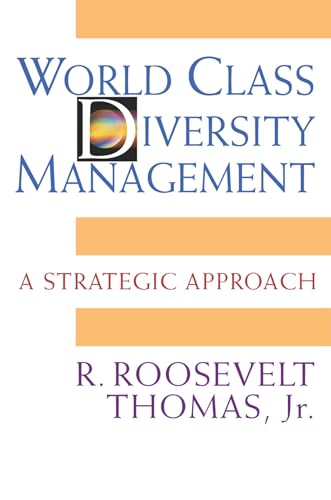
Globalization is transforming the very nature of our business relationships, decision-making processes, and interactions, making world-class diversity management more needed than ever before. But until now, the field of diversity had no established standard for evaluating best practices, or even agreement on fundamental philosophies, principles, and concepts. In this pioneering book, the world’s leading diversity authority proposes a framework that will facilitate the development of a truly world-class standard for diversity management.
R. Roosevelt Thomas begins by laying out his Four Quadrant model, which encompasses all core diversity strategies: managing workforce demographic representation, managing demographic relationships, managing diverse talent, and managing all strategic diversity mixtures. He analyzes the goals, motives, approaches, accomplishments, and challenges associated with each quadrant, as well as the paradigm or mindset that lies behind each quadrant’s express purpose.
Having laid out this broad range of strategies, Thomas shows how to realize them through the Strategic Diversity Management Process™, by far the most effective method for implementation. A detailed case study of CEO Jeff Kilt—a fictional composite of the many executives Thomas has worked with—effectively illustrates the complexities encountered when working with each of the Four Quadrant strategies in the real world.
This book offers a comprehensive blueprint that will enable leaders to address any diversity issue (not just race or gender) in any setting, anywhere in the world. Most important, it proves that a world-class standard of diversity management is indeed a possible and achievable goal.
Die Inhaltsangabe kann sich auf eine andere Ausgabe dieses Titels beziehen.
Über die Autorin bzw. den Autor
R. Roosevelt Thomas, Jr., is CEO of Roosevelt Thomas Consulting & Training, Inc., and is founder and senior research fellow of the American Institute for Managing Diversity. Recognized by the Wall Street Journal as one of the top ten consultants in the country and cited by Human Resource Executive as one of HR’s Most Influential People, he is a sought-after speaker and the author of several books, including Building on the Promise of Diversity, Beyond Race and Gender, and Building a House for Diversity.
Auszug. © Genehmigter Nachdruck. Alle Rechte vorbehalten.
INTRODUCTION
As I begin this introduction, I have been reflecting on previous situations where I have seen accelerated learning and growth through quality dialogue. The situations have been varied, but they have shared one characteristic: Before the discussion began, time was taken to establish a context for the discussion. Often that time was used to establish agreed-upon definitions.
Given the wide variety of perspectives on “diversity” and my experience in working with senior organizational leaders, I propose that we seek some common ground around definitions—if only for the purpose of discussion. Toward this end, I offer a set of definitions for the diversity-related terms that I have used throughout the book.
BASIC DEFINITIONS
Below are definitions that will make the reading of the book more enjoyable and profitable:
Diversity— the differences and similarities, and related tensions and complexities, that can characterize mixtures of any kind. When you speak of diversity, you are describing a characteristic of a collection or mixture of some kind, such as employees, customers, vendors, functions, organizational participants in an acquisition or merger, citizens, family members, or congregants in a religious setting.
This means that when you talk of a group’s diversity, you have to specify the dimension. In the United States, when someone says a group is “diverse,” he typically means with respect to race, gender, or ethnicity. In reality, the dimension possibilities are enormous, thus the need to specify.
In addition, with diversity (differences and similarities) come tensions and complexities. The greater the diversity, the greater the likelihood of tension and complexity.
Diversity tension— the stress and strain that come from the interaction and clashing of differences and similarities.
Complexity— that which makes something difficult to explain.
Diversity management— the ability to make quality decisions in the midst of any set of differences and similarities and related tensions and complexities.
Complexity management— the ability to make quality decisions in the midst of factors that make something difficult to explain.
Capability— the wherewithal to think through diversity issues of any kind in pursuit of quality decisions that support an entity’s overarching objectives. A critical assumption is that the individual or organization (represented by its leaders and managers) can be the actor.
Achieving this wherewithal requires understanding and operationalizing concepts, principles, theories, and paradigms; developing and mastering skills and competencies; and sustaining a high level of craftsmanship through continuous learning and introspection.
WORLD-CLASS DIVERSITY MANAGEMENT
Defined
Practicing World-Class Diversity Management means operating at a level that is the best in the world with respect to diversity management. At a minimum, it suggests the use of state-of-the-art strategies and approaches for addressing any diversity issue in any setting in any geographical location.
Achieving this status doesn’t require an enterprise to operate beyond its country’s borders. It might practice diversity management at a world-class level within its community, state, regional, or national boundaries. The determining factor would be that the quality of its practices cannot be beaten anywhere in the world.
Consider the realm of baseball. The “World Champion” New York Yankees may never play a team from outside the United States; yet, because of their understanding—rightly or not—that United States baseball is the best in the world, they can claim that winning the World Series entitles them to say, “We are world champions.” As the quality of professional baseball outside the United States grows in perceived excellence, World Series winners will not be able to claim “We are the best in the world” without engaging in some competition to prove that point.
With respect to diversity management, we still have to define the game and then determine what it means to play at a world-class level. To date, practitioners and managers have expressed relatively little interest in establishing and pursuing the standards that would allow us to do that.
Writing on the meaning of World-Class Diversity Management has brought to mind my first encounter with World-Class Manufacturing and Total Quality Management (TQM) in the mid-eighties, when the emphasis was on achieving world-class status in manufacturing. One of our first diversity clients placed great stock in being world class. The company viewed world class as the gold standard against which any self-respecting manufacturing organization must mea sure itself. As this company expanded its global manufacturing operations, its managers found that being competitive required familiarity with the best philosophies and practices of TQM and other manufacturing philosophies and tools. This was true for other corporations with global operations and for some with domestic sites only.
This reality led our client to send groups of its managers to attend seminars on different manufacturing approaches, to visit the sites of enterprises that advocated innovative strategies, to invite leading practitioners to tour and assess their facilities, and to devour books on various methodologies—TQM and others. Our clients and other corporations did make significant progress toward world-class status and touted that progress widely internally and externally.
As we began our diversity management work with the organization, its representatives told us that they wanted to be world class in diversity as well as in manufacturing. Given the embryonic nature of diversity at that time, we could not guarantee that our offer was world class. We were comfortable, however, in saying that our approach had the potential to become world class. We also gained credibility by relating our diversity approach to the company’s World-Class Manufacturing practices and philosophies.
My point here is that being world class had become a way of life for our clients wherever they operated a manufacturing facility in the world. As these manufacturing managers interacted with global functions, they often cited manufacturing philosophies and principles. The notion of world class had become ingrained in them.
The diversity field has not progressed to this point. We in the field have neither established what world class is nor specified how it might be achieved. Further, we lack agreement on our most fundamental philosophies, principles, and concepts, as well as consensus as to what best practices are. Indeed, it is not clear that we want to be world class. Some feeling exists that because the field is diversity, practitioners should be diverse (fragmented) in their thinking.
Requirements
Several elements must be in place if we are to establish and achieve world-class status in the diversity arena. These include the following:
Universal philosophies. We must have sets of universal theories, principles, concepts, and frameworks that can be applied to any type of diversity mixture at any geographic location. Aspirants to world-class stature need universal tools as a basis for world capability and applicability. Such tools are not currently readily available in the diversity arena. This book is intended to be a step toward filling that gap.
An approach that fosters ease of comparison, discussion, and analysis across the globe. This data gathering capability will be key to establishing the meaning of World-Class Diversity Management. Diversity means different things to people in different countries. This can...
„Über diesen Titel“ kann sich auf eine andere Ausgabe dieses Titels beziehen.
Suchergebnisse für World Class Diversity Management: A Strategic Approach

Beispielbild für diese ISBN
World Class Diversity Management: A Strategic Approach
Verlag:
Berrett-Koehler Publishers, 2010
ISBN 10: 1605094501
ISBN 13: 9781605094502
Gebraucht
Hardcover
Anbieter: World of Books (was SecondSale), Montgomery, IL, USA
Verkäuferbewertung 5 von 5 Sternen

Zustand: Acceptable. Item in acceptable condition! Textbooks may not include supplemental items i.e. CDs, access codes etc. Artikel-Nr. 00106719236
Gebraucht kaufen
EUR 5,50
Versand gratis
Versand innerhalb von USA
Versand innerhalb von USA
Anzahl: 1 verfügbar
Beispielbild für diese ISBN
World Class Diversity Management: A Strategic Approach
Verlag:
Berrett-Koehler Publishers, 2010
ISBN 10: 1605094501
ISBN 13: 9781605094502
Gebraucht
Hardcover
Anbieter: ThriftBooks-Dallas, Dallas, TX, USA
Verkäuferbewertung 5 von 5 Sternen
Hardcover. Zustand: Very Good. No Jacket. May have limited writing in cover pages. Pages are unmarked. ~ ThriftBooks: Read More, Spend Less. Artikel-Nr. G1605094501I4N00
Gebraucht kaufen
EUR 6,12
Versand gratis
Versand innerhalb von USA
Versand innerhalb von USA
Anzahl: 1 verfügbar
Beispielbild für diese ISBN
World Class Diversity Management : A Strategic Approach
Verlag:
Berrett-Koehler Publishers, Incorporated, 2010
ISBN 10: 1605094501
ISBN 13: 9781605094502
Gebraucht
Hardcover
Anbieter: Better World Books, Mishawaka, IN, USA
Verkäuferbewertung 5 von 5 Sternen
Zustand: Good. Pages intact with minimal writing/highlighting. The binding may be loose and creased. Dust jackets/supplements are not included. Stock photo provided. Product includes identifying sticker. Better World Books: Buy Books. Do Good. Artikel-Nr. 1533148-6
Gebraucht kaufen
EUR 7,18
Versand gratis
Versand innerhalb von USA
Versand innerhalb von USA
Anzahl: 1 verfügbar
Beispielbild für diese ISBN
World Class Diversity Management : A Strategic Approach
Verlag:
Berrett-Koehler Publishers, Incorporated, 2010
ISBN 10: 1605094501
ISBN 13: 9781605094502
Gebraucht
Hardcover
Anbieter: Better World Books: West, Reno, NV, USA
Verkäuferbewertung 5 von 5 Sternen
Zustand: Very Good. Pages intact with possible writing/highlighting. Binding strong with minor wear. Dust jackets/supplements may not be included. Stock photo provided. Product includes identifying sticker. Better World Books: Buy Books. Do Good. Artikel-Nr. 17857315-6
Gebraucht kaufen
EUR 7,18
Versand gratis
Versand innerhalb von USA
Versand innerhalb von USA
Anzahl: 1 verfügbar
Beispielbild für diese ISBN
World Class Diversity Management: A Strategic Approach
Verlag:
Berrett-Koehler Publishers, 2010
ISBN 10: 1605094501
ISBN 13: 9781605094502
Gebraucht
Hardcover
Anbieter: Books From California, Simi Valley, CA, USA
Verkäuferbewertung 4 von 5 Sternen

hardcover. Zustand: Good. Artikel-Nr. mon0003916506
Gebraucht kaufen
EUR 10,43
EUR 4,44 Versand
Versand innerhalb von USA
Versand innerhalb von USA
Anzahl: 1 verfügbar
Beispielbild für diese ISBN
World Class Diversity Management
Anbieter: Kennys Bookstore, Olney, MD, USA
Verkäuferbewertung 5 von 5 Sternen
Zustand: New. The field of diversity has not yet progressed towards a standard. We have neither established what world class is, nor specified how it might be achieved. World-Class Diversity fosters ease of comparison, discussion and analysis across the globe and offers a process for addressing any diversity issue. Num Pages: 288 pages, Illustrations. BIC Classification: KJM. Category: (P) Professional & Vocational. Dimension: 244 x 167 x 27. Weight in Grams: 580. . 2010. . . . . Books ship from the US and Ireland. Artikel-Nr. V9781605094502
Neu kaufen
EUR 42,91
EUR 9,35 Versand
Versand innerhalb von USA
Versand innerhalb von USA
Anzahl: 15 verfügbar
Beispielbild für diese ISBN
World Class Diversity Management: A Strategic Approach
Anbieter: Revaluation Books, Exeter, Vereinigtes Königreich
Verkäuferbewertung 5 von 5 Sternen
Hardcover. Zustand: Brand New. 1st edition. 288 pages. 9.25x6.25x1.00 inches. In Stock. Artikel-Nr. 1605094501
Neu kaufen
EUR 58,86
EUR 14,85 Versand
Versand von Vereinigtes Königreich nach USA
Versand von Vereinigtes Königreich nach USA
Anzahl: 1 verfügbar
Foto des Verkäufers
World Class Diversity Management : A Strategic Approach
Verlag:
Berrett-Koehler Publishers Aug 2010, 2010
ISBN 10: 1605094501
ISBN 13: 9781605094502
Neu
Hardcover
Anbieter: AHA-BUCH GmbH, Einbeck, Deutschland
Verkäuferbewertung 5 von 5 Sternen
Buch. Zustand: Neu. Neuware - The leading author and senior statesman in the field of diversity management identifies the most effective diversity management philosophies, strategies and practices from around the world.Today's competitive economic environment makes it necessary to access the most effective managerial philosophies possible - this is as true for diversity management as it is for management in general. It extends to both corporations with operations in multiple countries and those indirectly experiencing the impact of globalization. Even organizations that conduct business in only one country are finding that global interconnectedness, created through communications and technology, makes it difficult to avoid the influence of world dynamics in their industry and related sectors. It has become urgently important to possess awareness of 'best in the world' philosophies.However, the field of diversity has not yet progressed towards a standard. We have neither established what 'world class' is, nor specified how it might be achieved. Until now World Class Diversity fosters ease of comparison, discussion and analysis across the globe and offers a process for addressing any diversity issue. Given the multiplicity of approaches to diversity around the globe, 'world class' status requires a process that can be adapted to any approach and used with any mixture. This book provides the blueprint to create an effective new approach, describing a common language for dialogue across countries. By creating a unified terminology and framework for implementation, World Class Diversity Management aims to become the standard and foundational text for diversity managers across the globe. Artikel-Nr. 9781605094502
Neu kaufen
EUR 41,72
EUR 35,00 Versand
Versand von Deutschland nach USA
Versand von Deutschland nach USA
Anzahl: 2 verfügbar
Foto des Verkäufers
World Class Diversity Management: A Strategic Approach
Anbieter: moluna, Greven, Deutschland
Verkäuferbewertung 5 von 5 Sternen
Zustand: New. R. Roosevelt Thomas, Jr., is CEO of Roosevelt Thomas Consulting & Training, Inc., and is founder and senior research fellow of the American Institute for Managing Diversity. Recognized by the Wall Street Journal as one of the top ten consultants in the . Artikel-Nr. 596392733
Neu kaufen
EUR 31,20
EUR 48,99 Versand
Versand von Deutschland nach USA
Versand von Deutschland nach USA
Anzahl: Mehr als 20 verfügbar