
Verwandte Artikel zu Scenario Planning in Organizations: How to Create,...
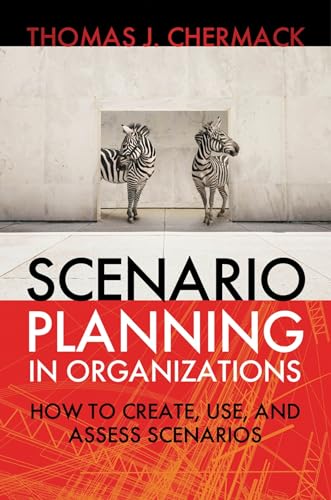
Scenario Planning in Organizations: How to Create, Use, and Assess Scenarios (The Berrett-Koehler Organizational Performance Series, Band 14) - Softcover
Inhaltsangabe
With scenario planning, leaders, executives, and decision makers can develop strategies for multiple futures, making their organizations resilient, agile, and capable of adapting to new circumstances at the speed of change.
Here, Thomas Chermack addresses the method’s complexities and, unlike other books, deals not just with developing different scenarios but also with applying those scenarios and assessing their impact.
This is the most comprehensive guide available to the scenario planning process, offering a thorough discussion of the method’s theoretical foundations and detailing a five-phase scenario planning system.
Chermack uses a real-world case study to illuminate the entire process—from project preparation to scenario exploration, development, implementation, and project assessment. He provides specific techniques and tools for gathering and analyzing relevant data, structuring and managing projects, and avoiding common pitfalls.
Die Inhaltsangabe kann sich auf eine andere Ausgabe dieses Titels beziehen.
Über die Autorin bzw. den Autor
Thomas J. Chermack is assistant professor in the Organizational Performance and Change program and director of the Scenario Planning Institute at Colorado State University. He is also founder and managing partner of Chermack Scenarios. He has facilitated scenario projects at Cargill, Saudi Aramco, General Mills, Motorola, and many other companies.
Auszug. © Genehmigter Nachdruck. Alle Rechte vorbehalten.
SCENARIO PLANNING IN ORGANIZATIONS
HOW TO CREATE, USE, AND ASSESS SCENARIOSBy THOMAS J. CHERMACKBerrett-Koehler Publishers, Inc.
Copyright © 2011 Thomas J. ChermackAll right reserved.
ISBN: 978-1-60509-413-7
Contents
List of Figures.....................................................................................viiForeword by Louis van der Merwe.....................................................................xiPreface.............................................................................................xv1 Introduction to Performance-Based Scenario Planning...............................................32 Theoretical Foundations of Scenario Planning......................................................293 The Performance-Based Scenario System.............................................................614 Scenario Case Study 7.............................................................................15 Phase 1—Project Preparation: Understanding Purpose and Building Support.....................816 Phase 2—Scenario Exploration: Breathing In..................................................1017 Phase 3—Scenario Development: Digging Deeper................................................1278 Phase 4—Scenario Implementation: Putting Scenarios to Use...................................1699 Phase 5—Project Assessment: Documenting Results.............................................18910 Managing Scenario Projects.......................................................................21711 Human Perceptions in the Scenario System.........................................................23312 Initiating Your First Scenario Project...........................................................241References..........................................................................................247Index...............................................................................................259About the Author....................................................................................271
Chapter One
Introduction to Performance-Based Scenario Planning
This book describes a method for including the realities of uncertainty in the planning process. Uncertainty and ambiguity are basic structural features of today's business environment. They can best be managed by including them in planning activities as standard features that must be considered in any significant decision.
This book focuses on avoiding crises of perception. Scenario planning is a tool for surfacing assumptions so that changes can be made in how decision makers see the environment. It is also a tool for changing and improving the quality of people's perceptions. Uncertainty is not a new problem, but the degree of uncertainty and the effects of unanticipated outcomes are unprecedented. Learning how to see a situation—complete with its uncertainties—is an important ability in today's world.
This chapter presents some of the challenges posed by today's fast-changing environment. A tool for dealing with those challenges has traditionally been strategic planning. Basic approaches to strategic planning are described; however, the rate and depth of change have increased over time to the point that those methods are no longer useful. Scenario planning emerged as an effective solution in the 1970s, and the ensuing history of scenario planning is discussed here. This chapter also describes a variety of major approaches to scenario planning, including their shortcomings. The fundamental problem with existing approaches to scenario planning is that they are not performance based. Evidence of this critical oversight is presented by reviewing the definitions and outcomes of scenario planning as they are described by major scenario planning authors. The outcomes they promote are generally vague and unclear. Finally, this chapter introduces performance-based scenario planning—which is the contribution of this book.
DILEMMAS
Some authors prefer to use the term dilemma instead of problem because the term problem can imply that there is a single solution (Cascio, 2009; Johansen, 2008). Most often, strategic decision making involves ambiguity and a realization that numerous solutions are possible. Each usually comes with its own caveats and difficult elements that must be considered. Hampden-Turner (1990) saw dilemmas as a dialectic and used the description "horns of the dilemma" to describe this way of observing specific dynamics in the environment. This way of describing complex dynamics takes a first step into looking for underlying systemic structure.
This book focuses on complex problems or dilemmas with unknown solutions. Therefore, its intent is to develop the understanding and expertise required to explore difficult, ambiguous problems and consider a variety of solutions in a wildly unpredictable and turbulent environment. Because there are no clear answers to questions of strategy and uncertainty, decision makers are compelled to do the best they can. These types of problems are the most complex, most ambiguous, and often the most deeply rooted. Experienced scenario planning practitioners have demonstrated their capacity to detect blind spots, avoid surprises, and increase the capacity to adjust when needed. Most important, modern-day dilemmas take place in an environment the likes of which we have never seen before.
THE ENVIRONMENT
Organizations operate in environmental contexts. These contexts include and are shaped by social, technological, economic, environmental, and political forces. The external environment has received much attention in literature from a variety of disciplines. Emery and Trist published a seminal work on the importance of the external environment in 1965. They suggested a four-step typology of the "causal texture" of the external environment:
Step 1—a placid, randomized environment
Step 2—a placid, clustered environment
Step 3—a disturbed, reactive environment
Step 4—a turbulent field
Few would disagree that most contemporary organizations are heavily steeped in turbulent fields. Turbulent fields are worlds in which dynamic processes create significant variance. These turbulent fields embody a serious rise in uncertainty, and the consequences of actions therein become increasingly unpredictable (Emery & Trist, 1965). These four different types of environments have existed over time, but today we are dealing with turbulent fields beyond the original conceptualization.
Reminding readers of Emery and Trist's classification, Ramirez, Selsky, and van der Heijden (2008) use the ideas of turbulence and complexity to frame their edited book Business Planning for Turbulent Times. They make their case that turbulence and environmental complexity are undeniable features of the business environment by citing research showing significant increases in published material focused on turbulence and uncertainty. It could be argued that these descriptors are more relevant today than they were in 1965.
Another description of the external environment uses the terms volatility, uncertainty, complexity, and ambiguity for the acronym VUCA (Johansen, 2007). VUCA originated at the U.S. Army War College, which has since become known as VUCA University. Indeed, the elements of volatility, uncertainty, complexity and ambiguity are undeniably present in the operating environment of any organization—the only...
„Über diesen Titel“ kann sich auf eine andere Ausgabe dieses Titels beziehen.
Suchergebnisse für Scenario Planning in Organizations: How to Create,...

Beispielbild für diese ISBN
Scenario Planning in Organizations: How to Create, Use, and Assess Scenarios
Anbieter: World of Books (was SecondSale), Montgomery, IL, USA
Verkäuferbewertung 5 von 5 Sternen

Paperback. Zustand: Good. With scenario planning, leaders, executives, and decision makers can develop strategies for multiple futures, making their organizations resilient, agile, and capable of adapting to new circumstances at the speed of change. Here, Thomas Chermack addresses the method's complexities and, unlike other books, deals not just with developing different scenarios but also with applying those scenarios and assessing their impact. This is the most comprehensive guide available to the scenario planning process, offering a thorough discussion of the method's theoretical foundations and detailing a five-phase scenario planning system. Chermack uses a real-world case study to illuminate the entire process-from project preparation to scenario exploration, development, implementation, and project assessment. He provides specific techniques and tools for gathering and analyzing relevant data, structuring and managing projects, and avoiding common pitfalls. Artikel-Nr. CIN1605094137G
Gebraucht kaufen
EUR 7,44
Versand gratis
Versand innerhalb von USA
Versand innerhalb von USA
Anzahl: 2 verfügbar
Beispielbild für diese ISBN
Scenario Planning in Organizations: How to Create, Use, and Assess Scenarios
Verlag:
Berrett-Koehler Publishers, 2011
ISBN 10: 1605094137
ISBN 13: 9781605094137
Gebraucht
Paperback
Anbieter: ThriftBooks-Dallas, Dallas, TX, USA
Verkäuferbewertung 5 von 5 Sternen
Paperback. Zustand: Good. No Jacket. Pages can have notes/highlighting. Spine may show signs of wear. ~ ThriftBooks: Read More, Spend Less. Artikel-Nr. G1605094137I3N00
Gebraucht kaufen
EUR 9,01
Versand gratis
Versand innerhalb von USA
Versand innerhalb von USA
Anzahl: 1 verfügbar
Beispielbild für diese ISBN
Scenario Planning in Organizations: How to Create, Use, and Assess Scenarios
Verlag:
Berrett-Koehler Publishers, 2011
ISBN 10: 1605094137
ISBN 13: 9781605094137
Gebraucht
Paperback
Anbieter: ThriftBooks-Phoenix, Phoenix, AZ, USA
Verkäuferbewertung 5 von 5 Sternen
Paperback. Zustand: Good. No Jacket. Pages can have notes/highlighting. Spine may show signs of wear. ~ ThriftBooks: Read More, Spend Less. Artikel-Nr. G1605094137I3N00
Gebraucht kaufen
EUR 9,01
Versand gratis
Versand innerhalb von USA
Versand innerhalb von USA
Anzahl: 1 verfügbar
Beispielbild für diese ISBN
Scenario Planning in Organizations: How to Create, Use, and Assess Scenarios
Verlag:
Berrett-Koehler Publishers, 2011
ISBN 10: 1605094137
ISBN 13: 9781605094137
Gebraucht
Paperback
Anbieter: ThriftBooks-Atlanta, AUSTELL, GA, USA
Verkäuferbewertung 5 von 5 Sternen
Paperback. Zustand: Good. No Jacket. Pages can have notes/highlighting. Spine may show signs of wear. ~ ThriftBooks: Read More, Spend Less. Artikel-Nr. G1605094137I3N00
Gebraucht kaufen
EUR 9,01
Versand gratis
Versand innerhalb von USA
Versand innerhalb von USA
Anzahl: 1 verfügbar
Beispielbild für diese ISBN
Scenario Planning in Organizations: How to Create, Use, and Assess Scenarios
Verlag:
Berrett-Koehler Publishers, 2011
ISBN 10: 1605094137
ISBN 13: 9781605094137
Gebraucht
Paperback
Anbieter: ThriftBooks-Reno, Reno, NV, USA
Verkäuferbewertung 5 von 5 Sternen
Paperback. Zustand: Good. No Jacket. Pages can have notes/highlighting. Spine may show signs of wear. ~ ThriftBooks: Read More, Spend Less. Artikel-Nr. G1605094137I3N00
Gebraucht kaufen
EUR 9,01
Versand gratis
Versand innerhalb von USA
Versand innerhalb von USA
Anzahl: 1 verfügbar
Beispielbild für diese ISBN
Scenario Planning in Organizations: How to Create, Use, and Assess Scenarios
Verlag:
Berrett-Koehler Publishers, 2011
ISBN 10: 1605094137
ISBN 13: 9781605094137
Gebraucht
Paperback
Anbieter: ThriftBooks-Atlanta, AUSTELL, GA, USA
Verkäuferbewertung 5 von 5 Sternen
Paperback. Zustand: Very Good. No Jacket. Former library book; May have limited writing in cover pages. Pages are unmarked. ~ ThriftBooks: Read More, Spend Less. Artikel-Nr. G1605094137I4N10
Gebraucht kaufen
EUR 9,01
Versand gratis
Versand innerhalb von USA
Versand innerhalb von USA
Anzahl: 1 verfügbar
Beispielbild für diese ISBN
Scenario Planning in Organizations: How to Create, Use, and Assess Scenarios
Verlag:
Berrett-Koehler Publishers, 2011
ISBN 10: 1605094137
ISBN 13: 9781605094137
Gebraucht
Paperback
Anbieter: ThriftBooks-Atlanta, AUSTELL, GA, USA
Verkäuferbewertung 5 von 5 Sternen
Paperback. Zustand: Fair. No Jacket. Readable copy. Pages may have considerable notes/highlighting. ~ ThriftBooks: Read More, Spend Less. Artikel-Nr. G1605094137I5N00
Gebraucht kaufen
EUR 9,01
Versand gratis
Versand innerhalb von USA
Versand innerhalb von USA
Anzahl: 1 verfügbar
Beispielbild für diese ISBN
Scenario Planning in Organizations: How to Create, Use, and Assess Scenarios: How to Create, Use, and Assess Scenarios (AGENCY/DISTRIBUTED)
Verlag:
Berrett-Koehler Publishers, 2011
ISBN 10: 1605094137
ISBN 13: 9781605094137
Gebraucht
Paperback
Anbieter: WorldofBooks, Goring-By-Sea, WS, Vereinigtes Königreich
Verkäuferbewertung 5 von 5 Sternen
Paperback. Zustand: Very Good. The book has been read, but is in excellent condition. Pages are intact and not marred by notes or highlighting. The spine remains undamaged. Artikel-Nr. GOR006902034
Gebraucht kaufen
EUR 36,28
EUR 6,63 Versand
Versand von Vereinigtes Königreich nach USA
Versand von Vereinigtes Königreich nach USA
Anzahl: 3 verfügbar
Beispielbild für diese ISBN
Scenario Planning in Organizations: How to Create, Use, and Assess Scenarios
Anbieter: Kennys Bookstore, Olney, MD, USA
Verkäuferbewertung 5 von 5 Sternen
Zustand: New. Suitable for graduate courses, and thoughtful practitioners seeking understanding beyond a "how-to" manual, this book can add important knowledge and fill in the information gaps by providing a view of scenario planning within the larger organizational and national contexts. Series: Bk Organizational Performance Series. Num Pages: 288 pages, Illustrations. BIC Classification: KJC; KJMD. Category: (P) Professional & Vocational. Dimension: 157 x 236 x 19. Weight in Grams: 476. . 2011. Paperback. . . . . Books ship from the US and Ireland. Artikel-Nr. V9781605094137
Neu kaufen
EUR 45,17
EUR 9,41 Versand
Versand innerhalb von USA
Versand innerhalb von USA
Anzahl: 15 verfügbar
Beispielbild für diese ISBN
Scenario Planning in Organizations: How to Create, Use, and Assess Scenarios
Anbieter: Revaluation Books, Exeter, Vereinigtes Königreich
Verkäuferbewertung 5 von 5 Sternen
Paperback. Zustand: Brand New. 288 pages. 9.19x6.13x0.82 inches. In Stock. Artikel-Nr. zk1605094137
Neu kaufen
EUR 52,56
EUR 11,84 Versand
Versand von Vereinigtes Königreich nach USA
Versand von Vereinigtes Königreich nach USA
Anzahl: 1 verfügbar