
Verwandte Artikel zu About Face: Military Resisters Turn Against War
Inhaltsangabe
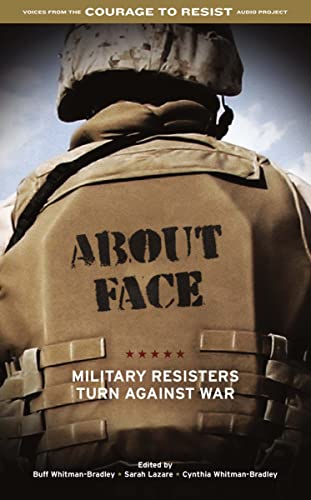
Veterans of recent conflicts describe their individual journeys from raw recruit to war resister in this collection of testimonials. Although it is not well publicized, the long tradition of refusing to fight unjust wars continues today within the American military. The stories in this book provide an intimate, honest look at the personal transformation of each of these young people and at the same time constitute a powerful argument against militarization and endless war. Also included are exclusive interviews with Noam Chomsky and Daniel Ellsberg addressing the U.S. wars in Vietnam, Iraq, and Afghanistan and the role civilian and GI resistance plays in bringing the troops home.
Die Inhaltsangabe kann sich auf eine andere Ausgabe dieses Titels beziehen.
Über die Autorin bzw. den Autor
Buff Whitman-Bradley is an author, an editor, and a social justice activist in the Courage to Resist organizing collective. He lives in Marin, California. Sarah Lazare is an independent journalist, an editor, and an organizer in the U.S. antiwar and GI resistance movement through the Civilian-Soldier Alliance and Courage to Resist. She lives in Urbana, Illinois. Cynthia Whitman-Bradley is a birth doula and an activist through Courage to Resist and ¡Presente! She lives in Marin, California.
Auszug. © Genehmigter Nachdruck. Alle Rechte vorbehalten.
About Face
Military Resisters Turn Against War
By Buff Whitman-Bradley, Sarah Lazare, Cynthia Whitman-Bradley, Jeff PatersonPM Press
Copyright © 2011 Buff Whitman-Bradley, Sarah Lazare, and Cynthia Whitman-Bradley
All rights reserved.
ISBN: 978-1-60486-440-3All rights reserved.
Contents
About Courage to Resist,
Preface,
Commonly used acronyms and terms,
Introduction,
Resistance to Wars of Empire,
Part I: Refusing to Go Back,
Benji Lewis,
Samantha Schutz,
André Shepherd,
Bryan Currie,
David Cortelyou,
Hart Viges,
William Shearer,
Kimberly Rivera,
Part II: Rejecting Military Culture,
Ryan Johnson,
Brad McCall,
Robin Long,
Part III: Looking Deeper,
Matthis Chiroux,
Michael Thurman,
Tim Richard,
Matt Mishler,
T.J. Buonomo,
Ryan Jackson,
Ghanim Khalil,
Brandon Hughey,
Part IV: Resisting Military Abuse,
Suzanne Swift,
Dustin Che Stevens,
Jose Crespo,
Skyler James,
Part V: Collateral Murder, WikiLeaks, and Bradley Manning,
The Courage to Reveal the Truth,
An Open Letter of Reconciliation and Responsibility to the Iraqi People,
Afterword,
Operation Recovery,
Supporting GI Resistance,
CHAPTER 1
Benji Lewis
October 2008
Benjamin "Benji" Lewis was honorably discharged from the Marines after two deployments to Iraq. Subsequent to his discharge, Benji was notified that the Marines were considering recalling him to active duty. On October 18, 2008, at a Winter Soldier event in Portland, Oregon, he announced his intention to refuse to return to the Marines.
I joined the Marine Corps, actually, as soon as I turned seventeen, and about six months after that I got my high-school diploma and went to boot camp. That was in 2003. I was going through kind of a rough spell in my life, kind of seeking direction. I felt at that time that the military was my chance to do some good and help out in the world.
I went to boot camp in San Diego and I was there for about four to six months before my first deployment to Iraq in 2004. Initially, we were sent to Okinawa. We were told we weren't going to Iraq. But once we got to Okinawa, we were notified that we were deploying to Iraq. At that time, my name came up because of testing scores and my ASVAB [Armed Forces Vocational Aptitude Battery]. I had a 99 on my ASVAB and 134 GT [General Technical] and they took me back to California, to Twentynine Palms, for Arabic language training. I was being trained to be a quasi-interpreter.
Haditha and Fallujah
When I returned to my unit, we went to Iraq. We were stationed at the Haditha Dam and we were running patrols in and around the city of Haditha and starting to build a rapport with the police department there. In March or April, we demobilized from the Haditha Dam and we went to assist in the push through Fallujah. While I was in Fallujah, I was also the adjusting "A" gunner for my mortar platoon, and we spent about two weeks or so lobbing mortars at Fallujah and then we maintained a presence there for another two weeks to a month before we went back to Haditha.
Once we were in Haditha again, my platoon was split basically into two provisional rifle platoons. Because of my language skills, I was attached to the one that was stationed in the Haditha police department where we stayed for a couple of months, basically guarding the police, the police station, while other units of the Marine Corps were to help aid the police in taking over security of their own town.
The closest I got to going into Fallujah was after we had basically pulverized the town. Artillery and air strikes were pretty much just pulverizing the town. Then our unit pushed in and we operated as a close frontline support for the riflemen as they were going street to street. They took three streets, and the rules of engagement would change and they'd fall back and then they'd go back and we kept up that mess for a week or two. Then the command post was formed at the edge of the city of Fallujah, and it was actually pretty much a dump site, you know, trash and garbage everywhere where they set up the command post. We maintained an active mortar posture there and stood guard, but by that time pretty much all the action had died down and most of the resistance elements in Fallujah had fled.
No Chance to Reflect
Actually it wasn't until significantly later, after my second tour, that I was able to start reflecting. We didn't get a whole lot of sleep in Iraq and because I was the adjusting "A" gunner for my entire mortar platoon, I got even less sleep because I always had to be by the gun, manning the gun. When we went to the Haditha police department, our guard rotation was such that we were lucky to get three hours of sleep or so a night. I would say I was pretty much sleep-deprived for the majority of my Marine Corps experience. The time for reflection, we didn't really do it; we didn't talk about it; we didn't want to talk about it so much. We were just looking forward to mail call. We were looking forward to the next time we'd get to go to the PX [Post Exchange] and buy some distractions or pick up some books or whatever. So I'd say for the most part, I never really reflected on what we were doing at that time.
At the time of the battle of Fallujah, we were told we were going in to fight the resistance fighters who had hung the four U.S. contractors on the bridge leading into Fallujah. Much later, I learned that killing them was in retaliation for a U.S.-endorsed assassination by Israel of a quadriplegic Muslim cleric. That was when I started really thinking back to my Marine Corps experience and realizing that most of what I was being told by my commanders was probably not the facts.
The Time between Deployments
I was in Iraq for approximately five months on my first deployment. I came back toward the end of 2004 and from there we had our decompression, went on leave, you know, and I'll be honest with you, it's all really fuzzy because the whole thing kind of ran together, but we had another approximately four or five months of training back in the States before we redeployed to Iraq again.
At that time, I would say that I and most of my fellows pretty much just self-medicated and when we weren't PTing [physical training], when we weren't training, when we weren't in the field, we pretty much stayed in a constant state of drunkenness.
Second Deployment
My second deployment to Iraq in 2005 for OIF 3 [Operation Iraqi Freedom] was, once again, to Fallujah. At this point, through involuntary response or whatever, I'd completely neglected my language and I'd forgotten most of the Arabic I'd learned.
We were stationed at a checkpoint for vehicles leaving and coming into Fallujah. It was about a seven-month deployment and it was a very long and stagnant tour. Not a lot happened. We were kind of just there to be a presence. We'd have eight-, ten-hour days out on the line, where we're wearing all our gear and it was just really hot and we would search vehicles for weapons coming into Fallujah. The whole thing was really ludicrous because there were so many other avenues of smuggling into Fallujah. Why anyone with any armaments would voluntarily go through a vehicle checkpoint, I don't know, but I think for the most part we were getting together a database, and they were issuing all the Fallujah citizens IDs. I...
„Über diesen Titel“ kann sich auf eine andere Ausgabe dieses Titels beziehen.
Suchergebnisse für About Face: Military Resisters Turn Against War

Beispielbild für diese ISBN
About Face: Military Resisters Turn Against War
Anbieter: World of Books (was SecondSale), Montgomery, IL, USA
Verkäuferbewertung 5 von 5 Sternen

Paperback. Zustand: Good. How does a young person who volunteers to serve in the US military become a war resister who risks ostracism, humiliation and prison rather than fight? Although it is not well publicised, the long tradition of refusing to fight in unjust wars continues today within the US military. About Face gives voice to some of these resisters, who describe in their own words the process they went through - from raw recruits to brave refusers. Also featured are exclusive interviews with Noam Chomsky and Daniel Ellsberg. Artikel-Nr. 00101977225
Gebraucht kaufen
EUR 4,59
Versand gratis
Versand innerhalb von USA
Versand innerhalb von USA
Anzahl: 2 verfügbar
Beispielbild für diese ISBN
About Face: Military Resisters Turn Against War
Anbieter: ThriftBooks-Dallas, Dallas, TX, USA
Verkäuferbewertung 5 von 5 Sternen
Paperback. Zustand: Good. No Jacket. Former library book; Pages can have notes/highlighting. Spine may show signs of wear. ~ ThriftBooks: Read More, Spend Less. Artikel-Nr. G1604864400I3N10
Gebraucht kaufen
EUR 6,53
Versand gratis
Versand innerhalb von USA
Versand innerhalb von USA
Anzahl: 1 verfügbar
Beispielbild für diese ISBN
About Face : Military Resisters Turn Against War
Anbieter: Better World Books, Mishawaka, IN, USA
Verkäuferbewertung 5 von 5 Sternen
Zustand: Fine. Used book that is in almost brand-new condition. May contain a remainder mark. Better World Books: Buy Books. Do Good. Artikel-Nr. 57249335-6
Gebraucht kaufen
EUR 6,57
Versand gratis
Versand innerhalb von USA
Versand innerhalb von USA
Anzahl: 1 verfügbar
Beispielbild für diese ISBN
About Face : Military Resisters Turn Against War
Anbieter: Better World Books, Mishawaka, IN, USA
Verkäuferbewertung 5 von 5 Sternen
Zustand: Good. Pages intact with minimal writing/highlighting. The binding may be loose and creased. Dust jackets/supplements are not included. Stock photo provided. Product includes identifying sticker. Better World Books: Buy Books. Do Good. Artikel-Nr. 5365606-6
Gebraucht kaufen
EUR 6,57
Versand gratis
Versand innerhalb von USA
Versand innerhalb von USA
Anzahl: 2 verfügbar
Beispielbild für diese ISBN
About Face
Anbieter: PBShop.store US, Wood Dale, IL, USA
Verkäuferbewertung 5 von 5 Sternen
PAP. Zustand: New. New Book. Shipped from UK. Established seller since 2000. Artikel-Nr. EB-9781604864403
Beispielbild für diese ISBN
About Face
Anbieter: PBShop.store UK, Fairford, GLOS, Vereinigtes Königreich
Verkäuferbewertung 5 von 5 Sternen
PAP. Zustand: New. New Book. Shipped from UK. Established seller since 2000. Artikel-Nr. EB-9781604864403
Neu kaufen
EUR 20,39
EUR 4,91 Versand
Versand von Vereinigtes Königreich nach USA
Versand von Vereinigtes Königreich nach USA
Anzahl: 15 verfügbar
Beispielbild für diese ISBN
About Face
Anbieter: Majestic Books, Hounslow, Vereinigtes Königreich
Verkäuferbewertung 4 von 5 Sternen

Zustand: New. pp. 272 Illus. (Col.). Artikel-Nr. 4283203
Neu kaufen
EUR 20,93
EUR 7,67 Versand
Versand von Vereinigtes Königreich nach USA
Versand von Vereinigtes Königreich nach USA
Anzahl: 3 verfügbar
Beispielbild für diese ISBN
About Face: Military Resisters Turn Against War
Anbieter: Revaluation Books, Exeter, Vereinigtes Königreich
Verkäuferbewertung 5 von 5 Sternen
Paperback. Zustand: Brand New. original edition. 234 pages. 7.75x5.00x0.50 inches. In Stock. Artikel-Nr. __1604864400
Neu kaufen
EUR 17,43
EUR 11,80 Versand
Versand von Vereinigtes Königreich nach USA
Versand von Vereinigtes Königreich nach USA
Anzahl: 2 verfügbar
Beispielbild für diese ISBN
About Face
Anbieter: Kennys Bookstore, Olney, MD, USA
Verkäuferbewertung 5 von 5 Sternen
Zustand: New. Editor(s): Whitman-Bradley, Buff; Whitman-Bradley, Cynthia; Lazare, Sarah. Num Pages: 240 pages, colour plates. BIC Classification: HBWS5; JPW. Category: (G) General (US: Trade). Dimension: 137 x 206 x 16. Weight in Grams: 296. . 2011. Paperback. . . . . Books ship from the US and Ireland. Artikel-Nr. V9781604864403
Neu kaufen
EUR 27,23
EUR 9,37 Versand
Versand innerhalb von USA
Versand innerhalb von USA
Anzahl: Mehr als 20 verfügbar
Foto des Verkäufers
About Face
Verlag:
TURNAROUND PUBLISHER SERVICES Okt 2011, 2011
ISBN 10: 1604864400
ISBN 13: 9781604864403
Neu
Taschenbuch
Anbieter: AHA-BUCH GmbH, Einbeck, Deutschland
Verkäuferbewertung 5 von 5 Sternen
Taschenbuch. Zustand: Neu. Neuware - Veterans of recent conflicts describe their individual journeys from raw recruit to war resister in this collection of testimonials. Although it is not well publicized, the long tradition of refusing to fight unjust wars continues today within the American military. The stories in this book provide an intimate, honest look at the personal transformation of each of these young people and at the same time constitute a powerful argument against militarization and endless war. Also included are exclusive interviews with Noam Chomsky and Daniel Ellsberg addressing the U.S. wars in Vietnam, Iraq, and Afghanistan and the role civilian and GI resistance plays in bringing the troops home. Artikel-Nr. 9781604864403
Neu kaufen
EUR 28,28
EUR 35,00 Versand
Versand von Deutschland nach USA
Versand von Deutschland nach USA
Anzahl: 2 verfügbar