
Verwandte Artikel zu New Reformation: Notes of a Neolithic Conservative
Inhaltsangabe
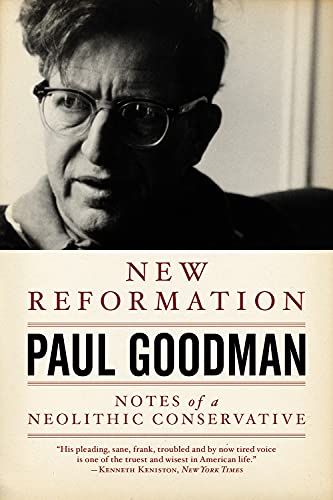
New Reformation was Paul Goodman’s last book of social criticism. The man who set the agenda for the Youth Movement of the Sixties with his best-selling Growing Up Absurd, and who wrote a book a year to keep his “crazy young allies” focused on the issues as he saw them, stepped back in 1970 to re-assess the results of what he considered a moral and spiritual upheaval comparable to the Protestant Reformation—“the breakdown of belief, and the emergence of new belief, in sciences and professions, education, and civil legitimacy.”
Michael Fisher’s introduction situates Goodman in his era and traces the development of his characteristic insights, now the common wisdom of every radical critique of American society. A poet and novelist famous in his day for books on decentralization, community planning, psychotherapy, education, linguistics, and media, nowhere is Goodman’s voice more prescient and still relevant than in New Reformation.
Die Inhaltsangabe kann sich auf eine andere Ausgabe dieses Titels beziehen.
Über die Autorinnen und Autoren
Paul Goodman, known in his day as “the philosopher of the New Left,” set the agenda for the youth movement of the 1960s with his bestselling Growing Up Absurd. He produced new books every year throughout that turbulent decade, while lecturing to hundreds of audiences on the nation’s campuses, covering subjects that ranged from movement politics to education and community planning, from psychotherapy and religion to literature and media. At the same time, a continuous stream of poems, plays, and fiction prompted composer and diarist Ned Rorem to say, “In a society increasingly specialized, he shone as a Renaissance artist.” America’s most celebrated public intellectual at the time of his death in 1972, his work still resonates for our own times of national crisis.
In his probing introduction to New Reformation, cultural and intellectual historian Michael C. Fisher speaks for a new generation of young scholars still in their twenties, as he assesses the initial impact and continuing relevance of Goodman’s problematic love affair with the radical youth of the Sixties. Fisher wrote his honors thesis on Goodman as an undergraduate at the University California at Davis, and is currently in his second year of doctoral studies in history at the University of Rochester.
Auszug. © Genehmigter Nachdruck. Alle Rechte vorbehalten.
New Reformation
Notes of a Neolithic Conservative
By Paul GoodmanPM Press
Copyright © 2010 Sally Goodman
All rights reserved.
ISBN: 978-1-60486-056-6All rights reserved.
CHAPTER 1
i
On March 4, 1969, there was a "work stoppage" and teach-in initiated by dissenting professors at the Massachusetts Institute of Technology, followed at thirty other major universities and technical schools across the country, against misdirected scientific research and the abuse of scientific technology. In this book I want to consider this event in a broader context than the professors did, as part of a religious crisis. An attack on the American scientific establishment is an attack on the worldwide system of belief. I think we are on the eve of a new Reformation, and no institution or status will go unaffected.
March 4 was, of course, only the latest of a series of protests in the twenty-five years since the Manhattan Project to build the atom bomb, during which time the central funding of research and innovation has grown so enormously and its purposes have become so unpalatable. In 1940 the federal budget for research and development was seventy-three million dollars, in 1967 seventeen billion. As the old man predicted in The Empire City, the "duration" has lasted longer than the war. Hitler's war was a watershed of modern times. We are accustomed, as H. R. Trevor-Roper has pointed out, to write Hitler off as an aberration, who was of little political significance. But in fact the military emergency that he and his Japanese allies created confirmed the worst tendencies of the giant states, till now they are probably irreversible by ordinary political means.
After Hiroshima, there was the conscience-stricken movement of the atomic scientists and the founding of their Bulletin. The American Association for the Advancement of Science pledged itself to keep the public informed about the dangerous bearings of new developments. There was the Oppenheimer incident. Ads of the East Coast scientists successfully stopped the bomb shelters, warned about the fallout, and helped produce the test ban. There was a scandal about the bombardment of the Van Allen belt. Scientists and technologists formed a powerful (and misguided) ad hoc group for Johnson in the 1964 election. In some universities, sometimes with bitter struggle, classified contracts have been excluded. There is a Society for Social Responsibility in Science. Rachel Carson's book on the pesticides made a stir, until the Department of Agriculture rescued the manufacturers and plantation-owners. Ralph Nader has been on his rampage. Thanks to spectacular abuses like the smog, strip-mining, oil pollution, random use of pesticides, and asphalting of arable land, ecologists and conservationists have been getting a hearing. Protest against the sonic boom has slowed the development of the supersonic transport. At present (1969), there is a concerted outcry against the antiballistic missiles.
The target of protest has become broader and the grounds of complaint deeper. The target is now not merely the military but the universities, the commercial corporations, and the government. It is said that money is being given by the wrong sponsors to the wrong people for the wrong purposes. In some of the great schools such funding is the main support; for instance at M.I.T. 90 percent of the research budget is from the government, and 65 percent of that is military.
Inevitably, such funding channels the brainpower of most of the brightest science students, who go where the action is, and this predetermines the course of American science and technology for the foreseeable future. At present nearly two hundred thousand American engineers and scientists spend all their time making weapons. This is a comment on, perhaps an explanation for, the usual statement that more scientists are now alive than since Adam and Eve. And the style of our research and development is not good. It is dominated by production of hardware, logistics, and devising of salable novelties. Often there is secrecy, always nationalism. Since the grants go overwhelmingly through a very few corporations and universities, they favor a limited number of scientific attitudes and preconceptions, with incestuous staffing. There is a premium on "positive results"; surprising "failures" cannot be pursued, so that science ceases to be a wandering dialogue with the unknown.
The policy is economically wasteful. A vast amount of brains and money is spent on crash programs to solve often essentially petty problems, and the claim that there is a spin-off of useful discoveries is laughable, considering the sums involved. The claim that research is neutral, and it doesn't matter what one works on, is shabby, considering the heavy funding in certain directions. Social priorities are scandalous: money is spent on overkill, the supersonic plane, brand-name identical drugs, annual model changes of cars, new detergents, and color television — many have objected to the moon shot — whereas water, air, cities, food, health, and foreign aid are neglected. And much research is so morally repugnant (consider the work on chemical and biological weapons) that we dare not humanly continue it.
The state of the behavioral sciences is, if anything, worse. Their claim to moral and political neutrality becomes, in effect, a means of diverting attention from glaring social evils, and they are in fact used — or would be if they worked — for warfare and social engineering, manipulation of people for the political and economic purposes of the powers that be. This is an especially sad betrayal since, in the not-too-distant past, the objective social sciences were developed largely to dissolve orthodoxy, irrational authority, and taboo. They were heretical and intellectually revolutionary, as the physical sciences had been in their own heroic age — and they weren't getting government grants.
This was the grim indictment of March 4, 1969. Even so, I do not think the dissenting scientists understand how deep their trouble is. They still take themselves too much for granted. Indeed, a repeated theme of the March 4th complaints was that the science budget was being cut back, especially in basic research. The assumption was that, though the sciences are abused, Science would rightly maintain and increase its expensive preeminence among social institutions. Our society was in a bad way; the abuse of science was part of it; but Science could find the answers.
Underlying the growing dissent, however, there is a historical crisis. There has been a profound change in popular feeling, more than among the professors. Put it this way: Modern societies have been operating as if religion were a minor and moribund part of the scheme of things. But this is unlikely. Men do not do without a system of "meanings" that everybody believes and puts his hope in even if, or especially if, he doesn't know anything about it; what Freud called a "shared psychosis," meaningful because shared, and with the power that resides in dream and longing. And in fact, in advanced countries it is science and technology themselves that have gradually and at last triumphantly become the system of mass faith, not disputed by various political ideologies and nationalisms that have also been mass religions. Marxism called itself "scientific socialism," as against moral and utopian socialisms; and movements of national liberation have especially promised to open the benefits of industrialization and technological progress when once they have gotten rid of the imperialists.
For three hundred years, science and...
„Über diesen Titel“ kann sich auf eine andere Ausgabe dieses Titels beziehen.
Suchergebnisse für New Reformation: Notes of a Neolithic Conservative

Beispielbild für diese ISBN
New Reformation: Notes of a Neolithic Conservative
Verlag:
PM Press (edition Second Edition, Second edition), 2010
ISBN 10: 1604860561
ISBN 13: 9781604860566
Gebraucht
Paperback
Anbieter: BooksRun, Philadelphia, PA, USA
Verkäuferbewertung 5 von 5 Sternen

Paperback. Zustand: Very Good. Second Edition, Second edition. It's a well-cared-for item that has seen limited use. The item may show minor signs of wear. All the text is legible, with all pages included. It may have slight markings and/or highlighting. Artikel-Nr. 1604860561-8-1
Gebraucht kaufen
EUR 5,67
Versand gratis
Versand innerhalb von USA
Versand innerhalb von USA
Anzahl: 1 verfügbar
Beispielbild für diese ISBN
New Reformation
Anbieter: Majestic Books, Hounslow, Vereinigtes Königreich
Verkäuferbewertung 4 von 5 Sternen

Zustand: New. pp. 226. Artikel-Nr. 6562371
Neu kaufen
EUR 20,23
EUR 7,56 Versand
Versand von Vereinigtes Königreich nach USA
Versand von Vereinigtes Königreich nach USA
Anzahl: 3 verfügbar
Beispielbild für diese ISBN
New Reformation: Notes of a Neolithic Conservative
Anbieter: Revaluation Books, Exeter, Vereinigtes Königreich
Verkäuferbewertung 5 von 5 Sternen
Paperback. Zustand: Brand New. 2nd edition. 226 pages. 9.06x6.10x0.59 inches. In Stock. Artikel-Nr. __1604860561
Neu kaufen
EUR 17,19
EUR 11,64 Versand
Versand von Vereinigtes Königreich nach USA
Versand von Vereinigtes Königreich nach USA
Anzahl: 2 verfügbar
Beispielbild für diese ISBN
New Reformation: Notes of a Neolithic Conservative
Anbieter: Kennys Bookstore, Olney, MD, USA
Verkäuferbewertung 5 von 5 Sternen
Zustand: New. 2010. Paperback. . . . . . Books ship from the US and Ireland. Artikel-Nr. V9781604860566
Neu kaufen
EUR 26,33
EUR 9,06 Versand
Versand innerhalb von USA
Versand innerhalb von USA
Anzahl: 1 verfügbar
Foto des Verkäufers
New Reformation: Notes of a Neolithic Conservative
Anbieter: moluna, Greven, Deutschland
Verkäuferbewertung 5 von 5 Sternen
Zustand: New. Über den AutorPaul Goodman, known in his day as the philosopher of the New Left, set the agenda for the youth movement of the 1960s with his bestselling Growing Up Absurd. He produced new books every year throughout th. Artikel-Nr. 904465880
Neu kaufen
EUR 25,17
EUR 48,99 Versand
Versand von Deutschland nach USA
Versand von Deutschland nach USA
Anzahl: 4 verfügbar