
Verwandte Artikel zu Let Freedom Ring: A Collection of Documents from the...
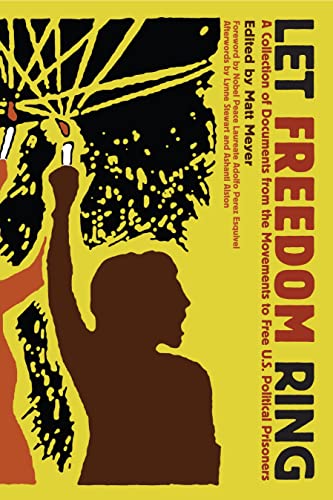
Let Freedom Ring: A Collection of Documents from the Movements to Free U.S. Political Prisoners - Softcover
Inhaltsangabe
Let Freedom Ring presents a two-decade sweep of essays, analyses, histories, interviews, resolutions, People’s Tribunal verdicts, and poems by and about the scores of U.S. political prisoners and the campaigns to safeguard their rights and secure their freedom. In addition to an extensive section on the campaign to free death-row journalist Mumia Abu-Jamal, represented here are the radical movements that have most challenged the U.S. empire from within: Black Panthers and other Black liberation fighters, Puerto Rican independentistas, Indigenous sovereignty activists, white anti-imperialists, environmental and animal rights militants, Arab and Muslim activists, Iraq war resisters, and others. Contributors in and out of prison detail the repressive methods—from long-term isolation to sensory deprivation to politically inspired parole denial—used to attack these freedom fighters, some still caged after 30+ years. This invaluable resource guide offers inspiring stories of the creative, and sometimes winning, strategies to bring them home.
Contributors include: Mumia Abu-Jamal, Dan Berger, Dhoruba Bin-Wahad, Bob Lederer, Terry Bisson, Laura Whitehorn, Safiya Bukhari, The San Francisco 8, Angela Davis, Bo Brown, Bill Dunne, Jalil Muntaqim, Susie Day, Luis Nieves Falcón, Ninotchka Rosca, Meg Starr, Assata Shakur, Jill Soffiyah Elijah, Jan Susler, Chrystos, Jose Lopez, Leonard Peltier, Marilyn Buck, Oscar López Rivera, Sundiata Acoli, Ramona Africa, Linda Thurston, Desmond Tutu, Mairead Corrigan Maguire and many more.
Die Inhaltsangabe kann sich auf eine andere Ausgabe dieses Titels beziehen.
Über die Autorinnen und Autoren
Matt Meyer is an educator-activist, based in New York City. Founding PJSA Co-Chair along with USF Dean Jennifer Turpin, Meyer has long worked to bring together academics and activists for lasting social change. A former public draft registration resister and chair of the War Resisters League, he continues to serve as convener of the War Resisters International Africa Working Group. With Bill Sutherland, Meyer authored Guns and Gandhi in Africa: Pan-African Insights on Nonviolence, Armed Struggle and Liberation. He has edited the Fellowship of Reconciliation’s “Puerto Rico: The Cost of Colonialism;” War in Africa and an African Peace; and the forthcoming two-volume Seeds of New Hope: African Peace Studies for the 21st Century.
Adolfo Pérez Esquivel is an Argentine activist, community organizer, art painter, writer, sculptor, and Nobel Peace Laureate.
Lynne Stewart was a defense attorney known for representing controversial, famous defendants. She was convicted on charges of conspiracy and providing material support to terrorists in 2005, and sentenced to 28 months in prison.
Ashanti Alston is a speaker, writer, organizer, and motivator as well as a former member of the Black Panther Party and the Black Liberation Army. He served a total of fourteen years as a political prisoner. Ashanti resides in Providence, Rhode Island.
Auszug. © Genehmigter Nachdruck. Alle Rechte vorbehalten.
Let Freedom Ring
A Collection of Documents from the Movements to Free U.S. Political Prisoners
By Matt MeyerPM Press
Copyright © 2008 Matt Meyer
All rights reserved.
ISBN: 978-1-60486-035-1All rights reserved.
Contents
Acknowledgments Matt Meyer,
Foreword Adolfo Pérez Esquivel,
Let Freedom Ring: An Introduction Matt Meyer,
Gearing Up: A Guide to This Collection Matt Meyer,
The Real Dragons: A Brief History of Political Militancy and,
Incarceration: 1960s to 2000s 3Dan Berger, 2008,
Section I • Putting Political Prisoners on the Map,
Section II • Int'l Tribunal on Political Prisoners/P.O.W.'s in the U.S.A.,
Section III • The Quincentenary: Diss'ing the "Discovery",
Section IV • Campaigning to End Colonialism in Puerto Rico,
Section V • Resisting Repression: Out and Proud,
Section VI • Pulling Out the Stops to Free Mumia Abu-Jamal,
Section VII • John Brown and Beyond,
Section VIII • Critical Resistance and the Prisoner Rights Movement,
Section IX • At War: The U.S. Government's Illegal and Ongoing War Against the Black Liberation Movement,
Section X • The Struggle Continues,
Contributor Profiles,
Political Prisoner Support Organizations,
Index,
CHAPTER 1
Section I. Putting Political Prisoners on the Map
In the early and mid-1980s, an upsurge in militant activity by U.S. revolutionary movements led to a series of arrests and renewed waves of repression, producing a whole new batch of political prisoners. Both the newer and the longer-term prisoners from each national movement, drawing on successful campaigns of the 1970s, pushed outside organizations to reassess their efforts, devise broader and more creative outreach methods, and build unity with one another. The result was that those organizations resumed working in a more coordinated way within the U.S. left and oppressed communities to put the issue of political prisoners squarely on the activist map. One of the strategies of choice was the use of People's Tribunals.
Not only did these organizations make the case that, contrary to U.S. government denial, there were more than 100 political prisoners, but also that authorities had programs scientifically designed to break the will of those prisoners through isolation, sensory deprivation, and brutality in specialized control units. Most notorious were the federal prison for men in Marion, Illinois, and for women in Lexington, Kentucky. Jailed revolutionaries like Bill Dunne (at Marion); Alejandrina Torres, Susan Rosenberg, and Silvia Baraldini (at Lexington); and Black political prisoners in the Research Committee on International Law and Black Freedom Fighters played key roles in documenting and exposing conditions in these and other units and in galvanizing outside activists to fight against them. A large-scale, multitactic campaign, including a federal lawsuit, pressured the government to shut down the Lexington Control Unit in 1988, but the Marion Control Unit would remain open for many more years. Ultimately, new and more sophisticated federal control units – particularly Florence, Colorado, for men and Marianna, Florida, for women – replaced them (although because of the struggle, conditions in Marianna have never matched the extreme abusiveness of Lexington), and horrendous clones now exist in virtually every state.
Despite these setbacks, the campaigns and events by the political prisoner support movements of the late '80s and early '90s paved the way for the broader popular support, and many of the victories, that mounted throughout the '90s.
I.1
Political Prisoners in the U.S.?
Freedom Now!
1989
The Government denies it. Yet today there are more than 100 people locked up in U.S. Prisons because of their political actions or beliefs.
The U.S. alone among the world's governments maintains the fiction that it holds no political prisoners. The official position is that all those jailed for politically motivated actions are "criminals." The U.S. tries to hide the existence of political prisoners because they challenge the image that the U.S. is a truly democratic and humane society. These prisoners expose the fact that there are political resistance movements of such influential impact that the government is compelled to use repression against them.
* * *
This was the text of a flier produced by Freedom Now!, an effort to pull together in a single organization representatives of all the U.S. political prisoners and leaders of all the internal national liberation movements.
By labeling political prisoners as criminals, the U.S. government has also been able to shield from view serious human rights violations against them. These include:
• excessive prison sentences — example: 8 Black political prisoners will soon begin their third decade behind bars;
• psychological torture;
• assault — example: one Puerto Rican prisoner of war was beaten to death by guards and his death labeled a suicide;
• sexual assault — example: under the guise of security, male prison staff forcibly conducted cavity searches on two women political prisoners at F.C.I. Tucson;
• denial of medical care;
• placement in control units — example: the men's federal prison in Marion, Illinois, which includes several political prisoners among its 400 inmates, has been condemned by Amnesty International for violating international standards on the minimum treatment of prisoners. The men in Marion are locked in their cells 23 hours per day and are sometimes chained spread-eagle to their beds for days at a time. The control unit for women at Lexington, Kentucky, was an experimental underground political prison that practiced isolation and sensory deprivation. It was finally closed by a federal judge after two years of protest by religious and human rights groups.
Human Rights Must Begin at Home!
Who are America's political prisoners? Like the four women and men pictured on the facing page — Alejandrina Torres, Leonard Peltier, Geronimo Pratt and Susan Rosenberg — they represent many movements for freedom and social justice.
People of color are most often targeted. Black activists participating in the fight for Black Liberation and against racism are the largest group represented, with well ever 50 political prisoners. Many of them, like Geronimo Pratt, have been in jail nearly 20 years.
The movement for Puerto Rican independence has also been heavily attacked with the imprisonment of many of its members. These include 14 women and men such as Alejandrina Torres who consider themselves prisoners of war. They have taken this position because they believe that as colonized people they have the right to fight for independence, and their captor, the United States, has no right to criminalize them.
Other political prisoners in the United States include more than thirty white North American activists. These militants are accused of various actions opposing the foreign, domestic and military policies of the U.S. government. Their protests have been directed against symbols of U.S. support for the apartheid regime in South Africa, military intervention in Central America, and the continued colonial oppression of Blacks and Puerto Ricans. Among these prisoners are women and men from the religious peace community who have received long sentences for direct actions against U.S. nuclear...
„Über diesen Titel“ kann sich auf eine andere Ausgabe dieses Titels beziehen.
Suchergebnisse für Let Freedom Ring: A Collection of Documents from the...

Beispielbild für diese ISBN
Let Freedom Ring: A Collection of Documents from the Movements to Free U.S. Political Prisoners
Anbieter: ThriftBooks-Atlanta, AUSTELL, GA, USA
Verkäuferbewertung 5 von 5 Sternen

Paperback. Zustand: Fair. No Jacket. Readable copy. Pages may have considerable notes/highlighting. ~ ThriftBooks: Read More, Spend Less. Artikel-Nr. G1604860359I5N00
Gebraucht kaufen
EUR 24,50
Versand gratis
Versand innerhalb von USA
Versand innerhalb von USA
Anzahl: 1 verfügbar
Beispielbild für diese ISBN
Let Freedom Ring: A Collection of Documents from the Movements to Free U.S. Political Prisoners
Anbieter: ThriftBooks-Dallas, Dallas, TX, USA
Verkäuferbewertung 5 von 5 Sternen
Paperback. Zustand: Good. No Jacket. Pages can have notes/highlighting. Spine may show signs of wear. ~ ThriftBooks: Read More, Spend Less. Artikel-Nr. G1604860359I3N00
Gebraucht kaufen
EUR 24,50
Versand gratis
Versand innerhalb von USA
Versand innerhalb von USA
Anzahl: 1 verfügbar
Beispielbild für diese ISBN
Let Freedom Ring : A Collection of Documents from the Movements to Free U. S. Political Prisoners
Anbieter: Better World Books, Mishawaka, IN, USA
Verkäuferbewertung 5 von 5 Sternen
Zustand: Good. Pages intact with minimal writing/highlighting. The binding may be loose and creased. Dust jackets/supplements are not included. Stock photo provided. Product includes identifying sticker. Better World Books: Buy Books. Do Good. Artikel-Nr. 68197782-6
Gebraucht kaufen
EUR 28,64
Versand gratis
Versand innerhalb von USA
Versand innerhalb von USA
Anzahl: 1 verfügbar
Beispielbild für diese ISBN
Let Freedom Ring: A Collection of Documents from the Movements to Free U.S. Political Prisoners
Anbieter: Kennys Bookstore, Olney, MD, USA
Verkäuferbewertung 5 von 5 Sternen
Zustand: New. 2008. Paperback. . . . . . Books ship from the US and Ireland. Artikel-Nr. V9781604860351
Neu kaufen
EUR 46,80
EUR 9,36 Versand
Versand innerhalb von USA
Versand innerhalb von USA
Anzahl: 1 verfügbar
Beispielbild für diese ISBN
Let Freedom Ring
Anbieter: Majestic Books, Hounslow, Vereinigtes Königreich
Verkäuferbewertung 4 von 5 Sternen

Zustand: New. pp. 912. Artikel-Nr. 6562390
Neu kaufen
EUR 60,62
EUR 7,67 Versand
Versand von Vereinigtes Königreich nach USA
Versand von Vereinigtes Königreich nach USA
Anzahl: 1 verfügbar
Beispielbild für diese ISBN
Let Freedom Ring: A Collection of Documents from the Movements to Free U.s. Political Prisoners
Anbieter: Revaluation Books, Exeter, Vereinigtes Königreich
Verkäuferbewertung 5 von 5 Sternen
Paperback. Zustand: Brand New. 912 pages. 8.75x6.00x2.25 inches. In Stock. Artikel-Nr. x-1604860359
Neu kaufen
EUR 53,47
EUR 17,70 Versand
Versand von Vereinigtes Königreich nach USA
Versand von Vereinigtes Königreich nach USA
Anzahl: 2 verfügbar
Foto des Verkäufers
Let Freedom Ring: A Collection of Documents from the Movements to Free U.S. Political Prisoners
Anbieter: moluna, Greven, Deutschland
Verkäuferbewertung 5 von 5 Sternen
Zustand: New. Über den AutorMatt Meyer is an educator-activist, based in New York City. Founding PJSA Co-Chair along with USF Dean Jennifer Turpin, Meyer has long worked to bring together academics and activists for lasting social change. A forme. Artikel-Nr. 904465863
Neu kaufen
EUR 41,43
EUR 48,99 Versand
Versand von Deutschland nach USA
Versand von Deutschland nach USA
Anzahl: Mehr als 20 verfügbar
Foto des Verkäufers
Let Freedom Ring : A Collection of Documents from the Movements to Free U.S. Political Prisoners
Anbieter: AHA-BUCH GmbH, Einbeck, Deutschland
Verkäuferbewertung 5 von 5 Sternen
Taschenbuch. Zustand: Neu. Neuware - Let Freedom Ring presents a two-decade sweep of essays, analyses, histories, interviews, resolutions, People's Tribunal verdicts, and poems by and about the scores of U.S. political prisoners and the campaigns to safeguard their rights and secure their freedom. In addition to an extensive section on the campaign to free death-row journalist Mumia Abu-Jamal, represented here are the radical movements that have most challenged the U.S. empire from within: Black Panthers and other Black liberation fighters, Puerto Rican independentistas, Indigenous sovereignty activists, white anti-imperialists, environmental and animal rights militants, Arab and Muslim activists, Iraq war resisters, and others. Contributors in and out of prison detail the repressive methodsfrom long-term isolation to sensory deprivation to politically inspired parole denialused to attack these freedom fighters, some still caged after 30+ years. This invaluable resource guide offers inspiring stories of the creative, and sometimes winning, strategies to bring them home. Contributors include: Mumia Abu-Jamal, Dan Berger, Dhoruba Bin-Wahad, Bob Lederer, Terry Bisson, Laura Whitehorn, Safiya Bukhari, The San Francisco 8, Angela Davis, Bo Brown, Bill Dunne, Jalil Muntaqim, Susie Day, Luis Nieves Falcón, Ninotchka Rosca, Meg Starr, Assata Shakur, Jill Soffiyah Elijah, Jan Susler, Chrystos, Jose Lopez, Leonard Peltier, Marilyn Buck, Oscar López Rivera, Sundiata Acoli, Ramona Africa, Linda Thurston, Desmond Tutu, Mairead Corrigan Maguire and many more. Artikel-Nr. 9781604860351
Neu kaufen
EUR 57,32
EUR 43,39 Versand
Versand von Deutschland nach USA
Versand von Deutschland nach USA
Anzahl: 2 verfügbar