
Verwandte Artikel zu The Wealth of Nations
Inhaltsangabe
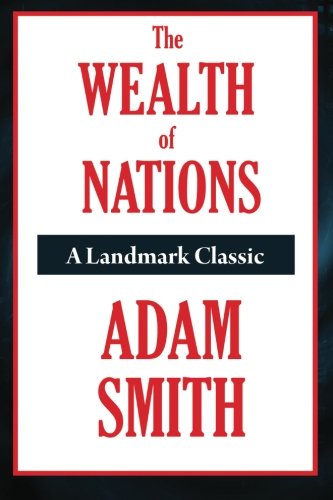
The Wealth of Nations is a clearly written account of economics at the dawn of the Industrial Revolution. The book was a landmark work in the history and economics as it was comprehensive and an accurate characterization of the economic mechanisms at work in modern economics. Smith believed in a Meritocracy. Smith emphasized the advancement that one could take based on their will to better themselves. This is simply one of the most important books ever written on the subject of economics. All five books are included here. A Thrifty Book is a well designed, easy to read book at an unbeatable price.
Die Inhaltsangabe kann sich auf eine andere Ausgabe dieses Titels beziehen.
Suchergebnisse für The Wealth of Nations

Beispielbild für diese ISBN
The Wealth of Nations
Anbieter: World of Books (was SecondSale), Montgomery, IL, USA
Verkäuferbewertung 5 von 5 Sternen

Paperback. Zustand: Good. The Wealth of Nations offers one of the world's first connected accounts of what builds nations' wealth, and has become a fundamental work in classical economics. It influenced a number of authors and economists, as well as governments and organizations. Alexander Hamilton was influenced in part by The Wealth of Nations to write his Report on Manufactures, in which he argued against many of Smith's policies. Interestingly, Hamilton based much of this report on the ideas of Jean-Baptiste Colbert, and it was, in part, Colbert's ideas that Smith responded to with The Wealth of Nations. Many other authors were influenced by the book and used it as a starting point in their own work, including Jean-Baptiste Say, David Ricardo, Thomas Malthus and, later, Ludwig von Mises. The Wealth of Nations was the product of seventeen years of notes and earlier studies, as well as an observation of conversation among economists of the time concerning economic and societal conditions during the beginning of the Industrial Revolution, and it took Smith some ten years to produce. It provided the foundation for economists, politicians, mathematicians, and thinkers of all fields to build upon. Irrespective of historical influence, The Wealth of Nations represented a clear paradigm shift in the field of economics, comparable to what Immanuel Kant's Critique of Pure Reason was for philosophy. Artikel-Nr. CIN1604598913G
Gebraucht kaufen
EUR 4,49
Versand gratis
Versand innerhalb von USA
Versand innerhalb von USA
Anzahl: 1 verfügbar
Foto des Verkäufers
The Wealth of Nations
Anbieter: Dream Books Co., Denver, CO, USA
Verkäuferbewertung 5 von 5 Sternen
Zustand: good. Gently used with minimal wear on the corners and cover. A few pages may contain light highlighting or writing, but the text remains fully legible. Dust jacket may be missing, and supplemental materials like CDs or codes may not be included. May be ex-library with library markings. Ships promptly! Artikel-Nr. DBV.1604598913.G
Gebraucht kaufen
EUR 6,10
Versand gratis
Versand innerhalb von USA
Versand innerhalb von USA
Anzahl: 1 verfügbar
Beispielbild für diese ISBN
The Wealth of Nations
Verlag:
Thrifty Books (edition ), 2009
ISBN 10: 1604598913
ISBN 13: 9781604598919
Gebraucht
Paperback
Anbieter: BooksRun, Philadelphia, PA, USA
Verkäuferbewertung 5 von 5 Sternen
Paperback. Zustand: Fair. The item might be beaten up but readable. May contain markings or highlighting, as well as stains, bent corners, or any other major defect, but the text is not obscured in any way. Artikel-Nr. 1604598913-7-1
Gebraucht kaufen
EUR 7,32
Versand gratis
Versand innerhalb von USA
Versand innerhalb von USA
Anzahl: 1 verfügbar
Beispielbild für diese ISBN
The Wealth of Nations
Anbieter: World of Books (was SecondSale), Montgomery, IL, USA
Verkäuferbewertung 5 von 5 Sternen
Paperback. Zustand: Very Good. The Wealth of Nations offers one of the world's first connected accounts of what builds nations' wealth, and has become a fundamental work in classical economics. It influenced a number of authors and economists, as well as governments and organizations. Alexander Hamilton was influenced in part by The Wealth of Nations to write his Report on Manufactures, in which he argued against many of Smith's policies. Interestingly, Hamilton based much of this report on the ideas of Jean-Baptiste Colbert, and it was, in part, Colbert's ideas that Smith responded to with The Wealth of Nations. Many other authors were influenced by the book and used it as a starting point in their own work, including Jean-Baptiste Say, David Ricardo, Thomas Malthus and, later, Ludwig von Mises. The Wealth of Nations was the product of seventeen years of notes and earlier studies, as well as an observation of conversation among economists of the time concerning economic and societal conditions during the beginning of the Industrial Revolution, and it took Smith some ten years to produce. It provided the foundation for economists, politicians, mathematicians, and thinkers of all fields to build upon. Irrespective of historical influence, The Wealth of Nations represented a clear paradigm shift in the field of economics, comparable to what Immanuel Kant's Critique of Pure Reason was for philosophy. Artikel-Nr. CIN1604598913VG
Gebraucht kaufen
EUR 12,82
Versand gratis
Versand innerhalb von USA
Versand innerhalb von USA
Anzahl: 1 verfügbar