
Verwandte Artikel zu Learning to Speak God from Scratch: Why Sacred Words...
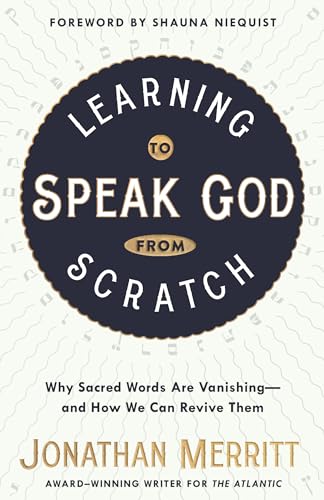
Learning to Speak God from Scratch: Why Sacred Words Are Vanishing--and How We Can Revive Them - Softcover
Inhaltsangabe
In a rapidly changing culture, many of us struggle to talk about faith. We can no longer assume our friends understand words such as grace or gospel. Others, like lost and sin, have become so negative they are nearly conversation-enders.
Jonathan Merritt knows this frustration well. After moving from the Bible Belt to New York City, he discovered that the sacred terms he used to describe his spiritual life didn’t connect as they had in the past. This launched him into an exploration of an increasing American reluctance to talk about faith—and the data he uncovered revealed a quiet crisis of affecting millions.
In this groundbreaking book, Jonathan revives ancient expressions through incisive cultural commentary, vulnerable personal narratives, and surprising biblical insights. Both provocative and liberating, Learning to Speak God from Scratch will breathe new life into your spiritual conversations and invite you into the embrace of the God who inhabits them.
Die Inhaltsangabe kann sich auf eine andere Ausgabe dieses Titels beziehen.
Über die Autorin bzw. den Autor
Jonathan Merritt is one of America’s most prolific religion and culture writers. An award-winning contributor for The Atlantic, he has published thousands of articles in outlets such as USA Today, Buzzfeed, and The Washington Post. As a sought after commentator, Jonathan has appeared on CNN, Fox News, MSNBC, ABC News, and NPR. He holds two graduate degrees in religion and resides in Brooklyn, NY.
Auszug. © Genehmigter Nachdruck. Alle Rechte vorbehalten.
Chapter 1.
A life coach once told me that adults searching for meaning should pursue their childhood dreams. Which seems reasonable enough if you fantasized as a kid about becoming a tax attorney or insurance adjuster as a kid. The principle doesn’t work as well for people like me, who dreamed about becoming a cowboy.
My mother reminisces about the way I played pretend in the living room, wearing nothing except pajama bottoms, a mini Stetson hat, and black boots with silver spurs. I’d force my cowboy boots onto the wrong feet, which made the whole scenario a little more precious and a lot more absurd. On more than one occasion, I sauntered around the house, knock-kneed, waving a plastic six-shooter and asking where I could find a good watering hole.
“When I grow up,” I told my mother, “I’m movin’ to El Paso.”
I had never been to El Paso. Heck, I’d never even seen pictures. In my version of El Paso, the townsfolk rode horses and never left home without pistols strapped to their hips. Only one lawman lived there, and he could usually be found outside the jailhouse smoking a hand-rolled cigarette. I assumed most residents wrangled cattle during the day, lay under a blanket of stars at night, and after a hard week’s work, gathered at the saloon for a frothy mug of sarsaparilla and a hand of Texas Hold ’Em.
When I was old enough to move to the city of my choosing, however, El Paso didn’t even make the Top 10. My cowboy dream had long faded. When I decided at the age of thirty-one to join the 8.5 million city slickers who call New York City home, I wondered if that wrangler spirit had led me there.
You won’t find horses in the Big Apple unless they’re dragging carriages around Central Park. The only cows we have are served medium rare and will cost you a second mortgage. The city’s strict gun laws mean you’re unlikely to see a pistol unless it’s resting in a police officer’s holster, and the closest thing you’ll find to a tumbleweed is a windswept potato chip bag.
And yet, New York City has a certain frontier-like quality. Countless people arrive each year—in moving vans, like modern covered wagons—with hopes of forging a new life, conquering the iron wilderness, and if they’re lucky, maybe even striking gold. The scent of opportunity is everywhere—I’ve caught whiffs on street corners and nearly choked on it on Wall Street.
America’s biggest metropolis is diverse enough that citizens can curate their own version. The New York of the Upper East Side is not at all like the New York of Astoria, Queens. So different are the two neighborhoods that it’s almost laughable for them to claim the same city of residence.
I settled into the Brooklyn neighborhood of Williamsburg, which is less like Seinfeld and more like Blue Bloods. The buildings are smattered with graffiti and bursting with third-wave coffee shops. Hipsters and Latinos mingle with a remnant population of Hasidic Jews who have decided to stay put even as the neighborhood gentrifies. (I spy more menorahs during Hanukkah than twinkling trees at Christmas.)
On the waterfront, Brooklyn residents lounge with loved ones on benches beside the East River and watch the summer sun sink into the skyline. The final rays of dusk wash Manhattan’s skyscrapers with sheets of light on clear nights. During the autumn months, McCarren Park fills with guitarists and flag football teams and a weekend farmer’s market where you can purchase apple cider and tupelo honey and rhubarb jelly.
Living here is just as lovely as it sounds.
The delights of New York did not blindside me, of course. But I never anticipated, upon arriving, that I’d run into a crippling language barrier. Sure, I could order a late-night kebab from a halal street cart or relay an address to a taxicab driver. I spoke English as well as I always had.
My problem was that I could no longer “speak God.”
Prior to moving to New York, I resided in a suburban neighborhood in the heart of the Bible Belt. Almost all my friends were Christian, and most of us attended the same type of church. I worked as a minister to a congregation outside of Atlanta, and before that, I was a full-time seminary student. The community in which I was immersed was so thoroughly Christian, I sometimes forgot that other people practiced different religions or none at all.
In this world, there was a kind of cultural Christian lingo that many speak and almost everyone else understands. If someone sneezed, a stranger might say, “God bless you.” The sneezer would not stop to think, What do you mean by “God”? Or by “bless”? If someone mentioned that he had been “saved,” “born again,” or “attended a Bible-believing church,” no follow-up question was needed. On meeting a new acquaintance, Southerners will usually ask where they attend church rather than if.
I used religious language with ease in the South, rarely pausing to think about the meaning of my words. I grew up surrounded by these syllables of faith, used daily in my home and community. But I was not in Georgia anymore. I penned columns about the intersection of “faith and culture” from my Southern Christian enclave, but as it turns out, pontificating about a post-Christian society is far easier than living in one.
In New York, religious fluency is not assumed. The majority of residents don’t attend church on any given Sunday, and only about three percent of the population is evangelical Protestant like I was raised. I soon discovered people who had never heard the sacred words I’d long taken for granted—and others who used them with wildly different meanings.
I realized this linguistic chasm en route to visit a church in Manhattan on my first Sunday in New York. Waiting on a subway platform, a woman standing next to me asked where I was headed. I explained that I was going to a “worship service.” She asked for clarification, having never heard that phrase. I clarified that I was new to the city and was going to visit a church. She perked up and said she practiced the Baha'i faith. She held up her crystal amulet necklace and explained that it protected her from evil spirits. If I was spiritually curious, the woman said, she’d read my chakra and access the invisible energy fields around my body.
As we talked about our respective religious practices, it became clear that neither of us understood what the other was saying. I glanced down the dark tunnel in hopes of spotting a train, but rescue wasn’t in sight.
She peppered me with questions about God and the Bible and the afterlife. I fumbled for answers, but what came out didn’t make much sense. When I used terms I considered common—“grace” or “gospel” or “salvation”—my conversation partner stopped me mid-thought to ask for a definition, please. I sputtered, stammered, and stuttered, trying to rephrase those words in ordinary vernacular, but I couldn’t seem to articulate their meanings. It was like trying to define the word color or the. Though I had used the terms often, I’d never stopped to consider their meanings.
The train finally slid into the station. I thanked the lady for conversing, though I felt anything but grateful, and bolted down the platform to find a separate train car.
Not all New Yorkers are like this woman, I came to realize. Others presented a different set of obstacles. Many are familiar with sacred terms but have experienced them as a source of pain or judgment or coercion. In such cases, I often felt...
„Über diesen Titel“ kann sich auf eine andere Ausgabe dieses Titels beziehen.
Suchergebnisse für Learning to Speak God from Scratch: Why Sacred Words...

Beispielbild für diese ISBN
Learning to Speak God from Scratch: Why Sacred Words Are Vanishing--and How We Can Revive Them
Verlag:
Harmony/Rodale/Convergent, 2018
ISBN 10: 1601429304
ISBN 13: 9781601429308
Gebraucht
Softcover
Anbieter: World of Books (was SecondSale), Montgomery, IL, USA
Verkäuferbewertung 5 von 5 Sternen

Zustand: Good. Item in good condition. Textbooks may not include supplemental items i.e. CDs, access codes etc. Artikel-Nr. 00087299368
Gebraucht kaufen
EUR 3,63
Versand gratis
Versand innerhalb von USA
Versand innerhalb von USA
Anzahl: 5 verfügbar
Beispielbild für diese ISBN
Learning to Speak God from Scratch: Why Sacred Words Are Vanishing--and How We Can Revive Them
Verlag:
Harmony/Rodale/Convergent, 2018
ISBN 10: 1601429304
ISBN 13: 9781601429308
Gebraucht
Softcover
Anbieter: World of Books (was SecondSale), Montgomery, IL, USA
Verkäuferbewertung 5 von 5 Sternen
Zustand: Acceptable. Item in good condition. Textbooks may not include supplemental items i.e. CDs, access codes etc. Artikel-Nr. 00069841890
Gebraucht kaufen
EUR 3,63
Versand gratis
Versand innerhalb von USA
Versand innerhalb von USA
Anzahl: 1 verfügbar
Beispielbild für diese ISBN
Learning to Speak God from Scratch: Why Sacred Words Are Vanishing--and How We Can Revive Them
Verlag:
Harmony/Rodale/Convergent (edition ), 2018
ISBN 10: 1601429304
ISBN 13: 9781601429308
Gebraucht
Paperback
Anbieter: BooksRun, Philadelphia, PA, USA
Verkäuferbewertung 5 von 5 Sternen
Paperback. Zustand: Very Good. It's a well-cared-for item that has seen limited use. The item may show minor signs of wear. All the text is legible, with all pages included. It may have slight markings and/or highlighting. Artikel-Nr. 1601429304-8-1
Gebraucht kaufen
EUR 4,31
Versand gratis
Versand innerhalb von USA
Versand innerhalb von USA
Anzahl: 1 verfügbar
Beispielbild für diese ISBN
Learning to Speak God from Scratch: Why Sacred Words Are Vanishing--and How We Can Revive Them
Verlag:
Harmony/Rodale/Convergent (edition ), 2018
ISBN 10: 1601429304
ISBN 13: 9781601429308
Gebraucht
Paperback
Anbieter: BooksRun, Philadelphia, PA, USA
Verkäuferbewertung 5 von 5 Sternen
Paperback. Zustand: Very Good. It's a well-cared-for item that has seen limited use. The item may show minor signs of wear. All the text is legible, with all pages included. It may have slight markings and/or highlighting. Artikel-Nr. 1601429304-11-1
Gebraucht kaufen
EUR 4,51
Versand gratis
Versand innerhalb von USA
Versand innerhalb von USA
Anzahl: 1 verfügbar
Beispielbild für diese ISBN
Learning to Speak God from Scratch : Why Sacred Words Are Vanishing--And How We Can Revive Them
Verlag:
Potter/Ten Speed/Harmony/Rodale, 2018
ISBN 10: 1601429304
ISBN 13: 9781601429308
Gebraucht
Softcover
Anbieter: Better World Books, Mishawaka, IN, USA
Verkäuferbewertung 5 von 5 Sternen
Zustand: Good. Former library copy. Pages intact with minimal writing/highlighting. The binding may be loose and creased. Dust jackets/supplements are not included. Includes library markings. Stock photo provided. Product includes identifying sticker. Better World Books: Buy Books. Do Good. Artikel-Nr. 18408560-6
Gebraucht kaufen
EUR 6,41
Versand gratis
Versand innerhalb von USA
Versand innerhalb von USA
Anzahl: 1 verfügbar
Beispielbild für diese ISBN
Learning to Speak God from Scratch : Why Sacred Words Are Vanishing--And How We Can Revive Them
Verlag:
Potter/Ten Speed/Harmony/Rodale, 2018
ISBN 10: 1601429304
ISBN 13: 9781601429308
Gebraucht
Softcover
Anbieter: Better World Books, Mishawaka, IN, USA
Verkäuferbewertung 5 von 5 Sternen
Zustand: Good. Pages intact with minimal writing/highlighting. The binding may be loose and creased. Dust jackets/supplements are not included. Stock photo provided. Product includes identifying sticker. Better World Books: Buy Books. Do Good. Artikel-Nr. 16368554-6
Gebraucht kaufen
EUR 6,41
Versand gratis
Versand innerhalb von USA
Versand innerhalb von USA
Anzahl: 3 verfügbar
Beispielbild für diese ISBN
Learning to Speak God from Scratch: Why Sacred Words Are Vanishing--and How We Can Revive Them
Verlag:
Harmony/Rodale/Convergent, 2018
ISBN 10: 1601429304
ISBN 13: 9781601429308
Gebraucht
Softcover
Anbieter: Wonder Book, Frederick, MD, USA
Verkäuferbewertung 5 von 5 Sternen
Zustand: Very Good. Very Good condition. A copy that may have a few cosmetic defects. May also contain light spine creasing or a few markings such as an owner's name, short gifter's inscription or light stamp. Artikel-Nr. I12K-00706
Gebraucht kaufen
EUR 7,17
Versand gratis
Versand innerhalb von USA
Versand innerhalb von USA
Anzahl: 1 verfügbar
Beispielbild für diese ISBN
Learning to Speak God from Scratch: Why Sacred Words Are Vanishing--and How We Can Revive Them
Verlag:
Harmony/Rodale/Convergent, 2018
ISBN 10: 1601429304
ISBN 13: 9781601429308
Gebraucht
Paperback
Anbieter: WorldofBooks, Goring-By-Sea, WS, Vereinigtes Königreich
Verkäuferbewertung 5 von 5 Sternen
Paperback. Zustand: Very Good. The book has been read, but is in excellent condition. Pages are intact and not marred by notes or highlighting. The spine remains undamaged. Artikel-Nr. GOR010741948
Gebraucht kaufen
EUR 8,53
EUR 6,52 Versand
Versand von Vereinigtes Königreich nach USA
Versand von Vereinigtes Königreich nach USA
Anzahl: 3 verfügbar
Beispielbild für diese ISBN
Learning to Speak God from Scratch: Why Sacred Words Are Vanishing--And How We Can Revive Them
Anbieter: Anybook.com, Lincoln, Vereinigtes Königreich
Verkäuferbewertung 5 von 5 Sternen
Zustand: Good. This is an ex-library book and may have the usual library/used-book markings inside.This book has soft covers. In good all round condition. Please note the Image in this listing is a stock photo and may not match the covers of the actual item,300grams, ISBN:9781601429308. Artikel-Nr. 5798350
Gebraucht kaufen
EUR 4,57
EUR 15,83 Versand
Versand von Vereinigtes Königreich nach USA
Versand von Vereinigtes Königreich nach USA
Anzahl: 1 verfügbar
Beispielbild für diese ISBN
Learning to Speak God from Scratch: Why Sacred Words Are Vanishing--and How We Can Revive Them
Verlag:
Harmony/Rodale/Convergent, 2018
ISBN 10: 1601429304
ISBN 13: 9781601429308
Gebraucht
Softcover
Anbieter: medimops, Berlin, Deutschland
Verkäuferbewertung 5 von 5 Sternen
Zustand: very good. Gut/Very good: Buch bzw. Schutzumschlag mit wenigen Gebrauchsspuren an Einband, Schutzumschlag oder Seiten. / Describes a book or dust jacket that does show some signs of wear on either the binding, dust jacket or pages. Artikel-Nr. M01601429304-V
Gebraucht kaufen
EUR 14,56
EUR 10,00 Versand
Versand von Deutschland nach USA
Versand von Deutschland nach USA
Anzahl: 1 verfügbar