
Verwandte Artikel zu 100 Things Texas A&M Fans Should Know & Do...
100 Things Texas A&M Fans Should Know & Do Before They Die (100 Things...Fans Should Know) - Softcover
Buch 21 von 50: 100 Things...Fans Should Know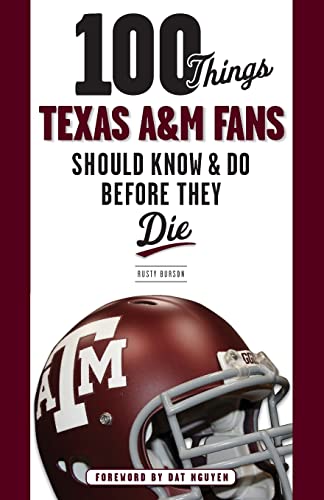
Inhaltsangabe
Describing the personalities, events, and facts that any and every Aggies fan should know, this work stands as a complete guide to one of the most accomplished and unique histories in college football. Highlighting the traditions that make Texas A&M football one of a kind&;the 12th Man, the Aggie Bonfire, and Midnight Yell Practice&;this book details the team&;s recent resurgence with their electrifying, Heisman Trophy&;winning quarterback Johnny Manziel before taking readers back to the Aggies&; three national championships and describing the larger-than-life figures who have coached at the school, including Paul &;Bear&; Bryant, Gene Stallings, Jackie Sherrill, R. C. Slocum, and Kevin Sumlin. More than a century of team history is distilled to highlight the essential moments, describing in an informative and lively way the personalities, games, rivalries, and plays that have come together to make Texas A&M one of college football&;s most beloved programs.
Die Inhaltsangabe kann sich auf eine andere Ausgabe dieses Titels beziehen.
Über die Autorin bzw. den Autor
Rusty Burson is a former newspaper reporter and feature writer and is the current associate editor of 12th Man Magazine as well as the senior development officer for the 12th Man Foundation at Texas A&M University. He is the author of 10 books, including 100 Things Ranger Fans Should Know & Do Before They Die and What It Means to Be an Aggie. He lives in College Station, Texas. Dat Nguyen is one of the greatest linebackers in the history of the Texas A&M football program.
Auszug. © Genehmigter Nachdruck. Alle Rechte vorbehalten.
100 Things Texas A&M Fans Should Know & Do Before They Die
By Rusty BursonTriumph Books
Copyright © 2013 Rusty Burson
All rights reserved.
ISBN: 978-1-60078-839-0All rights reserved.
Contents
Foreword by Dat Nguyen,
Acknowledgments,
Introduction,
1. Salute Gen. James Earl Rudder for the Best Decision Ever,
2. Wear a Bow Tie in Honor of Dr. Loftin,
3. Give to the 12th Man Foundation,
4. 2012 Heisman Winner Johnny Manziel,
5. Dat Nguyen,
6. Von Miller,
7. The Bonfire Game of 1999,
8. The 1939 Aggies,
9. The Financial Reward of Winning It All,
10. The 1998 Big 12 Championship Game,
11. The 2012 Upset of Alabama,
12. TexAgs.com,
13. Stopping Bo in the Cotton Bowl,
14. 1957 Heisman Winner John David Crow,
15. R.C. Slocum,
16. The Best Loss Ever in 2011,
17. A November to Remember in 1985,
18. John Kimbrough,
19. Kevin Murray,
20. Bucky Richardson,
21. Jackie Sherrill,
22. Red, White, and Blue Out,
23. Dana Bible,
24. E. King Gill,
25. The 1986 Comeback Against Baylor,
26. Junction,
27. Kevin Smith,
28. Homer Norton,
29. The 1940 Loss to Texas,
30. Kiddie Corps,
31. Ray Childress,
32. Kevin Sumlin,
33. Emory Bellard,
34. Edd Hargett,
35. Luke Joeckel,
36. The 1956 Texas Game,
37. The 1975 Texas Game,
38. Ed Simonini,
39. The 1967 Texas Game,
40. Bear Bryant,
41. The 1998 Nebraska Game,
42. The 1967 Texas Tech Comeback,
43. Quentin Coryatt and The Hit,
44. Chet Brooks and the Wrecking Crew,
45. The Rise and Fall of the '57 Aggies,
46. The 2012 Ole Miss Game,
47. The 1990 Holiday Bowl,
48. The 1975 Loss to Arkansas,
49. Joe Routt,
50. Ryan Swope,
51. Lester Hayes,
52. Darren Lewis,
53. Greg Hill,
54. Terrence Murphy,
55. The Texas Special,
56. Jack Pardee,
57. Johnny Holland,
58. Stay in the Stands for the Fightin' Texas Aggie Band,
59. 12th Man Kickoff Team,
60. The 2010 Nebraska Game,
61. Attend Yell Practice,
62. Shane Lechler,
63. The Rice Comeback in 1955,
64. Aaron Wallace,
65. Tony Franklin,
66. Jacob Green,
67. Ryan Tannehill,
68. Billy Liucci,
69. Bob Smith,
70. The 1968 Cotton Bowl,
71. Jake Matthews and His Brothers,
72. Dave Elmendorf,
73. Curtis Dickey,
74. Sam Adams,
75. Dave South,
76. Gene Stallings,
77. Joe Boyd,
78. Pat Thomas,
79. Ray Mickens,
80. Aaron Glenn,
81. Larry Jackson,
82. Alan Cannon,
83. Homer Jacobs,
84. Gabe Bock,
85. Randy Bullock,
86. Forget the Fran Era,
87. Beating No. 1 Oklahoma in 2002,
88. Brent Zwerneman,
89. Antonio Armstrong,
90. Dan Campbell,
91. The McKinney Brothers,
92. Ty Warren,
93. John Roper,
94. Jerrod Johnson,
95. Corey Pullig,
96. Charlie Moran,
97. Stealing Tim Brown's Towel,
98. Reveille,
98. Reveille,
100. Billy Pickard,
Sources,
About the Author,
CHAPTER 1
Salute Gen. James Earl Rudder for the Best Decision Ever
If World War II had never taken place, it's conceivable that James Earl Rudder could have been hired as the head football coach at Texas A&M. After all, Rudder, a 1930 graduate of A&M, had already earned his first collegiate head coaching job at John Tarleton Agricultural College (now Tarleton State) by the time he was 28 in 1938.
Perhaps Rudder could have succeeded Homer Norton as head coach in Aggieland in 1948 instead of Harry Stiteler, who "led" A&M to its only winless season in school history and lasted only three years in College Station. Perhaps Rudder could have prevented A&M from falling upon such unfortunate football times, as the Aggies were just 28–56 –7 from 1946–54.
Maybe Rudder, with his legendary leadership skills, would have been so successful at his alma mater that the Aggies would have never needed to lure Paul "Bear" Bryant from Kentucky.
We'll never know, as World War II did occur, and Rudder became one of the most revered military heroes of the D-Day invasion. As commander and trainer of the Second Ranger Battalion, Rudder's Rangers stormed the beach at Pointe du Hoc and, under constant enemy fire, scaled 100' cliffs to reach and destroy German gun batteries. The perilous mission resulted in a higher than 50 percent casualty rate, and Rudder was wounded twice during the fighting.
He later became Texas Land Commissioner and served as the 16th president of Texas A&M from 1959 until his death in March 1970.
He never officially coached a game for A&M. But he certainly deserves the top spot in any book that documents, celebrates, or pays homage to the evolution of Aggie football. For that matter, Texas A&M wouldn't be Texas A&M as we know it today without Rudder's ground-breaking influence and leadership.
During Rudder's administration, the university doubled its enrollment, expanded its research programs, and improved academic and faculty standards. And one extremely controversial Rudder decision laid the groundwork for future growth and — among other things — athletic success, as Rudder transformed the university by making the military requirement optional and opening admission to women.
Until Rudder's landmark decision in the mid-1960s, A&M was all male, all military, and all but forgotten in the minds of most prospective students and student-athletes in Texas. By 1962, for example, A&M's enrollment barely topped 8,000, as high school students throughout the region chose instead to seek admission to coeducational state universities such as Texas, Texas Tech, and Houston.
Rudder could envision an increasingly bleak future for the university, and instead of allowing his alma mater to dwindle into obscurity, he forced radical changes during the recess of an Association of Former Students (AFS) board meeting on January 25, 1964. According to Homer Jacobs' book, The Pride of Aggieland, it was on that day that Rudder approached John Lindsey, president of the AFS board, and handed him a torn piece of paper with a handwritten note that essentially stated, "Admit women on a full-scale basis."
Although the wives of students and daughters of A&M faculty had been allowed to take courses since the college's earliest days, the idea of a full-fledged coeducational institution had been fought vigorously by students and former students for generations. Lindsey knew the note Rudder had handed him would likely whip the attendees into a volatile frenzy. Nevertheless, Lindsey made his announcement.
"Gen. Rudder gave me a resolution to admit women all the way," Lindsey said to the group following the recess. "He wants it and needs it. Gentlemen, this is the best thing for our university — and now I'm going to call on a vote."
Lindsey later described the scene to Homer Jacobs: "I said, 'Those in favor say aye,' and there were some ayes. I then said, 'All opposed say no,' and there were a lot of them. But I said, 'The ayes have it,' and that was that. Many of the men were yelling for another voice vote or ballot vote, but I refused."
With that "vote," Rudder had all he needed for the board of directors to provide the green light to admitting women. At first, the growth of the female student population was extremely slow, but by 1974–75,...
„Über diesen Titel“ kann sich auf eine andere Ausgabe dieses Titels beziehen.
Suchergebnisse für 100 Things Texas A&M Fans Should Know & Do...

Beispielbild für diese ISBN
100 Things Texas A&M Fans Should Know & Do Before They Die
Anbieter: World of Books (was SecondSale), Montgomery, IL, USA
Verkäuferbewertung 5 von 5 Sternen

Paperback. Zustand: Good. Describing the personalities, events, and facts that any and every Aggies fan should know, this work stands as a complete guide to one of the most accomplished and unique histories in college football. Highlighting the traditions that make Texas A&M football one of a kind--the 12th Man, the Aggie Bonfire, and Midnight Yell Practice--this book details the team's recent resurgence with their electrifying, Heisman Trophy-winning quarterback Johnny Manziel before taking readers back to the Aggies' three national championships and describing the larger-than-life figures who have coached at the school, including Paul Bear Bryant, Gene Stallings, Jackie Sherrill, R. C. Slocum, and Kevin Sumlin. More than a century of team history is distilled to highlight the essential moments, describing in an informative and lively way the personalities, games, rivalries, and plays that have come together to make Texas A&M one of college football's most beloved programs. Artikel-Nr. 00109718375
Gebraucht kaufen
EUR 4,51
Versand gratis
Versand innerhalb von USA
Versand innerhalb von USA
Anzahl: 1 verfügbar
Beispielbild für diese ISBN
100 Things Texas A&M Fans Should Know & Do Before They Die
Anbieter: World of Books (was SecondSale), Montgomery, IL, USA
Verkäuferbewertung 5 von 5 Sternen
Paperback. Zustand: Very Good. Describing the personalities, events, and facts that any and every Aggies fan should know, this work stands as a complete guide to one of the most accomplished and unique histories in college football. Highlighting the traditions that make Texas A&M football one of a kind--the 12th Man, the Aggie Bonfire, and Midnight Yell Practice--this book details the team's recent resurgence with their electrifying, Heisman Trophy-winning quarterback Johnny Manziel before taking readers back to the Aggies' three national championships and describing the larger-than-life figures who have coached at the school, including Paul Bear Bryant, Gene Stallings, Jackie Sherrill, R. C. Slocum, and Kevin Sumlin. More than a century of team history is distilled to highlight the essential moments, describing in an informative and lively way the personalities, games, rivalries, and plays that have come together to make Texas A&M one of college football's most beloved programs. Artikel-Nr. 00093005301
Gebraucht kaufen
EUR 4,51
Versand gratis
Versand innerhalb von USA
Versand innerhalb von USA
Anzahl: 1 verfügbar
Beispielbild für diese ISBN
100 Things Texas a&M Fans Should Know and Do Before They Die
Anbieter: Better World Books, Mishawaka, IN, USA
Verkäuferbewertung 5 von 5 Sternen
Zustand: Good. Pages intact with minimal writing/highlighting. The binding may be loose and creased. Dust jackets/supplements are not included. Stock photo provided. Product includes identifying sticker. Better World Books: Buy Books. Do Good. Artikel-Nr. 42617959-6
Gebraucht kaufen
EUR 7,22
Versand gratis
Versand innerhalb von USA
Versand innerhalb von USA
Anzahl: 1 verfügbar
Beispielbild für diese ISBN
100 Things Texas a&M Fans Should Know and Do Before They Die
Anbieter: Better World Books, Mishawaka, IN, USA
Verkäuferbewertung 5 von 5 Sternen
Zustand: Fine. Used book that is in almost brand-new condition. May contain a remainder mark. Better World Books: Buy Books. Do Good. Artikel-Nr. 55818164-6
Gebraucht kaufen
EUR 7,22
Versand gratis
Versand innerhalb von USA
Versand innerhalb von USA
Anzahl: 1 verfügbar
Beispielbild für diese ISBN
100 Things Texas A&M Fans Should Know & Do Before They Die
Anbieter: ThriftBooks-Dallas, Dallas, TX, USA
Verkäuferbewertung 5 von 5 Sternen
Paperback. Zustand: Very Good. No Jacket. May have limited writing in cover pages. Pages are unmarked. ~ ThriftBooks: Read More, Spend Less. Artikel-Nr. G1600788394I4N00
Gebraucht kaufen
EUR 9,17
Versand gratis
Versand innerhalb von USA
Versand innerhalb von USA
Anzahl: 1 verfügbar
Beispielbild für diese ISBN
100 Things Texas A&M Fans Should Know & Do Before They Die
Anbieter: ThriftBooks-Atlanta, AUSTELL, GA, USA
Verkäuferbewertung 5 von 5 Sternen
Paperback. Zustand: Very Good. No Jacket. May have limited writing in cover pages. Pages are unmarked. ~ ThriftBooks: Read More, Spend Less. Artikel-Nr. G1600788394I4N00
Gebraucht kaufen
EUR 9,17
Versand gratis
Versand innerhalb von USA
Versand innerhalb von USA
Anzahl: 1 verfügbar
Beispielbild für diese ISBN
100 Things Texas A&M Fans Should Know & Do Before They Die
Anbieter: Revaluation Books, Exeter, Vereinigtes Königreich
Verkäuferbewertung 5 von 5 Sternen
Paperback. Zustand: Brand New. 224 pages. 8.46x5.58x0.74 inches. In Stock. Artikel-Nr. zk1600788394
Neu kaufen
EUR 23,06
EUR 14,77 Versand
Versand von Vereinigtes Königreich nach USA
Versand von Vereinigtes Königreich nach USA
Anzahl: 1 verfügbar