
Verwandte Artikel zu When Baseball Went to War
Inhaltsangabe
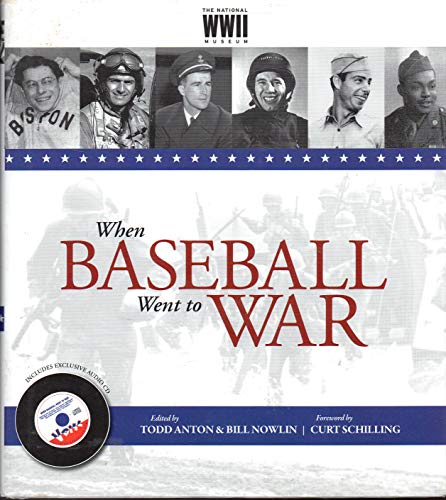
Combined with never-before-published photographs and other special features, this account tells the compelling and unforgettable story of ballplayers such as Ted Williams, Dom DiMaggio, Jerry Coleman, Bob Feller, Lou Brissie, and Johnny Pesky who answered their nation's call to serve their country.
Die Inhaltsangabe kann sich auf eine andere Ausgabe dieses Titels beziehen.
Über die Autorin bzw. den Autor
Todd Anton is a U.S. history teacher, an author, and a member of the National World War II Museum's board of trustees. He was nominated as Teacher of the Year by the Veterans of Foreign Wars as a result of his and his students' nearly 2,000 interviews with veterans of World War II. Bill Nowlin is the vice president of the Society for American Baseball Research, the founder of Rounder Records, a former political science professor, and the author of more than 20 books about the Red Sox. Curt Schilling is a former pitcher for Major League Baseball. Anton, Nowlin, and Schilling collaborated on an episode of Fox TV's War Stories devoted to World War II and baseball.
Auszug. © Genehmigter Nachdruck. Alle Rechte vorbehalten.
When Baseball Went to War
By Todd Anton, Bill NowlinTriumph Books
Copyright © 2008 Todd Anton and Bill Nowlin
All rights reserved.
ISBN: 978-1-60078-126-1All rights reserved.
Contents
FOREWORD,
ACKNOWLEDGMENTS,
BASEBALL AND WAR,
ESSAYS,
BALLPLAYERS,
PERSPECTIVES,
CHAMPIONSHIPS,
LISTS,
CONTRIBUTORS,
AFTERWORD,
CHAPTER 1
BASEBALL AND WAR
Our National Pastime
by Dr. Gordon H. "Nick" Mueller President/CEO, The National World War II Museum
It was December 1944. American forces were facing a German assault in Belgium and Luxembourg commonly known as "The Battle of the Bulge." Many German SS troopers donned American uniforms to cause havoc behind American lines. Their English was perfect: accent-free. How could a GI make sure he was talking to another "Joe" rather than a "Kraut"? The answer was simple: Ask baseball questions. "How did the Dodgers do this year?" "Who is Joltin' Joe?" "What's a Texas Leaguer?" "Where is Ebbets Field?"
You'd better know baseball to stay alive. Americans did. Stories such as this remind us of how baseball's myth and legend are part of popular American culture today. For well over a century, baseball has been the lifeblood of our nation. Even many who aren't fans of the game are familiar with Abner Doubleday's "invention" of the game in Cooperstown, New York, the legend of Casey at the Bat, Babe Ruth's "called shot" in the World Series, and the various curses that have hexed the Chicago Cubs for nearly 100 years. Hey, as most Cubs fans say, anyone can have a bad century. That may be true for the Cubs, but for America and its national pastime, that is hardly the case.
Baseball is America's game.
During World War II, heroes from the ballfield reported for duty. Stars such as Hank Greenberg of the Detroit Tigers joined the Army as kids pleaded with him, "Don't let Hitler kill baseball." Radio broadcasts and newspaper boxscores helped create a sense of normalcy on the home front for millions working for national defense. Boys wearing olive drab uniforms — be they from Pennsylvania to South Carolina, from Iowa to California — could pick up a ball, bat, or glove in foreign theaters of war and, if only for the briefest of moments, feel like they were back at their neighborhood sandlot or field with their families and friends. They wanted to be throwing fastballs, not hand grenades. They wanted to hit home runs and "Texas Leaguers," not assault beaches named Omaha or islands named Iwo Jima.
Baseball helped win the war, but not by inflicting casualties on the enemy or through territorial gains on a map. The game helped remind Americans of the way of life for which they were fighting. It reminded them that they were all on the same team. It reminded them that once victory in this epic struggle was achieved, they could all return to the lives they were used to before the war. Baseball gave veterans their humanity. Baseball reminded them of the boys they once were and were never to be again.
Over Veterans Day weekend in November 2007, The National World War II Museum hosted a baseball conference in New Orleans, "When Baseball Went to War." In no professional sport have more men sacrificed for their country than baseball. This conference was sponsored by Humana and brought to the Museum many of baseball's military veterans, including Jerry Coleman, Johnny Pesky, Bob Feller, Morrie Martin, Lou Brissie, local Negro Leaguer Herb "Briefcase" Simpson who played with the Homestead Grays, and Dolly Brumfield White of the All-American Girls Professional Baseball League.
These presenters were able to provide insight into their lesser-known but just as fascinating stories of their lives in World War II. By sharing their experiences, these veterans of the battlefield and ballfield told a sold-out audience how they felt about their service and how their war experiences changed them both as ballplayers and as men and women. The memories and wisdom of the players who saved baseball reawakened an important image — the greatness of baseball and the character of those who helped save it. It was amazing to see men in their seventies and eighties asking Bob Feller for an autograph as if they were still boys. It was truly a gift to hear the keynote address of legendary Dodgers manager Tommy Lasorda remind us all of the greatness of America and baseball. The conference was as diverse as our nation, but one common theme was as obvious in baseball as it was throughout America — "we're all in this together" and the goal was victory.
In recognition of their service, this conference provided an opportunity to thank these veterans/players. The Museum was honored to do so by bestowing its American Spirit Silver Service Medallion, presented by two members of our Board of Trustees — conference originator and baseball/WWII historian Todd Anton and current baseball pitching ace Curt Schilling of the World Champion Boston Red Sox — to the players in attendance.
The weekend was a grand slam, and as always, the veterans were the stars. Whether the players were in the Hall of Fame or not, the audience was enthralled to hear what these people had done for this nation, baseball, and the world more than 60 years ago. Never once were the baseball veterans bitter over lost records or lost moments on the field. One baseball veteran, when asked about his missing baseball years — those "gaps" in his statistics — responded with typical humility, "Imagine the gaps in my character as a man had I not served." Like all of the other men and women who put aside their normal lives for the duration of the war, they all wanted to — in Bob Feller's words — "Throw a few strikes for Uncle Sam!"
America is glad and grateful that they did!
CHAPTER 2When Baseball Went to War
by Gary Bedingfield
On September 16, 1940, faced with Japanese territorial gains in the Pacific and Nazi Germany's continued conquest of its neighbors in Europe, President Roosevelt signed the Selective Training and Service Act, better known as the draft. The draft affected every profession, and baseball was no exception. Every American male between the ages of 21 and 36 was required to register for 12 months of military service. These civilian soldiers began arriving at training camps all across the United States in October of 1940. By the end of 1941, nearly 2 million Americans were in uniform. Three hundred of them were professional baseball players.
Major League Baseball was at its zenith in 1941, enjoying a momentous year. Ted Williams batted .406, Joe DiMaggio captivated the nation by hitting safely in 56 consecutive games, and 41-year-old Lefty Grove got his 300th career win. The Brooklyn Dodgers finally made it to the World Series, although catcher Mickey Owen was to be forever immortalized for mishandling a Hugh Casey pitch that cost them the Series against the Yankees. Meanwhile, baseball bid a resounding farewell to the first two major league players to enter military service. Hugh "Losing Pitcher" Mulcahy — a veteran with the Philadelphia Phillies — holds the distinction of being the first major league regular to be drafted in World War II, being inducted on March 8, 1941. The 27-year-old right-hander earned his nickname by losing an astounding 76 games between 1937 and 1940 as a starter with the senior circuit's perennial basement team. "My losing streak is over for the duration," he proudly announced as he reported for induction at Camp Devens in Massachusetts. "I'm on a winning team now."
Detroit...
„Über diesen Titel“ kann sich auf eine andere Ausgabe dieses Titels beziehen.
Suchergebnisse für When Baseball Went to War

Beispielbild für diese ISBN
When Baseball Went to War
Anbieter: World of Books (was SecondSale), Montgomery, IL, USA
Verkäuferbewertung 5 von 5 Sternen

Zustand: Good. Item in good condition. Textbooks may not include supplemental items i.e. CDs, access codes etc. Artikel-Nr. 00098464829
Gebraucht kaufen
EUR 4,43
Versand gratis
Versand innerhalb von USA
Versand innerhalb von USA
Anzahl: 5 verfügbar
Beispielbild für diese ISBN
When Baseball Went to War
Anbieter: ThriftBooks-Atlanta, AUSTELL, GA, USA
Verkäuferbewertung 5 von 5 Sternen
Hardcover. Zustand: Very Good. No Jacket. May have limited writing in cover pages. Pages are unmarked. ~ ThriftBooks: Read More, Spend Less. Artikel-Nr. G1600781268I4N00
Gebraucht kaufen
EUR 5,87
Versand gratis
Versand innerhalb von USA
Versand innerhalb von USA
Anzahl: 1 verfügbar
Beispielbild für diese ISBN
When Baseball Went to War
Anbieter: ThriftBooks-Phoenix, Phoenix, AZ, USA
Verkäuferbewertung 5 von 5 Sternen
Hardcover. Zustand: Very Good. No Jacket. May have limited writing in cover pages. Pages are unmarked. ~ ThriftBooks: Read More, Spend Less. Artikel-Nr. G1600781268I4N00
Gebraucht kaufen
EUR 5,87
Versand gratis
Versand innerhalb von USA
Versand innerhalb von USA
Anzahl: 1 verfügbar
Beispielbild für diese ISBN
When Baseball Went to War
Anbieter: ThriftBooks-Dallas, Dallas, TX, USA
Verkäuferbewertung 5 von 5 Sternen
Hardcover. Zustand: Very Good. No Jacket. May have limited writing in cover pages. Pages are unmarked. ~ ThriftBooks: Read More, Spend Less. Artikel-Nr. G1600781268I4N00
Gebraucht kaufen
EUR 5,87
Versand gratis
Versand innerhalb von USA
Versand innerhalb von USA
Anzahl: 1 verfügbar
Beispielbild für diese ISBN
When Baseball Went to War
Anbieter: ThriftBooks-Reno, Reno, NV, USA
Verkäuferbewertung 5 von 5 Sternen
Hardcover. Zustand: Very Good. No Jacket. May have limited writing in cover pages. Pages are unmarked. ~ ThriftBooks: Read More, Spend Less. Artikel-Nr. G1600781268I4N00
Gebraucht kaufen
EUR 5,87
Versand gratis
Versand innerhalb von USA
Versand innerhalb von USA
Anzahl: 1 verfügbar
Beispielbild für diese ISBN
When Baseball Went to War
Verlag:
Triumph Books (edition Har/Com), 2008
ISBN 10: 1600781268
ISBN 13: 9781600781261
Gebraucht
Hardcover
Anbieter: BooksRun, Philadelphia, PA, USA
Verkäuferbewertung 5 von 5 Sternen
Hardcover. Zustand: Very Good. Har/Com. It's a well-cared-for item that has seen limited use. The item may show minor signs of wear. All the text is legible, with all pages included. It may have slight markings and/or highlighting. Artikel-Nr. 1600781268-11-6
Gebraucht kaufen
EUR 5,91
Versand gratis
Versand innerhalb von USA
Versand innerhalb von USA
Anzahl: 1 verfügbar
Beispielbild für diese ISBN
When Baseball Went to War
Anbieter: Wonder Book, Frederick, MD, USA
Verkäuferbewertung 5 von 5 Sternen
Zustand: Very Good. Very Good condition. Very Good dust jacket. With CD! A copy that may have a few cosmetic defects. May also contain light spine creasing or a few markings such as an owner's name, short gifter's inscription or light stamp. Artikel-Nr. U06A-04655
Gebraucht kaufen
EUR 6,59
Versand gratis
Versand innerhalb von USA
Versand innerhalb von USA
Anzahl: 2 verfügbar
Beispielbild für diese ISBN
When Baseball Went to War
Anbieter: Wonder Book, Frederick, MD, USA
Verkäuferbewertung 5 von 5 Sternen
Zustand: As New. Like New condition. Like New dust jacket. With CD! A near perfect copy that may have very minor cosmetic defects. Artikel-Nr. E18L-000203
Gebraucht kaufen
EUR 6,59
Versand gratis
Versand innerhalb von USA
Versand innerhalb von USA
Anzahl: 1 verfügbar
Foto des Verkäufers
When Baseball Went to War
Anbieter: A.C. Daniel's Collectable Books, South Paris, ME, USA
Verkäuferbewertung 5 von 5 Sternen
Hardcover. Zustand: Very Good. like new hardcover edition no damage seen. Artikel-Nr. 006244
Gebraucht kaufen
EUR 6,79
Versand gratis
Versand innerhalb von USA
Versand innerhalb von USA
Anzahl: 1 verfügbar
Beispielbild für diese ISBN
When Baseball Went to War
Anbieter: Better World Books, Mishawaka, IN, USA
Verkäuferbewertung 5 von 5 Sternen
Zustand: Good. Har/Com. Pages intact with minimal writing/highlighting. The binding may be loose and creased. Dust jackets/supplements are not included. Stock photo provided. Product includes identifying sticker. Better World Books: Buy Books. Do Good. Artikel-Nr. 4493112-6
Gebraucht kaufen
EUR 7,00
Versand gratis
Versand innerhalb von USA
Versand innerhalb von USA
Anzahl: 1 verfügbar