
Verwandte Artikel zu India: In Word and Image, Revised, Expanded and Updated:...
Inhaltsangabe
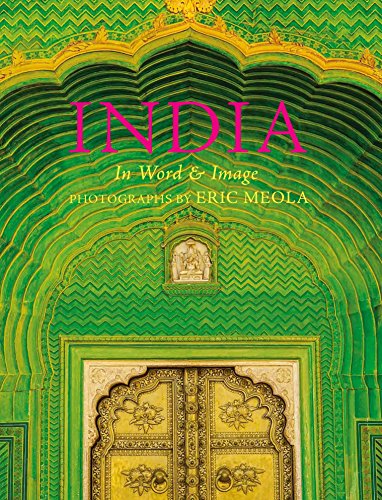
Gorgeously jaw-dropping, India has been beautifully redesigned with 32 additional pages of glorious photos shot by Eric Meola since India was first published.
This revised and expanded version of Eric Meola's 2008 India takes the reader on a journey through Mumbai, Rajasthan, Agra, Dungarpur, along desert roads, to the Ganges water's edge, including spectacular ruins, the Taj Mahal, and the Festival of Elephants, capturing the spectacle and vibrant colors of these ancient regions.
INDIA is rapidly becoming one of the pre-eminent leaders of the twenty-first century. For more than a decade, Eric Meola has returned repeatedly to India, photographing the people, temples, landscapes, architecture, celebrations, and art of this uniquely exuberant and incredibly diverse country. Meola's journeys took him from the Himalayas and monasteries in the North to the temples of Tamil Nadu in the South, from the color and pageantry of Rajasthan in the West to the tea plantations of Darjeeling in the East. Over 200 photographs (edited from more than 25,000 images) will fill this beautifully printed, large-format book. The photographs will be accompanied by dozens of essays, stories, and poems by contemporary and classical Indian writers.
Table of Contents
INDIA: In Word & Image
Photographs by Eric Meola
Contents
19 Eric Meola
My Private India
24 Bharati Mukherjee
Introduction
29 Salman Rushdie
Midnight’s Children
34 I. Allan Sealy
The Trotter-Nama
47 R. K. Narayan
Ganga’s Story
52 R. K. Narayan
The Ramayana
63 William Buck
Mahabharata
67 R. K. Narayan
Mr. Sampath—The Printer of Malgudi
71 Gita Mehta
A River Sutra
83 Kiran Desai
The Inheritance of Loss
86 Manil Suri
The Death of Vishnu
94 R. K. Narayan
The Guide
100 Ruth Prawer Jhabvala
The Housewife
110 Jhumpa Lahiri
Interpreter of Maladies
119 Thomas Byrom
Dhammapada
120 Anita Desai
Fasting, Feasting
129 Amit Chaudhuri
A Strange and Sublime Address
132 Nirad C. Chaudhuri
My Birthplace
136 R. K. Narayan
The Dark Room
147 Nirad C. Chaudhuri
My Birthplace
150 Kiran Desai
Hullabaloo in the Guava Orchard
163 Salman Rushdie
Midnight’s Children
169 Clark Blaise and Bharati Mukherjee
Days and Nights in Calcutta
178 Rabindranath Tagore
Subha
182 Upamanyu Chatterjee
English, August
185 Vikram Seth
A Suitable Boy
190 Amit Chaudhuri
A Strange and Sublime Address
194 Arundhati Roy
The God of Small Things
198 Anita Desai
Fasting, Feasting
203 O. V. Vijayan
The River
211 Kamala Markandaya
Nectar in a Sieve
214 Amit Chaudhuri
Sandeep’s Visit
222 Gita Mehta
A River Sutra
232 V. S. Naipaul
An Area of Darkness
239 Manil Suri
The Death of Vishnu
243 Ismat Chughtai
The Wedding Shroud
246 Nirad C. Chaudhuri
The Autobiography of an Unknown Indian
250 Nirad C. Chaudhuri
My Birthplace
254 Anita Desai
A Devoted Son
260 Kamala Markandaya
Nectar in a Sieve
---
Die Inhaltsangabe kann sich auf eine andere Ausgabe dieses Titels beziehen.
Über die Autorin bzw. den Autor
Eric Meola’s graphic use of color has informed his photographs for more than four decades. In 2004, Graphis Editions published his first book The Last Places on Earth. An exhibition in England of his photographs of Bruce Springsteen, which coincided with the publication of his second book Born to Run: The Unseen Photos (Insight Editions, 2006), was followed in 2008 by the first edition of INDIA: In Word & Image (Welcome Books, NY), and an exhibit in 2009 at the Art Directors Club of New York. In 2011, Ormond Yard Press of London published his most unusual book, an oversize (18"x24", 14 lbs.) edition of photographs of Bruce Springsteen—Born to Run Revisted—that was limited to 500 copies. Streets of Fire, his fifth book, was published by HarperCollins in September of 2012. Winner of numerous awards, with prints in several private collections and museums, including the National Portrait Gallery, he is a Canon “Explorer of Light”.
Introduction Author
Bharati Mukherjee, award-winning author and professor of English at the University of California, Berkeley, is well known both as a writer of fiction and as a social commentator. Her most recent novel is The Tree Bride, the second novel in a trilogy that bridges modern America and historical India. Her other novels include Jasmine, Leave It to Me, Desirable Daughters, and The Holder of the World. Her short stories are found in The Middleman and Other Stories, and Darkness.
Auszug. © Genehmigter Nachdruck. Alle Rechte vorbehalten.
from India: In Word and Image
Photographs by Eric Meola
1 Flap copy
2 Back cover quote
3 Foreword by Eric Meola
4 Introduction by Bharati Mukherjee
5 "Mahabharata" by William Buck
6 “Fasting, Feasting” by Anita Desai
---
1 Back cover quotes
“[An] exotic five-star vacation in itself. The portraits, landscapes, and photographic studies of flora and architecture are more art than documentary, and are accompanied not by history lessons, but by masterly literary prose…Such words can hold their own with any pictures, even Meola’s glorious photographs.” — Amy Finnerty, New York Times Book Review
“Eric Meola has captured a brilliant portrait of a vast and vibrant India through his artistic mastery of his lens. In a nation where city life resembles any urban metropolis globally, he has captured the unaltered richness of ancient India juxtaposed between thousands of years of its traditional civilization.” — Vishaka Hussain Pathak, US India Business Council
“Within pages I was mesmerized by the changing contrasts in hues, textures, and compositions of this visual odyssey. This work is mostly about India’s onslaught on the senses” — David Braun, National Geographic News Watch
---
2 Flap copy
India: a kingdom of color where every turn dazzles more than the turn before. Where every nuance speaks of pageantry and celebration, of gods within gods, of maharajahs and past glory, of a sense of life and wonder unlike any other place on earth. For more than a decade, Eric Meola has returned repeatedly to India, photographing the people, landscapes, architecture, celebrations, and art of this uniquely exuberant and incredibly diverse country. Meola’s journeys took him from the Himalayas and monasteries in the North to the temples of Tamil Nadu in the South, from the color and pageantry of Rajasthan in the West to the tea plantations of Darjeeling in the East. More than 200 photographs fill this stunning, ambitious book. Camels in the dust at the Pushkar fair; a young boy crossing the Yamuna river on the back of a water buffalo; the spectacular celebration of Holi near Mathura; a lone gypsy in the stark desert near Jaipur. . .each and every one of Meola’s images is a work of art that speaks of India’s myriad colors and wonders. This visual celebration is accompanied with words from major writers whose works derive inspiration from Indian themes. Salman Rushdie speaks of a mythical land with a new dream; Anita Desai gives life to relationships; R. K. Narayan shares the legends of India; Jhumpa Lahiri explores the possibility of love among ancient ruins. More than 30 literary passages capture and immerse readers in the compelling story that is India. INDIA: In Word & Image captures and reveals this mysterious and dazzling country.
---
3 Foreword by Eric Meola
October 2007
I am in an air-conditioned car somewhere in the streets of Kolkata, scrolling through the names on my cell phone: Pankaj, Deepak, Namas, Saritha, Venkat, Narendra, Mahesh. . . I ask the driver to turn off the cold air as my lenses will fog as soon as I jump out, which might be at any moment now.
The summer heat has wrapped itself around us, but inside the car there is only the ubiquitous, incessant sound of honking horns. I watch through the window as men in the street sell fruit, candy, pots, tires, rope . . . all manner of things. A woman walks by breastfeeding her baby. A man, completely naked, walks by in the opposite direction.
What seems like a thousand thousand cars are simmering in the heat, packed within fractions of an inch of one another. Bicyclists weave in and out of the interstices of space between. A man approaches a porter carrying a huge container of water strapped to his back; lifting a bowl to his mouth he drinks, then dips again, and lifting the bowl far above his head he empties a waterfall over his body. Another man is kneeling nearby, welding a car’s axle. Yet another is squatting at the street’s edge repairing shoes, the tools of his trade scattered in dull scraps at his feet.
Dogs, cattle, goats, monkeys, cats, and children scurry through the traffic-choked streets. A man sleeps on his back in a cart. A donkey falls asleep while standing up. In ultraslow motion we drift by a spotless polished Rolls Royce sitting on a rotating pedestal in a showroom. Billboards for Gucci and Prada hang above a man sitting on the pavement, legs crossed, eyes closed. . .motionless. There are no two-way or one-way streets. There are only Everyway streets—left, right, forward, and back. And around and around.
A woman knocks on our window, begging. Just beyond her a bus driver is counting money, the bills crisply folded between fingers of a closed hand while the fingers of the other hand leaf through tightly packed 10-rupee notes.
Suddenly I remark to my guide about this seemingly infinite chaos, which somehow seems choreographed by some unknown force. In its own way, the way of India, there is an order to this world I see spinning out of control. Nowhere is anyone quarreling, nowhere does anyone seem unhappy. A bit impatient perhaps. The honking horns fill my ears again. My ears pick up the incongruous ring of an old thumb-operated bell on a bicycle’s handlebars . . .and then a calliope, its high-pitched notes a perfect metaphor for the circus in front of me.
I comment to my guide about how thunderstruck I am that everything seems to keep going, that somehow, despite a million people moving in opposite directions, despite an overwhelming sense of “it” not working, everyone will get to where they are going. He breaks into a grin and says, “Well, your country gave us that, you know!”
Seeing my puzzled look he continues: “Your great writer from America, Thoreau. He taught us this, this sense of acceptance, this inner peace, this patience with life.” It is not the first time I have been lectured about Thoreau by an Indian. Once, in a small village in the Rann of Kutch, a man came out of a doorway bent over from the blinding sun, which beat down mercilessly. He walked a few steps, then turned and asked me about Thoreau and told me how much Thoreau’s writings meant to him. And to Gandhi.
Suddenly I am wrenched back to the present—the driver is beginning to make a U-turn! He not only has the audacity to consider it, but somehow in this sea of metal on metal he accomplishes the impossible.
January 2007
. . .Seven and a half hours to Paris, two hours on the ground, another seven and a half hours to Mumbai, a delayed flight, and five hours in a dreary, dark lounge before going on another two hours to Delhi. Two hours for the luggage to come off the plane, and three waiting in line to report my check-in luggage had been lost. On to customs and the rep from the tourist board. But customs agent Singh has something different in mind, and I am soon in the midst of the abyss of Indian bureaucracy. I watch as my camera pack is taken into a labyrinthine room and locked away. Three days later my luggage is found and the equipment released. Then a 14-hour night drive to Allahabad to see the Kumbh Mela, the blinding light of oncoming headlights erasing my body’s need to collapse in exhaustion. The next day I am wedged in a mass of human flesh locked so tight that all movment is suspended by a simple law of physics: 10 million people cannot occupy the same space at the same time.
A few days later in Varanasi I watch as five women walk down the steps of the Sankatha ghat and with...
„Über diesen Titel“ kann sich auf eine andere Ausgabe dieses Titels beziehen.
Suchergebnisse für India: In Word and Image, Revised, Expanded and Updated:...

Beispielbild für diese ISBN
India: In Word and Image, Revised, Expanded and Updated: In Word and Image
ISBN 10: 1599621282
ISBN 13: 9781599621289
Gebraucht
Paperback
Anbieter: WorldofBooks, Goring-By-Sea, WS, Vereinigtes Königreich
Verkäuferbewertung 5 von 5 Sternen

Paperback. Zustand: Very Good. Gorgeously jaw-dropping, India has been beautifully redesigned with 32 additional pages of glorious photos shot by Eric Meola since India was first published.This revised and expanded version of Eric Meola's 2008 India takes the reader on a journey through Mumbai, Rajasthan, Agra, Dungarpur, along desert roads, to the Ganges water's edge, including spectacular ruins, the Taj Mahal, and the Festival of Elephants, capturing the spectacle and vibrant colors of these ancient regions. INDIA is rapidly becoming one of the pre-eminent leaders of the twenty-first century. For more than a decade, Eric Meola has returned repeatedly to India, photographing the people, temples, landscapes, architecture, celebrations, and art of this uniquely exuberant and incredibly diverse country. Meola's journeys took him from the Himalayas and monasteries in the North to the temples of Tamil Nadu in the South, from the color and pageantry of Rajasthan in the West to the tea plantations of Darjeeling in the East. Over 200 photographs (edited from more than 25,000 images) will fill this beautifully printed, large-format book. The photographs will be accompanied by dozens of essays, stories, and poems by contemporary and classical Indian writers.Table of ContentsINDIA: In Word & Image Photographs by Eric Meola Contents 19 Eric Meola My Private India 24 Bharati Mukherjee Introduction 29 Salman Rushdie Midnights Children 34 I. Allan Sealy The Trotter-Nama 47 R. K. Narayan Gangas Story 52 R. K. Narayan The Ramayana 63 William Buck Mahabharata 67 R. K. Narayan Mr. SampathThe Printer of Malgudi 71 Gita Mehta A River Sutra 83 Kiran Desai The Inheritance of Loss 86 Manil Suri The Death of Vishnu 94 R. K. Narayan The Guide 100 Ruth Prawer Jhabvala The Housewife 110 Jhumpa Lahiri Interpreter of Maladies 119 Thomas Byrom Dhammapada 120 Anita Desai Fasting, Feasting 129 Amit Chaudhuri A Strange and Sublime Address 132 Nirad C. Chaudhuri My Birthplace 136 R. K. Narayan The Dark Room 147 Nirad C. Chaudhuri My Birthplace 150 Kiran Desai Hullabaloo in the Guava Orchard 163 Salman Rushdie Midnights Children 169 Clark Blaise and Bharati Mukherjee Days and Nights in Calcutta 178 Rabindranath Tagore Subha 182 Upamanyu Chatterjee English, August 185 Vikram Seth A Suitable Boy 190 Amit Chaudhuri A Strange and Sublime Address 194 Arundhati Roy The God of Small Things 198 Anita Desai Fasting, Feasting 203 O. V. Vijayan The River 211 Kamala Markandaya Nectar in a Sieve 214 Amit Chaudhuri Sandeeps Visit 222 Gita Mehta A River Sutra 232 V. S. Naipaul An Area of Darkness 239 Manil Suri The Death of Vishnu 243 Ismat Chughtai The Wedding Shroud 246 Nirad C. Chaudhuri The Autobiography of an Unknown Indian 250 Nirad C. Chaudhuri My Birthplace 254 Anita Desai A Devoted Son 260 Kamala Markandaya Nectar in a Sieve---. The book has been read, but is in excellent condition. Pages are intact and not marred by notes or highlighting. The spine remains undamaged. Artikel-Nr. GOR007435692
Gebraucht kaufen
EUR 35,67
EUR 6,52 Versand
Versand von Vereinigtes Königreich nach USA
Versand von Vereinigtes Königreich nach USA
Anzahl: 1 verfügbar
Beispielbild für diese ISBN
India: In Word and Image, Revised, Expanded and Updated
Anbieter: medimops, Berlin, Deutschland
Verkäuferbewertung 5 von 5 Sternen
Zustand: good. Befriedigend/Good: Durchschnittlich erhaltenes Buch bzw. Schutzumschlag mit Gebrauchsspuren, aber vollständigen Seiten. / Describes the average WORN book or dust jacket that has all the pages present. Artikel-Nr. M01599621282-G
Gebraucht kaufen
EUR 62,63
EUR 10,00 Versand
Versand von Deutschland nach USA
Versand von Deutschland nach USA
Anzahl: 1 verfügbar