
Verwandte Artikel zu Sacred Desire: Growing in Compassionate Living
Inhaltsangabe
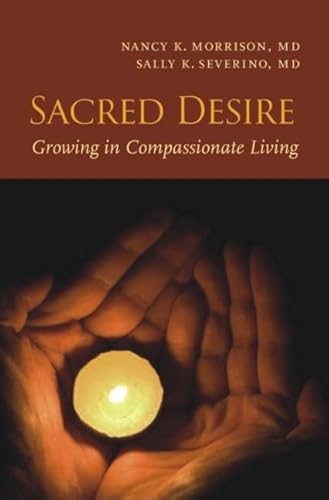
Is the call to spirituality embedded in human biology? Authors Nancy K. Morrison and Sally K. Severino draw on cutting-edge research, including the recent discovery of brain "mirror neurons" and the elucidation of the physiology of social affiliation and attachment, to make a bold case that we are, in fact, biologically wired to seek oneness with the divine. They have termed this innate urge "sacred Desire."
In their new book on the subject, ,em>Sacred Desire: Growing in Compassionate Living, Morrison and Severino, both highly esteemed academic psychiatrists, draw on neurophysiology, relationship studies, research on spiritual development, and psychotherapy to show how spirituality is intimately connected with our physical being. The authors offer several clinical examples of how recognizing sacred Desire can advance a person's healing and they provide an action plan for using Desire to move from fear to love of self, others, and all creation.
In addition to psychiatrists and neurophysiologists, who will undoubtedly welcome this significant contribution to their fields of study, Sacred Desire is sure to appeal as well to the much wider audience of spiritual seekers looking for intellectually and scientifically credible ways to understand spirituality in today's world.
Die Inhaltsangabe kann sich auf eine andere Ausgabe dieses Titels beziehen.
Über die Autorinnen und Autoren
Nancy K. Morrison, MD, is associate professor of psychiatry at the University of New Mexico Health Sciences Center, where she serves as director of both residency training and psychotherapy training. Currently in private practice, she focuses on issues of attunement and shame. She has spoken widely on these issues and psychopathology, particularly in the area of post-traumatic stress disorder. Dr. Morrison is also an ordained priest in the Evangelical Anglican Church in America.
Sally K. Severino, MD, is professor emeritus of psychiatry at the University of New Mexico Health Sciences Center. Dr. Severino is certified by the American Psychoanalytic Association and served as the first woman president of the American College of Psychoanalysts. She is also a Felician Associate of the Assumption of the Blessed Virgin Mary Province in Rio Rancho, New Mexico. Together with Dr. Nancy Morrison, she leads retreats and workshops based on their collaborative work.
Auszug. © Genehmigter Nachdruck. Alle Rechte vorbehalten.
Sacred Desire
Growing in Compassionate Living
By Nancy K. Morrison, Sally K. SeverinoTempleton Foundation Press
Copyright © 2009 Nancy K. Morrison Sally K. Severino
All rights reserved.
ISBN: 978-1-59947-150-1All rights reserved.
Contents
Foreword by Paula Huston,
Introduction,
1. Womb of Compassion: The Beginning of Life and Love,
2. The Grace of Gazing,
3. The Widening Boundaries of Life and Love,
4. Living in Sacred Desire,
5. The Distortion of Desire,
6. Beyond Distortion: Reconfiguring Our Past Today,
7. The Healing Power of Desire: Practical Steps to Loving Self and Others,
8. Redemptive Attuning: Desire's Continuing Journey,
9. Incarnated Spirit: The Work of Restoring Community,
10. Toward a World of Compassion: Beginning to Live and Love Globally,
Glossary,
Acknowledgments,
Notes,
CHAPTER 1
WOMB OF COMPASSION
The Beginning of Life and Love
From all eternity God [the Divine] lies on a maternity bed giving birth. The essence of God [the Divine] is birthing. —MEISTER ECKHART
THAT OUR LIFE BEGINS IN LOVE is beautifully conveyed in Hebrew, where the word for compassion or mercy, rachamim, comes from the same root as the word meaning womb, rechem. The view of the Divine as "womb of compassion" captures the vast benevolence that underlies all of creation, including our own coming into being. It also exemplifies how all of life is relational—from the relationship between the Divine and nature, between the Divine and humans, between parent and child, and between body and mind and spirit as told herein.
As Jeannie B., speaking of her first pregnancy, put it, "I felt like the three of us—my husband, my baby, and I—were all caught up in the wonder of the Divine." Like Jeannie, we are sometimes acutely aware (just as we are also sometimes utterly unaware) of this wonder, this manifestation of our relationship with the Divine that is expressed as love.
Often parents manifest this love in particularly strong and compelling ways, even before a child is born. Shortly after Peg S. learned she was pregnant, someone asked her if she planned to keep the baby. "Of course, I'm going to keep the baby!" she cried, her response immediate and visceral like a power potion coursing through her body. Looking back, Peg comments, "It was almost as if my own life was threatened." Her body spontaneously readied her to protect the inviolable connectedness that she felt within her for her baby.
Peg's love of and connection with the life growing inside her vitally illustrates the womb of compassion—what Jewish scholar Avivah Gottlieb Zornberg calls "the space of desire, the hollow of holiness." In a very unexpected way, Peg's love of the life in her space of desire led her to a deeper love of herself. "I felt precious to have this child within me," she says. "It was an honor to carry this child."
The womb itself is inherently compassionate. While we live in the womb, we are kept warm without clothing and nourished without eating. We don't even need to breathe. All of our needs in utero are met without our effort.
In addition to a baby growing, much happens during pregnancy. Biologically, Mother's hormones are changing. Psychologically, Mother is imagining her baby and forming a mother mind-set. Spiritually, Mother is developing a spirit-set about being a mother and about her relationship with her baby. Socially, Father and extended family are offering the support that allows this psychobiospiritual experience to blossom.
One mother—quoted by infant researcher Daniel Stern and his psychiatrist wife, Nadia Bruschweiler-Stern—gives us a glimpse of the mind-set and spirit-set she is developing. During her fourth month of gestation when she felt her baby kick, she said, "It's as if this baby kicks in accordance with my moods, like he's already tuned in to me." According to the Sterns, "The imagined baby is, of course, purely subjective, so the same kick could inspire the mother to imagine any ... possible character traits."
Peg, whom we met earlier, did not talk about her imaginary baby, but she did say, "I still felt precious even after he was out of my body. I'd never thought of it that way before, and that sense of preciousness remained." In Peg's sense of preciousness, she experienced the womb as compassionate in a very palpable way that nourished her spirit-set for motherhood.
Giving birth—like pregnancy—was a spiritual experience for Peg, but she was totally unprepared for the immensity of that experience. "Everyone wanted to prepare me for the pain, the panic," she remembered. But Peg's experience of giving birth included more than her labor pains. "Nobody told me how giving birth would be an experience of ecstasy," she continued. "I was afraid people would think I was crazy if I told them." Indeed, science now confirms what Peg felt. She literally was infused with the Holy. A holy nectar, a term we coined, pervaded her being, promoting her feeling of ecstasy and also producing her uterine contractions.
The Holy Nectar
When experiencing safety, our body produces a biochemical named oxytocin—what we are calling a holy nectar—that appears in our bloodstream as a hormone and in our brain as a signaling substance (called neurotransmitter). This nectar
• Makes us calm and friendly
• Activates our parasympathetic nervous system that decreases our blood pressure and increases our digestion
• Gives us trust and security to bond positively with others
Unlike most hormones that shut off their own production, oxytocin does the opposite. The presence of oxytocin triggers the production of more oxytocin. In other words, we are made so that we can't run out of love. The more we have, the more we get. The more we get, the more we live in the physiology underlying our trust of Desire.
Source: Kerstin Uvnas Moberg, The Oxytocin Factor: Tapping the Hormone of Calm, Love, and Healing (Cambridge, Mass.: Da Capo Press, 2003), x–xii, 4.
Mothers, nonmothers, fathers, and nonfathers know "womb" experiences—hollow of holiness experiences, space of desire experiences. Womb experiences demand that we take seriously the fact that our bodies are made to be spirit-nurturers for one another. Linda L., remembering when she was pregnant with her now-teenaged son, says, "What surprised me about pregnancy was what a huge responsibility it was to be carrying life inside me. I realized that anything I did to my body affected my child." She worried about all the things she should or shouldn't do, including what she should eat or not eat. Then someone told her that whatever she ate, the nutrients the baby needed would go to the baby first, then to her. "It was such a great joy to have a baby," Linda continued, "but also a great relief to know that my body would give the baby what he needed." As Linda experienced relief when learning that the whole responsibility for the well-being of her child was not hers alone, she experienced the reality of being a spirit-nurturer.
As infants, once held and fed by our mother's womb, we enter the world with full potential to become spirit-nurturers (as well as the potential to be sidetracked from this destiny). How our potentials develop depends, normally, on how we are welcomed by our mothers and other caregivers. In this sense, the womb of compassion is our human capacity to be spirit-nurturers for one another. We are not...
„Über diesen Titel“ kann sich auf eine andere Ausgabe dieses Titels beziehen.
Suchergebnisse für Sacred Desire: Growing in Compassionate Living

Beispielbild für diese ISBN
Sacred Desire: Growing in Compassionate Living
Verlag:
Templeton Foundation Press,U.S., 2009
ISBN 10: 1599471507
ISBN 13: 9781599471501
Gebraucht
Hardcover
Anbieter: World of Books (was SecondSale), Montgomery, IL, USA
Verkäuferbewertung 5 von 5 Sternen

Hardback. Zustand: Good. Is the call to spirituality embedded in human biology? Authors Nancy K. Morrison and Sally K. Severino draw on cutting-edge research, including the recent discovery of brain "mirror neurons" and the elucidation of the physiology of social affiliation and attachment, to make a bold case that we are, in fact, biologically wired to seek oneness with the divine. They have termed this innate urge "sacred Desire." In their new book on the subject, ,em>Sacred Desire: Growing in Compassionate Living, Morrison and Severino, both highly esteemed academic psychiatrists, draw on neurophysiology, relationship studies, research on spiritual development, and psychotherapy to show how spirituality is intimately connected with our physical being. The authors offer several clinical examples of how recognizing sacred Desire can advance a person's healing and they provide an action plan for using Desire to move from fear to love of self, others, and all creation. In addition to psychiatrists and neurophysiologists, who will undoubtedly welcome this significant contribution to their fields of study, Sacred Desire is sure to appeal as well to the much wider audience of spiritual seekers looking for intellectually and scientifically credible ways to understand spirituality in today's world. . Artikel-Nr. 00101650476
Gebraucht kaufen
EUR 6,99
Versand gratis
Versand innerhalb von USA
Versand innerhalb von USA
Anzahl: 2 verfügbar
Beispielbild für diese ISBN
Sacred Desire: Growing in Compassionate Living
Anbieter: ThriftBooks-Atlanta, AUSTELL, GA, USA
Verkäuferbewertung 5 von 5 Sternen
Hardcover. Zustand: Very Good. No Jacket. May have limited writing in cover pages. Pages are unmarked. ~ ThriftBooks: Read More, Spend Less. Artikel-Nr. G1599471507I4N00
Gebraucht kaufen
EUR 7,85
Versand gratis
Versand innerhalb von USA
Versand innerhalb von USA
Anzahl: 1 verfügbar
Beispielbild für diese ISBN
Sacred Desire
Anbieter: Kennys Bookstore, Olney, MD, USA
Verkäuferbewertung 5 von 5 Sternen
Zustand: New. Artikel-Nr. V9781599471501
Neu kaufen
EUR 44,55
EUR 9,44 Versand
Versand innerhalb von USA
Versand innerhalb von USA
Anzahl: 15 verfügbar
Beispielbild für diese ISBN
Sacred Desire Growing in Compassionate Living
Anbieter: Revaluation Books, Exeter, Vereinigtes Königreich
Verkäuferbewertung 5 von 5 Sternen
Hardcover. Zustand: Brand New. 224 pages. 8.40x5.60x1.00 inches. In Stock. Artikel-Nr. 1599471507
Neu kaufen
EUR 45,84
EUR 14,95 Versand
Versand von Vereinigtes Königreich nach USA
Versand von Vereinigtes Königreich nach USA
Anzahl: 1 verfügbar
Foto des Verkäufers
Sacred Desire : Growing in Compassionate Living
Anbieter: AHA-BUCH GmbH, Einbeck, Deutschland
Verkäuferbewertung 5 von 5 Sternen
Buch. Zustand: Neu. Neuware - Is the call to spirituality embedded in human biology Authors Nancy K. Morrison and Sally K. Severino draw on cutting-edge research, including the recent discovery of brain 'mirror neurons' and the elucidation of the physiology of social affiliation and attachment, to make a bold case that we are, in fact, biologically wired to seek oneness with the divine. They have termed this innate urge 'sacred Desire.' In their new book on the subject, ,em>Sacred Desire: Growing in Compassionate Living, Morrison and Severino, both highly esteemed academic psychiatrists, draw on neurophysiology, relationship studies, research on spiritual development, and psychotherapy to show how spirituality is intimately connected with our physical being. The authors offer several clinical examples of how recognizing sacred Desire can advance a person's healing and they provide an action plan for using Desire to move from fear to love of self, others, and all creation. In addition to psychiatrists and neurophysiologists, who will undoubtedly welcome this significant contribution to their fields of study, Sacred Desire is sure to appeal as well to the much wider audience of spiritual seekers looking for intellectually and scientifically credible ways to understand spirituality in today's world. Artikel-Nr. 9781599471501
Neu kaufen
EUR 52,15
EUR 35,00 Versand
Versand von Deutschland nach USA
Versand von Deutschland nach USA
Anzahl: 2 verfügbar
Foto des Verkäufers
Sacred Desire: Growing in Compassionate Living
Anbieter: moluna, Greven, Deutschland
Verkäuferbewertung 5 von 5 Sternen
Zustand: New. Über den Autor Nancy K. Morrison, MD, is associate professor of psychiatry at the University of New Mexico Health Sciences Center, where she serves as director of both residency training and psychotherapy training. Artikel-Nr. 904439562
Neu kaufen
EUR 39,06
EUR 48,99 Versand
Versand von Deutschland nach USA
Versand von Deutschland nach USA
Anzahl: Mehr als 20 verfügbar