
Verwandte Artikel zu Ultimate Guide to Pay-Per-Click Advertising (Ultimate...
Inhaltsangabe
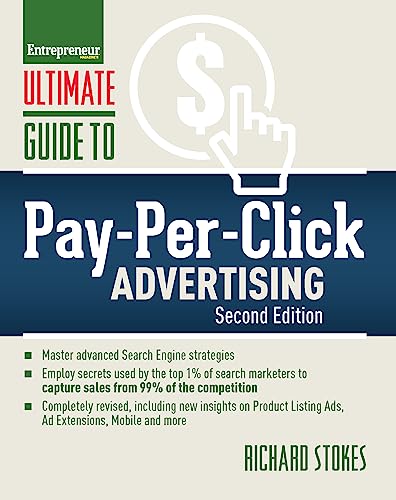
Millions compete for exposure on Google but 99% of them fail to get results.
As the founder of leading digital intelligence firm AdGooroo, search advertising authority Richard Stokes is in a unique position to reveal what’s going wrong and provide solutions to fix it.
Using proven strategies from today’s search advertising elite, discover how to drive significantly more traffic to your site, dramatically increase click-through rates, steal impressions from competitors, boost your conversions, and increase your sales by unbelievable amounts.
Since the previous edition, there have been a number of revolutionary changes in paid search. First, we are increasingly searching from our cell phones rather than desktop computers. Second, Google is no longer the only game in town. For example, Bing, relatively ignored by marketers, once accounted for 30 percent of all U.S. searches and remains a stealth marketing tool. Finally, "search extensions" have become a powerful new technique you can use to collect phone numbers and email addresses with your ads, limit your ads to certain times of day, deliver coupons to nearby customers, and even provide handy "call me" buttons that are displayed only on cell phones. In this new edition, Stokes details all this and more.
As the founder of leading digital intelligence firm AdGooroo, search advertising authority Richard Stokes is in a unique position to reveal what’s going wrong and provide solutions to fix it.
Using proven strategies from today’s search advertising elite, discover how to drive significantly more traffic to your site, dramatically increase click-through rates, steal impressions from competitors, boost your conversions, and increase your sales by unbelievable amounts.
Since the previous edition, there have been a number of revolutionary changes in paid search. First, we are increasingly searching from our cell phones rather than desktop computers. Second, Google is no longer the only game in town. For example, Bing, relatively ignored by marketers, once accounted for 30 percent of all U.S. searches and remains a stealth marketing tool. Finally, "search extensions" have become a powerful new technique you can use to collect phone numbers and email addresses with your ads, limit your ads to certain times of day, deliver coupons to nearby customers, and even provide handy "call me" buttons that are displayed only on cell phones. In this new edition, Stokes details all this and more.
Die Inhaltsangabe kann sich auf eine andere Ausgabe dieses Titels beziehen.
Über die Autorin bzw. den Autor
Internet marketing expert Richard Stokes is the author of three books on web marketing with over 15 years of experience bringing out the best in cutting edge marketing and building innovative teams. He is currently "Entrepreneur in Residence" at AskHoodie.com.
Von der hinteren Coverseite
OUTSMART COMPETITORS. SPEND LESS. MAKE MORE.
Millions compete for exposure on Google and Bing, but 99% of them fail to get results. As the founder of leading digital intelligence firm, AdGooroo, search advertising authority Richard Stokes is in a unique position to reveal what’s going wrong and provide solutions to fix it. Led by Stokes, master proven strategies from today's search advertising elite, and discover how to drive significantly more traffic to your website. Learn how to dramatically increase click-through rates, steal impressions from competitors, boost conversions, and increase your sales by unbelievable amounts.
Millions compete for exposure on Google and Bing, but 99% of them fail to get results. As the founder of leading digital intelligence firm, AdGooroo, search advertising authority Richard Stokes is in a unique position to reveal what’s going wrong and provide solutions to fix it. Led by Stokes, master proven strategies from today's search advertising elite, and discover how to drive significantly more traffic to your website. Learn how to dramatically increase click-through rates, steal impressions from competitors, boost conversions, and increase your sales by unbelievable amounts.
Aus dem Klappentext
OUTSMART COMPETITORS. SPEND LESS. MAKE MORE.
Millions compete for exposure on Google and Bing, but 99% of them fail to get results. As the founder of leading digital intelligence firm, AdGooroo, search advertising authority Richard Stokes is in a unique position to reveal what's going wrong and provide solutions to fix it. Led by Stokes, master proven strategies from today's search advertising elite, and discover how to drive significantly more traffic to your website. Learn how to dramatically increase click-through rates, steal impressions from competitors, boost conversions, and increase your sales by unbelievable amounts.Auszug. © Genehmigter Nachdruck. Alle Rechte vorbehalten.
Chapter 12. How Quality Score Works in 2014
April 2007 brought with it a major change to AdWords that effectively shut down many advertisers’ campaigns overnight. This change, also known by some as the Google Slap, was intended to get rid of low-value affiliate and one-page sales letter sites from the paid listings, but there was plenty of collateral damage. Many high-quality sites (including some affiliates) were shut out of the paid search listings, while many not-so-high-quailty sites (including some affiliates) posing as high-quality retail or review sites were awarded rankings and coverage bonuses.
Like many others, I had sites that were affected by this change. The minimum required bid for keywords where I’ve been advertising profitably for years increased to $10.00 because of Google’s insistence that my sites were no longer relevant.
I don’t believe it was Google’s intention to shut down legitimate sites that provide value for search engine visitors. Rather, they instituted this new algorithm as a means to encourage advertisers to raise the quality of their own ads. Where they went wrong was in providing little guidance to advertisers as to exactly what constituted ?quality.” Furthermore, the algorithm has continued to evolve over time, making it somewhat of a moving target which advertisers constantly have to chase.
As we saw in the past two chapters, managing your quality score is a critical step in effectively managing a paid search campaign. Quality score affects your average position, coverage, clickthrough rate, and your cost-per-click. So this information contained in this section should prove invaluable.
[H1] What Are Quality Scores?
For every keyword in your AdWords campaign, Google will assign you a Quality Score between one and ten. A low score indicates a low quality ad while a high score indicates a high quality ad.
Why Is Quality Score Important?
Quality score is one of the components used to calculate your ad rank. Higher quality scores help to both push your ads higher up on the page and also increase the difference between your maximum bid and the average CPC. In other words, high quality ads cost less and gain exposure to more search traffic (impression share.)
Another benefit of having a high quality score is that it will lower the estimated bid to reach the first page of the search results. This metric, also called the first page bid estimate, approximates the CPC needed to reach the first page of the Google search results when your ad is triggered by an exact match. A high quality ad may cost as little as $0.03 to be shown on the first page, while a low quality ad can cost as much as $100.00, so it’s easy to see why you must be cognizant of your quality scores.
History of the Quality Score Algorithm
In the early days of paid search (2000), there was no Quality Score. Google sold placements in the traditional manner (through ad reps) to larger advertisers on a CPM basis. CPM ? cost-per-mille (thousand) ? meant that advertisers paid for every thousand impressions their ads received.
In 2002, Google opened up its advertising platform to anyone with a credit card under the name, ?AdWords Select”. A key innovation of this platform was the incorporation of clickthrough rate into the pricing formula. Unlike the Overture (Yahoo!) straight-auction model in which the highest bidder always received top placements, advertisers who received a higher CTR on their ads would pay less for their placements.
While effective, the platform was still rife with unwanted ads. Thus, the Quality Score algorithm was introduced by Google in August, 2005 and underwent frequent iterations over the following years. The original version was not exposed to advertisers until 2007, when Google added the Quality Score designations, ?Poor,” ?Ok,” and ?Great”. At the time, Google also added a feature which lowered the minimum bids for high-quality ads and raised the minimum bid for low-quality ones.
Quality Score worked by searching for tell-tale signs of spam within the ad copy (does it have multiple exclamation points? Does it use the word ?free”? Does it match the targeted keyword phrase?) as well as the landing page (Is it a brand new domain? Who’s linking to the site? Does it take a long time to load?). There were also various metrics which played into the original Quality Score algorithm as well (keyword density, backlinks, page load time, and more). As advertisers became more aware of how Quality Score was being computed, Google continued to evolve the rules.
2008 brought several changes including the incorporation of landing page load time, real-time calculation, and an adjustment to account for the impact of average position on clickthrough rate (quality score normalization). There were potentially many other minor inputs as well (Google filed patent applications in 2007 for 44 different Quality Score factors). However, any automated criteria can be gamed exactly the same way that spammers have been gaming the search engines for years and this is exactly what happened after each of these changes. Through the use of clever tricks such as keyword stuffing, crash and burn domains, doorway pages, and so forth, spammers could find ways to get around some of these automated checks.
In response, we began to see an increase in the number of manual reviews which were designed to complement the automated checks and give advertisers a means to appeal the automated system. However, this approach did little to deter spammers (who would just close out their old account and start a new one) and turned out to be incredibly frustrating for many advertisers who were running legitimate campaigns. Imagine how it feels to wait two or three days for your ads to start running and then have someone tell you that your landing pages aren’t ?high quality” enough. Moreover, there were extreme lapses of judgment and abuses of the system .
Another troubling aspect of the algorithm was that the minimum bid which Google calculated for all advertisers affected ads shown anywhere on the search network or partner sites. The ?all or none” philosophy behind this approach angered advertisers and also resulted in a large drop in ad coverage . This may have negatively impacted Google’s revenues (management even said as much during their second quarter 2008 shareholders meeting) and the algorithm was changed from a static, all or nothing approach to a dynamic one in September, 2008.
The new approach calculated quality scores on the fly. This means that ads would be awarded higher quality scores for different keywords, in certain regions, and on different partner sites. While this new added flexibility addressed the ?all or nothing” problem, it was yet one more change which made the Quality Score algorithm even more complicated than before.
In the previous edition of this book, I expressed hope that Google would perhaps one day dial down the complexity and make things easier on us. Well in 2011, chatter among search marketers suggested another change was taking place and we independently discovered that some of the traditional quality score factors were being downplayed. We decided to test this with our own models and found that approximately 70% of the variance in Quality Score could be explained by a single factor: clickthrough rate.
The Official Explanation of the AdWords Quality Score
A good place to start in our understanding of the Quality Score calculation is to read what Google has to say about it :
How we calculate Quality Score
Every time someone does a search that triggers your ad, we calculate a Quality Score. To calculate this Quality Score, we look at a number of different things related to...
April 2007 brought with it a major change to AdWords that effectively shut down many advertisers’ campaigns overnight. This change, also known by some as the Google Slap, was intended to get rid of low-value affiliate and one-page sales letter sites from the paid listings, but there was plenty of collateral damage. Many high-quality sites (including some affiliates) were shut out of the paid search listings, while many not-so-high-quailty sites (including some affiliates) posing as high-quality retail or review sites were awarded rankings and coverage bonuses.
Like many others, I had sites that were affected by this change. The minimum required bid for keywords where I’ve been advertising profitably for years increased to $10.00 because of Google’s insistence that my sites were no longer relevant.
I don’t believe it was Google’s intention to shut down legitimate sites that provide value for search engine visitors. Rather, they instituted this new algorithm as a means to encourage advertisers to raise the quality of their own ads. Where they went wrong was in providing little guidance to advertisers as to exactly what constituted ?quality.” Furthermore, the algorithm has continued to evolve over time, making it somewhat of a moving target which advertisers constantly have to chase.
As we saw in the past two chapters, managing your quality score is a critical step in effectively managing a paid search campaign. Quality score affects your average position, coverage, clickthrough rate, and your cost-per-click. So this information contained in this section should prove invaluable.
[H1] What Are Quality Scores?
For every keyword in your AdWords campaign, Google will assign you a Quality Score between one and ten. A low score indicates a low quality ad while a high score indicates a high quality ad.
Why Is Quality Score Important?
Quality score is one of the components used to calculate your ad rank. Higher quality scores help to both push your ads higher up on the page and also increase the difference between your maximum bid and the average CPC. In other words, high quality ads cost less and gain exposure to more search traffic (impression share.)
Another benefit of having a high quality score is that it will lower the estimated bid to reach the first page of the search results. This metric, also called the first page bid estimate, approximates the CPC needed to reach the first page of the Google search results when your ad is triggered by an exact match. A high quality ad may cost as little as $0.03 to be shown on the first page, while a low quality ad can cost as much as $100.00, so it’s easy to see why you must be cognizant of your quality scores.
History of the Quality Score Algorithm
In the early days of paid search (2000), there was no Quality Score. Google sold placements in the traditional manner (through ad reps) to larger advertisers on a CPM basis. CPM ? cost-per-mille (thousand) ? meant that advertisers paid for every thousand impressions their ads received.
In 2002, Google opened up its advertising platform to anyone with a credit card under the name, ?AdWords Select”. A key innovation of this platform was the incorporation of clickthrough rate into the pricing formula. Unlike the Overture (Yahoo!) straight-auction model in which the highest bidder always received top placements, advertisers who received a higher CTR on their ads would pay less for their placements.
While effective, the platform was still rife with unwanted ads. Thus, the Quality Score algorithm was introduced by Google in August, 2005 and underwent frequent iterations over the following years. The original version was not exposed to advertisers until 2007, when Google added the Quality Score designations, ?Poor,” ?Ok,” and ?Great”. At the time, Google also added a feature which lowered the minimum bids for high-quality ads and raised the minimum bid for low-quality ones.
Quality Score worked by searching for tell-tale signs of spam within the ad copy (does it have multiple exclamation points? Does it use the word ?free”? Does it match the targeted keyword phrase?) as well as the landing page (Is it a brand new domain? Who’s linking to the site? Does it take a long time to load?). There were also various metrics which played into the original Quality Score algorithm as well (keyword density, backlinks, page load time, and more). As advertisers became more aware of how Quality Score was being computed, Google continued to evolve the rules.
2008 brought several changes including the incorporation of landing page load time, real-time calculation, and an adjustment to account for the impact of average position on clickthrough rate (quality score normalization). There were potentially many other minor inputs as well (Google filed patent applications in 2007 for 44 different Quality Score factors). However, any automated criteria can be gamed exactly the same way that spammers have been gaming the search engines for years and this is exactly what happened after each of these changes. Through the use of clever tricks such as keyword stuffing, crash and burn domains, doorway pages, and so forth, spammers could find ways to get around some of these automated checks.
In response, we began to see an increase in the number of manual reviews which were designed to complement the automated checks and give advertisers a means to appeal the automated system. However, this approach did little to deter spammers (who would just close out their old account and start a new one) and turned out to be incredibly frustrating for many advertisers who were running legitimate campaigns. Imagine how it feels to wait two or three days for your ads to start running and then have someone tell you that your landing pages aren’t ?high quality” enough. Moreover, there were extreme lapses of judgment and abuses of the system .
Another troubling aspect of the algorithm was that the minimum bid which Google calculated for all advertisers affected ads shown anywhere on the search network or partner sites. The ?all or none” philosophy behind this approach angered advertisers and also resulted in a large drop in ad coverage . This may have negatively impacted Google’s revenues (management even said as much during their second quarter 2008 shareholders meeting) and the algorithm was changed from a static, all or nothing approach to a dynamic one in September, 2008.
The new approach calculated quality scores on the fly. This means that ads would be awarded higher quality scores for different keywords, in certain regions, and on different partner sites. While this new added flexibility addressed the ?all or nothing” problem, it was yet one more change which made the Quality Score algorithm even more complicated than before.
In the previous edition of this book, I expressed hope that Google would perhaps one day dial down the complexity and make things easier on us. Well in 2011, chatter among search marketers suggested another change was taking place and we independently discovered that some of the traditional quality score factors were being downplayed. We decided to test this with our own models and found that approximately 70% of the variance in Quality Score could be explained by a single factor: clickthrough rate.
The Official Explanation of the AdWords Quality Score
A good place to start in our understanding of the Quality Score calculation is to read what Google has to say about it :
How we calculate Quality Score
Every time someone does a search that triggers your ad, we calculate a Quality Score. To calculate this Quality Score, we look at a number of different things related to...
„Über diesen Titel“ kann sich auf eine andere Ausgabe dieses Titels beziehen.
Suchergebnisse für Ultimate Guide to Pay-Per-Click Advertising (Ultimate...

Beispielbild für diese ISBN
Ultimate Guide to Pay-Per-Click Advertising
Verlag:
Entrepreneur Media Inc/Entrepreneur Press, 2014
ISBN 10: 1599185342
ISBN 13: 9781599185347
Gebraucht
Softcover
Anbieter: Better World Books: West, Reno, NV, USA
Verkäuferbewertung 5 von 5 Sternen

Zustand: Good. 2nd Edition. Pages intact with minimal writing/highlighting. The binding may be loose and creased. Dust jackets/supplements are not included. Stock photo provided. Product includes identifying sticker. Better World Books: Buy Books. Do Good. Artikel-Nr. 8341206-6
Gebraucht kaufen
EUR 6,36
Versand gratis
Versand innerhalb von USA
Versand innerhalb von USA
Anzahl: 1 verfügbar
Beispielbild für diese ISBN
Ultimate Guide to Pay-Per-Click Advertising
Verlag:
Entrepreneur Media Inc/Entrepreneur Press, 2014
ISBN 10: 1599185342
ISBN 13: 9781599185347
Gebraucht
Softcover
Anbieter: Better World Books, Mishawaka, IN, USA
Verkäuferbewertung 5 von 5 Sternen
Zustand: Very Good. 2nd Edition. Pages intact with possible writing/highlighting. Binding strong with minor wear. Dust jackets/supplements may not be included. Stock photo provided. Product includes identifying sticker. Better World Books: Buy Books. Do Good. Artikel-Nr. 18008650-6
Gebraucht kaufen
EUR 6,36
Versand gratis
Versand innerhalb von USA
Versand innerhalb von USA
Anzahl: 1 verfügbar
Beispielbild für diese ISBN
Ultimate Guide to Pay-Per-Click Advertising
Anbieter: ThriftBooks-Dallas, Dallas, TX, USA
Verkäuferbewertung 5 von 5 Sternen
Paperback. Zustand: Good. No Jacket. Former library book; Pages can have notes/highlighting. Spine may show signs of wear. ~ ThriftBooks: Read More, Spend Less. Artikel-Nr. G1599185342I3N10
Gebraucht kaufen
EUR 6,42
Versand gratis
Versand innerhalb von USA
Versand innerhalb von USA
Anzahl: 1 verfügbar
Beispielbild für diese ISBN
Ultimate Guide to Pay-Per-Click Advertising
Anbieter: ThriftBooks-Atlanta, AUSTELL, GA, USA
Verkäuferbewertung 5 von 5 Sternen
Paperback. Zustand: Very Good. No Jacket. May have limited writing in cover pages. Pages are unmarked. ~ ThriftBooks: Read More, Spend Less. Artikel-Nr. G1599185342I4N00
Gebraucht kaufen
EUR 6,42
Versand gratis
Versand innerhalb von USA
Versand innerhalb von USA
Anzahl: 1 verfügbar
Beispielbild für diese ISBN
Ultimate Guide to Pay-Per-Click Advertising
Anbieter: WorldofBooks, Goring-By-Sea, WS, Vereinigtes Königreich
Verkäuferbewertung 5 von 5 Sternen
Paperback. Zustand: Very Good. The book has been read, but is in excellent condition. Pages are intact and not marred by notes or highlighting. The spine remains undamaged. Artikel-Nr. GOR006540361
Gebraucht kaufen
EUR 7,69
EUR 6,62 Versand
Versand von Vereinigtes Königreich nach USA
Versand von Vereinigtes Königreich nach USA
Anzahl: 2 verfügbar
Beispielbild für diese ISBN
Ultimate Guide to Pay-Per-Click Advertising (Ultimate Series)
Anbieter: AwesomeBooks, Wallingford, Vereinigtes Königreich
Verkäuferbewertung 5 von 5 Sternen
Paperback. Zustand: Very Good. Ultimate Guide to Pay-Per-Click Advertising (Ultimate Series) This book is in very good condition and will be shipped within 24 hours of ordering. The cover may have some limited signs of wear but the pages are clean, intact and the spine remains undamaged. This book has clearly been well maintained and looked after thus far. Money back guarantee if you are not satisfied. See all our books here, order more than 1 book and get discounted shipping. Artikel-Nr. 7719-9781599185347
Gebraucht kaufen
EUR 13,33
EUR 4,87 Versand
Versand von Vereinigtes Königreich nach USA
Versand von Vereinigtes Königreich nach USA
Anzahl: 2 verfügbar
Foto des Verkäufers
Ultimate Guide to Pay-Per-Click Advertising (Ultimate Series)
Anbieter: WeBuyBooks, Rossendale, LANCS, Vereinigtes Königreich
Verkäuferbewertung 5 von 5 Sternen
paperback. Zustand: Very Good. Most items will be dispatched the same or the next working day. A copy that has been read, but is in excellent condition. Pages are intact and not marred by notes or highlighting. The spine remains undamaged. Artikel-Nr. rev1447385681
Gebraucht kaufen
EUR 11,34
EUR 8,61 Versand
Versand von Vereinigtes Königreich nach USA
Versand von Vereinigtes Königreich nach USA
Anzahl: 1 verfügbar
Beispielbild für diese ISBN
Ultimate Guide to Pay-Per-Click Advertising (Ultimate Series)
Anbieter: Bahamut Media, Reading, Vereinigtes Königreich
Verkäuferbewertung 4 von 5 Sternen

Paperback. Zustand: Very Good. This book is in very good condition and will be shipped within 24 hours of ordering. The cover may have some limited signs of wear but the pages are clean, intact and the spine remains undamaged. This book has clearly been well maintained and looked after thus far. Money back guarantee if you are not satisfied. See all our books here, order more than 1 book and get discounted shipping. Artikel-Nr. 6545-9781599185347
Gebraucht kaufen
EUR 13,14
EUR 8,25 Versand
Versand von Vereinigtes Königreich nach USA
Versand von Vereinigtes Königreich nach USA
Anzahl: 2 verfügbar
Beispielbild für diese ISBN
Ultimate Guide to Pay-per-click Advertising
Anbieter: Revaluation Books, Exeter, Vereinigtes Königreich
Verkäuferbewertung 5 von 5 Sternen
Paperback. Zustand: Brand New. 2nd edition. 292 pages. 10.00x8.00x0.60 inches. In Stock. Artikel-Nr. 1599185342
Neu kaufen
EUR 27,59
EUR 14,77 Versand
Versand von Vereinigtes Königreich nach USA
Versand von Vereinigtes Königreich nach USA
Anzahl: 1 verfügbar