
Verwandte Artikel zu Serial Killer's Apprentice: And Other True Stories...
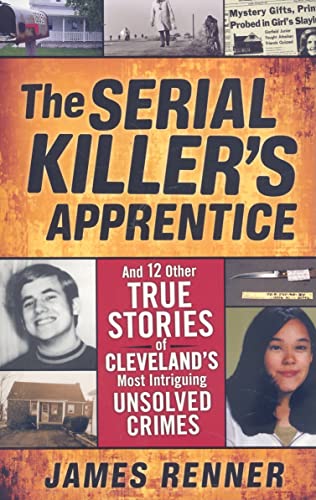
Serial Killer's Apprentice: And Other True Stories of Cleveland's Most Intriguing Unsolved Crimes: And 12 Other True Stories of Cleveland's Most Intriguing Unsolved Crimes - Softcover
Inhaltsangabe
Presenting the most notorious unsolved crimes in Northeast Ohio …
Investigative reporter James Renner reopens cold cases and delves into dark secrets that have baffled Clevelanders for years, including:
- Murder—Beverly Jarosz, just 16 years old, felt a dark foreboding in the months before she was stabbed to death in her quiet Garfield Heights home. It all started with an anonymous gift.
- Stolen Identity—Joseph Newton Chandler of Eastlake was not who he claimed to be. Some think he was the Zodiac killer; others say he was D.B. Cooper, or even Jim Morrison.
- Suicide or murder?—Joseph Kupchik hid gambling problems from friends and family until he was found at the bottom of a nine-story parking deck in downtown Cleveland—with multiple stab wounds.
- Heist—In 1969, Lakewood bank employee Ted Conrad nabbed $215,000 from the vault one day after his twentieth birthday. The FBI still shows up at his high school reunions.
- Controversy—Jeffrey Krotine was thrice tried for the grisly 2003 murder of his wife and ultimately acquitted, to the frustration of Cuyahoga County prosecutors, detectives, and even jurors.
These stories venture into dark alleys and seedy strip clubs, as well as comfortable suburbs and cozy small towns, where some of the region’s most horrendous crimes have occurred. Renner’s unblinking eye for detail and unwavering search for the truth make this book a gripping read.
“James Renner is genuine. He cares about these victims … When it comes to true crime, this is the kind of writer we need.” — Crime Shadow News
Die Inhaltsangabe kann sich auf eine andere Ausgabe dieses Titels beziehen.
Über die Autorin bzw. den Autor
James Renner is a novelist and freelance journalist. His true crime stories have been published in the Best American Crime Reporting and Best Creative Nonfiction anthologies. His film adaptation of a Stephen King story was an official selection at the 2005 Montreal World Film Festival. A graduate of Kent State University, he lives in Akron, Ohio.
Auszug. © Genehmigter Nachdruck. Alle Rechte vorbehalten.
Dream a Little Dream of Me
The Unsolved Murder of Joseph Kupchik
In dreams, Joseph Kupchik never remembers that he’s dead. Seems unaware that he plunged to his death off a parking deck in downtown Cleveland in 2006. It’s always up to his twin brother, Johnathan, to give him the bad news.
John’s dreams started shortly after Joe died and haven’t let up since. Sometimes the two of them are at home, playing video games. In this one, they’re shooting hoops. Joe bounces the basketball against the backboard, into the net, then returns it to his brother.
Joe, you’re dead, says John. You died.
But Joe only stares at him, uncomprehending.
He’s confused, John thinks. Or maybe I’m the one who’s confused. Maybe this is real.
It’s not, of course.
Joe is dead in the Real World.
The cops think Joe committed suicide. But if it was suicide, he found an unusual way to do it. A growing number of friends and family believe Joe was murdered.
Either way, when John wakes up, he’ll have to leave Joe behind. So let’s give them a moment alone. They’ve got a game to finish just now.
Joe and John Kupchik were hard to tell apart. Both inherited their mother’s deep, dark eyes and their father’s coarse, burgundy-brown hair. They had the same smile and gently sloping shoulders. Joe was slightly taller and had a larger nose and tilted his head when he met someone, almost bashfully. But they looked enough alike that John is reminded of Joe every time he looks in the mirror. He misses his twin and sometimes feels him, like an amputated limb. Their connection, that odd closeness that their sister Kate calls “the creepy twin thing,” is still being severed.
The Kupchiks live in a modest two-story home inside a nondescript subdivision in Strongsville, domiciles of the shrinking middle class. Joe—“Kuppy” to friends—graduated from Strongsville High School in 2004. He wasn’t much of an athlete; couldn’t make a lay-up to save his life, friends say. But he played games of pick-up football in the neighborhood and loved watching the NFL on weekends, Green Bay in particular. He often wore a giant cheese head in the living room, though it’s long been suspected he chose the team for its colors. Sometimes he made minor bets—a dollar or two—with John or his older brother Michael.
In the fall of 2004, then-18-year-old Joe and John decided it was time to discover their own destinies. John set off for the University of Dayton. Joe stayed home and enrolled at Cuyahoga Community College, taking accounting classes at the main branch in Parma.
During this time, Joe met many of his closest friends while working at Wendy’s on Pearl Road. Joe was a crew leader and opened the store on Saturday and Sunday mornings. Megan Rachow, who still works at Wendy’s, remembers Joe’s knack for making endless shifts a little more entertaining. During lulls they played tic-tac-toe on the parking lot with chalk. Sometimes Joe put sandwich buns in the fryer. In retaliation for some prank she can no longer remember, Megan once put a ladle of cheese sauce in Joe’s hat, but he noticed before putting it on. Out back one day, she offered him his first cigarette, the single puff coming out in loud coughs a moment later as he laughed and laughed.
That first year at Tri-C, Joe pulled a C average. He figured his shifts at Wendy’s were impacting his studies, so he quit in the fall of 2005. His transcripts show an immediate improvement. That semester, Joe took a full course load and earned two As and three Bs. He also became treasurer of the Tri-C Philosophy Club. Around this same time, he discovered online gambling.
The bets were small at first. He and John anted up $35 apiece to start an account at BoDog.com to bet on NFL games. They schemed over the phone and usually picked at least four winners for every seven games. By Christmas, their initial investment of $70 had ballooned to nearly $1,600.
Then Joe began betting on college basketball on their account, laying down more money and losing more often than not. When John complained, Joe gave him half their winnings—about $800—and changed the password.
During the long winter break from school, Joe also started a new job at Steak ’n Shake in nearby Brunswick. He worked the grill at first and then began to wait tables. A co-worker recalls that Joe charmed many of his regular customers but had a hard time fitting in with other employees. They picked on him for bobbing his head when he talked, a nervous habit. And for talking too smart. Joe complained to a close friend that co-workers often changed his schedule, giving him less profitable shifts. (According to a former manager of the Brunswick Steak ’n Shake, employees were allowed to change the schedule as long as someone showed up.) All Joe’s parents knew was that before leaving for work, he always left a note with his hours on the kitchen counter.
The morning of February 11, a Saturday, Joe’s father, George, gathered receipts and W-2s for the family’s tax filings. He also planned to fill out student loan paperwork, so that Joe could transfer to the University of Cincinnati later that year. While Joe was still in bed, George stuck his head inside his son’s room.
“How much money do you have in your bank account?” George asked, waking him up.
“Seven thousand dollars,” Joe replied.
After talking to his dad, Joe got up and dressed for work—black pants and a white button-up shirt. Before he left, Joe jotted down his work schedule for the day: noon to 10 p.m. George heard Joe shut the door of his Honda Civic. The sound echoes in George’s mind still: the last noise he ever heard his son make. It was a little after 11 in the morning.
Only later would George learn that Joe had lied about his savings account. Some of the money had been loaned out to family and friends, but a lot had gone toward online bets. That morning, Joe’s balance was $4.46.
Adam Worner, age 22, left the Blind Pig on West 6th that Saturday night around 1 a.m. and began the long walk back to his apartment on the east side of downtown Cleveland. His path lead him down Ontario Street. As he passed Fat Fish Blue, he came upon the body of a young man lying on the cement, just inside a thin alley, below a nine-story parking deck. He wasn’t the first one on the scene. Later, he would say that he saw a black man, about his age, dressed in jeans and a nice jacket, standing over the body.
“I don’t want to get into the blood and guts and gore of it,” Worner says. He’ll only say that the body belonged to a young man. That he was a bloodied wreck and unconscious, but not dead. That he was not wearing shoes. Worner used his cell phone to dial 911.
Sometime during the frenzy of activity as the EMS crew arrived and loaded the body into the ambulance, the black man quietly walked away. Worner is not sure he could recognize him if he saw him again on the street.
Officer James Foley arrived at the scene first and searched the garage. On the top floor, he found a Honda Civic with its driver’s side door open, the keys dangling from the ignition, the engine turned off. The driver’s seat was bloody, and a rolled-up white shirt covered in blood lay between the seat and the door, beside a bloody leather jacket. A pair of shoes rested on the floor under the steering wheel. A trail of blood snaked from the door to the railing. A six-inch fillet knife lay on the snowy cement a few feet from the car. Written on a piece of paper on the dash was Joseph Kupchik’s phone number and...
„Über diesen Titel“ kann sich auf eine andere Ausgabe dieses Titels beziehen.
Suchergebnisse für Serial Killer's Apprentice: And Other True Stories...

Beispielbild für diese ISBN
Serial Killers Apprentice And
Verlag:
Gray & Company, Publishers, 2008
ISBN 10: 1598510460
ISBN 13: 9781598510461
Gebraucht
Softcover
Anbieter: World of Books (was SecondSale), Montgomery, IL, USA
Verkäuferbewertung 5 von 5 Sternen

Zustand: Good. Good condition ex-library book with usual library markings and stickers. Artikel-Nr. 00108507274
Gebraucht kaufen
EUR 4,70
Versand gratis
Versand innerhalb von USA
Versand innerhalb von USA
Anzahl: 1 verfügbar
Beispielbild für diese ISBN
Serial Killers Apprentice And
Verlag:
Gray & Company, Publishers, 2008
ISBN 10: 1598510460
ISBN 13: 9781598510461
Gebraucht
Softcover
Anbieter: World of Books (was SecondSale), Montgomery, IL, USA
Verkäuferbewertung 5 von 5 Sternen
Zustand: Good. Item in good condition. Textbooks may not include supplemental items i.e. CDs, access codes etc. Artikel-Nr. 00107983843
Gebraucht kaufen
EUR 4,70
Versand gratis
Versand innerhalb von USA
Versand innerhalb von USA
Anzahl: 1 verfügbar
Beispielbild für diese ISBN
Serial Killers Apprentice And
Verlag:
Gray & Company, Publishers, 2008
ISBN 10: 1598510460
ISBN 13: 9781598510461
Gebraucht
Softcover
Anbieter: World of Books (was SecondSale), Montgomery, IL, USA
Verkäuferbewertung 5 von 5 Sternen
Zustand: Very Good. Item in very good condition! Textbooks may not include supplemental items i.e. CDs, access codes etc. Artikel-Nr. 00108241929
Gebraucht kaufen
EUR 4,70
Versand gratis
Versand innerhalb von USA
Versand innerhalb von USA
Anzahl: 1 verfügbar
Beispielbild für diese ISBN
Serial Killer's Apprentice: And Other True Stories of Cleveland's Most Intriguing Unsolved Crimes
Verlag:
Gray & Company, Publishers (edition 1), 2008
ISBN 10: 1598510460
ISBN 13: 9781598510461
Gebraucht
Paperback
Anbieter: BooksRun, Philadelphia, PA, USA
Verkäuferbewertung 5 von 5 Sternen
Paperback. Zustand: Very Good. 1. It's a well-cared-for item that has seen limited use. The item may show minor signs of wear. All the text is legible, with all pages included. It may have slight markings and/or highlighting. Artikel-Nr. 1598510460-11-1
Gebraucht kaufen
EUR 4,71
Versand gratis
Versand innerhalb von USA
Versand innerhalb von USA
Anzahl: 1 verfügbar
Beispielbild für diese ISBN
The Serial Killer's Apprentice : And 12 Other True Stories of Cleveland's Most Intriguing Unsolved Crimes
Verlag:
Gray & Company, Publishers, 2008
ISBN 10: 1598510460
ISBN 13: 9781598510461
Gebraucht
Softcover
Anbieter: Better World Books, Mishawaka, IN, USA
Verkäuferbewertung 5 von 5 Sternen
Zustand: Good. Pages intact with minimal writing/highlighting. The binding may be loose and creased. Dust jackets/supplements are not included. Stock photo provided. Product includes identifying sticker. Better World Books: Buy Books. Do Good. Artikel-Nr. 12988224-20
Gebraucht kaufen
EUR 8,05
Versand gratis
Versand innerhalb von USA
Versand innerhalb von USA
Anzahl: 1 verfügbar
Beispielbild für diese ISBN
Serial Killer's Apprentice: And Other True Stories of Cleveland's Most Intriguing Unsolved Crimes
Verlag:
Gray & Company, Publishers, 2008
ISBN 10: 1598510460
ISBN 13: 9781598510461
Gebraucht
Paperback
Anbieter: WorldofBooks, Goring-By-Sea, WS, Vereinigtes Königreich
Verkäuferbewertung 5 von 5 Sternen
Paperback. Zustand: Very Good. The book has been read, but is in excellent condition. Pages are intact and not marred by notes or highlighting. The spine remains undamaged. Artikel-Nr. GOR004979561
Gebraucht kaufen
EUR 6,09
EUR 6,52 Versand
Versand von Vereinigtes Königreich nach USA
Versand von Vereinigtes Königreich nach USA
Anzahl: 2 verfügbar
Beispielbild für diese ISBN
The Serial Killer's Apprentice: And 12 Other True Stories of Cleveland's Most Intriguing Unsolved Crimes
Anbieter: Revaluation Books, Exeter, Vereinigtes Königreich
Verkäuferbewertung 5 von 5 Sternen
Paperback. Zustand: Brand New. 1st edition. 235 pages. 8.25x5.25x0.75 inches. In Stock. Artikel-Nr. zk1598510460
Neu kaufen
EUR 27,26
EUR 11,64 Versand
Versand von Vereinigtes Königreich nach USA
Versand von Vereinigtes Königreich nach USA
Anzahl: 1 verfügbar