
Verwandte Artikel zu Securing Civil Rights: Freedmen, the Fourteenth Amendment,...
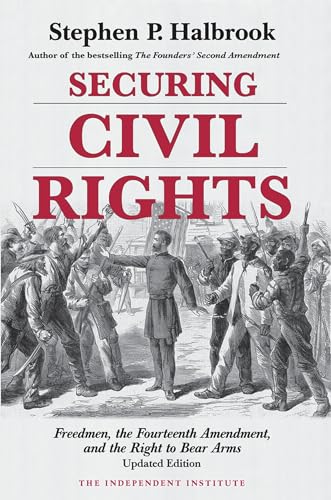
Securing Civil Rights: Freedmen, the Fourteenth Amendment, and the Right to Bear Arms: Freedmen, the Fourteenth Amendement, and the Right to Bear Arms - Softcover
Inhaltsangabe
Unique and well-researched, this study concentrates on the right to keep and bear arms and analyzes the incorporation of the Bill of Rights into the Fourteenth Amendment. Examining the history of the recognition of the right of freedmen to keep and bear arms in the period between 1866 and 1876, this comprehensive volume analyzes the extent to which American political society was willing to secure the same civil rights to all without regard to race or previous condition of slavery.
Die Inhaltsangabe kann sich auf eine andere Ausgabe dieses Titels beziehen.
Über die Autorin bzw. den Autor
Stephen P. Halbrook has taught philosophy and law at Tuskegee Institute, Georgetown University, Howard University, and George Mason University. He has won three cases he argued before the U.S. Supreme Court, including Printz v. United States, which overturned portions of the “Brady Bill” requiring local police to enforce federal gun control regulations. He is the author of various books, including The Founders' Second Amendment. He lives in Fairfax, Virginia.
Auszug. © Genehmigter Nachdruck. Alle Rechte vorbehalten.
Securing Civil Rights
Freedmen, the Fourteenth Amendment, and the Right to Bear Arms
By Stephen P. HalbrookThe Independent Institute
Copyright © 1998 Stephen P. Halbrook
All rights reserved.
ISBN: 978-1-59813-038-6All rights reserved.
Contents
Preface to the Updated Edition,
1 The Civil Rights and Freedmen's Bureau Acts and the Proposal of the Fourteenth Amendment,
2 Congress Reacts to Southern Rejection of the Fourteenth Amendment,
3 The Southern State Constitutional Conventions,
4 The Freedmen's Bureau Act Reenacted and the Fourteenth Amendment Ratified,
5 Toward Adoption of the Civil Rights Act of 1871,
6 From the Klan Trials and Hearings Through the End of the Civil Rights Revolution,
7 The Cruikshank Case, from Trial to the Supreme Court,
8 Unfinished Jurisprudence,
Notes,
Table of Cases,
Bibliography,
Index,
About the Author,
Praise for Securing Civil Rights,
About the Independent Institute,
Independent Studies in Political Economy,
CHAPTER 1
The Civil Rights and Freedmen's Bureau Acts and the Proposal of the Fourteenth Amendment
That No Freedman Shall Keep or Carry Firearms: The Black Codes as Badges of Slavery
NUMEROUS ANTEBELLUM commentators interpreted the Second Amendment as guaranteeing an individual right to keep and bear arms free from both State and federal infringement. In his famous criminal law commentaries, Joel P. Bishop wrote in 1865:
The constitution of the United States provides, that, "a well-regulated militia being necessary to the security of a free State, the right of the people to keep and bear arms shall not be infringed." This provision is found among the amendments; and, though most of the amendments are restrictions on the General Government alone, not on the States, this one seems to be of a nature to bind both the State and National legislatures.
Yet Bishop's references to State "statutes relating to the carrying of arms by negroes and slaves" and an "act to prevent free people of color from carrying firearms" exemplified the need for a constitutional guarantee to protect the rights of all persons, regardless of race, to keep and carry firearms. After the Civil War, these slave codes, which limited the access of blacks to land, firearms, and the courts, began to reappear as "black codes." Congress quickly turned its attention to these efforts to reenslave the freedmen.
E.G. Baker, a white Mississippi planter, wrote a letter to members of the State legislature on October 22, 1865, warning of a possible negro insurrection. He added: "It is well known here that our negroes through the country are well equipped with fire arms, muskets, double barrel shot guns & pistols, — & furthermore, it would be well if they are free to prohibit the use of fire arms until they had proved themselves to be good citizens in their altered state." Forwarding a copy of the letter to the Union commander in Northern Mississippi, Governor Benjamin G. Humphreys warned that "unless some measures are taken to disarm [the freedmen] a collision between the races may be speedily looked for."
White fears of armed ex-slaves led to the quick enactment of the 1865 Mississippi "Act to Regulate the Relation of Master and Apprentice Relative to Freedmen, Free Negroes, and Mulattoes." In addition to prohibiting seditious speeches and unlicensed preaching by freedmen, the statute contained a firearms prohibition that would serve as a model for the black codes of other Southern States:
Section 1. Be it enacted, ... That no freedman, free negro or mulatto, not in the military service of the United States government, and not licensed so to do by the board of police of his or her county, shall keep or carry fire-arms of any kind, or any ammunition, dirk or bowie-knife, and on conviction thereof in the county court shall be punished by fine, not exceeding ten dollars, and pay the costs of such proceedings, and all such arms or ammunition shall be forfeited to the informer; and it shall be the duty of every civil and military officer to arrest any freedman, free negro, or mulatto found with any such arms or ammunition, and cause him or her to be committed to trial in default of bail....
Section 3. ... If any white person shall sell, lend, or give to any freedman, free negro, or mulatto any fire-arms, dirk or bowie-knife, or ammunition, or any spirituous or intoxicating liquors, such person or persons ... shall be fined not exceeding fifty dollars, and may be imprisoned, at the discretion of the court, not exceeding thirty days....
Section 5. ... If any freedman, free negro, or mulatto, convicted of any of the misdemeanors provided against in this act, shall fail or refuse for the space of five days, after conviction, to pay the fine and costs imposed, such person shall be hired out by the sheriff or other officer, at public outcry, to any white person who will pay said fine and all costs, and take said convict for the shortest time.
Two weeks after the Mississippi prohibition passed, Calvin Holly, a black private assigned to the Freedmen's Bureau in Mississippi, wrote to Bureau Commissioner O.O. Howard, relating in his letter an article in the Vicksburg Journal about an incident involving blacks with a gun, and noting that "they was forbidden not to have any more but did not heed." "The Rebbles," Holly warned, "are going about in many places through the State and robbing the colored people of arms[,] money and all they have and in many places killing." Holly continued: "They talk of taking the arms away from (col[ored]) people and arresting them and put them on farms next month and if they go at that I think there will be trouble and in all probability a great many lives lost."
When the 39th Congress convened in December 1865, Republican leaders quickly sought to establish committees charged with the task of drafting protections for the freedmen. On December 6, the House resolved that the Speaker appoint a Select Committee on Freedmen. A few minutes later, Representative John A. Bingham, an Ohio Republican, introduced a joint resolution to amend the Constitution "to empower Congress to pass all necessary and proper laws to secure to all persons in their rights, life, liberty, and property. ..." Bingham's bill would become, of course, the Fourteenth Amendment.
The House Select Committee on Freedmen consisted of Thomas D. Eliot of Massachusetts, William D. Kelley of Pennsylvania, Godlove S. Orth of Indiana, John A. Bingham of Ohio, Nelson Taylor of New York, Benjamin F. Loan of Missouri, Josiah B. Grinnell of Iowa, Halbert E. Paine of Wisconsin, and Samuel S. Marshall of Illinois. John Bingham would author § 1 of the Fourteenth Amendment. Other significant committees were the Senate Judiciary Committee, chaired by Lyman Trumbull of Illinois, and the House Judiciary Committee, chaired by James F. Wilson of Iowa.
On December 12, the Senate concurred with a House resolution to appoint a Joint Committee of Fifteen to investigate the condition of the Southern States. This committee would later hear extensive testimony on the violations of freedmen's rights, and eventually drafted the Fourteenth Amendment.
The enactment of the black code provisions prompted initiation of civil rights legislation that culminated in the proposal of the Fourteenth Amendment. Among the first proposals was S. 9, which declared as void all laws or other actions by the rebel States "whereby or wherein any inequality of civil rights and immunities among the...
„Über diesen Titel“ kann sich auf eine andere Ausgabe dieses Titels beziehen.
Weitere beliebte Ausgaben desselben Titels

Suchergebnisse für Securing Civil Rights: Freedmen, the Fourteenth Amendment,...

Beispielbild für diese ISBN
Securing Civil Rights: Freedmen, the Fourteenth Amendment, and the Right to Bear Arms
Anbieter: ThriftBooks-Atlanta, AUSTELL, GA, USA
Verkäuferbewertung 5 von 5 Sternen

Paperback. Zustand: Very Good. No Jacket. May have limited writing in cover pages. Pages are unmarked. ~ ThriftBooks: Read More, Spend Less. Artikel-Nr. G1598130382I4N00
Gebraucht kaufen
EUR 5,90
Versand gratis
Versand innerhalb von USA
Versand innerhalb von USA
Anzahl: 1 verfügbar