
Verwandte Artikel zu Evolution and Christian Faith: Reflections of an Evolutionar...
Inhaltsangabe
Click here to visit evolutionandchristianfaith.org
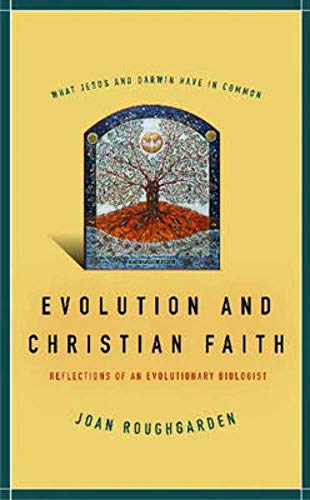
"I'm an evolutionary biologist and a Christian," states Stanford professor Joan Roughgarden at the outset of her groundbreaking new book, Evolution and Christian Faith: Reflections of an Evolutionary Biologist. From that perspective, she offers an elegant, deeply satisfying reconciliation of the theory of evolution and the wisdom of the Bible. Perhaps only someone with Roughgarden's unique academic standing could examine so well controversial issues such as the teaching of intelligent design in public schools, or the potential flaws in Darwin's theory of evolution. Certainly Roughgarden is uniquely suited to reference both the minutiae of scientific processes and the implication of Biblical verses. Whether the topic is mutation rates and lizards or the hidden meanings behind St. Paul's letters, Evolution and Christian Faith distils complex arguments into everyday understanding. Roughgarden has scoured the Bible and scanned the natural world, finding examples time and again, not of conflict, but of harmony. The result is an accessible and intelligent context for a Christian vision of the world that embraces science. In the ongoing debates over creationism and evolution, Evolution and Christian Faith will be seen as a work of major significance, written for contemporary readers who wonder how-or if-they can embrace scientific advances while maintaining their traditional values.Die Inhaltsangabe kann sich auf eine andere Ausgabe dieses Titels beziehen.
Über die Autorin bzw. den Autor
Joan Roughgarden is professor of biological sciences and of geophysics at Stanford University. Her many books include Evolution's Rainbow (University of California Press, 2004), Primer of Ecological Theory (Prentice Hall, 1995), and Theory of Population Genetics and Evolutionary Ecology (Macmillan, 1979).She is a fellow of the American Academy of Arts and Sciences.
Auszug. © Genehmigter Nachdruck. Alle Rechte vorbehalten.
Evolution and Christian Faith
Reflections of an Evolutionary Biologist
By Joan RoughgardenISLAND PRESS
Copyright © 2006 Joan Roughgarden
All rights reserved.
ISBN: 978-1-59726-098-5All rights reserved.
Contents
Title Page,
Copyright Page,
Dedication,
Acknowledgments,
1 - Science with Religion,
2 - Single Tree of Life,
3 - Species Change,
4 - Taking the Bible Literally,
5 - How Change Happens,
6 - Random Mutation,
7 - Evolution's Direction,
8 - Roman Catholic Position,
9 - To-Do List for Theorists,
10 - Intelligent Design,
11 - Gender and Sexuality,
12 - Future Directions,
Index,
About Island Press,
CHAPTER 1
Science with Religion
BOTH SIDES OUGHT TO BE PROPERLY taught," urged President George W. Bush when asked at a news conference in August 2005 about teaching evolution and its alternatives, such as intelligent design, in the public schools. I'm an evolutionary biologist and a Christian. Here's my perspective on what to teach about evolution and on how to understand today's collision between science and Christian faith.
It is 175 years since Darwin embarked on his 1831 voyage to South America in a ten- gun brig of the British navy called the Beagle. That voyage carried him to the Galápagos where he began his thinking about evolution. After all this time we can now say that some parts of the subject he started, called evolutionary biology, have been demonstrated as true. I believe the demonstrated parts should be taught in all our schools and that to not do so is like failing to teach that the earth is round. On the other hand, not all of evolutionary biology is as clear-cut as evolution's basic facts are, and some points are seriously problematic. This book clarifies what is truly established in evolutionary biology, indicates what aspects of evolutionary theory remain inadequate, and identifies some parts that are probably wrong. It will, I hope, give you a balanced view of the state of evolutionary biology today.
I'm a Christian and active in the Episcopal Church. My parents were Episcopal missionaries, and I grew up in the Philippine Islands and Indonesia. I attended church through high school, drifted away after college, and returned about ten years ago when I was facing personal trials. Since then, I've worked through the connection between my faith and my occupation as an evolutionary biologist.
Although we keep hearing of "sides" in a "debate" between evolution and religion, I don't think that way. After all, the famous "monkey" trial in Tennessee ended long ago, in 1925. This trial challenged the teaching of evolution in schools and is named the Scopes Trial after the defendant, John T. Scopes, who was a teacher. You may have seen this trial dramatized in the classic 1960 movie Inherit the Wind, with Spencer Tracy, and may recall that evolution came out the "winner." I ask, Why should we bother replaying that trial again and again today? I don't want to argue with other Christians. I want to share with them the fellowship and the love of Jesus.
Here we'll look at actual biblical passages and you can see for yourself whether any conflict exists with evolutionary biology. You may agree that the Bible doesn't have any necessary conflict with evolutionary biology, as many people already think. I think that, even more important, what evolutionary biologists are finding through their research and thinking actually promotes a Christian view of nature and of our human place in it. Thus, as Christians we don't have to simply stand aside and say, Well, science is about the material and religion about the spiritual, and ne'er the twain shall meet. Instead, we can rejoice as Christians in the ethical meaning behind what evolutionary biologists are increasingly finding. I've been exhilarated by this personal realization, and I hope you will be, too.
I've written this book for several reasons. First, I want to provide a short and succinct statement of what evolutionary biology is, what it says and what it doesn't say. Because many people get their idea of evolution secondhand, a lot of misunderstanding is creeping in and I think there's a need to set the record straight. Second, I want to discuss what the Bible actually says, for the Bible too is often misrepresented. Third, I want to investigate the relationship between evolutionary biology and the Bible. I want to do this because it pains me to see proponents of science and Christianity ridicule and hurt each other. I hope to get us talking constructively.
I've kept the book short—a read for a long plane trip, or a night or two's sitting to brief for a school board meeting, parent–teacher conference, or church group discussion, or for writing a term paper—any situation where you've got to come up to speed fast on today's incarnation of the controversy over teaching evolution.
I've been struck by how the "debate" over teaching evolution is not about plants and animals but about God and whether science somehow threatens one's belief in God. To analyze this threat, I'll discuss plants, animals, and God all together—something people rarely do. My specialty is lizards. When I lecture, I discuss what islands my lizards live on, what food they eat, what their colors are, and who their predators are. I never mention God. When anti-evolutionists lecture, they discuss God, what's in the Bible, and how they think the Bible should be interpreted. They never mention lizards. So, if we're going to get a dialogue going on evolution, we're going to have to start talking about plants, animals, and the Bible together in one place, as I do in this book.
In talking about plants, animals, and the Bible in the same paragraph, even in the same breath, are we fudging the separation between science and religion? Is this right? Maybe in some past world the spheres of science and religion were kept separate, but today the separation has disappeared—the polls tell us that we're past the point of no return.
A CBS News poll in November 2004, based on a nationwide telephone survey of 885 adults, showed that 65 percent of all Americans favored teaching creationism alongside evolution. A follow-up poll of 2,000 people by the Pew Forum on Religion and Public Life in July 2005 found that 64 percent were open to the idea of teaching creationism in addition to evolution. Both polls are practically identical and confirm each other. The polls also show large numbers, around 40 percent, in favor of replacing evolution with creationism in the science curriculum. When compared with these poll results, President Bush's position that both sides should be taught seems modest.
Similarly, Senator Bill Frist, a Tennessee Republican leader who is a medical doctor, also endorsed teaching both sides, saying such an approach "doesn't force any particular theory on anyone ... I think in a pluralistic society that is the fairest way to go about education and training people for the future." Many scientists were surprised by Senator Frist's statement and dismissed it as an attempt to garner conservative Christian support for his anticipated presidential bid. One might anticipate that medical doctors, because of their substantial education in biology during premedical training, would be more supportive of teaching evolution than the general public is. But, in fact, many doctors are unsure of evolution, and Senator Frist's view is not extreme among them.
A poll in May 2004 of 1,472 physicians by the Louis Finkelstein Institute at the Jewish...
„Über diesen Titel“ kann sich auf eine andere Ausgabe dieses Titels beziehen.
Suchergebnisse für Evolution and Christian Faith: Reflections of an Evolutionar...

Beispielbild für diese ISBN
Evolution and Christian Faith: Reflections of an Evolutionary Biologist
Verlag:
Island Press (edition Illustrated), 2006
ISBN 10: 1597260983
ISBN 13: 9781597260985
Gebraucht
Hardcover
Anbieter: BooksRun, Philadelphia, PA, USA
Verkäuferbewertung 5 von 5 Sternen

Hardcover. Zustand: Very Good. Illustrated. With dust jacket. It's a well-cared-for item that has seen limited use. The item may show minor signs of wear. All the text is legible, with all pages included. It may have slight markings and/or highlighting. Artikel-Nr. 1597260983-11-6-29
Gebraucht kaufen
EUR 4,94
Versand gratis
Versand innerhalb von USA
Versand innerhalb von USA
Anzahl: 1 verfügbar
Beispielbild für diese ISBN
Evolution and Christian Faith : Reflections of an Evolutionary Biologist
Anbieter: Better World Books: West, Reno, NV, USA
Verkäuferbewertung 5 von 5 Sternen
Zustand: Good. Pages intact with minimal writing/highlighting. The binding may be loose and creased. Dust jackets/supplements are not included. Stock photo provided. Product includes identifying sticker. Better World Books: Buy Books. Do Good. Artikel-Nr. 4294945-6
Gebraucht kaufen
EUR 6,16
Versand gratis
Versand innerhalb von USA
Versand innerhalb von USA
Anzahl: 1 verfügbar
Beispielbild für diese ISBN
Evolution and Christian Faith : Reflections of an Evolutionary Biologist
Anbieter: Better World Books, Mishawaka, IN, USA
Verkäuferbewertung 5 von 5 Sternen
Zustand: Good. Former library copy. Pages intact with minimal writing/highlighting. The binding may be loose and creased. Dust jackets/supplements are not included. Includes library markings. Stock photo provided. Product includes identifying sticker. Better World Books: Buy Books. Do Good. Artikel-Nr. 3784018-6
Gebraucht kaufen
EUR 6,16
Versand gratis
Versand innerhalb von USA
Versand innerhalb von USA
Anzahl: 1 verfügbar
Beispielbild für diese ISBN
Evolution and Christian Faith : Reflections of an Evolutionary Biologist
Anbieter: Better World Books, Mishawaka, IN, USA
Verkäuferbewertung 5 von 5 Sternen
Zustand: Good. Pages intact with minimal writing/highlighting. The binding may be loose and creased. Dust jackets/supplements are not included. Stock photo provided. Product includes identifying sticker. Better World Books: Buy Books. Do Good. Artikel-Nr. 4294945-6
Gebraucht kaufen
EUR 6,16
Versand gratis
Versand innerhalb von USA
Versand innerhalb von USA
Anzahl: 2 verfügbar
Beispielbild für diese ISBN
Evolution and Christian Faith: Reflections of an Evolutionary Biologist
Anbieter: ThriftBooks-Atlanta, AUSTELL, GA, USA
Verkäuferbewertung 5 von 5 Sternen
Hardcover. Zustand: Very Good. No Jacket. May have limited writing in cover pages. Pages are unmarked. ~ ThriftBooks: Read More, Spend Less. Artikel-Nr. G1597260983I4N00
Gebraucht kaufen
EUR 6,93
Versand gratis
Versand innerhalb von USA
Versand innerhalb von USA
Anzahl: 1 verfügbar
Beispielbild für diese ISBN
Evolution and Christian Faith: Reflections of an Evolutionary Biologist
Anbieter: ThriftBooks-Phoenix, Phoenix, AZ, USA
Verkäuferbewertung 5 von 5 Sternen
Hardcover. Zustand: Good. No Jacket. Pages can have notes/highlighting. Spine may show signs of wear. ~ ThriftBooks: Read More, Spend Less. Artikel-Nr. G1597260983I3N00
Gebraucht kaufen
EUR 6,93
Versand gratis
Versand innerhalb von USA
Versand innerhalb von USA
Anzahl: 1 verfügbar
Beispielbild für diese ISBN
Evolution and Christian Faith: Reflections of an Evolutionary Biologist
Anbieter: ThriftBooks-Atlanta, AUSTELL, GA, USA
Verkäuferbewertung 5 von 5 Sternen
Hardcover. Zustand: Good. No Jacket. Pages can have notes/highlighting. Spine may show signs of wear. ~ ThriftBooks: Read More, Spend Less. Artikel-Nr. G1597260983I3N00
Gebraucht kaufen
EUR 6,93
Versand gratis
Versand innerhalb von USA
Versand innerhalb von USA
Anzahl: 1 verfügbar
Beispielbild für diese ISBN
Evolution and Christian Faith: Reflections of an Evolutionary Biologist
Anbieter: ThriftBooks-Dallas, Dallas, TX, USA
Verkäuferbewertung 5 von 5 Sternen
Hardcover. Zustand: Very Good. No Jacket. Former library book; May have limited writing in cover pages. Pages are unmarked. ~ ThriftBooks: Read More, Spend Less. Artikel-Nr. G1597260983I4N10
Gebraucht kaufen
EUR 6,93
Versand gratis
Versand innerhalb von USA
Versand innerhalb von USA
Anzahl: 1 verfügbar
Beispielbild für diese ISBN
Evolution and Christian Faith: Reflections of an Evolutionary Biologist
Anbieter: ThriftBooks-Dallas, Dallas, TX, USA
Verkäuferbewertung 5 von 5 Sternen
Hardcover. Zustand: Very Good. No Jacket. May have limited writing in cover pages. Pages are unmarked. ~ ThriftBooks: Read More, Spend Less. Artikel-Nr. G1597260983I4N00
Gebraucht kaufen
EUR 6,93
Versand gratis
Versand innerhalb von USA
Versand innerhalb von USA
Anzahl: 1 verfügbar
Beispielbild für diese ISBN
Evolution and Christian Faith: Reflections of an Evolutionary Biologist
Anbieter: Windows Booksellers, Eugene, OR, USA
Verkäuferbewertung 5 von 5 Sternen
Hardcover with dust jacket. VG/G. Slightly scuffed on back board. Else good. 155 pages. 155 pp. Artikel-Nr. 451334
Gebraucht kaufen
EUR 9,15
EUR 6,66 Versand
Versand innerhalb von USA
Versand innerhalb von USA
Anzahl: 1 verfügbar