
Verwandte Artikel zu Fruitless Fall: The Collapse of the Honey Bee and the...
Inhaltsangabe
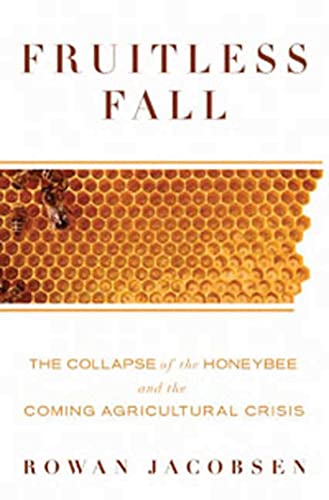
How the disappearance of the world's honeybee population puts the food we eat at risk.
Many people will remember that Rachel Carson predicted a silent spring, but she also warned of a fruitless fall, a time when "there was no pollination and there would be no fruit." The fruitless fall nearly became a reality last year when beekeepers watched one third of the honeybee population—thirty billion bees—mysteriously die. The deaths have continued in 2008. Rowan Jacobsen uses the mystery of Colony Collapse Disorder to tell the bigger story of bees and their' essential connection to our daily lives. With their disappearance, we won't just be losing honey. Industrial agriculture depends on the honeybee to pollinate most fruits, nuts, and vegetables—one third of American crops. Yet this system is falling apart. The number of these professional pollinators has become so inadequate that they are now trucked across the country and flown around the world, pushing them ever closer to collapse. By exploring the causes of CCD and the even more chilling decline of wild pollinators, Fruitless Fall does more than just highlight this growing agricultural crisis. It emphasizes the miracle of flowering plants and their pollination partners, and urges readers not to take for granted the Edenic garden Homo sapiens has played in since birth. Our world could have been utterly different—and may be still.
Die Inhaltsangabe kann sich auf eine andere Ausgabe dieses Titels beziehen.
Über die Autorin bzw. den Autor
Rowan Jacobsen writes about food, the environment, and the connections between the two. His work has appeared in the Art of Eating, the New York Times, Wild Earth, Wondertime, Culture & Travel, NPR.org, and elsewhere. He is the author of Chocolate Unwrapped and A Geography of Oysters. He lives in rural Vermont with his wife and son.
Auszug. © Genehmigter Nachdruck. Alle Rechte vorbehalten.
FRUITLESS FALL
The Collapse of the Honey Bee and the Coming Agricultural CrisisBy Rowan JacobsenBLOOMSBURY
Copyright © 2008 Rowan JacobsenAll right reserved.
ISBN: 978-1-59691-537-4
Contents
Prologue: Florida, November 2006........................................1Chapter 1 Breakfast in America.........................................6Chapter 2 How the Honey Bee Conquered the World........................22Chapter 3 Collapse.....................................................57Chapter 4 Whodunit.....................................................67Chapter 5 Slow Poison..................................................84Chapter 6 Florida, November 2007.......................................100Chapter 7 The Almond Orgy..............................................123Chapter 8 Bees on the Verge of a Nervous Breakdown.....................137Chapter 9 Resilience and the Russians..................................154Chapter 10 The Birth of Beauty..........................................184Chapter 11 Fruitless Fall...............................................201Epilogue: First Frost...................................................215Appendix 1 The African Paradox..........................................218Appendix 2 Keeping Bees.................................................228Appendix 3 Cultivating a Pollinator Garden..............................231Appendix 4 The Healing Power of Honey...................................245Acknowledgments.........................................................251Sources.................................................................253Index...................................................................265
Chapter One
BREAKFAST IN AMERICA
I'm standing in my kitchen on a July morning, serving up breakfast for my family. Honey-Nut O's for my son, almond granola for my wife and me, all piled high with blueberries and cherries. Wedges of melon, glasses of apple cider, and mugs of coffee on the side. It's a delicious breakfast, its colors, textures, and flavors a feast for the senses. And it wouldn't exist without honey bees. Take away the bees and we'd be left with nothing but wind-pollinated oats and maybe some milk to wet them.
Berries, cherries, melons, and apples are all fruits, you see, and fruits are special. Almonds and other nuts are simply the large seeds inside fruits. (Almonds are in the family of stone fruits, like peaches and plums, and do have a fruit around them, but it's inedible. With a peach you eat the flesh and discard the nut; with an almond the reverse.) Coffee beans come wrapped in fruit jackets, too. Even many of the foods we think of as vegetables-cucumbers and tomatoes and peppers and squash-are fruits. And fruits, unlike true vegetables, or meat, or just about anything else we eat, want to be eaten. Nature has designed them-with a little help from human plant breeders-to be as eye-catching and irresistibly delicious to animals as possible.
And they are. No matter how many rungs up the industrial food chain I sit, no matter how far removed from my primate roots, I still react to the dazzling sapphire of a ripe blueberry in a satisfyingly primitive way. My mouth waters, my hands reach, and I am its slave. My nine-year-old son, a full-fledged frugivore, will hurry past cakes and cookies to get to a plate of pink, juicy watermelon.
The plan, which is certainly working on us, is that the animals eat the fruit and unwittingly spread the plant's seeds around-a major challenge for an immobile life-form. It's an ancient covenant, one that has served them and us well, and one that's still fairly obvious, since not so long ago we primates were playing a significant role in the process.
But there is another covenant, equally essential and much easier for us to overlook because it rarely involves large creatures. We've done a spectacular job of ignoring it across all levels of society, with catastrophic consequences that are only now beginning to hit home.
The basic story of plant life, familiar to every grade-schooler, is that the plant grows and has a flower, and the flower turns into a seed-bearing fruit, and the fruit falls to the ground, where the cycle starts all over again. In the common imagination, the process happens all on its own. The fruit is the event. The flower is nothing really, just the herald of the fruit. Eye candy. Growing up, I don't think I even connected the flower and the fruit. Flowers grew along roadsides-daisies and hawkweed and Queen Anne's lace. Fruit came from the supermarket. They were two things trees and weeds produced, not necessarily related.
But, of course, flowers are not there to please landscape artists. They are supremely functional, and their function is sex. Flowers' purpose is to swap genetic material with other individuals of the same species and reproduce. When that happens successfully, a fruit grows out of the flower.
No flower, no fruit. It's that simple.
The presence of a flower doesn't guarantee fruit. Most flowers have male and female parts. The anthers-the long filaments with pads on the end-hold grains of pollen, the plant equivalent of sperm. To make a fruit, that pollen needs to be carried to the stigma, the central column that is the female receptor. From there, it can combine with the ovule-the plant equivalent of an egg-in the ovary (usually hidden within the flower). A seed is born, and fruit is soon to follow.
Some flowers can use their own pollen to fertilize their ovules, but this doesn't accomplish the gene mixing that is the whole point of sexual reproduction, so most can be fertilized only by the pollen from a different individual. The trick is to get the pollen from one flower to another. A few of our food plants-primarily corn, oats, and the other grains-use wind to do the job. Make vast quantities of powdery, flyweight pollen, cast it to the winds, and cross one's metaphorical fingers, it's like direct mail, or Internet spam: You need to send out a million if you hope to get a single hit. When your car is caked in yellow pine pollen, or your nasal passages are swollen with ragweed pollen, you can be sure that a wind pollinator is broadcasting.
Direct mail is pretty wasteful, so most of our food plants rely on courier service instead. Somebody picks up the pollen package from one flower and delivers it directly to another flower of the same species. Most birds and mammals aren't going to fit this bill; they are way too big to handle sand-sized grains of pollen. Insects, on the other hand, are perfect.
For 150 million years, insects have served as sexual handmaidens to the flowering plants. Most plants on earth today can't reproduce without them. Of course, they aren't doing it out of the goodness of their hearts. It takes a bribe. Protein-rich pollen makes good health food, but nectar-energy-rich sugar water contained in tiny wells in most flowers-seals the deal. The bugs visit the flower to drink the nectar and in the process brush against the sticky pollen grains, which become attached to them. When the bugs fly to the next flower for more nectar, some of the pollen is transferred to the new stigma. Wham, barn, thank you, ma'am.
Thousands of insect species feed on nectar and pollen. Some 80 million years ago, one group of them, the bees, made it a specialty. Of the twenty thousand species of bees, only one has become a true artisan of nectar, developing a worldwide human culture around itself. That insect is Apis mellifera, the honey bee. And how this one life-form wound up...
„Über diesen Titel“ kann sich auf eine andere Ausgabe dieses Titels beziehen.
Weitere beliebte Ausgaben desselben Titels

Suchergebnisse für Fruitless Fall: The Collapse of the Honey Bee and the...

Beispielbild für diese ISBN
Fruitless Fall: The Collapse of the Honey Bee and the Coming Agricultural Crisis
Verlag:
Bloomsbury USA (edition First Edition), 2008
ISBN 10: 1596915374
ISBN 13: 9781596915374
Gebraucht
Hardcover
Erstausgabe
Anbieter: BooksRun, Philadelphia, PA, USA
Verkäuferbewertung 5 von 5 Sternen

Hardcover. Zustand: Very Good. First Edition. It's a well-cared-for item that has seen limited use. The item may show minor signs of wear. All the text is legible, with all pages included. It may have slight markings and/or highlighting. Artikel-Nr. 1596915374-11-1
Gebraucht kaufen
EUR 4,96
Versand gratis
Versand innerhalb von USA
Versand innerhalb von USA
Anzahl: 1 verfügbar
Beispielbild für diese ISBN
Fruitless Fall : The Collapse of the Honey Bee and the Coming Agricultural Crisis
Verlag:
Bloomsbury Publishing USA, 2008
ISBN 10: 1596915374
ISBN 13: 9781596915374
Gebraucht
Hardcover
Anbieter: Better World Books, Mishawaka, IN, USA
Verkäuferbewertung 5 von 5 Sternen
Zustand: Very Good. Former library copy. Pages intact with possible writing/highlighting. Binding strong with minor wear. Dust jackets/supplements may not be included. Includes library markings. Stock photo provided. Product includes identifying sticker. Better World Books: Buy Books. Do Good. Artikel-Nr. 4678395-75
Gebraucht kaufen
EUR 6,09
Versand gratis
Versand innerhalb von USA
Versand innerhalb von USA
Anzahl: 2 verfügbar
Beispielbild für diese ISBN
Fruitless Fall : The Collapse of the Honey Bee and the Coming Agricultural Crisis
Verlag:
Bloomsbury Publishing USA, 2008
ISBN 10: 1596915374
ISBN 13: 9781596915374
Gebraucht
Hardcover
Anbieter: Better World Books, Mishawaka, IN, USA
Verkäuferbewertung 5 von 5 Sternen
Zustand: Good. Former library copy. Pages intact with minimal writing/highlighting. The binding may be loose and creased. Dust jackets/supplements are not included. Includes library markings. Stock photo provided. Product includes identifying sticker. Better World Books: Buy Books. Do Good. Artikel-Nr. 4176729-6
Gebraucht kaufen
EUR 6,09
Versand gratis
Versand innerhalb von USA
Versand innerhalb von USA
Anzahl: 1 verfügbar
Beispielbild für diese ISBN
Fruitless Fall: The Collapse of the Honey Bee and the Coming Agricultural Crisis
Anbieter: ThriftBooks-Atlanta, AUSTELL, GA, USA
Verkäuferbewertung 5 von 5 Sternen
Hardcover. Zustand: Good. No Jacket. Pages can have notes/highlighting. Spine may show signs of wear. ~ ThriftBooks: Read More, Spend Less. Artikel-Nr. G1596915374I3N00
Gebraucht kaufen
EUR 6,93
Versand gratis
Versand innerhalb von USA
Versand innerhalb von USA
Anzahl: 1 verfügbar
Beispielbild für diese ISBN
Fruitless Fall: The Collapse of the Honey Bee and the Coming Agricultural Crisis
Anbieter: ThriftBooks-Reno, Reno, NV, USA
Verkäuferbewertung 5 von 5 Sternen
Hardcover. Zustand: Good. No Jacket. Pages can have notes/highlighting. Spine may show signs of wear. ~ ThriftBooks: Read More, Spend Less. Artikel-Nr. G1596915374I3N00
Gebraucht kaufen
EUR 6,93
Versand gratis
Versand innerhalb von USA
Versand innerhalb von USA
Anzahl: 1 verfügbar
Beispielbild für diese ISBN
Fruitless Fall: The Collapse of the Honey Bee and the Coming Agricultural Crisis
Anbieter: ThriftBooks-Dallas, Dallas, TX, USA
Verkäuferbewertung 5 von 5 Sternen
Hardcover. Zustand: Good. No Jacket. Pages can have notes/highlighting. Spine may show signs of wear. ~ ThriftBooks: Read More, Spend Less. Artikel-Nr. G1596915374I3N00
Gebraucht kaufen
EUR 6,93
Versand gratis
Versand innerhalb von USA
Versand innerhalb von USA
Anzahl: 1 verfügbar
Beispielbild für diese ISBN
Fruitless Fall : The Collapse of the Honey Bee and the Coming Agricultural Crisis
Verlag:
Bloomsbury Publishing USA, 2008
ISBN 10: 1596915374
ISBN 13: 9781596915374
Gebraucht
Hardcover
Anbieter: Better World Books Ltd, Dunfermline, Vereinigtes Königreich
Verkäuferbewertung 5 von 5 Sternen
Zustand: Very Good. Former library copy. Pages intact with possible writing/highlighting. Binding strong with minor wear. Dust jackets/supplements may not be included. Includes library markings. Stock photo provided. Product includes identifying sticker. Better World Books: Buy Books. Do Good. Artikel-Nr. 4678395-75
Gebraucht kaufen
EUR 9,12
EUR 5,83 Versand
Versand von Vereinigtes Königreich nach USA
Versand von Vereinigtes Königreich nach USA
Anzahl: 1 verfügbar
Beispielbild für diese ISBN
Fruitless Fall
Anbieter: Hamelyn, Madrid, M, Spanien
Verkäuferbewertung 5 von 5 Sternen
Zustand: Bueno. : En 'Fruitless Fall', Rowan Jacobsen explora la alarmante disminución de las poblaciones de abejas melíferas y su impacto en la agricultura. El libro detalla las causas del Trastorno de Colapso de Colonias (CCD) y cómo este fenómeno amenaza la polinización de cultivos esenciales. Jacobsen destaca la conexión vital entre las abejas y la producción de alimentos, advirtiendo sobre las posibles consecuencias para la seguridad alimentaria global. Una lectura esencial para comprender la crisis apícola y su relación con la agricultura industrial. EAN: 9781596915374 Tipo: Libros Categoría: Ciencias Título: Fruitless Fall Autor: Rowan Jacobsen Editorial: Bloomsbury Pub Plc USA Idioma: en Páginas: 279 Formato: tapa dura. Artikel-Nr. Happ-2025-12-18-ac95e76c
Gebraucht kaufen
EUR 14,65
EUR 12,99 Versand
Versand von Spanien nach USA
Versand von Spanien nach USA
Anzahl: 1 verfügbar