
Verwandte Artikel zu The First Man-Made Man: The Story of Two Sex Changes,...
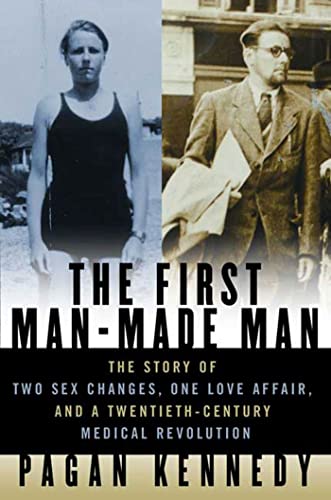
The First Man-Made Man: The Story of Two Sex Changes, One Love Affair, and a Twentieth-Century Medical Revolution - Hardcover
Inhaltsangabe
In the 1920s when Laura Dillon felt like a man trapped in a woman's body, there were no words to describe her condition; transsexuals had yet to enter common usage. And there was no known solution to being stuck between the sexes. Laura Dillon did all she could on her own: she cut her hair, dressed in men's clothing, bound her breasts with a belt. But in a desperate bid to feel comfortable in her own skin, she experimented with breakthrough technologies that ultimately transformed the human body and revolutionized medicine. From upper-class orphan girl to Oxford lesbian, from post-surgery romance with Roberta Cowell (an early male-to-female) to self-imposed exile in India, Michael Dillon's incredible story reveals the struggles of early transsexuals and challenges conventional notions of what gender really means.
Die Inhaltsangabe kann sich auf eine andere Ausgabe dieses Titels beziehen.
Über die Autorin bzw. den Autor
Pagan Kennedy has published seven books. Her biography Black Livingstone was named a New York Times Notable. Her novel Spinsters was short-listed for the Orange Prize and was the winner of the Barnes & Noble Discover Award. She has written for the New York Times magazine, Boston Globe magazine, the Village Voice, Details, the Utne Reader, the Nation, and Ms. magazine. She lives in Somerville, Massachusetts.
Rezensionen
Adult/High School—Born into a wealthy family near the beginning of the 20th century, Laura Dillon attended Oxford University and went on to become a doctor, a published author, and, eventually, a man named Michael. At Oxford, she tried to identify as a homosexual, but that didn't quite fit; it would be years before the words transsexual or transgendered were coined. In 1939, Dillon began to experiment with a new drug, testosterone. Her life changed after meeting Dr. Gillies, a practitioner in the emerging field of plastic surgery, who performed several operations to reconfigure Dillon's anatomy. Upon meeting Roberta Crowell in 1949, Michael believed that he had found his soul mate. Born and raised as a man, Crowell was in the process of transforming into a woman. Following a failed love affair, Dillon traveled to India to study Buddhism. He died a pauper after finally discovering happiness among monks in Tibet. He left a legacy of notebooks, memoirs, and a groundbreaking treatise on the nature of sex and gender. These form the basis of Kennedy's narrative, which leapfrogs back and forth across Dillon's life. Kennedy traces the emotional isolation and triumphs throughout Dillon's struggle to define himself according to his own rules. The author peppers the text with historical details of early-20th-century medicine and evolving notions of gender in Western society. This story is fascinating to modern readers whether or not they have personal questions about gender.—Heidi Dolamore, San Mateo County Library, CA
Copyright © Reed Business Information, a division of Reed Elsevier Inc. All rights reserved.
In 1950, Michael Dillon, a dapper, bearded medical student, met Roberta Cowell, a boyish-looking woman, for lunch in a discreet London restaurant. During the lunch, Dillon announced that five years earlier he was a woman named Laura, and Roberta stated she was on her way to full womanhood from being Robert. Eventually, Cowell (a former Royal Air Force captain) would garner fame as a glamorous woman and author of the 1954 bestseller Roberta Cowell's Story, while in 1958 Dillon began a long, rocky journey to become a Tibetan monk. But Kennedy (Black Livingstone) does far more than detail their short-lived, topsy-turvy transgender romance. She gives us an enlightening tour of how mid-century science conceptualized gender, hormones and transsexual surgery, as well as how advances in plastic surgery for men maimed in WWI became the basis for sex change operations. Kennedy's slangy style—she describes presurgery Dillon as living in the "slushy canal between sexes"—also suits the material. Though her effort doesn't surpass other books on the topic—especially Joanne Meyerowitz's How Sex Changed: A History of Transsexuality in the United States—it's an entertaining and informative popular history. (Mar.)
Copyright © Reed Business Information, a division of Reed Elsevier Inc. All rights reserved.
*Starred Review* The 1920s, the era of Kennedy's devastatingly good book, were a time when, though thousands may have felt trapped in the wrong bodies, the word transsexual was unknown. For such persons, leading double lives and being unable to trust anyone for fear of exposure involved "silence and subterfuge." Lives could "be destroyed by one stray rumor." Yet back then, Michael Dillon (nee Laura Dillon) and Roberta Cowell (ne Robert Cowell) risked everything to change their genders. In mesmerizing detail after mesmerizing detail, Kennedy describes the deception, the secrets, the endless humiliations, and the almost unimaginable effort that went into not only Dillon's and Cowell's daily lives, which essentially involved living a lie during every waking moment, but also the struggles they had to endure to find someone who understood what they were going through and, most important, could alter their lives--that is, perform sex change operations. In the early 1950s, Christine Jorgensen became known as the first transsexual (male-to-female), but Man-Made Man makes clear that that distinction belongs to Michael Dillon (female-to-male). Novelist Kennedy's literary chops serve her well in this fascinating and heartbreaking social history and tale of two lost souls, for it is as absorbing and powerful as any fiction. June Sawyers
Copyright © American Library Association. All rights reserved
Auszug. © Genehmigter Nachdruck. Alle Rechte vorbehalten.
The First Man-Made Man
The Story of Two Sexes, One Love Affair, and a Twentieth-Century Medical Revolution By Pagan KennedyBLOOMSBURY
Copyright © 2006 Pagan KennedyAll right reserved.
ISBN: 978-1-59691-015-7
Contents
Part I: Make The Body1. He Proposes............................................32. When There's No Word for It3. Magic Pills4. Sir Harold's Scalpel5. With Girls One Has to be Careful6. Orchid7. A Passport into the World of WomenPart II: Fit the Mind8. The Third Eye9. The Calling Card10. Becoming Jivaka11. A New Age12. RizongEpilogueAcknowledgmentsNotesIndex
Chapter One
HE PROPOSESMichael Dillon, a bearded medical student, fiddled with his pipe and then lit it nervously. The year was 1950; the city, London; the restaurant, discreet. Dillon shared his table with a person so odd-looking that the other diners in the restaurant ogled and whispered to one another. He - or was it a she? - wore a blazer and trousers, cropped hair, and tie, but seemed to be hiding breasts under the suit jacket. In fact, Roberta Cowell had been born male, but she could not live as a man anymore. She had begun dosing herself on massive amounts of estrogen - enough to melt away her muscles and put a blush in her cheeks. With no idea how to push her transformation further, Cowell was stuck in a no man's land between the sexes - a terrible place to find yourself in 1950.
The word "transsexual" had yet to enter common usage. Almost no medical literature acknowledged that thousands of people felt themselves to be trapped in the wrong bodies and would do anything - including risk death - to change their sex. Michael Dillon, the medical student, had authored what was then one of the few books in the world to delve into the subject. In an eccentric little volume called Self: A Study in Ethics and Endocrinology, he had argued on behalf of people like Roberta Cowell. Dillon proposed an idea that seemed wildly radical at that time: Why not give patients the bodies they wanted? Thanks to recent technological breakthroughs, doctors could transform a man into a woman and visa versa. But because of the stigma against these sex changes - as well as laws that prohibited castration - only a few people in the world had ever crossed the line.
Roberta Cowell had discovered Michael Dillon's book and decided she had to meet the open-minded scholar. She'd written to him care of his publisher and they'd exchanged a flurry of letters. Now, finally, they sat across from one another.
Dillon turned out to be handsome, Cowell reported in her autobiography. "He was a good deal younger than I had expected and wore a full beard. Not bad-looking, he was a very masculine type."
Maybe too masculine. Despite his progressive attitude about sex-change treatments, Dillon "appeared to have a very low opinion of women." It was an attitude that Cowell couldn't abide. After they'd eaten, she lingered at the table to debate the issue of women's intelligence. They ordered coffee. Dillon gestured with his pipe as he lectured her about the differences between the male and female brain. He clearly liked to throw his opinions around, especially with a lady present.
Cowell played along. After all, if she was ever to emerge from the awful limbo of her body, she would need his help. Dillon seemed to relish his role as her protector, fingering his droll little beard, dropping Latin words and medical terms. He assured her that sex changes did exist. It was now possible for surgeons to entirely re-shape the human body, he claimed. In fact, he possessed startling proof of exactly what medical science could do.
Then, Michael Dillon fell silent. He puffed smoke and fidgeted with his coffee cup but did not drink. He glanced up at Roberta, and then, finally, spoke. "I don't really see why I shouldn't tell you. Five years ago I was a woman."
* * *
More than a decade earlier, an athletic blonde named Laura Dillon roared through the streets of Bristol on her motorbike. She wore her hair short and a sports jacket hid her breasts; a skirt, her only concession to femininity, flapped around her calves. With her broad shoulders, patrician accent, and Eton haircut, she could easily pass for a pampered young man. In fact, Laura had grown up thinking of herself as above the common lot. Her brother, the eighth baronet of Lusmullen, presided over a threadbare estate in Ireland, and her family still retained a residue of an ancient fortune.
At first glance, Laura seemed to be a fellow just out of Oxford, dismounting his motorbike with a dashing leap. But blink again and Laura was nothing but a cross-dressed girl. People who passed her on the street couldn't help staring, confused by the double image she presented. The children and old ladies were the cruelest, shouting insults or demanding Laura explain herself. When they came toward her, Laura froze her face into a mask. She refused to let them see how they got to her.
Still, she preferred their taunts to the alternative: female clothing. Evening gowns terrified her - they invited young men to slide their arms around her waist. Ordinary dresses filled her with the sickening sense that she had been obliterated. She knew herself to be a man, a man who was disappearing inside a ridiculous body, underneath breasts and hips. She didn't think she could go on this way anymore.
Pills saved her. Laura Dillon had managed to get hold of testosterone pills in 1938, soon after she'd graduated from college. She became the first woman on record to take the drug with the intention of changing her sex. Over a period of several years, the hormone therapy transformed her into a muscular, deep-voiced man with fuzz on his cheeks. As soon as Dillon could looked entirely male, he became invisible. Pumping petrol at the garage where he worked, greasy in his coveralls, Dillon easily passed as just another workingman. More than passed. He became bland-looking, unremarkable, ordinary - which was what he'd always wanted. "How different was life now! I could walk past anyone and not fear to hear any comments for no one looked at me twice," he wrote about his earliest, testosterone-fueled transformation. By the early 1940s, Dillon had mustered the courage to leave the garage for medical school - under his male name.
But hormones could only take Dillon so far. If other men happened to catch a glimpse of him in the locker room or public baths, they would know immediately he had been born female. So in the early 1940s, Dillon sought out Sir Harold Gillies, Britain's top plastic surgeon. Gillies had reconstructed the genitals of soldiers who'd been bombed or burned, but he had never built a penis from scratch on a woman's body. It would be a grueling process, and Gillies could not guarantee the results.
At least the operation would be legal. While an arcane law protected male genitals from "mutilation," no such bans applied to female genitals and reproductive organs.
Dillon would eventually undergo a series of thirteen operations to construct a penis. He began the treatments in 1946, while he was a student at Trinity College medical school in Dublin and he finished his surgeries in 1949, a year before he met Roberta Cowell. Gillies had to harvest skin for the new organ from Dillon's legs and stomach; Dillon suffered from oozing infections where the skin had been flayed; at times, he was so debilitated he had to walk with a cane.
And why did Dillon want the penis so badly? Not necessarily for sex. Rather, a penis would serve as a...
„Über diesen Titel“ kann sich auf eine andere Ausgabe dieses Titels beziehen.
Suchergebnisse für The First Man-Made Man: The Story of Two Sex Changes,...

Beispielbild für diese ISBN
The First Man made Man: The St
Anbieter: World of Books (was SecondSale), Montgomery, IL, USA
Verkäuferbewertung 5 von 5 Sternen

Zustand: Good. Good condition ex-library book with usual library markings and stickers. Artikel-Nr. 00106755166
Gebraucht kaufen
EUR 5,38
Versand gratis
Versand innerhalb von USA
Versand innerhalb von USA
Anzahl: 1 verfügbar
Beispielbild für diese ISBN
The First Man-Made Man: The Story of Two Sex Changes, One Love Affair, and a Twentieth-Century Medical Revolution
Anbieter: ThriftBooks-Dallas, Dallas, TX, USA
Verkäuferbewertung 5 von 5 Sternen
Hardcover. Zustand: Very Good. No Jacket. Former library book; May have limited writing in cover pages. Pages are unmarked. ~ ThriftBooks: Read More, Spend Less. Artikel-Nr. G1596910151I4N10
Gebraucht kaufen
EUR 5,98
Versand gratis
Versand innerhalb von USA
Versand innerhalb von USA
Anzahl: 1 verfügbar
Beispielbild für diese ISBN
The First Man-Made Man: The Story of Two Sex Changes, One Love Affair, and a Twentieth-Century Medical Revolution
Anbieter: ThriftBooks-Atlanta, AUSTELL, GA, USA
Verkäuferbewertung 5 von 5 Sternen
Hardcover. Zustand: Good. No Jacket. Pages can have notes/highlighting. Spine may show signs of wear. ~ ThriftBooks: Read More, Spend Less. Artikel-Nr. G1596910151I3N00
Gebraucht kaufen
EUR 5,98
Versand gratis
Versand innerhalb von USA
Versand innerhalb von USA
Anzahl: 1 verfügbar
Beispielbild für diese ISBN
The First Man-Made Man: The Story of Two Sex Changes, One Love Affair, and a Twentieth-Century Medical Revolution
Anbieter: ThriftBooks-Dallas, Dallas, TX, USA
Verkäuferbewertung 5 von 5 Sternen
Hardcover. Zustand: Good. No Jacket. Pages can have notes/highlighting. Spine may show signs of wear. ~ ThriftBooks: Read More, Spend Less. Artikel-Nr. G1596910151I3N00
Gebraucht kaufen
EUR 5,98
Versand gratis
Versand innerhalb von USA
Versand innerhalb von USA
Anzahl: 1 verfügbar
Beispielbild für diese ISBN
The First Man-Made Man: The Story of Two Sex Changes, One Love Affair, and a Twentieth-Century Medical Revolution
Anbieter: ThriftBooks-Phoenix, Phoenix, AZ, USA
Verkäuferbewertung 5 von 5 Sternen
Hardcover. Zustand: Very Good. No Jacket. Former library book; May have limited writing in cover pages. Pages are unmarked. ~ ThriftBooks: Read More, Spend Less. Artikel-Nr. G1596910151I4N10
Gebraucht kaufen
EUR 5,98
Versand gratis
Versand innerhalb von USA
Versand innerhalb von USA
Anzahl: 1 verfügbar
Beispielbild für diese ISBN
The First Man-Made Man : The Story of Two Sex Changes, One Love Affair, and a Twentieth-Century Medical Revolution
Verlag:
Bloomsbury Publishing USA, 2007
ISBN 10: 1596910151
ISBN 13: 9781596910157
Gebraucht
Hardcover
Erstausgabe
Anbieter: Better World Books, Mishawaka, IN, USA
Verkäuferbewertung 5 von 5 Sternen
Zustand: Good. 1st Edition. Former library copy. Pages intact with minimal writing/highlighting. The binding may be loose and creased. Dust jackets/supplements are not included. Includes library markings. Stock photo provided. Product includes identifying sticker. Better World Books: Buy Books. Do Good. Artikel-Nr. 3783502-6
Gebraucht kaufen
EUR 7,05
Versand gratis
Versand innerhalb von USA
Versand innerhalb von USA
Anzahl: 1 verfügbar
Beispielbild für diese ISBN
The First Man-Made Man : The Story of Two Sex Changes, One Love Affair, and a Twentieth-Century Medical Revolution
Verlag:
Bloomsbury Publishing USA, 2007
ISBN 10: 1596910151
ISBN 13: 9781596910157
Gebraucht
Hardcover
Erstausgabe
Anbieter: Better World Books: West, Reno, NV, USA
Verkäuferbewertung 5 von 5 Sternen
Zustand: Good. 1st Edition. Former library copy. Pages intact with minimal writing/highlighting. The binding may be loose and creased. Dust jackets/supplements are not included. Includes library markings. Stock photo provided. Product includes identifying sticker. Better World Books: Buy Books. Do Good. Artikel-Nr. 3783502-6
Gebraucht kaufen
EUR 7,05
Versand gratis
Versand innerhalb von USA
Versand innerhalb von USA
Anzahl: 1 verfügbar