
Verwandte Artikel zu The Port Chicago 50: Disaster, Mutiny, and the Fight...
Inhaltsangabe
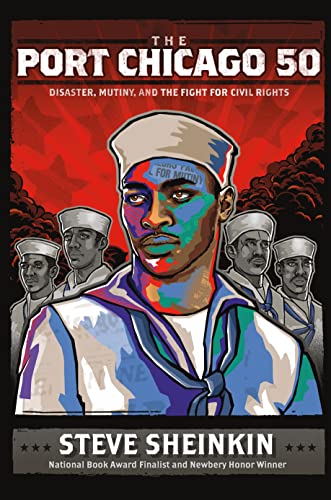
Presents an account of the 1944 civil rights protest involving hundreds of African-American Navy servicemen who were unjustly charged with mutiny for refusing to work in unsafe conditions after the deadly Port Chicago explosion.
Die Inhaltsangabe kann sich auf eine andere Ausgabe dieses Titels beziehen.
Über die Autorin bzw. den Autor
Steve Sheinkin is the award-winning author of several fascinating books on American history, including The Notorious Benedict Arnold, which won the YALSA Award for Excellence in Nonfiction for Young Adults, the Boston Globe/Horn Book Award for nonfiction, and received three starred reviews; and Bomb, a National Book Award finalist and recipient of five starred reviews. He lives in Saratoga Springs, NY.
Auszug. © Genehmigter Nachdruck. Alle Rechte vorbehalten.
The Port Chicago 50
Disaster, Mutiny, and the Fight for Civil Rights
By Steve SheinkinRoaring Brook Press
Copyright © 2014 Steve Sheinkin
All rights reserved.
ISBN: 978-1-59643-796-8All rights reserved.
Contents
TITLE PAGE,
COPYRIGHT NOTICE,
THE PORT CHICAGO 50,
EPIGRAPH,
FIRST HERO,
THE POLICY,
PORT CHICAGO,
WORK AND LIBERTY,
THE LAWYER,
HOT CARGO,
THE EXPLOSION,
THE INQUIRY,
COLUMN LEFT,
PRISON BARGE,
THE FIFTY,
TREASURE ISLAND,
PROSECUTION,
JOE SMALL,
THE VERDICT,
HARD LABOR,
SMALL GOES TO SEA,
EPILOGUE: CIVIL RIGHTS HEROES,
SOURCE NOTES,
LIST OF WORKS CITED,
ACKNOWLEDGMENTS,
PICTURE CREDITS,
INDEX,
COPYRIGHT,
CHAPTER 1
FIRST HERO
HE WAS GATHERING dirty laundry when the bombs started falling.
It was early on the morning of December 7, 1941, at the U.S. naval base at Pearl Harbor, Hawaii, and Mess Attendant Dorie Miller had just gone on duty aboard the battleship USS West Virginia. A six-foot-three, 225-pound Texan, Miller was the ship's heavyweight boxing champ. But his everyday duties were somewhat less challenging. As one of the ship's African American mess attendants, he cooked and cleaned for the white sailors.
Miller was below deck, picking up clothes, when the first torpedo slammed into the side of the West Virginia. Sirens shrieked and a voice roared over the loudspeaker:
"Japanese are attacking! All hands, General Quarters!"
Miller ran to his assigned battle station, an ammunition magazine — and saw it had already been blown apart.
He raced up to the deck and looked up at a bright blue sky streaked with enemy planes and falling bombs. Japan's massive attack had taken the base by surprise, and thunderous explosions were rocking American ships all over the harbor. Two direct hits cracked through the deck of the West Virginia, sending flames and shrapnel flying.
Amid the smoke and chaos, an officer saw Miller and shouted for him to help move the wounded. Miller began lifting men, carrying them farther from the spreading fires.
Then he spotted a dead gunner beside an anti-aircraft machine gun. He'd never been instructed in the operation of this weapon. But he'd seen it used. That was enough.
Jumping behind the gun, Miller tilted the barrel up and took aim at a Japanese plane. "It wasn't hard," he'd later say. "I just pulled the trigger, and she worked fine."
As Miller blasted away, downing at least one enemy airplane, several more torpedoes blew gaping holes in the side of the West Virginia. The ship listed sharply to the left as it took on water.
The captain, who lay dying of a belly wound, ordered, "Abandon ship!"
Sailors started climbing over the edge of the ship, leaping into the water. Miller scrambled around the burning, tilting deck, helping wounded crewmembers escape the sinking ship before jumping to safety himself.
* * *
After the battle, an officer who had witnessed Miller's bravery recommended him for the Navy Cross, the highest decoration given by the Navy. "For distinguished devotion to duty," declared Miller's official Navy Cross citation, "extraordinary courage and disregard for his own personal safety during the attack on the Fleet in Pearl Harbor."
In early 1942, soon after the United States had entered World War II, Admiral Chester Nimitz personally pinned the medal to Miller's chest. "This marks the first time in this conflict that such high tribute has been made in the Pacific Fleet to a member of his race," Nimitz declared. "I'm sure that the future will see others similarly honored for brave acts."
And then Dorie Miller, one of the first American heroes of World War II, went back to collecting laundry. He was still just a mess attendant.
It was the only position open to black men in the United States Navy.
CHAPTER 2THE POLICY
THE DAY AFTER JAPAN ATTACKED Pearl Harbor, the United States declared war on Japan. Japan's powerful ally, Germany, responded by declaring war on the United States. World War II was already raging across Europe, Africa, and Asia. Now the United States had officially entered the biggest war in human history.
"We are now fighting to maintain our right to live among our world neighbors in freedom," President Franklin D. Roosevelt told Americans in a radio address from the White House. "We are now in the midst of a war, not for conquest, not for vengeance, but for a world in which this nation, and all that this nation represents, will be safe for our children."
Trucks with roof-mounted speakers cruised slowly through American cities, blaring the call to arms: "Patriotic, red-blooded Americans! Join the Navy and help Uncle Sam hit back!"
For black Americans this was not so simple. When they volunteered to fight as sailors, they were reminded of the Navy's long-standing policy. They could serve on ships only as mess attendants.
* * *
It was a policy as old as the country itself.
When George Washington took command of the Continental Army in 1775, he told recruiters to stop signing up black soldiers. The fact is, black volunteers had already fought in the war's opening battles at Lexington, Concord, and Bunker Hill. But slave owners objected that arming African Americans could lead to slave rebellions, and Washington agreed not to accept more black soldiers. Two years of losing battles to the British, and soldiers to desertion and disease, changed the commander's perspective. Washington needed men, no matter the color. Eventually, about 5,000 African Americans helped win the American Revolution.
The pattern was repeated soon after the Civil War erupted in 1861. At first the United States Army would not accept black men, fearing that to do so would offend the slave states that were still in the Union. Then, as the war dragged on, and the Union's need for fighting men grew increasingly desperate, the policy changed. More than 200,000 black soldiers fought to save the Union and end slavery — but they did so in segregated units, led by white officers.
In the Spanish-American War, future president Teddy Roosevelt became a national hero for leading the charge up Cuba's San Juan Hill. Actually, hundreds of African American soldiers were charging up the hill too, in separate, segregated units. By the time they reached the top, white and black soldiers were all mixed together, and together they took the hill. But when newspapers reported on the victory, Roosevelt and his white volunteers got the credit.
More than 350,000 African Americans served in World War I, nearly all in segregated labor battalions. They drove trucks, dug trenches, buried bodies. The military based its policy of using African Americans as laborers on the prejudiced assumption — one already decisively disproven by history — that black men would not make good combat soldiers.
"Poor Negroes!" one American general wrote in his diary during the war. "Everyone feeling and saying that they are worthless as soldiers."
Tellingly, several African American regiments wound up under the command of the French army, where they were given a fair shot to fight, and fought well. One black regiment from New York, nicknamed the Harlem Hellfighters, spent 191 days in combat — longer than any white American unit. They won a pile of medals, and returned to New York City as heroes. But the policy of the American military did not change.
At the...
„Über diesen Titel“ kann sich auf eine andere Ausgabe dieses Titels beziehen.
Suchergebnisse für The Port Chicago 50: Disaster, Mutiny, and the Fight...

Beispielbild für diese ISBN
The Port Chicago 50 Disaster M
Anbieter: World of Books (was SecondSale), Montgomery, IL, USA
Verkäuferbewertung 5 von 5 Sternen

Zustand: Good. Item in good condition. Textbooks may not include supplemental items i.e. CDs, access codes etc. Artikel-Nr. 00087285293
Gebraucht kaufen
EUR 3,71
Versand gratis
Versand innerhalb von USA
Versand innerhalb von USA
Anzahl: 13 verfügbar
Beispielbild für diese ISBN
The Port Chicago 50 Disaster M
Anbieter: World of Books (was SecondSale), Montgomery, IL, USA
Verkäuferbewertung 5 von 5 Sternen
Zustand: Very Good. Item in very good condition! Textbooks may not include supplemental items i.e. CDs, access codes etc. Artikel-Nr. 00107496094
Gebraucht kaufen
EUR 3,71
Versand gratis
Versand innerhalb von USA
Versand innerhalb von USA
Anzahl: 3 verfügbar
Foto des Verkäufers
The Port Chicago 50: Disaster, Mutiny, and the Fight for Civil Rights (National Book Award Finalist)
Anbieter: Dream Books Co., Denver, CO, USA
Verkäuferbewertung 5 von 5 Sternen
Zustand: good. Gently used with minimal wear on the corners and cover. A few pages may contain light highlighting or writing, but the text remains fully legible. Dust jacket may be missing, and supplemental materials like CDs or codes may not be included. May be ex-library with library markings. Ships promptly! Artikel-Nr. DBV.1596437960.G
Gebraucht kaufen
EUR 5,89
Versand gratis
Versand innerhalb von USA
Versand innerhalb von USA
Anzahl: 1 verfügbar
Beispielbild für diese ISBN
The Port Chicago 50 : Disaster, Mutiny, and the Fight for Civil Rights (National Book Award Finalist)
Anbieter: Better World Books, Mishawaka, IN, USA
Verkäuferbewertung 5 von 5 Sternen
Zustand: Very Good. Pages intact with possible writing/highlighting. Binding strong with minor wear. Dust jackets/supplements may not be included. Stock photo provided. Product includes identifying sticker. Better World Books: Buy Books. Do Good. Artikel-Nr. 6120059-6
Gebraucht kaufen
EUR 6,16
Versand gratis
Versand innerhalb von USA
Versand innerhalb von USA
Anzahl: 1 verfügbar
Beispielbild für diese ISBN
The Port Chicago 50 : Disaster, Mutiny, and the Fight for Civil Rights (National Book Award Finalist)
Anbieter: Better World Books, Mishawaka, IN, USA
Verkäuferbewertung 5 von 5 Sternen
Zustand: Good. Former library copy. Pages intact with minimal writing/highlighting. The binding may be loose and creased. Dust jackets/supplements are not included. Includes library markings. Stock photo provided. Product includes identifying sticker. Better World Books: Buy Books. Do Good. Artikel-Nr. 4412847-75
Gebraucht kaufen
EUR 6,16
Versand gratis
Versand innerhalb von USA
Versand innerhalb von USA
Anzahl: 3 verfügbar
Beispielbild für diese ISBN
The Port Chicago 50 : Disaster, Mutiny, and the Fight for Civil Rights (National Book Award Finalist)
Anbieter: Better World Books, Mishawaka, IN, USA
Verkäuferbewertung 5 von 5 Sternen
Zustand: Good. Pages intact with minimal writing/highlighting. The binding may be loose and creased. Dust jackets/supplements are not included. Stock photo provided. Product includes identifying sticker. Better World Books: Buy Books. Do Good. Artikel-Nr. 3990616-6
Gebraucht kaufen
EUR 6,16
Versand gratis
Versand innerhalb von USA
Versand innerhalb von USA
Anzahl: 1 verfügbar
Beispielbild für diese ISBN
The Port Chicago 50: Disaster, Mutiny, and the Fight for Civil Rights
Anbieter: Wonder Book, Frederick, MD, USA
Verkäuferbewertung 5 von 5 Sternen
Zustand: Good. Good condition. Good dust jacket. A copy that has been read but remains intact. May contain markings such as bookplates, stamps, limited notes and highlighting, or a few light stains. Artikel-Nr. V09B-05025
Gebraucht kaufen
EUR 6,40
Versand gratis
Versand innerhalb von USA
Versand innerhalb von USA
Anzahl: 2 verfügbar
Beispielbild für diese ISBN
The Port Chicago 50: Disaster, Mutiny, and the Fight for Civil Rights
Anbieter: ThriftBooks-Atlanta, AUSTELL, GA, USA
Verkäuferbewertung 5 von 5 Sternen
Hardcover. Zustand: Good. No Jacket. Former library book; Pages can have notes/highlighting. Spine may show signs of wear. ~ ThriftBooks: Read More, Spend Less. Artikel-Nr. G1596437960I3N10
Gebraucht kaufen
EUR 6,91
Versand gratis
Versand innerhalb von USA
Versand innerhalb von USA
Anzahl: 1 verfügbar
Beispielbild für diese ISBN
The Port Chicago 50: Disaster, Mutiny, and the Fight for Civil Rights
Anbieter: ThriftBooks-Reno, Reno, NV, USA
Verkäuferbewertung 5 von 5 Sternen
Hardcover. Zustand: Good. No Jacket. Former library book; Pages can have notes/highlighting. Spine may show signs of wear. ~ ThriftBooks: Read More, Spend Less. Artikel-Nr. G1596437960I3N10
Gebraucht kaufen
EUR 6,91
Versand gratis
Versand innerhalb von USA
Versand innerhalb von USA
Anzahl: 1 verfügbar
Beispielbild für diese ISBN
The Port Chicago 50: Disaster, Mutiny, and the Fight for Civil Rights
Anbieter: ThriftBooks-Reno, Reno, NV, USA
Verkäuferbewertung 5 von 5 Sternen
Hardcover. Zustand: Good. No Jacket. Missing dust jacket; Pages can have notes/highlighting. Spine may show signs of wear. ~ ThriftBooks: Read More, Spend Less. Artikel-Nr. G1596437960I3N01
Gebraucht kaufen
EUR 6,91
Versand gratis
Versand innerhalb von USA
Versand innerhalb von USA
Anzahl: 1 verfügbar