
Verwandte Artikel zu Bomb: The Race to Build--And Steal--The World's Most...
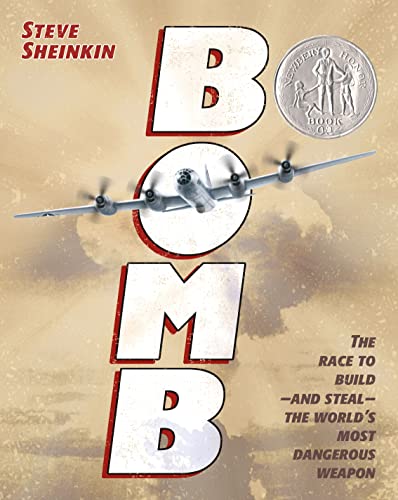
Bomb: The Race to Build--And Steal--The World's Most Dangerous Weapon: The Race to Build--And Steal--The World's Most Dangerous Weapon (Newbery Honor Book & National Book Award Finalist) - Hardcover
Inhaltsangabe
New York Times bestselling author Steve Sheinkin presents the fascinating and frightening true story of the creation behind the most destructive force that caused the arms race and the Cold War
★ A Newbery Honor book
★ A National Book Awards finalist for Young People's Literature
★ A Washington Post Best Kids Books of the Year title
In December of 1938, a chemist in a German laboratory made a shocking discovery: When placed next to radioactive material, a Uranium atom split in two. That simple discovery launched a scientific race that spanned three continents.
In Great Britain and the United States, Soviet spies worked their way into the scientific community; in Norway, a commando force slipped behind enemy lines to attack German heavy-water manufacturing; and deep in the desert, one brilliant group of scientists, led by "father of the atomic bomb" J. Robert Oppenheimer, was hidden away at a remote site at Los Alamos. This is the story of the plotting, the risk-taking, the deceit, and genius that created the world's most formidable weapon. This is the story of the atomic bomb.
Don’t miss out on these exciting true stories by Steve Sheinkin, perfect for all historians!
● Impossible Escape: A True Story of Survival and Heroism in Nazi Europe
● Fallout: Spies, Superbombs, and the Ultimate Cold War Showdown
● Born to Fly: The First Women's Air Race Across America
● Undefeated: Jim Thorpe and the Carlisle Indian School Football Team
● Most Dangerous: Daniel Ellsberg and the Secret History of the Vietnam War
● The Port Chicago 50: Disaster, Mutiny, and the Fight for Civil Rights
● Bomb: The Race to Build--and Steal--the World's Most Dangerous Weapon (A Newbery Honor Book–also available in Graphic Novel!)
● The Notorious Benedict Arnold: A True Story of Adventure, Heroism & Treachery
…and more!
Die Inhaltsangabe kann sich auf eine andere Ausgabe dieses Titels beziehen.
Über die Autorin bzw. den Autor
Steve Sheinkin is the acclaimed author of fast-paced, cinematic nonfiction histories, including Fallout, Undefeated, Born to Fly, The Port Chicago 50, and Bomb. His accolades include a Newbery Honor, three Boston Globe–Horn Book Awards, a Sibert Medal and Honor, and three National Book Award finalist honors. He lives in Saratoga Springs, New York, with his wife and two children.
Auszug. © Genehmigter Nachdruck. Alle Rechte vorbehalten.
Bomb
The Race to Build--and Steal--the World's Most Dangerous WeaponBy Steve SheinkinFlash Point
Copyright © 2012 Steve SheinkinAll right reserved.
ISBN: 9781596434875
SKINNY SUPERHERO
HARRY GOLD WAS RIGHT: This is a big story. It’s the story of the creation—and theft—of the deadliest weapon ever invented. The scenes speed around the world, from secret labs to commando raids to street-corner spy meetings. But like most big stories, this one starts small. Let’s pick up the action sixteen years before FBI agents cornered Harry Gold in Philadelphia. Let’s start 3,000 miles to the west, in Berkeley, California, on a chilly night in February 1934.
On a hill high above town, a man and woman sat in a parked car. In the driver’s seat was a very thin young physics professor named Robert Oppenheimer. Beside him sat his date, a graduate student named Melba Phillips. The two looked out at the view of San Francisco Bay.
It was a fine view, but Oppenheimer couldn’t seem to stay focused on the date. He turned to Phillips and asked, “Are you comfortable?”
She said she was.
“Mind if I get out and walk for a few minutes?”
She didn’t mind.
Oppenheimer got out and strolled into the darkness. Phillips wrapped a coat around her legs and waited. She waited a long time. At some point, she fell asleep.
She woke up in the middle of the night—the seat beside her was still empty. Worried, she stepped onto the road and waved down a passing police car.
“My escort went for a walk hours ago and he hasn’t returned,” she told the cop.
The police searched the park, but found nothing. They notified headquarters, and a wider search was begun. An officer drove to Oppenheimer’s apartment to look for useful clues.
He found the professor in bed, sound asleep.
The cop shook Oppenheimer awake and demanded an explanation. Oppenheimer said he’d gotten out of the car to think about physics. “I just walked and walked,” he said, “and I was home and I went to bed. I’m so sorry.”
A reporter for the San Francisco Chronicle got hold of the story and wrote an article with the headline: “Forgetful Prof Parks Girl, Takes Self Home.”
No one who knew Robert Oppenheimer was the least bit surprised.
* * *
HE’D ALWAYS BEEN DIFFERENT. A girl who knew Robert as a child in New York City described him as “very frail, very pink-cheeked, very shy, and very brilliant.”
Oppenheimer was a tougher critic. “A repulsively good little boy,” he said of himself. “My life as a child did not prepare me for the fact that the world is full of cruel and bitter things.”
He was constantly getting sick, so his nervous parents tried to protect him by keeping him inside. While other boys played in the street, Robert sat alone in his room studying languages, devouring books of literature and science, and filling notebooks with poetry. Around kids his age he was awkward and quiet, never knowing what to say unless he could bring the conversation around to books. Then he would let loose annoying bursts of learning.
“Ask me a question in Latin,” he’d say, “and I’ll answer you in Greek.”
Hoping to toughen up their stick-skinny fourteen-year-old, Robert’s parents sent him to a sports summer camp. But he was an awful athlete and simply refused to participate. Then the other campers found out he wrote home every day, and that he liked poetry and looking for minerals. That’s when they started calling him “Cutie.”
Robert never fought back. He never even responded. That made his tormentors even angrier.
One night, after dinner, Robert went for a walk. A group of boys waited for him in the woods. They grabbed him, dragged him to the icehouse, and tossed him on the rough wood floor. They ripped off his shirt and pants, dipped a brush in green paint, and slapped the dripping bristles against his bony body.
Robert never said a word about the attack to camp counselors. “I don’t know how Robert stuck out those remaining weeks,” his only friend at camp later said. “Not many boys would have—or could have—but Robert did. It must have been hell for him.”
Science saved him. Robert dove deep into chemistry and physics in high school, graduated from Harvard University in 1925, then earned advanced degrees at top universities in Britain and Germany. Even in classes with some of the brightest students in the world, “Oppie,” as friends called him, never lost his know-it-all style. He interrupted physics lectures with his own theories, sometimes charging to the chalkboard, grabbing the chalk and declaring. “This can be done much better in the following manner.” Classmates got so annoyed they actually signed a petition asking him to allow others to speak in class. After that, Oppenheimer calmed down. A little bit. “The trouble,” a friend said, “is that Oppie is so quick on the trigger intellectually, that he puts the other guy at a disadvantage.”
He’d lucked into a thrilling time in theoretical physics. Physicists were just beginning to figure out what atoms look like, and how the tiny particles inside them move and affect each other. Theoretical physicists were the explorers of their day, using imagination and mind-bending math to dig deeper and deeper into the surprising inner workings of atoms. Oppenheimer knew he’d found his calling.
When he returned to the States, schools all over the country tried to hire him. He picked the University of California, in Berkeley, where he quickly built the country’s best theoretical physics program. Students who came to study with Oppenheimer quickly realized they were in for a wild ride. “When you took a question to him,” one student remembered, “he would spend hours—until midnight perhaps—exploring every angle with you.”
“He generally would answer patiently,” another student agreed, “unless the question was manifestly stupid, in which event his response was likely to be quite caustic.”
While sitting in on other professors’ lectures, Oppenheimer was known to squirm impatiently. “Oh, come now!” he’d call out. “We all know that. Let’s get on with it!”
Oppenheimer’s own lectures, according to a student named Edward Gerjuoy, were lightning bursts of ideas, theories, and math on the blackboard. “He spoke quite rapidly, and puffed equally rapidly,” Gerjuoy said. “When one cigarette burned down to a fragment he no longer could hold, he lit another.” Oppenheimer paced as he lectured, his wiry black hair sticking straight up, his large blue eyes flashing, as he furiously wrote, erased, wrote more, talked, puffed, and bobbed in and out of a cloud of white smoke.
During one lecture, he told students to think about a formula he’d written. There were dozens scrawled all over the board, and a student cut in to ask which formula he was talking about.
“Not that one,” Oppenheimer said, pointing to the blackboard, “the one underneath.”
There was no formula below that one, the student pointed out.
“Not below, underneath,” snapped Oppenheimer. “I have written over it.”
As one of Oppenheimer’s students put it: “Everyone sort...
HARRY GOLD WAS RIGHT: This is a big story. It’s the story of the creation—and theft—of the deadliest weapon ever invented. The scenes speed around the world, from secret labs to commando raids to street-corner spy meetings. But like most big stories, this one starts small. Let’s pick up the action sixteen years before FBI agents cornered Harry Gold in Philadelphia. Let’s start 3,000 miles to the west, in Berkeley, California, on a chilly night in February 1934.
On a hill high above town, a man and woman sat in a parked car. In the driver’s seat was a very thin young physics professor named Robert Oppenheimer. Beside him sat his date, a graduate student named Melba Phillips. The two looked out at the view of San Francisco Bay.
It was a fine view, but Oppenheimer couldn’t seem to stay focused on the date. He turned to Phillips and asked, “Are you comfortable?”
She said she was.
“Mind if I get out and walk for a few minutes?”
She didn’t mind.
Oppenheimer got out and strolled into the darkness. Phillips wrapped a coat around her legs and waited. She waited a long time. At some point, she fell asleep.
She woke up in the middle of the night—the seat beside her was still empty. Worried, she stepped onto the road and waved down a passing police car.
“My escort went for a walk hours ago and he hasn’t returned,” she told the cop.
The police searched the park, but found nothing. They notified headquarters, and a wider search was begun. An officer drove to Oppenheimer’s apartment to look for useful clues.
He found the professor in bed, sound asleep.
The cop shook Oppenheimer awake and demanded an explanation. Oppenheimer said he’d gotten out of the car to think about physics. “I just walked and walked,” he said, “and I was home and I went to bed. I’m so sorry.”
A reporter for the San Francisco Chronicle got hold of the story and wrote an article with the headline: “Forgetful Prof Parks Girl, Takes Self Home.”
No one who knew Robert Oppenheimer was the least bit surprised.
* * *
HE’D ALWAYS BEEN DIFFERENT. A girl who knew Robert as a child in New York City described him as “very frail, very pink-cheeked, very shy, and very brilliant.”
Oppenheimer was a tougher critic. “A repulsively good little boy,” he said of himself. “My life as a child did not prepare me for the fact that the world is full of cruel and bitter things.”
He was constantly getting sick, so his nervous parents tried to protect him by keeping him inside. While other boys played in the street, Robert sat alone in his room studying languages, devouring books of literature and science, and filling notebooks with poetry. Around kids his age he was awkward and quiet, never knowing what to say unless he could bring the conversation around to books. Then he would let loose annoying bursts of learning.
“Ask me a question in Latin,” he’d say, “and I’ll answer you in Greek.”
Hoping to toughen up their stick-skinny fourteen-year-old, Robert’s parents sent him to a sports summer camp. But he was an awful athlete and simply refused to participate. Then the other campers found out he wrote home every day, and that he liked poetry and looking for minerals. That’s when they started calling him “Cutie.”
Robert never fought back. He never even responded. That made his tormentors even angrier.
One night, after dinner, Robert went for a walk. A group of boys waited for him in the woods. They grabbed him, dragged him to the icehouse, and tossed him on the rough wood floor. They ripped off his shirt and pants, dipped a brush in green paint, and slapped the dripping bristles against his bony body.
Robert never said a word about the attack to camp counselors. “I don’t know how Robert stuck out those remaining weeks,” his only friend at camp later said. “Not many boys would have—or could have—but Robert did. It must have been hell for him.”
Science saved him. Robert dove deep into chemistry and physics in high school, graduated from Harvard University in 1925, then earned advanced degrees at top universities in Britain and Germany. Even in classes with some of the brightest students in the world, “Oppie,” as friends called him, never lost his know-it-all style. He interrupted physics lectures with his own theories, sometimes charging to the chalkboard, grabbing the chalk and declaring. “This can be done much better in the following manner.” Classmates got so annoyed they actually signed a petition asking him to allow others to speak in class. After that, Oppenheimer calmed down. A little bit. “The trouble,” a friend said, “is that Oppie is so quick on the trigger intellectually, that he puts the other guy at a disadvantage.”
He’d lucked into a thrilling time in theoretical physics. Physicists were just beginning to figure out what atoms look like, and how the tiny particles inside them move and affect each other. Theoretical physicists were the explorers of their day, using imagination and mind-bending math to dig deeper and deeper into the surprising inner workings of atoms. Oppenheimer knew he’d found his calling.
When he returned to the States, schools all over the country tried to hire him. He picked the University of California, in Berkeley, where he quickly built the country’s best theoretical physics program. Students who came to study with Oppenheimer quickly realized they were in for a wild ride. “When you took a question to him,” one student remembered, “he would spend hours—until midnight perhaps—exploring every angle with you.”
“He generally would answer patiently,” another student agreed, “unless the question was manifestly stupid, in which event his response was likely to be quite caustic.”
While sitting in on other professors’ lectures, Oppenheimer was known to squirm impatiently. “Oh, come now!” he’d call out. “We all know that. Let’s get on with it!”
Oppenheimer’s own lectures, according to a student named Edward Gerjuoy, were lightning bursts of ideas, theories, and math on the blackboard. “He spoke quite rapidly, and puffed equally rapidly,” Gerjuoy said. “When one cigarette burned down to a fragment he no longer could hold, he lit another.” Oppenheimer paced as he lectured, his wiry black hair sticking straight up, his large blue eyes flashing, as he furiously wrote, erased, wrote more, talked, puffed, and bobbed in and out of a cloud of white smoke.
During one lecture, he told students to think about a formula he’d written. There were dozens scrawled all over the board, and a student cut in to ask which formula he was talking about.
“Not that one,” Oppenheimer said, pointing to the blackboard, “the one underneath.”
There was no formula below that one, the student pointed out.
“Not below, underneath,” snapped Oppenheimer. “I have written over it.”
As one of Oppenheimer’s students put it: “Everyone sort...
„Über diesen Titel“ kann sich auf eine andere Ausgabe dieses Titels beziehen.
Suchergebnisse für Bomb: The Race to Build--And Steal--The World's Most...

Beispielbild für diese ISBN
Bomb The Race to BuildAnd Stea
Anbieter: World of Books (was SecondSale), Montgomery, IL, USA
Verkäuferbewertung 5 von 5 Sternen

Zustand: Acceptable. Item in acceptable condition! Textbooks may not include supplemental items i.e. CDs, access codes etc. Artikel-Nr. 00105311452
Gebraucht kaufen
EUR 4,17
Versand gratis
Versand innerhalb von USA
Versand innerhalb von USA
Anzahl: 3 verfügbar
Beispielbild für diese ISBN
Bomb The Race to BuildAnd Stea
Anbieter: World of Books (was SecondSale), Montgomery, IL, USA
Verkäuferbewertung 5 von 5 Sternen
Zustand: Very Good. Item in very good condition! Textbooks may not include supplemental items i.e. CDs, access codes etc. Artikel-Nr. 00108598733
Gebraucht kaufen
EUR 4,17
Versand gratis
Versand innerhalb von USA
Versand innerhalb von USA
Anzahl: 5 verfügbar
Beispielbild für diese ISBN
Bomb
Anbieter: World of Books (was SecondSale), Montgomery, IL, USA
Verkäuferbewertung 5 von 5 Sternen
Hardback. Zustand: Good. In December of 1938, a chemist in a German laboratory made a shocking discovery: When placed next to radioactive material, a Uranium atom split in two. That simple discovery launched a scientific race that spanned 3 continents. In Great Britain and the United States, Soviet spies worked their way into the scientific community; in Norway, a commando force slipped behind enemy lines to attack German heavy-water manufacturing; and deep in the desert, one brilliant group of scientists was hidden away at a remote site at Los Alamos. This is the story of the plotting, the risk-taking, the deceit, and genius that created the world's most formidable weapon. This is the story of the atomic bomb. Bomb is a 2012 National Book Awards finalist for Young People's Literature. Bomb is a 2012 Washington Post Best Kids Books of the Year title. Bomb is a 2013 Newbery Honor book. Artikel-Nr. 00105900911
Gebraucht kaufen
EUR 4,17
Versand gratis
Versand innerhalb von USA
Versand innerhalb von USA
Anzahl: Mehr als 20 verfügbar
Beispielbild für diese ISBN
Bomb: The Race to Build--and Steal--the World's Most Dangerous Weapon (Newbery Honor Book & National Book Award Finalist)
Verlag:
Flash Point (edition Illustrated), 2012
ISBN 10: 1596434872
ISBN 13: 9781596434875
Gebraucht
Hardcover
Anbieter: BooksRun, Philadelphia, PA, USA
Verkäuferbewertung 5 von 5 Sternen
Hardcover. Zustand: Very Good. Illustrated. With dust jacket. It's a well-cared-for item that has seen limited use. The item may show minor signs of wear. All the text is legible, with all pages included. It may have slight markings and/or highlighting. Artikel-Nr. 1596434872-11-1-29
Gebraucht kaufen
EUR 5,46
Versand gratis
Versand innerhalb von USA
Versand innerhalb von USA
Anzahl: 1 verfügbar
Beispielbild für diese ISBN
Bomb: The Race to Build--And Steal--The World's Most Dangerous Weapon (Newbery Honor Book & National Book Award Finalist)
Anbieter: ThriftBooks-Reno, Reno, NV, USA
Verkäuferbewertung 5 von 5 Sternen
Hardcover. Zustand: Good. No Jacket. Former library book; Pages can have notes/highlighting. Spine may show signs of wear. ~ ThriftBooks: Read More, Spend Less. Artikel-Nr. G1596434872I3N10
Gebraucht kaufen
EUR 5,87
Versand gratis
Versand innerhalb von USA
Versand innerhalb von USA
Anzahl: 9 verfügbar
Beispielbild für diese ISBN
Bomb: The Race to Build--And Steal--The World's Most Dangerous Weapon (Newbery Honor Book & National Book Award Finalist)
Anbieter: ThriftBooks-Dallas, Dallas, TX, USA
Verkäuferbewertung 5 von 5 Sternen
Hardcover. Zustand: Very Good. No Jacket. Former library book; May have limited writing in cover pages. Pages are unmarked. ~ ThriftBooks: Read More, Spend Less. Artikel-Nr. G1596434872I4N10
Gebraucht kaufen
EUR 5,87
Versand gratis
Versand innerhalb von USA
Versand innerhalb von USA
Anzahl: 1 verfügbar
Beispielbild für diese ISBN
Bomb: The Race to Build--And Steal--The World's Most Dangerous Weapon (Newbery Honor Book & National Book Award Finalist)
Anbieter: ThriftBooks-Reno, Reno, NV, USA
Verkäuferbewertung 5 von 5 Sternen
Hardcover. Zustand: Fair. No Jacket. Missing dust jacket; Readable copy. Pages may have considerable notes/highlighting. ~ ThriftBooks: Read More, Spend Less. Artikel-Nr. G1596434872I5N01
Gebraucht kaufen
EUR 5,87
Versand gratis
Versand innerhalb von USA
Versand innerhalb von USA
Anzahl: 1 verfügbar
Beispielbild für diese ISBN
Bomb: The Race to Build--And Steal--The World's Most Dangerous Weapon (Newbery Honor Book & National Book Award Finalist)
Anbieter: ThriftBooks-Phoenix, Phoenix, AZ, USA
Verkäuferbewertung 5 von 5 Sternen
Hardcover. Zustand: Good. No Jacket. Missing dust jacket; Pages can have notes/highlighting. Spine may show signs of wear. ~ ThriftBooks: Read More, Spend Less. Artikel-Nr. G1596434872I3N01
Gebraucht kaufen
EUR 5,87
Versand gratis
Versand innerhalb von USA
Versand innerhalb von USA
Anzahl: 8 verfügbar
Beispielbild für diese ISBN
Bomb: The Race to Build--And Steal--The World's Most Dangerous Weapon (Newbery Honor Book & National Book Award Finalist)
Anbieter: ThriftBooks-Atlanta, AUSTELL, GA, USA
Verkäuferbewertung 5 von 5 Sternen
Hardcover. Zustand: Good. No Jacket. Pages can have notes/highlighting. Spine may show signs of wear. ~ ThriftBooks: Read More, Spend Less. Artikel-Nr. G1596434872I3N00
Gebraucht kaufen
EUR 5,87
Versand gratis
Versand innerhalb von USA
Versand innerhalb von USA
Anzahl: 3 verfügbar
Beispielbild für diese ISBN
Bomb: The Race to Build--And Steal--The World's Most Dangerous Weapon (Newbery Honor Book & National Book Award Finalist)
Anbieter: ThriftBooks-Phoenix, Phoenix, AZ, USA
Verkäuferbewertung 5 von 5 Sternen
Hardcover. Zustand: Very Good. No Jacket. Missing dust jacket; May have limited writing in cover pages. Pages are unmarked. ~ ThriftBooks: Read More, Spend Less. Artikel-Nr. G1596434872I4N01
Gebraucht kaufen
EUR 5,87
Versand gratis
Versand innerhalb von USA
Versand innerhalb von USA
Anzahl: 1 verfügbar