
Verwandte Artikel zu Force of Nature: Mind, Body, Soul, and, of Course,...
Inhaltsangabe
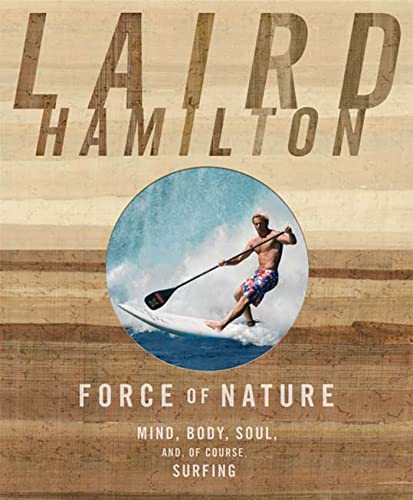
A celebrity surfer shares his strategies for achieving optimal health and spiritual balance, counseling readers on a wide variety of topics, from nutrition and injury prevention to overcoming negativity and embracing one's passions. 100,000 first printing.
Die Inhaltsangabe kann sich auf eine andere Ausgabe dieses Titels beziehen.
Über die Autorin bzw. den Autor
Laird Hamilton is known as the guiding genius of crossover board sports, and he is truly amazing in the water. His size--6'3", over 215 pounds--makes him seem indestructible. Laird is the elder son of sixties' surfing legend Bill Hamilton and is a throwback to that time when surfers prided themselves on being all-around watermen. His mother, JoAnn, gave birth to him in a "bathysphere" with reduced gravity as part of an experiment at the UC Medical Center in San Francisco. JoAnn was also a surfer and decided to move the family from California to Hawaii when Laird was just a few months old. They lived on Oahu's North Shore and later in a remote valley on Kauai, not far from one of the world's best surf breaks. He learned to surf between the ages of 2 and 3 on the front half of a surfboard; and at age 8, hi father took him to the 6-foot cliff at Waimea Falls, where Laird looked down, looked back at his dad, and jumped. "He's been bold since day one," says Bill, "and hell-bent on living life to the extreme." He lives in Hawaii and California with his wife and three daughters.
Auszug. © Genehmigter Nachdruck. Alle Rechte vorbehalten.
PART 1 MIND
We're all human, which means we all have the same opportunities and the same struggles. It's all about that voice inside our head that we call our mind--what it leads us to believe determines how we act and how our lives unfold. Which is why when I catch myself thinking bleak thoughts, I'll go out and do something physically strenuous, like clear brush or move rocks or paddle down the coast.
I believe that our thoughts have real, powerful effects on us. For instance, let's say you wake up one morning in a rotten mood. You don't know why, but you're just looking for a fight. Well, in my experience, the moment you walk out your front door you're going to find someone who wants to fight you back. He'll probably be standing right there. On the other hand, if you're just thinking about enjoying yourself, you're probably not running into a lot of complications. Everything comes down to attitude: You determine what yours is, and the external world will reflect it back.
Whether that's good news or bad news depends on you--on your outlook. If you think you're not able to do something, guess what? You're right. What if you believe that everything's for the best and see the beauty all around you, and you have faith that things will be good? You're right, too. If you cultivate something in your mind, you give it a life. It's really that simple.
RISK AND ITS REWARDS
A LITTLE ADRENALINE EVERY DAY KEEPS THE BOREDOM AWAY.
When I was 10, my step father took me to Waimea Falls on Oahu. I walked to the edge of a 60-foot cliff, and when he looked away, I jumped. For whatever reason, from the start it's been in my spirit to do those kinds of things. I've always wanted to jump from the highest place, experience the greatest thrill.
I may be an extreme case, but we all need to take risks. I think it goes back to our primitive state, our deepest DNA, when we were hunters and had to avoid getting eaten by large animals. Survival meant risk. The need for adventure is part of human nature. It's in every cell of our bodies. When some people hear the word risk, they think of life-or-death situations that they'd rather avoid. But risk doesn't always have to be life threatening. It can be as simple as putting yourself in an unfamiliar situation.
Some people don't need to go out of their way to seek risk. If you live in Afghanistan, for instance, you're not in need of any extra uncertainty. But for those of us who are fortunate enough to live in places where our lives are relatively safe, I think if we challenged ourselves--even scared ourselves--once a day, we'd be better people. It helps to have that little jolt of perspective to remind you that life's fragile.
The distinction between being courageous and being reckless is an important one. "Courageous" means you're able to calculate what you're doing. In my life I've taken calculated risks, as well as inadvertent risks. I've seen 18-foot-long tiger sharks in the water with me; I've been trapped under waterfalls. My mom was surprised that I made it to my 20th birthday. I guess it's the whole nine lives thing. There were a few close calls, but I'm still here. I've got a few of those nine lives left.
DEALING WITH FEAR AND NEGATIVITY
MAKE SURE YOUR WORST ENEMY DOESN'T LIVE BETWEEN YOUR OWN TWO EARS.
FEAR: NOT TO BE FEARED Every so often, in an article or an interview, someone describes me as "fearless." In my opinion, that's like calling me an idiot. Fear is a natural response. Without it, we wouldn't survive. If you're never scared, then you've either never been hurt or you're completely ignorant. The idea that fear is something to deny is completely misguided.
Forget your emotions around fear for a second and look at the simple reality: It's an energy source designed to increase performance. Adrenaline and the natural hormones your body creates when you're scared are more powerful than any drug. The ability to harness it constructively, that's the tricky part. Once you start to understand fear, it becomes something you can tap into. In my experience, fear usually prompts me to make really good decisions. I'd even go so far as to say that it gives me power.
How do you use fear to empower yourself? You don't fight it, and you don't overanalyze it. Thinking too much about a frightening situation causes your mind to start chattering, and it gets in the way of your body.
At Teahupoo, Tahiti, in 2000, I faced what has been, to date, the most dangerous situation of my career. I'd surfed this wave before, but never at the size it was that day--and neither had anybody else. The thing about Teahupoo is that it's a massively thick, deep, fast-moving barrel, and when it breaks it heaves so much water over the falls that it practically drains the reef. And the noise--you'd think it was a neutron bomb exploding. If you fall in the wrong conditions at Teahupoo, you're looking at a serious problem--possibly the last one you'll ever have.
When I let go of the rope after being towed in, I knew that the wave I'd just caught was a monster. But a split second later, I realized that it was actually a two-headed monster, unlike anything I'd ever ridden. My mind tried every trick in the book to get me to doubt my ability to survive what everyone could see (and I instinctively knew, even though it was behind me) was a potentially fatal ride. But if I had listened to those panicked thoughts and jumped off that wave, I probably wouldn't be here to tell you not to let panic dictate your actions.
If you think about it, the flip side of fear is commitment. You can spend your life fence-sitting because you're frightened of something bad that might happen--or you can launch yourself into it with all of your conviction and all of your intelligence. Here's my advice: Meet up with your fears. If you're afraid of sharks, go learn all about sharks. Get into the water with one. If you respect fear, face it straight on and act anyway. What you'll find isn't terror--it's exhilaration and the moments that you never forget.
NEGATIVITY: WE ALL GET IT, BUT THAT DOESN'T MEAN YOU HAVE TO TAKE IT Negativity is going to crop up in your mind. I think that's an unfortunate part of being human. It's as sure as daytime, nighttime. The question is: How much life do you give it? How dominant do you let it get? You have to make sure that the positive has more power and gets more time in your head than the negative. If you let that negative side take charge, you're going to find yourself in a hole.
I can be as negative as anyone, but when it comes to what I'm doing in sports, that stuff is out. For instance, if I'm surfing and I start thinking about wiping out, that is getting pushed out of my brain. I'm consciously removing that thought; that's not something I'm giving any kind of life to. Mental discipline is key--and when it comes down to it, negativity is the easy way out. Quitting: easy. Daring to triumph: hard.
DROPPING IN
GABBY REECE
I think I'm a pretty good athlete. I mean a good athlete. But it's a humbling thing being with someone like Laird. There are the 1 percent athletes--the people who are at the top of the college sports scene; the ones who become pros. About 1 percent of talented athletes will make it that far. But then, every so often, you get a Tiger Woods. He's like the 1 percent of the 1 percent--a different breed. And Laird is in that group. I've been around a lot of pro athletes, and I'll watch him training and think, That's just a whole other existence going on over there. Being around someone with that talent, whether it's in sports or art or science or whatever--you don't get in the way of it. You've got to support it because it's unique.
When we met, I knew exactly what Laird did for a living. As far as being nervous about it, I think I just accepted a long time ago that it's part of...
„Über diesen Titel“ kann sich auf eine andere Ausgabe dieses Titels beziehen.
Suchergebnisse für Force of Nature: Mind, Body, Soul, and, of Course,...

Beispielbild für diese ISBN
Force of Nature: Mind, Body, Soul (And, of Course, Surfing)
Anbieter: World of Books (was SecondSale), Montgomery, IL, USA
Verkäuferbewertung 5 von 5 Sternen

Hardback. Zustand: Fair. Laird Hamilton has been hailed as the world's greatest big-wave surfer. His first book, Force of Nature, allows readers a rare glimpse inside the unique philosophy that has created his circumstances, and not the other way around. After all, this is a man whose biological father abandoned him shortly after he was born; whose first job was working on a pig far; who dropped out of school in eleventh grade. And then the career decision: surfer. Though earning enough to pay the rent as any kind of surfer is next to impossible, Hamilton has ended up in the place we all desire to be: doing exactly what he loves, becoming the world's best in the process, making a great living, being surrounded by nature and family, radiating peak health and fitness, and succeeding by any definition of the word. How did he get there? And more importantly, how can the rest of us join him? Force of Nature is a detailed map to that destination, with Laird Hamilton as the reader's guide. It's not about chasing trophies or accolades or cash. It's about quality over quantity, soul and being true to your physical, mental, and spiritual roots. Not only is it possible to thrive in the modern world without adopting its harmful habits, it's essential. And not only has Hamilton mastered this balance, he makes a compelling and articulate case that anyone who wants to can do the same. This book is a deeply authoritative and cutting-edge guide to peak fitness in mind, body, sould, and surfing. It comes directly from the source and his inner circle, which includes those at the vanguard of sports, training, nutrition, and more. Former pro volleyball player Gabrielle Reece; surf legend Dave Kalama; fitness gurus Paul Chek, T.R. Goodman, and Don Wildman; and Food Network star Giada De Laurentiis all contribute their knowledge. Readers will get an all-access pass into an elite world filled with definitive and provocative ideas. Artikel-Nr. 00101139336
Gebraucht kaufen
EUR 3,99
Versand gratis
Versand innerhalb von USA
Versand innerhalb von USA
Anzahl: 1 verfügbar
Beispielbild für diese ISBN
Force of Nature: Mind, Body, Soul (And, of Course, Surfing)
Anbieter: World of Books (was SecondSale), Montgomery, IL, USA
Verkäuferbewertung 5 von 5 Sternen
Hardback. Zustand: Good. Laird Hamilton has been hailed as the world's greatest big-wave surfer. His first book, Force of Nature, allows readers a rare glimpse inside the unique philosophy that has created his circumstances, and not the other way around. After all, this is a man whose biological father abandoned him shortly after he was born; whose first job was working on a pig far; who dropped out of school in eleventh grade. And then the career decision: surfer. Though earning enough to pay the rent as any kind of surfer is next to impossible, Hamilton has ended up in the place we all desire to be: doing exactly what he loves, becoming the world's best in the process, making a great living, being surrounded by nature and family, radiating peak health and fitness, and succeeding by any definition of the word. How did he get there? And more importantly, how can the rest of us join him? Force of Nature is a detailed map to that destination, with Laird Hamilton as the reader's guide. It's not about chasing trophies or accolades or cash. It's about quality over quantity, soul and being true to your physical, mental, and spiritual roots. Not only is it possible to thrive in the modern world without adopting its harmful habits, it's essential. And not only has Hamilton mastered this balance, he makes a compelling and articulate case that anyone who wants to can do the same. This book is a deeply authoritative and cutting-edge guide to peak fitness in mind, body, sould, and surfing. It comes directly from the source and his inner circle, which includes those at the vanguard of sports, training, nutrition, and more. Former pro volleyball player Gabrielle Reece; surf legend Dave Kalama; fitness gurus Paul Chek, T.R. Goodman, and Don Wildman; and Food Network star Giada De Laurentiis all contribute their knowledge. Readers will get an all-access pass into an elite world filled with definitive and provocative ideas. Artikel-Nr. 00086739905
Gebraucht kaufen
EUR 3,99
Versand gratis
Versand innerhalb von USA
Versand innerhalb von USA
Anzahl: 11 verfügbar
Foto des Verkäufers
Force of Nature: Mind, Body, Soul (And, of Course, Surfing)
Anbieter: Dream Books Co., Denver, CO, USA
Verkäuferbewertung 5 von 5 Sternen
Zustand: very_good. Pages are clean with no markings. May show minor signs of wear or cosmetic defects marks, cuts, bends, or scuffs on the cover, spine, pages, or dust jacket. May have remainder marks on edges. Artikel-Nr. DBV.1594869421.VG
Gebraucht kaufen
EUR 4,69
Versand gratis
Versand innerhalb von USA
Versand innerhalb von USA
Anzahl: 1 verfügbar
Beispielbild für diese ISBN
Force of Nature: Mind, Body, Soul (And, of Course, Surfing)
Verlag:
Rodale Books (edition 1), 2008
ISBN 10: 1594869421
ISBN 13: 9781594869426
Gebraucht
Hardcover
Anbieter: BooksRun, Philadelphia, PA, USA
Verkäuferbewertung 5 von 5 Sternen
Hardcover. Zustand: Very Good. 1. With dust jacket. It's a well-cared-for item that has seen limited use. The item may show minor signs of wear. All the text is legible, with all pages included. It may have slight markings and/or highlighting. Artikel-Nr. 1594869421-11-1-29
Gebraucht kaufen
EUR 5,17
Versand gratis
Versand innerhalb von USA
Versand innerhalb von USA
Anzahl: 1 verfügbar
Beispielbild für diese ISBN
Force of Nature: Mind, Body, Soul (And, of Course, Surfing)
Anbieter: ThriftBooks-Dallas, Dallas, TX, USA
Verkäuferbewertung 5 von 5 Sternen
Hardcover. Zustand: Very Good. No Jacket. Missing dust jacket; May have limited writing in cover pages. Pages are unmarked. ~ ThriftBooks: Read More, Spend Less. Artikel-Nr. G1594869421I4N01
Gebraucht kaufen
EUR 5,91
Versand gratis
Versand innerhalb von USA
Versand innerhalb von USA
Anzahl: 1 verfügbar
Beispielbild für diese ISBN
Force of Nature: Mind, Body, Soul (And, of Course, Surfing)
Anbieter: ThriftBooks-Dallas, Dallas, TX, USA
Verkäuferbewertung 5 von 5 Sternen
Hardcover. Zustand: Very Good. No Jacket. Former library book; May have limited writing in cover pages. Pages are unmarked. ~ ThriftBooks: Read More, Spend Less. Artikel-Nr. G1594869421I4N10
Gebraucht kaufen
EUR 5,91
Versand gratis
Versand innerhalb von USA
Versand innerhalb von USA
Anzahl: 1 verfügbar
Beispielbild für diese ISBN
Force of Nature: Mind, Body, Soul (And, of Course, Surfing)
Anbieter: ThriftBooks-Atlanta, AUSTELL, GA, USA
Verkäuferbewertung 5 von 5 Sternen
Hardcover. Zustand: Very Good. No Jacket. Missing dust jacket; May have limited writing in cover pages. Pages are unmarked. ~ ThriftBooks: Read More, Spend Less. Artikel-Nr. G1594869421I4N01
Gebraucht kaufen
EUR 5,91
Versand gratis
Versand innerhalb von USA
Versand innerhalb von USA
Anzahl: 1 verfügbar
Beispielbild für diese ISBN
Force of Nature : Mind, Body, Soul, and, of Course, Surfing
Verlag:
Rodale Press, Incorporated, 2008
ISBN 10: 1594869421
ISBN 13: 9781594869426
Gebraucht
Hardcover
Anbieter: Better World Books: West, Reno, NV, USA
Verkäuferbewertung 5 von 5 Sternen
Zustand: Good. Former library copy. Pages intact with minimal writing/highlighting. The binding may be loose and creased. Dust jackets/supplements are not included. Includes library markings. Stock photo provided. Product includes identifying sticker. Better World Books: Buy Books. Do Good. Artikel-Nr. GRP102351020
Gebraucht kaufen
EUR 6,82
Versand gratis
Versand innerhalb von USA
Versand innerhalb von USA
Anzahl: 1 verfügbar
Beispielbild für diese ISBN
Force of Nature : Mind, Body, Soul, and, of Course, Surfing
Verlag:
Rodale Press, Incorporated, 2008
ISBN 10: 1594869421
ISBN 13: 9781594869426
Gebraucht
Hardcover
Anbieter: Better World Books: West, Reno, NV, USA
Verkäuferbewertung 5 von 5 Sternen
Zustand: Very Good. Pages intact with possible writing/highlighting. Binding strong with minor wear. Dust jackets/supplements may not be included. Stock photo provided. Product includes identifying sticker. Better World Books: Buy Books. Do Good. Artikel-Nr. 4030507-6
Gebraucht kaufen
EUR 6,82
Versand gratis
Versand innerhalb von USA
Versand innerhalb von USA
Anzahl: 3 verfügbar
Beispielbild für diese ISBN
Force of Nature : Mind, Body, Soul, and, of Course, Surfing
Verlag:
Rodale Press, Incorporated, 2008
ISBN 10: 1594869421
ISBN 13: 9781594869426
Gebraucht
Hardcover
Anbieter: Better World Books, Mishawaka, IN, USA
Verkäuferbewertung 5 von 5 Sternen
Zustand: Good. Pages intact with minimal writing/highlighting. The binding may be loose and creased. Dust jackets/supplements are not included. Stock photo provided. Product includes identifying sticker. Better World Books: Buy Books. Do Good. Artikel-Nr. GRP104763164
Gebraucht kaufen
EUR 6,82
Versand gratis
Versand innerhalb von USA
Versand innerhalb von USA
Anzahl: 1 verfügbar