
Inhaltsangabe
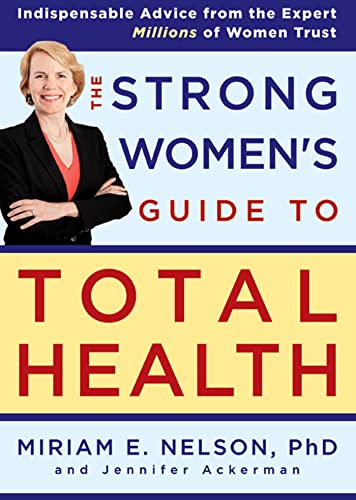
This practical and interactive guide shows women how to optimize their potential for health and well-being through in-depth information, self-assessment quizzes, and checklists to determine individual risk factors for common ailments and more serious diseases. Dr. Miriam Nelson shares the preventative measures that can be taken now to avoid such health problems down the road.
From sexual and reproductive health to beauty, heart health, emotional well-being, bone and muscle health, and weight control, Strong Women's Guide to Total Health offers a complete picture of the broad spectrum of issues that impact overall health. It is essential reading for women of all ages.
Die Inhaltsangabe kann sich auf eine andere Ausgabe dieses Titels beziehen.
Über die Autorin bzw. den Autor
MIRIAM NELSON, PhD, is director of the Center for Physical Activity and Nutrition and associate professor of nutrition at Tufts University.
JENNIFER ACKERMAN is a science and health writer whose most recent book, Sex Sleep Eat Drink Dream, was named a New York Times Editors Choice.
Auszug. © Genehmigter Nachdruck. Alle Rechte vorbehalten.
1
Reproduction
The female reproductive system is an intricate and complex set of organs that carry out an amazing variety of tasks, from producing sex hormones to nurturing the miracle of new life. They include internal organs--ovaries, fallopian tubes, uterus, vagina, and accessory glands--and also the vulva, which covers the opening to the vagina. A woman's main reproductive organs are two ovaries--each about the size and shape of an almond--located on either side of the uterus. Ovaries produce eggs (ova) and sex hormones. Over the course of a lifetime, they produce, store, and release about 450 eggs in a process known as ovulation.
Two slender 4-inch fallopian tubes, or oviducts, connect the ovaries with the uterus. The end of each tube near the ovary is funnel shaped and fringed with fingerlike extensions called fimbriae that draw the egg into the tube. When an egg is released from your ovary, the fimbriae catch it and help push it along the fallopian tube in its 7-day journey to the uterus. Because the egg is only fertile for about a day, fertilization occurs in the fallopian tubes before the egg moves to the uterus.
Your uterus, or womb, provides the fertilized egg with a nurturing, hospitable environment in which to grow. The uterus is a powerful, muscular organ, normally about the size and shape of an upside-down pear. Its 1-inch- thick muscular walls can expand to accommodate a full-term fetus and help push the baby out during labor. The lining of the uterus, known as the endometrium, is where a fertilized egg arriving from the fallopian tube embeds and develops. If the egg is not fertilized, it dries up and, roughly 2 weeks later, exits the body along with menstrual flow consisting of sloughed tissue from the endometrium.
Your uterus opens to your vagina at the cervix, a strong, thick-walled opening normally no wider than a straw but capable of expanding to allow the passage of a baby. Within the cervix are glands that secrete mucus. This mucus varies in consistency from tacky and sticky to thin and clear and either assists or impedes sperm, depending on the time of your cycle.
From the cervix, the vagina runs about 4 inches to the vaginal opening. A hollow, accordion-like muscular tube lined with mucous membranes that keep it moist, the vagina is where the erect penis is inserted during sexual intercourse. It also serves as the birth canal and as a passageway for menstrual flow from the uterus. The vagina expands during sexual arousal and, especially, during childbirth. The lower third of the vagina is laced with many nerve endings and includes the Grafenberg spot, or G-spot, a sensitive spot roughly the size of a dime, 2 to 3 inches up just past the pubic bone; for some women, it is an area of erotic sensitivity. During sexual arousal, small glands on either side of the vagina known as Bartholin's glands may also swell and lubricate the passage. The opening to the vagina is known as the introitus; at birth it may be partially covered with a membrane of tissue called the hymen. It was once thought that a torn hymen was evidence of sexual intercourse, but that's simply not true. A hymen can be easily stretched, abraded, or torn by physical activity, use of tampons, masturbation, and other activities.
Your external genitalia, also known as your vulva or pudendum, include the mons pubis, the fleshy area just above your vaginal opening; the labia majora and labia minora, the two skin flaps surrounding the vaginal opening, which help keep bacteria out of the vestibule of the vagina; and the clitoris, a highly sensitive structure rich in blood supply and nerves, which swells during sexual arousal. Your clitoris is the only part of your body that is designed solely for pleasure.
While your breasts are not strictly necessary for procreation, they are part of your reproductive system and are sensitive to female hormones. Each breast has a raised nipple surrounded by a circular pigmented area called the areola, which contains muscles that make your nipple stand erect in response to touch and, sometimes, to cold. Your nipples contain openings for milk ducts within the breast. Inside, your breasts have lobes of glandular tissue (known as mammary glands) that include the sacs and tubes that make milk. The lobes are separated by protective fat and supported by connective tissue. The shape of your breast is determined by the amount and distribution of fat. The function of your mammary glands is regulated by estrogen and progesterone from your ovaries and, from your brain, prolactin and oxytocin--two hormones involved in breast development and milk production, among other things.
Female Reproductive System
The main organs of the female reproductive system include two ovaries, a pair of fallopian tubes (capped by fimbriae), and the uterus. An ovary releases the egg, which is swept by the fimbriae into the opening of the fallopian tubes, and from there, travels into the uterus.
Although we tend not to think of it this way, the brain is a powerful sexual organ, integral to both reproductive and sexual life. The pituitary gland, for instance, a structure about the size of a pea located just beneath the hypothalamus at the base of the brain, sends signals to the ovaries to prepare your eggs for ovulation. Both the hypothalamus and the pituitary gland play an important role in regulating female hormones.
YOUR REPRODUCTIVE CYCLES
A finely tuned array of interacting sex hormones orchestrates your reproductive cycles. At puberty, the pituitary gland in the brain begins to secrete two key hormones: folliclestimulating hormone (FSH) and luteinizing hormone (LH). These hormones stimulate your ovaries to make other hormones, including estrogen. Toward the end of puberty, your ovaries begin to release eggs--one per month--as part of your monthly menstrual cycle. The cycle has four phases:
1. Follicular. This phase begins just after menstruation ends and lasts for 6 to 13 days. The pituitary releases FSH and LH, stimulating the growth of a group of egg follicles, only one of which will eventually make a mature egg. Estrogen promotes the thickening of the endometrium in preparation for a fertilized egg.
2. Ovulatory. On around day 14 of your cycle, a mature egg is released into the fallopian tube--the process called ovulation. At this time of the cycle, your cervical mucus may become clear, copious, and stretchy, a state hospitable to sperm. The cervix opens a little.
3. Luteal. In this stage, progesterone and estrogen further stimulate the development of the endometrium. If there's no fertilization, however, the hormone levels drop. At this phase, the endometrium may produce prostaglandins--hormonelike substances that can trigger the cramps, breast tenderness, and mood swings of premenstrual syndrome.
4. Menstrual. The endometrial buildup, about 2 to 6 tablespoonfuls of blood and tissue, is expelled out of the uterus by uterine contractions. Normal menstrual flow can be light or heavy, regular or irregular, and can last from 3 to 7 days. After this, the endometrium rebuilds itself, and the cycle begins anew.
A girl's first period, called menarche, may occur anytime between the ages of 9 and 16. Although there are few statistics, it's widely believed that the age of menarche decreased by 2 to 3 years between 1900 and 1970, most likely due to better nutrition and health care. Today, some 10 percent of American girls reach menarche by age 11 and 90 percent by age 13.75. The average age of menarche in healthy American girls is 12.5, but it's perfectly normal to start menstruating at either end of the age spectrum. I didn't get my period until I was 16. At the time, I thought I was abnormal because all of my friends had already begun menstruating. But now I realize I was just at the older end of the age range. Once menarche takes place, most...
„Über diesen Titel“ kann sich auf eine andere Ausgabe dieses Titels beziehen.
Suchergebnisse für The Strong Women's Guide to Total Health

Beispielbild für diese ISBN
The Strong Women's Guide to To
Anbieter: World of Books (was SecondSale), Montgomery, IL, USA
Verkäuferbewertung 5 von 5 Sternen

Zustand: Very Good. Item in very good condition! Textbooks may not include supplemental items i.e. CDs, access codes etc. Artikel-Nr. 00097006792
Gebraucht kaufen
EUR 5,56
Versand gratis
Versand innerhalb von USA
Versand innerhalb von USA
Anzahl: 1 verfügbar
Beispielbild für diese ISBN
The Strong Women's Guide to To
Anbieter: World of Books (was SecondSale), Montgomery, IL, USA
Verkäuferbewertung 5 von 5 Sternen
Zustand: Good. Item in good condition and has highlighting/writing on text. Used texts may not contain supplemental items such as CDs, info-trac etc. Artikel-Nr. 00098087592
Gebraucht kaufen
EUR 5,56
Versand gratis
Versand innerhalb von USA
Versand innerhalb von USA
Anzahl: 1 verfügbar
Beispielbild für diese ISBN
The Strong Women's Guide to Total Health
Verlag:
Rodale Books, 2010
ISBN 10: 1594867798
ISBN 13: 9781594867798
Gebraucht
Hardcover
Erstausgabe
Anbieter: Better World Books, Mishawaka, IN, USA
Verkäuferbewertung 5 von 5 Sternen
Zustand: Good. 1st Edition. Former library copy. Pages intact with minimal writing/highlighting. The binding may be loose and creased. Dust jackets/supplements are not included. Includes library markings. Stock photo provided. Product includes identifying sticker. Better World Books: Buy Books. Do Good. Artikel-Nr. 6419745-6
Gebraucht kaufen
EUR 6,35
Versand gratis
Versand innerhalb von USA
Versand innerhalb von USA
Anzahl: 2 verfügbar
Beispielbild für diese ISBN
The Strong Women's Guide to Total Health
Anbieter: ThriftBooks-Atlanta, AUSTELL, GA, USA
Verkäuferbewertung 5 von 5 Sternen
Hardcover. Zustand: Very Good. No Jacket. May have limited writing in cover pages. Pages are unmarked. ~ ThriftBooks: Read More, Spend Less. Artikel-Nr. G1594867798I4N00
Gebraucht kaufen
EUR 6,67
Versand gratis
Versand innerhalb von USA
Versand innerhalb von USA
Anzahl: 1 verfügbar
Beispielbild für diese ISBN
The Strong Women's Guide to Total Health
Anbieter: ThriftBooks-Dallas, Dallas, TX, USA
Verkäuferbewertung 5 von 5 Sternen
Hardcover. Zustand: Very Good. No Jacket. May have limited writing in cover pages. Pages are unmarked. ~ ThriftBooks: Read More, Spend Less. Artikel-Nr. G1594867798I4N00
Gebraucht kaufen
EUR 6,67
Versand gratis
Versand innerhalb von USA
Versand innerhalb von USA
Anzahl: 1 verfügbar
Beispielbild für diese ISBN
The Strong Women's Guide to Total Health
Anbieter: Wonder Book, Frederick, MD, USA
Verkäuferbewertung 5 von 5 Sternen
Zustand: Very Good. Very Good condition. Very Good dust jacket. A copy that may have a few cosmetic defects. May also contain light spine creasing or a few markings such as an owner's name, short gifter's inscription or light stamp. Artikel-Nr. X12D-00752
Gebraucht kaufen
EUR 6,79
Versand gratis
Versand innerhalb von USA
Versand innerhalb von USA
Anzahl: 1 verfügbar
Beispielbild für diese ISBN
The Strong Women's Guide to Total Health
Anbieter: Wonder Book, Frederick, MD, USA
Verkäuferbewertung 5 von 5 Sternen
Zustand: Very Good. Very Good condition. Good dust jacket. A copy that may have a few cosmetic defects. May also contain light spine creasing or a few markings such as an owner's name, short gifter's inscription or light stamp. Artikel-Nr. D03B-02796
Gebraucht kaufen
EUR 6,79
Versand gratis
Versand innerhalb von USA
Versand innerhalb von USA
Anzahl: 1 verfügbar
Beispielbild für diese ISBN
The Strong Women's Guide to Total Health
Verlag:
Rodale Books (edition 1), 2010
ISBN 10: 1594867798
ISBN 13: 9781594867798
Gebraucht
Hardcover
Anbieter: BooksRun, Philadelphia, PA, USA
Verkäuferbewertung 5 von 5 Sternen
Hardcover. Zustand: Very Good. 1. With dust jacket. It's a well-cared-for item that has seen limited use. The item may show minor signs of wear. All the text is legible, with all pages included. It may have slight markings and/or highlighting. Artikel-Nr. 1594867798-11-6-29
Gebraucht kaufen
EUR 7,69
Versand gratis
Versand innerhalb von USA
Versand innerhalb von USA
Anzahl: 1 verfügbar
Beispielbild für diese ISBN
The Strong Women's Guide to Total Health
Verlag:
Rodale Press 13/04/2010, 2010
ISBN 10: 1594867798
ISBN 13: 9781594867798
Gebraucht
Hardcover
Anbieter: AwesomeBooks, Wallingford, Vereinigtes Königreich
Verkäuferbewertung 5 von 5 Sternen
Zustand: Very Good. This book is in very good condition and will be shipped within 24 hours of ordering. The cover may have some limited signs of wear but the pages are clean, intact and the spine remains undamaged. This book has clearly been well maintained and looked after thus far. Money back guarantee if you are not satisfied. See all our books here, order more than 1 book and get discounted shipping. . Artikel-Nr. 7719-9781594867798
Gebraucht kaufen
EUR 3,60
EUR 5,78 Versand
Versand von Vereinigtes Königreich nach USA
Versand von Vereinigtes Königreich nach USA
Anzahl: 1 verfügbar
Beispielbild für diese ISBN
The Strong Women's Guide to Total Health
Verlag:
Rodale Books, 2010
ISBN 10: 1594867798
ISBN 13: 9781594867798
Gebraucht
Hardcover
Erstausgabe
Anbieter: Better World Books Ltd, Dunfermline, Vereinigtes Königreich
Verkäuferbewertung 5 von 5 Sternen
Zustand: Very Good. 1st Edition. Former library copy. Pages intact with possible writing/highlighting. Binding strong with minor wear. Dust jackets/supplements may not be included. Includes library markings. Stock photo provided. Product includes identifying sticker. Better World Books: Buy Books. Do Good. Artikel-Nr. GRP63585078
Gebraucht kaufen
EUR 5,60
EUR 5,79 Versand
Versand von Vereinigtes Königreich nach USA
Versand von Vereinigtes Königreich nach USA
Anzahl: 1 verfügbar