
Verwandte Artikel zu An Inconvenient Truth: The Planetary Emergency of Global...
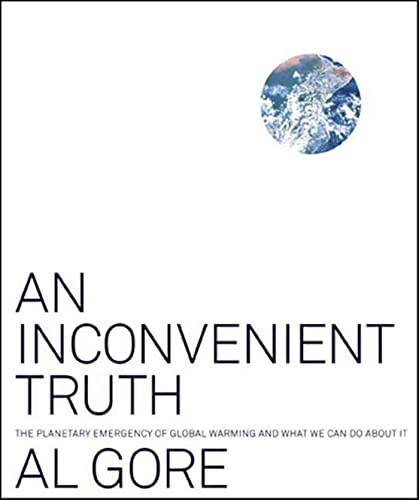
An Inconvenient Truth: The Planetary Emergency of Global Warming and What We Can Do About It - Softcover
Inhaltsangabe
An Inconvenient Truth—Gore's groundbreaking, battle cry of a follow-up to the bestselling Earth in the Balance—is being published to tie in with a documentary film of the same name. Both the book and film were inspired by a series of multimedia presentations on global warming that Gore created and delivers to groups around the world. With this book, Gore, who is one of our environmental heroes—and a leading expert—brings together leading-edge research from top scientists around the world; photographs, charts, and other illustrations; and personal anecdotes and observations to document the fast pace and wide scope of global warming. He presents, with alarming clarity and conclusiveness—and with humor, too—that the fact of global warming is not in question and that its consequences for the world we live in will be disastrous if left unchecked. This riveting new book—written in an accessible, entertaining style—will open the eyes of even the most skeptical.
Die Inhaltsangabe kann sich auf eine andere Ausgabe dieses Titels beziehen.
Über die Autorin bzw. den Autor
Former vice president Al Gore is co-founder and chairman of both Generation Investment Management and Current TV. He is also a senior partner at Kleiner Perkins Caufield & Byers, and a member of Apple Inc.’s board of directors. Gore spends the majority of his time as chairman of The Climate Reality Project, a nonprofit devoted to solving the climate crisis. Gore was elected to the U.S. House of Representatives four times and the U.S. Senate twice. He served eight years as vice president. He authored the bestsellers Earth in the Balance, An Inconvenient Truth, The Assault on Reason, Our Choice, and The Future. He is a co-recipient of the 2007 Nobel Peace Prize.
Auszug. © Genehmigter Nachdruck. Alle Rechte vorbehalten.
Introduction
Some experiences are so intense while Some experiences are so intense while they are happening that time seems to stop altogether. When it begins again and our lives resume their normal course, those intense experiences remain vivid, refusing to stay in the past, remaining always and forever with us.
Seventeen years ago my youngest child was badly--almost fatally--injured. This is a story I have told before, but its meaning for me continues to change and to deepen.
That is also true of the story I have tried to tell for many years about the global environment. It was during that interlude 17 years ago when I started writing my first book, Earth in the Balance. It was because of my son's accident and the way it abruptly interrupted the flow of my days and hours that I began to rethink everything, especially what my priorities had been. Thankfully, my son has long since recovered completely. But it was during that traumatic period that I made at least two enduring changes: I vowed always to put my family first, and I also vowed to make the climate crisis the top priority of my professional life.
Unfortunately, in the intervening years, time has not stood still for the global environment. The pace of destruction has worsened and the urgent need for a response has grown more acute.
The fundamental outline of the climate crisis story is much the same now as it was then. The relationship between human civilization and the Earth has been utterly transformed by a combination of factors, including the population explosion, the technological revolution, and a willingness to ignore the future consequences of our present actions. The underlying reality is that we are colliding with the planet's ecological system, and its most vulnerable components are crumbling as a result.
I have learned much more about this issue over the years. I have read and listened to the world's leading scientists, who have offered increasingly dire warnings. I have watched with growing concern as the crisis gathers strength even more rapidly than anyone expected.
In every corner of the globe--on land and in water, in melting ice and disappearing snow, during heat waves and droughts, in the eyes of hurricanes and in the tears of refugees--the world is witnessing mounting and undeniable evidence that nature's cycles are profoundly changing.
I have learned that, beyond death and taxes, there is at least one absolutely indisputable fact: Not only does human-caused global warming exist, but it is also growing more and more dangerous, and at a pace that has now made it a planetary emergency.
Part of what I have learned over the last 14 years has resulted from changes in my personal circumstances as well. Since 1992, our children have all grown up, and our two oldest daughters have married. Tipper and I now have two grandchildren. Both of my parents have died, as has Tipper's mother.
And less than a year after Earth in the Balance was published, I was elected vice president--ultimately serving for eight years. I had the opportunity, as a member of the Clinton-Gore administration, to pursue an ambitious agenda of new policies addressing the climate crisis.
At that time I discovered, firsthand, how fiercely Congress would resist the changes we were urging them to make, and I watched with growing dismay as the opposition got much, much worse after the takeover of Congress in 1994 by the Republican party and its newly aggressive conservative leaders.
I organized and held countless events to spread public awareness about the climate crisis, and to build more public support for congressional action. I also learned numerous lessons about the significant changes in recent decades in the nature and quality of America's "conversation of democracy." Specifically, that entertainment values have transformed what we used to call news, and individuals with independent voices are routinely shut out of the public discourse.
In 1997 I helped achieve a breakthrough at the negotiations in Kyoto, Japan, where the world drafted a groundbreaking treaty whose goal is to control global warming pollution. But then I came home and faced an uphill battle to gain support for the treaty in the U.S. Senate.
In 2000 I ran for president. It was a hard-fought campaign that was ended by a 5-4 decision in the Supreme Court to halt the counting of votes in the key state of Florida. This was a hard blow.
I then watched George W. Bush get sworn in as president. In his very first week in office, President Bush reversed a campaign pledge to regulate C02 emissions--a pledge that had helped persuade many voters that he was genuinely concerned about matters relating to the environment.
Soon after the election, it became clear that the Bush-Cheney administration was determined to block any policies designed to help limit global-warming pollution. They launched an all-out effort to roll back, weaken, and--wherever possible--completely eliminate existing laws and regulations. Indeed, they even abandoned Bush's pre-election rhetoric about global warming, announcing that, in the president's opinion, global warming wasn't a problem at all.
As the new administration was getting underway, I had to begin making decisions about what I would do in my own life. After all, I was now out of a job. This certainly wasn't an easy time, but it did offer me the chance to make a fresh start--to step back and think about where I should direct my energies.
I began teaching courses at two colleges in Tennessee, and, along with Tipper, published two books about the American family. We moved to Nashville and bought a house less than an hour's drive from our farm in Carthage. I entered the business world and eventually started two new companies. I became an adviser to two already established major high-tech businesses.
I am tremendously excited about these ventures, and feel fortunate to have found ways to make a living while simultaneously moving the world--at least a little--in the right direction.
With my partner Joel Hyatt I started Current TV, a news and information cable and satellite network for young people in their twenties, based on an idea that is, in our present-day society, revolutionary: that viewers themselves can make the programs and in the process participate in the public forum of American democracy. With my partner David Blood I also started Generation Investment Management, a firm devoted to proving that the environment and other sustainability factors can be fully integrated into the mainstream investment process in a way that enhances profitability for our clients, while encouraging businesses to operate more sustainably.
At first, I thought I might run for president again, but over the last several years I have discovered that there are other ways to serve, and that I enjoy them. I have also continued to make speeches on public policy, and--as I have at almost every crossroads moment in my life--to make the global environment my central focus.
Since my childhood summers on our family's farm in Tennessee, when I first learned from my father about taking care of the land, I have been deeply interested in learning more about threats to the environment. I grew up half in the city and half in the country, and the half I loved most was on our farm. Since my mother read to my sister and me from Rachel Carson's classic book, Silent Spring, and especially since I was first introduced to the idea of global warming by my college professor Roger Revelle, I have always tried to deepen my own understanding of the human impact on nature, and in my public service I have tried to implement policies to ameliorate-- and eventually eliminate--that harmful impact.
During the Clinton-Gore years we accomplished a lot in terms of environmental issues, even though, with the hostile...
„Über diesen Titel“ kann sich auf eine andere Ausgabe dieses Titels beziehen.
Suchergebnisse für An Inconvenient Truth: The Planetary Emergency of Global...

Beispielbild für diese ISBN
An Inconvenient Truth: The Planetary Emergency of Global Warming and What We Can Do About It
Anbieter: World of Books (was SecondSale), Montgomery, IL, USA
Verkäuferbewertung 5 von 5 Sternen

Zustand: Good. Item in good condition. Textbooks may not include supplemental items i.e. CDs, access codes etc. Artikel-Nr. 00029651119
Gebraucht kaufen
EUR 3,42
Versand gratis
Versand innerhalb von USA
Versand innerhalb von USA
Anzahl: Mehr als 20 verfügbar
Beispielbild für diese ISBN
An Inconvenient Truth: The Planetary Emergency of Global Warming and What We Can Do about It
Anbieter: ThriftBooks-Phoenix, Phoenix, AZ, USA
Verkäuferbewertung 5 von 5 Sternen
Paperback. Zustand: As New. No Jacket. Pages are clean and are not marred by notes or folds of any kind. ~ ThriftBooks: Read More, Spend Less. Artikel-Nr. G1594865671I2N00
Gebraucht kaufen
EUR 5,72
Versand gratis
Versand innerhalb von USA
Versand innerhalb von USA
Anzahl: 1 verfügbar
Beispielbild für diese ISBN
An Inconvenient Truth: The Planetary Emergency of Global Warming and What We Can Do about It
Anbieter: ThriftBooks-Dallas, Dallas, TX, USA
Verkäuferbewertung 5 von 5 Sternen
Paperback. Zustand: As New. No Jacket. Pages are clean and are not marred by notes or folds of any kind. ~ ThriftBooks: Read More, Spend Less. Artikel-Nr. G1594865671I2N00
Gebraucht kaufen
EUR 5,72
Versand gratis
Versand innerhalb von USA
Versand innerhalb von USA
Anzahl: 1 verfügbar
Beispielbild für diese ISBN
An Inconvenient Truth: The Planetary Emergency of Global Warming and What We Can Do About It
Verlag:
Rodale Books (edition First Edition), 2006
ISBN 10: 1594865671
ISBN 13: 9781594865671
Gebraucht
Paperback
Erstausgabe
Anbieter: BooksRun, Philadelphia, PA, USA
Verkäuferbewertung 5 von 5 Sternen
Paperback. Zustand: Very Good. First Edition. It's a well-cared-for item that has seen limited use. The item may show minor signs of wear. All the text is legible, with all pages included. It may have slight markings and/or highlighting. Artikel-Nr. 1594865671-8-1
Gebraucht kaufen
EUR 5,86
Versand gratis
Versand innerhalb von USA
Versand innerhalb von USA
Anzahl: 1 verfügbar
Beispielbild für diese ISBN
An Inconvenient Truth : The Planetary Emergency of Global Warming and What We Can Do about It
Verlag:
Potter/Ten Speed/Harmony/Rodale, 2006
ISBN 10: 1594865671
ISBN 13: 9781594865671
Gebraucht
Softcover
Anbieter: Better World Books: West, Reno, NV, USA
Verkäuferbewertung 5 von 5 Sternen
Zustand: Good. First Printing. Former library copy. Pages intact with minimal writing/highlighting. The binding may be loose and creased. Dust jackets/supplements are not included. Includes library markings. Stock photo provided. Product includes identifying sticker. Better World Books: Buy Books. Do Good. Artikel-Nr. GRP12664450
Gebraucht kaufen
EUR 5,93
Versand gratis
Versand innerhalb von USA
Versand innerhalb von USA
Anzahl: 2 verfügbar
Beispielbild für diese ISBN
An Inconvenient Truth : The Planetary Emergency of Global Warming and What We Can Do about It
Verlag:
Potter/Ten Speed/Harmony/Rodale, 2006
ISBN 10: 1594865671
ISBN 13: 9781594865671
Gebraucht
Softcover
Anbieter: Better World Books, Mishawaka, IN, USA
Verkäuferbewertung 5 von 5 Sternen
Zustand: Very Good. First Printing. Former library copy. Pages intact with possible writing/highlighting. Binding strong with minor wear. Dust jackets/supplements may not be included. Includes library markings. Stock photo provided. Product includes identifying sticker. Better World Books: Buy Books. Do Good. Artikel-Nr. 8751047-75
Gebraucht kaufen
EUR 5,93
Versand gratis
Versand innerhalb von USA
Versand innerhalb von USA
Anzahl: 1 verfügbar
Beispielbild für diese ISBN
An Inconvenient Truth : The Planetary Emergency of Global Warming and What We Can Do about It
Verlag:
Potter/Ten Speed/Harmony/Rodale, 2006
ISBN 10: 1594865671
ISBN 13: 9781594865671
Gebraucht
Softcover
Anbieter: Better World Books: West, Reno, NV, USA
Verkäuferbewertung 5 von 5 Sternen
Zustand: Good. First Printing. Pages intact with minimal writing/highlighting. The binding may be loose and creased. Dust jackets/supplements are not included. Stock photo provided. Product includes identifying sticker. Better World Books: Buy Books. Do Good. Artikel-Nr. GRP73090756
Gebraucht kaufen
EUR 5,93
Versand gratis
Versand innerhalb von USA
Versand innerhalb von USA
Anzahl: 3 verfügbar
Beispielbild für diese ISBN
An Inconvenient Truth : The Planetary Emergency of Global Warming and What We Can Do about It
Verlag:
Potter/Ten Speed/Harmony/Rodale, 2006
ISBN 10: 1594865671
ISBN 13: 9781594865671
Gebraucht
Softcover
Anbieter: Better World Books: West, Reno, NV, USA
Verkäuferbewertung 5 von 5 Sternen
Zustand: Very Good. First Printing. Pages intact with possible writing/highlighting. Binding strong with minor wear. Dust jackets/supplements may not be included. Stock photo provided. Product includes identifying sticker. Better World Books: Buy Books. Do Good. Artikel-Nr. 10090518-75
Gebraucht kaufen
EUR 5,93
Versand gratis
Versand innerhalb von USA
Versand innerhalb von USA
Anzahl: 6 verfügbar
Beispielbild für diese ISBN
An Inconvenient Truth : The Planetary Emergency of Global Warming and What We Can Do about It
Verlag:
Potter/Ten Speed/Harmony/Rodale, 2006
ISBN 10: 1594865671
ISBN 13: 9781594865671
Gebraucht
Softcover
Anbieter: Better World Books, Mishawaka, IN, USA
Verkäuferbewertung 5 von 5 Sternen
Zustand: Good. First Printing. Former library copy. Pages intact with minimal writing/highlighting. The binding may be loose and creased. Dust jackets/supplements are not included. Includes library markings. Stock photo provided. Product includes identifying sticker. Better World Books: Buy Books. Do Good. Artikel-Nr. GRP12664450
Gebraucht kaufen
EUR 5,93
Versand gratis
Versand innerhalb von USA
Versand innerhalb von USA
Anzahl: 2 verfügbar
Beispielbild für diese ISBN
An Inconvenient Truth : The Planetary Emergency of Global Warming and What We Can Do about It
Verlag:
Potter/Ten Speed/Harmony/Rodale, 2006
ISBN 10: 1594865671
ISBN 13: 9781594865671
Gebraucht
Softcover
Anbieter: Better World Books, Mishawaka, IN, USA
Verkäuferbewertung 5 von 5 Sternen
Zustand: Good. First Printing. Pages intact with minimal writing/highlighting. The binding may be loose and creased. Dust jackets/supplements are not included. Stock photo provided. Product includes identifying sticker. Better World Books: Buy Books. Do Good. Artikel-Nr. GRP73090756
Gebraucht kaufen
EUR 5,93
Versand gratis
Versand innerhalb von USA
Versand innerhalb von USA
Anzahl: 3 verfügbar