
Verwandte Artikel zu The Shaolin Workout: 28 Days to Transforming Your Body...
Inhaltsangabe
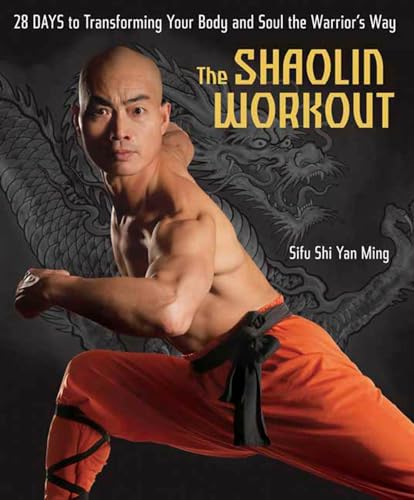
In his loft in New york City's Greenwich Village, Sifu Shi Yan Ming trains men and women of all ages, body types and backgrounds in the fundamentals of kung fu. A 34th generation Shaolin Warrior monk from China's Shaolin Temple—the birthplace of Chan Buddhism and the mecca of all martial arts—Yan Ming teaches the students at his USA Shaolin Temple that there is no better workout program than his brand of kung fu for getting the body and mind into warrior condition.
Lavishly illustrated with hundreds of four-color photographs, the warrior workout, distills a lifetime of Shaolin training and wisdom into a 28-day workout. The Shaolin Workout is a complete-unto-itself program of both fitness and spiritual lessons can be applied to every aspect of one's life: work, relationships, family.
Kung fu gives a superb aerobic workout at the same time that it dramatically increases flexibility, power, and speed. The ultimate promise of the book is this: stick to the plan for 28 days—for as little as 15 minutes a day—to be transformed inside and out. And the enormous sense of accomplishment that results will radiate through your life, allowing you to tackle the world with a warrior's confidence, calm, and poise.
Die Inhaltsangabe kann sich auf eine andere Ausgabe dieses Titels beziehen.
Über die Autorin bzw. den Autor
SIFU SHI YAN MING, a 34th-generation Shaolin Warrior monk, is respected not only in the martial arts world but also in the entertainment world by stars like Jet Li, Jackie Chan, Wesley Snipes, and the Wu-Tang clan. His kung fu classes have been featured in USA Today, the New York Times, New York Daily News, and Entertainment Weekly. Brian Gray of Inside Kung Fu magazine has called him a "living treasure of China." He lives in New York City.
Auszug. © Genehmigter Nachdruck. Alle Rechte vorbehalten.
1. Kung Fu, the Way of the Warrior
Before I was born who was I?
After I am born who am I?
Respect yourself, everybody will respect you.
Understand yourself, everybody will understand you.
There are mirrors all around you, strive to see and understand yourself.
Strive to have the heart of a Buddha.
Stop doing bad things, only do good.
Do whatever you can to help others.
In these ways you help yourself.
Help yourself, and you help the world.
Amituofo!
--Sifu Shi Yan Ming
In a typical loft space in Manhattan's hip Greenwich Village, a not-so- typical New Yorker is warming up. He is Sifu Shi Yan Ming, a 34th- generation warrior monk hailing from China's Shaolin Temple, birthplace of Chan Buddhism 1,500 years ago and mecca of all martial arts. Although he is not tall by American standards, his almost impossibly trim body gives an impression of awesome physical power even when he is simply tying the laces of his white training sneakers. With his shaved head and his sternly chiseled good looks, he is the very ideal of the legendary kung fu warrior.
As he begins to move, the impression is more than confirmed. When he stretches his spine, bending forward from the hips and lowering his torso until he can grip his ankles and touch the ground with the top of his head, he makes folding himself in half like a wallet look effortless. Then he executes a series of dazzling kicks, his feet flashing as though he's about to kick a hole in the antique tin ceiling 8 feet above his head. When he punches the air, his fists explode out and back with blinding speed and what one imagines would be devastating force. Then he leaps, and his entire body corkscrews in midair, as though he had ball bearings in place of a lower spine.
It's an amazing display of strength, precision, lightning speed, and incredible agility. He might even go on to break a stack of bricks with his head, slice a stack of boards with his hand, or lean into the points of three spears with his throat--his throat!--and bend the spears rather than be impaled.
Sifu is a world-renowned master of the martial arts. International action movie stars like Jackie Chan, Chow Yun-Fat, and Michelle Yeoh respectfully address him as "Sifu"--typically translated into English as "Master." So have the thousands of students who have come to this loft space, the U.S.A. Shaolin Temple, to train under him.
A young woman, one of his students, enters the space. Sifu pauses, his body impeccably poised in front of a snarling-dragon mural on the Chinese-red wall. There isn't a dot of perspiration on him. He's not even breathing heavily.
"Amituofo, Sifu!" she calls out.
"Amituofo!" he replies energetically.
Pronounced ah-mee-toh-foh, it is the name of one of the three Paradise Buddhas, Amituo ("fo" signifies Buddha in Chinese). Saying his name is an international greeting for Buddhists. It is said to show respect, and as a blessing and a prayer. Buddhists chant it as an aid to meditation and often use it as a replacement for common utterances like hello and good-bye, excuse me, and thank you, as a way to stay always mindful of their spiritual lives.
"Merry Christmas!" Sifu then adds--even though it's late spring.
The student smiles. "Happy New Year!" she replies.
It's something else Sifu and his students say often, all year round. Even the letter carrier responds with a laughing "Happy New Year!" when he drops off the day's mail. It's one of Sifu's ways of reminding everyone around him that life is a beautiful gift, and we should celebrate it not just on a few special holidays like Christmas and New Year's, but every day, every hour, every minute--"8 days a week," he likes to say, "and 366 days a year."
More students begin to gather in the space, piling out of the small elevator in the front, or bounding up the three flights of narrow stairs in the back. The temple lights up with smiles and laughter, with ringing cries of "Amituofo!" and "Happy New Year!" as they hurry into their training uniforms. Twenty, 30, 40 students appear for this particular class.
They are male and female, of all sizes, shapes, ages, and ethnicities. They come from all over New York City, from the Bronx to Brooklyn and Queens, or travel in from Long Island and New Jersey. Like Sifu, some of them have come to New York from other countries--Switzerland, India, Germany, Brazil, Korea, Italy, Canada, and Austria, among others. Sifu's students include college students and professors, blue-collar and office workers, movie stars and rap stars, business executives and retail salespeople, yoga instructors, a cop, a doorman, a young Italian apprentice chef, an orchestral composer. Children from as young as 3 to 14 also train at the temple, in their own afternoon classes.
For all their diverse backgrounds, Sifu's students act nothing like strangers who have dragged themselves to the typical gym for a routine class. Everyone greets everyone else by name or nickname, and Sifu knows them all. Everyone is happy and excited to be here. It feels like a large family gathering on a holiday, with Sifu as its patriarch. "He's like a father to us," you often hear students say, even though some of them are older than he is.
"I was amazed at the feeling I had just walking in the door," Sifu's student and disciple Shi Heng Xu recalls of her first time at the U.S.A. Shaolin Temple. "There was this feeling of bliss."
Incredibly, the buzz of high spirits is maintained through the next 2 hours of extremely strenuous training in kung fu, or Chan Quan. (Although "kung fu" is the universally recognized term in the West, Chan Quan--pronounced chan chwan--is the proper name for Chan Buddhism or martial arts. In this book we will use "kung fu" and "Chan Quan" interchangeably.) Some of the students in today's class have trained with Sifu for years; some just started today. Some can execute startling leaps and kicks with power and precision; others are just learning. But there is absolutely no sense of competition, showing off, or self-consciousness. In fact, it is just the opposite: Everyone cheers everyone else on, encouraging each student to strive for his or her personal best, which is all Sifu asks of any student.
"Sifu sees everybody's potential," says actor John Leguizamo, who has trained at the temple. "His method is so democratic and fair that way. You only compete with yourself, even though you may see people performing way better than you and way worse than you. It puts your life into perspective in a simple, martial arts kind of way, without words and fancy therapy sessions."
"We all sweat together," Heng Xu explains. "We all go through the pain together. It breaks down your barriers and helps you to be yourself, not just in here but out in the rest of your life."
David, a businessman, makes the 2-hour drive into Manhattan from Long Island three or four times a week to train. In his early forties, he had some 20 years' experience with other exercise and martial arts programs when he first came to the U.S.A. Shaolin Temple.
"I can tell you this is the best workout I've ever had," he says after 8 months of training at the temple. "Nobody ever made me work the way Sifu does." But he stresses that it is far more than just an exercise program. "This is a way to approach your whole life. Sifu has opened my head in all sorts of ways. I've noticed that people who've been coming to the temple for 2, 3 years, or more are all very successful in their lives. I don't just mean that they drive nice cars and have successful careers, although a lot of them do. I mean you can see it in their whole approach to their lives. They respect themselves. People who come to the temple just to get a workout tend not to stick with it. It's as much about the way of living as the physical...
„Über diesen Titel“ kann sich auf eine andere Ausgabe dieses Titels beziehen.
Suchergebnisse für The Shaolin Workout: 28 Days to Transforming Your Body...

Beispielbild für diese ISBN
The Shaolin Workout: 28 Days to Transforming Your Body and Soul the Warrior's Way
Anbieter: ThriftBooks-Dallas, Dallas, TX, USA
Verkäuferbewertung 5 von 5 Sternen

Hardcover. Zustand: Very Good. No Jacket. Missing dust jacket; May have limited writing in cover pages. Pages are unmarked. ~ ThriftBooks: Read More, Spend Less. Artikel-Nr. G1594864004I4N01
Gebraucht kaufen
EUR 34,82
Versand gratis
Versand innerhalb von USA
Versand innerhalb von USA
Anzahl: 1 verfügbar
Beispielbild für diese ISBN
The Shaolin Workout: 28 Days to Transforming Your Body and Soul the Warrior's Way
Anbieter: ThriftBooks-Dallas, Dallas, TX, USA
Verkäuferbewertung 5 von 5 Sternen
Hardcover. Zustand: Good. No Jacket. Pages can have notes/highlighting. Spine may show signs of wear. ~ ThriftBooks: Read More, Spend Less. Artikel-Nr. G1594864004I3N00
Gebraucht kaufen
EUR 34,82
Versand gratis
Versand innerhalb von USA
Versand innerhalb von USA
Anzahl: 1 verfügbar
Beispielbild für diese ISBN
The Shaolin Workout: 28 Days to Transforming Your Body and Soul the Warrior's Way
Anbieter: ThriftBooks-Atlanta, AUSTELL, GA, USA
Verkäuferbewertung 5 von 5 Sternen
Hardcover. Zustand: Good. No Jacket. Pages can have notes/highlighting. Spine may show signs of wear. ~ ThriftBooks: Read More, Spend Less. Artikel-Nr. G1594864004I3N00
Gebraucht kaufen
EUR 34,82
Versand gratis
Versand innerhalb von USA
Versand innerhalb von USA
Anzahl: 1 verfügbar
Beispielbild für diese ISBN
The Shaolin Workout: 28 Days to Transforming Your Body and Soul the Warrior's Way
Anbieter: ThriftBooks-Dallas, Dallas, TX, USA
Verkäuferbewertung 5 von 5 Sternen
Hardcover. Zustand: As New. No Jacket. Pages are clean and are not marred by notes or folds of any kind. ~ ThriftBooks: Read More, Spend Less. Artikel-Nr. G1594864004I2N00
Gebraucht kaufen
EUR 34,82
Versand gratis
Versand innerhalb von USA
Versand innerhalb von USA
Anzahl: 1 verfügbar
Beispielbild für diese ISBN
The Shaolin Workout
Anbieter: World of Books (was SecondSale), Montgomery, IL, USA
Verkäuferbewertung 5 von 5 Sternen
Zustand: Very Good. Item in very good condition! Textbooks may not include supplemental items i.e. CDs, access codes etc. Artikel-Nr. 00110535484
Gebraucht kaufen
EUR 39,10
Versand gratis
Versand innerhalb von USA
Versand innerhalb von USA
Anzahl: 1 verfügbar
Beispielbild für diese ISBN
The Shaolin Workout: 28 Days to Transforming Your Body and Soul the Warrior's Way
Anbieter: Revaluation Books, Exeter, Vereinigtes Königreich
Verkäuferbewertung 5 von 5 Sternen
Hardcover. Zustand: Brand New. 304 pages. 9.25x7.50x0.75 inches. In Stock. Artikel-Nr. 1594864004
Neu kaufen
EUR 108,28
EUR 14,58 Versand
Versand von Vereinigtes Königreich nach USA
Versand von Vereinigtes Königreich nach USA
Anzahl: 1 verfügbar