
Verwandte Artikel zu Change Up: An Oral History of 8 Key Events That Shaped...
Inhaltsangabe
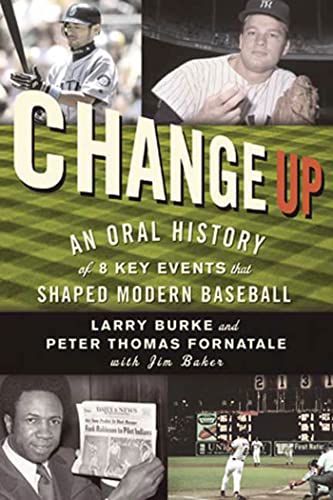
Draws on the experiences and testimonies of such contributors as Derek Jeter, Cal Ripkin, and David Maraniss to identify eight turning points in baseball, in an oral history that covers such events as the creation of the players union, the hiring of first black manager Frank Robinson, and the rise of Latino and Japanese players.
Die Inhaltsangabe kann sich auf eine andere Ausgabe dieses Titels beziehen.
Über die Autorin bzw. den Autor
Larry Burke is a senior editor at Sports Illustrated. He is the author of four books, including The Baseball Chronicles: A Decade-by-Decade History of the All-American Pastime. He lives in Connecticut.
Peter Thomas Fornatale is an author and writer whose work has appeared in many places, including ESPN.com and the New York Times. He lives in Brooklyn, New York.
Jim Baker is an author at Baseball Prospectus and a frequent contributor to ESPN.com, and has contributed to baseball books by Bill James and Rob Neyer. He lives in Austin, Texas.
Auszug. © Genehmigter Nachdruck. Alle Rechte vorbehalten.
THE 1962 METS
Featuring
ROGER CRAIG: Veteran starting pitcher who had spent a dozen years with the Dodgers organization.
JIM HICKMAN: Rookie center fielder from the Cardinals organization.
JAY HOOK: Starting pitcher from the Reds organization who got the victory in the Mets' first win ever.
ED KRANEPOOL: Local high school phenom signed by the Mets and brought to the majors at the end of the season at the age of 17.
ROBERT LIPSYTE: A young writer who did feature stories on the team for the New York Times.
KEN MACKENZIE: Reliever acquired in a trade with the Braves.
FRANK THOMAS: Veteran slugger obtained in a trade with the Braves but most often identified with the Pirates.
WHEN THE AMERICAN LEAGUE doubled the number of big-league clubs to 16 at the turn of the 20th century, the U.S. population was about 77 million. Within 50 years that number had in turn doubled to 155 million and had grown an additional 25 million by 1960. In spite of those massive gains in potential ticket buyers, baseball remained as it was, a 16-team operation at the big-league level. And the recently transplanted Los Angeles Dodgers and San Francisco Giants were the only major-league teams west of Missouri.
That number seemed almost sacrosanct and, as has so often been the case in baseball's attitude toward change, it was going to take external pressure for it to move forward. Because so much of the population was not being serviced by major-league baseball other than via television, the door was open to fill that need. The pressure on major-league baseball came in two forms. First, the Pacific Coast League made some noise about becoming a third major league, going so far as to change from a lettered classification to an open one in 1952, but a general decline in minor- league attendance and the westward franchise shifts of the Giants and Dodgers put an end to that talk. Secondly, the void created in New York by the Giants' and Dodgers' moves could not possibly go unfilled. It inspired William Shea, a New York attorney, to first make overtures about moving existing teams such as the Pirates and Reds to the city and then to create the Continental League, a third major league cut from whole cloth.
Whatever Shea's intentions--and some have suggested that the whole enterprise was a leverage move to get the National League back into New York after his attempts to land an existing team had failed--the Continental League did exist on paper for a full year. From July 1959 to August 1960, ownership groups were in place for seven cities. (All, save for one--Buffalo--would eventually get major-league franchises, some sooner rather than later.) This presence was enough for the major-league owners to finally increase their franchise number to better reflect the market realities around them. The Washington Senators would move to Minneapolis- St. Paul--a Continental League city--and be replaced by a new Senators franchise. The Minnesota Twins would be joined in the American League by a second Los Angeles franchise; both of those teams began play in 1961. (The Continental League had some prescient choices among its locales, but it did not extend itself to the West Coast.) The following year the National League would move into the Sun Belt by awarding a franchise in another CL city, Houston. The second National League expansion team would go to New York.
And therein begins this tale. While the other three new clubs managed to create rosters that would win at least 60 games in their first year of existence (the Angels were especially successful, getting outscored by only 40 runs in 1961 and finishing in third place in '62), the architects of the Mets managed to create a perfect storm of a ball club, one that lost a record 120 games. Although their counterparts did a much better job of hitting the ground running, it was those Mets, under their colorful manager Casey Stengel, who became legendary.
GETTING STARTED
The new teams' rosters were stocked by an expansion draft, the players for which were provided from the major- and minor-league rosters of the existing eight teams. In the first phase of the draft the Mets and Colt .45s would select from lists of 15 players submitted by each of the eight established NL teams. Eight of the 15 players had to have been on the 25- man major-league roster as of August 31, 1961, while another seven could come from elsewhere in the organization. The Mets and Houston Colt .45s were required to take two men from each team at a cost of $75,000 each. It was from this phase that the Mets landed their first player, catcher Hobie Landrith. (Baseball's most recent expansion teams, which joined the majors in 1998, began operating minor-league teams in the seasons leading up to their debut. Houston and New York had no such luxury.)
The second phase of the draft was dubbed the "premium" phase. Each team designated two more players from its major-league roster, and the Mets and Colt .45s could select no more than one from each club at $125,000 each. The first player the Mets got in this round was Cardinals pitcher Bob Miller. In all, the Mets spent $1.8 million on expansion draft day, a fairly sizable amount of money given the level of talent made available and the fact that this money wasn't included in the franchise fee. The Mets' premium picks were Miller, Reds pitcher Jay Hook, Cubs infielder Don Zimmer and Phillies corner infielder/outfielder Lee Walls. Two months after the draft New York shipped Walls to Los Angeles for Charlie Neal and a player to be named later, who turned out to be pitcher Willard Hunter.
Of the four premium choices, only Zimmer could have been considered a regular in 1961. Two of the players the Mets took in the initial draft were deemed expendable by their respective teams after they had been struck by routine maladies the year before. Cardinals catcher Chris Cannizzaro had lost playing time to appendicitis in 1961. Jay Hook had been hit by the mumps. Ironically, it was during a turn as a baseball goodwill ambassador that he caught the disease.
JAY HOOK: When [the Reds] wanted somebody to speak at schools or something where they didn't pay anybody to do it, they thought of me. So we were out in California and I had gone out to speak at the school--actually the guy had been the principal at the grade school I went to in Illinois but had moved to California. I must have contracted [the mumps] there but they really knocked me out for that 1961 season, which was a shame, because I ended up with mono; at the end of the season they insisted I go get a physical and my blood count was still high. So anyway, I had a terrible year in 1961 [1-3, 7.76 ERA in 622/3 innings] when we won the pennant. I really didn't get to pitch very much after I got sick. But I think they put me in the draft--they put me as one of the premium draft choices--because they probably didn't think anybody would pick me. My wife Joanne and I were driving home from the World Series in our little Austin-Healey--the kids had gone home early-- and we heard over the radio that we'd been sold to the Mets.
ROGER CRAIG: [The move to the Mets] had some possibilities because in 1960 I had had a collision with Vada Pinson and broken my clavicle and I came back and pitched after a doctor said I'd never pitch again. I came back eight weeks later and nearly had a complete-game victory against the Cardinals. I didn't really feel that bad because baseball is a business and sometimes you just have to move on.
JIM HICKMAN: Like anybody, I was glad to go to the big leagues; I was glad to get there.
ROGER CRAIG: I saw it as a chance to get a new start and pitch every fourth day. I was looking forward to playing for Casey Stengel--which, as it turned out, I really enjoyed for those two years. I knew we were going to lose a lot of ball games because we had a lot of...
„Über diesen Titel“ kann sich auf eine andere Ausgabe dieses Titels beziehen.
Suchergebnisse für Change Up: An Oral History of 8 Key Events That Shaped...

Beispielbild für diese ISBN
Change Up : An Oral History of 8 Key Events That Shaped Modern Baseball
Verlag:
Rodale Books, 2008
ISBN 10: 1594861897
ISBN 13: 9781594861895
Gebraucht
Hardcover
Erstausgabe
Anbieter: Better World Books, Mishawaka, IN, USA
Verkäuferbewertung 5 von 5 Sternen

Zustand: Good. First Edition. Former library copy. Pages intact with minimal writing/highlighting. The binding may be loose and creased. Dust jackets/supplements are not included. Includes library markings. Stock photo provided. Product includes identifying sticker. Better World Books: Buy Books. Do Good. Artikel-Nr. 1509694-6
Gebraucht kaufen
EUR 7,87
Versand gratis
Versand innerhalb von USA
Versand innerhalb von USA
Anzahl: 2 verfügbar
Beispielbild für diese ISBN
Change Up: An Oral History of 8 Key Events That Shaped Baseball
Anbieter: ThriftBooks-Atlanta, AUSTELL, GA, USA
Verkäuferbewertung 5 von 5 Sternen
Hardcover. Zustand: Very Good. No Jacket. May have limited writing in cover pages. Pages are unmarked. ~ ThriftBooks: Read More, Spend Less. Artikel-Nr. G1594861897I4N00
Gebraucht kaufen
EUR 8,04
Versand gratis
Versand innerhalb von USA
Versand innerhalb von USA
Anzahl: 1 verfügbar
Beispielbild für diese ISBN
Change Up: An Oral History of 8 Key Events That Shaped Baseball
Anbieter: Wonder Book, Frederick, MD, USA
Verkäuferbewertung 5 von 5 Sternen
Zustand: Very Good. Very Good condition. Very Good dust jacket. A copy that may have a few cosmetic defects. May also contain light spine creasing or a few markings such as an owner's name, short gifter's inscription or light stamp. Artikel-Nr. Q13R-00345
Gebraucht kaufen
EUR 137,97
Versand gratis
Versand innerhalb von USA
Versand innerhalb von USA
Anzahl: 1 verfügbar