
Verwandte Artikel zu Einstein Never Used Flashcards: How Our Children Really...
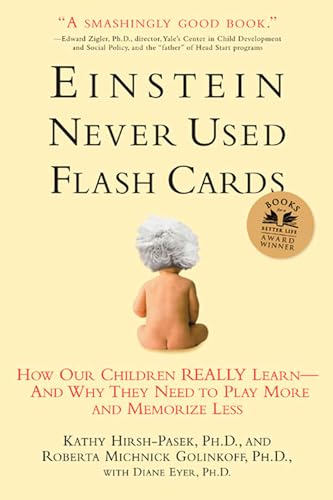
Einstein Never Used Flashcards: How Our Children Really Learn--and Why They Need To Play More And Memorize Less - Softcover
Inhaltsangabe
Now Available in Paperback!
In Einstein Never Used Flashcards highly credentialed child psychologists, Kathy Hirsh-Pasek, Ph.D., and Roberta Michnick Golinkoff, Ph.D., with Diane Eyer, Ph.D., offer a compelling indictment of the growing trend toward accelerated learning. It's a message that stressed-out parents are craving to hear: Letting tots learn through play is not only okay-it's better than drilling academics!
Drawing on overwhelming scientific evidence from their own studies and the collective research results of child development experts, and addressing the key areas of development-math, reading, verbal communication, science, self-awareness, and social skills-the authors explain the process of learning from a child's point of view. They then offer parents 40 age-appropriate games for creative play. These simple, fun--yet powerful exercises work as well or better than expensive high-tech gadgets to teach a child what his ever-active, playful mind is craving to learn.
Die Inhaltsangabe kann sich auf eine andere Ausgabe dieses Titels beziehen.
Über die Autorin bzw. den Autor
Kathy Hirsh Pasek, Ph.D., is a professor in the psychology department at Temple University, where she directs the Infant Language Laboratory and participated in one of the nation's largest studies of the effects of childcare. She also composes and performs children's music. She currently lives in Ardmore, PA.
Roberta Michnick Golinkoff, Ph.D., directs the Infant Language Project at the University of Delaware, where she holds a joint appointment with the departments of linguistics and psychology. Together, she and Dr. Hirsch-Pasek were featured on the PBS Human Language series and are the authors of How Babies Talk. She currently resides in Wilmington, Delaware
Diane Eyer, Ph.D., is a member of the psychology department at Temple University and is the author of Motherguilt and Mother-Infant Bonding. She resides in Bucks County, PA.
Auszug. © Genehmigter Nachdruck. Alle Rechte vorbehalten.
CHAPTER + 1
THE PLIGHT OF THE MODERN PARENT
ONE SATURDAY MORNING, 6 months into her first pregnancy, Felicia Montana headed to the mall with her friends to shop for the basic gear she'd soon be needing for her baby. What she got instead was a crash course that could be called "The Science of Modern Parenting 101."
Her education began in a store with a rainbow-colored sign, which had seemed like the right place to start shopping. In fact, that was the store's name: The Right Start. "That's exactly what we want for our baby," Felicia thought as she and her friends headed in. But by the time they left, she didn't know what she wanted anymore.
Felicia quickly noticed that the list of "must-have" baby-care equipment these days runs into far more exotic territory than the old standards of diaper bags, strollers, and car seats. Should she buy flash cards with images on the front and words on the back that offered "the best way to communicate new knowledge to your baby"? If so, which flash cards were more effective--the "Baby Dolittle" animal-identification cards or the "Baby Webster" vocabulary cards? Her friends, experienced mothers, all felt strongly about their babies' favorites.
"Jeremy knew all his animals by the time he was 18 months," Anna bragged.
"Alice liked 'Webster' better--she was using some big vocabulary words when she was 17 months," Erica boasted.
Once Felicia made that decision, should she buy the Baby Einstein, the Baby Shakespeare, or the Baby Van Gogh videotape, which offered "a unique introduction to the culture of language, music, literature, and art"? Or would her baby need all three? And what about the Brainy Baby video, designed to develop both the left and right sides of her baby's brain "between 6 months and 36 months"?
All of these products seemed to carry lofty promises to improve her baby's development if she bought them--but she also felt an unspoken hint of dire consequences if she didn't. After all, Babybrain gives babies the "intellectual edge needed to excel academically and professionally." Isn't parenting all about giving your children every possible advantage?
By the time she emerged back into the mall, her nerves were jangled and her confidence shaken--and she would feel even more unsettled once she got to the bookstore.
Felicia's husband, Steve, had asked her to pick up a few books on parenting. He wanted to be well-read on the subject so he could be an equal partner in raising their child.
Once in the bookstore, she went to the parenting section and picked up the first book her hand fell upon. Prenatal Parenting promised to provide guidance for "fetal parenting," including a chapter on "becoming a brain architect." Felicia slid the book back into its slot on the densely packed bookshelf and put her hand to her forehead, pondering her own aching brain.
Fetal parenting? Brain architecture? This is what new parents are supposed to worry about now? Felicia found herself becoming increasingly anxious about her baby's intellectual development--before her child was even born!
DOING THE CHILDHOOD HUSTLE
As Felicia now knows, the race to turn children into the most talented kids in their classroom begins even earlier than the crib--it now begins in the womb. Magazine articles coax expectant parents to exercise during pregnancy with the promise that it will enhance their babies' intelligence. Ads on the next page urge them to buy foreign-language CDs to play to the unborn children. Many parents wouldn't flinch at learning that fiber-optic tubes could be used to televise educational courses to "pre-infants" still floating in the womb! Fortunately, we're not at that point--not yet, anyway.
Once these babies are born, the push to move them as quickly as possible toward adult competencies intensifies. They're prodded to pick up reading skills faster, add and subtract sooner, and even master obscure tasks like identifying the faces of long-dead musical composers years before they'll need this information (if they ever will).
The baby-educating industry has found a receptive audience of parents eager to enrich their offspring. One survey shows that 65 percent of parents believe that flash cards are "very effective" in helping 2-year-olds develop their intellectual capacity. And more than a third of the parents surveyed believe that playing Mozart to their infants enhances brain development.
Obviously, parents have been listening to the toy companies' marketing pitches: The baby-educating toy category is now a $1-billion-a-year business. Business is so good, in fact, that companies such as Baby Einstein, which was purchased by Disney in 2001, are extending their product lines, including a "Little Einstein" line aimed at 3- to 5-year- olds.
The pitch has even penetrated into some unlikely audiences. "My grandmother- -in an old-age home, mind you--sent me a mobile that plays Mozart and Bach," reports Diane, a San Francisco mother of a 2-year-old and a newborn. "My grandmother said she wanted my baby to be at the top of his class!"
Once these infants get older, many graduate to more extensive--and expensive--learning opportunities, including violin lessons, riding lessons, private grade school, and private tutors.
THE ROADRUNNER SOCIETY: FASTER, BETTER, MORE
In today's world, the prevailing message is that it's no longer sufficient for infants and toddlers to learn independently as they have for millennia, via their own curiosity and a little help from family members when teaching opportunities arise.
However, these little ones are merely the youngest residents of our modern, sped-up, competitive society. Adults are urged to work longer and more productively than their employers' rivals. We eat prepackaged meals nuked in the microwave and schedule our leisure time into blink-and-you-miss-it vacations. Adults hear the message that getting more done faster is better and pass the pace right on down to their kids.
Consider a day in the life of a typical American family--let's call them the Smiths. Marie Smith, a schoolteacher, wakes up at 6 A.M. every day. In the next hour, she'll dress the kids--Gerry, 11, and Jessica, 3--fix breakfast, do housework, and catch a few minutes of TV news before driving Jessica to day care. Her husband, Brian, leaves for McDonnell Douglas at 6:20 A.M., dropping off Gerry at basketball practice on his way to work. Marie picks up Gerry at 7:35 A.M. and they walk to her school, where she teaches kindergarten and he is in the fifth grade.
After work, Marie picks up Gerry at 5 P.M. from his after-school program and Jessica at day care. She buys groceries and often searches for supplies, such as poster board or colored marshmallows, that Gerry needs for homework projects. At 6 P.M., she interrupts her dinner preparation to drive Gerry to soccer, his church youth group, or his guitar lesson. Finally, the pressure ends around 7:30 P.M. when Brian arrives home with Gerry, after a commute of at least an hour, so that they can have dinner together.
Unfortunately, this type of rushed schedule seems to be the norm rather than the exception. One monumental change in family life in recent generations has been the rise in the dual-career family. In 1975, 34 percent of mothers with children under 6 were in the workforce. By 1999, that number had nearly doubled, with 61 percent of mothers in the workforce.A large portion of those working moms were mothers of infants. And of course, we know that most dads have been working outside the home for more than a century. But society is now demanding that both parents not just work, but put in longer hours.
In fact, Americans are now working harder than almost anyone else in the world, including the Japanese. According to a 1997 study by the International Labor Organization, fathers were working an...
„Über diesen Titel“ kann sich auf eine andere Ausgabe dieses Titels beziehen.
Suchergebnisse für Einstein Never Used Flashcards: How Our Children Really...

Beispielbild für diese ISBN
Einstein Never Used Flash Cards: How Our Children Really Learn--and Why They Need to Play More and Memorize Less
Anbieter: World of Books (was SecondSale), Montgomery, IL, USA
Verkäuferbewertung 5 von 5 Sternen

Paperback. Zustand: Fair. Now Available in Paperback! In Einstein Never Used Flashcards highly credentialed child psychologists, Kathy Hirsh-Pasek, Ph.D., and Roberta Michnick Golinkoff, Ph.D., with Diane Eyer, Ph.D., offer a compelling indictment of the growing trend toward accelerated learning. It's a message that stressed-out parents are craving to hear- Letting tots learn through play is not only okay-it's better than drilling academics! Drawing on overwhelming scientific evidence from their own studies and the collective research results of child development experts, and addressing the key areas of development-math, reading, verbal communication, science, self-awareness, and social skills-the authors explain the process of learning from a child's point of view. They then offer parents 40 age-appropriate games for creative play. These simple, fun--yet powerful exercises work as well or better than expensive high-tech gadgets to teach a child what his ever-active, playful mind is craving to learn. Artikel-Nr. CIN1594860688A
Gebraucht kaufen
EUR 4,04
Versand gratis
Versand innerhalb von USA
Versand innerhalb von USA
Anzahl: 1 verfügbar
Beispielbild für diese ISBN
Einstein Never Used Flash Cards: How Our Children Really Learn--and Why They Need to Play More and Memorize Less
Anbieter: World of Books (was SecondSale), Montgomery, IL, USA
Verkäuferbewertung 5 von 5 Sternen
Paperback. Zustand: Good. Now Available in Paperback! In Einstein Never Used Flashcards highly credentialed child psychologists, Kathy Hirsh-Pasek, Ph.D., and Roberta Michnick Golinkoff, Ph.D., with Diane Eyer, Ph.D., offer a compelling indictment of the growing trend toward accelerated learning. It's a message that stressed-out parents are craving to hear- Letting tots learn through play is not only okay-it's better than drilling academics! Drawing on overwhelming scientific evidence from their own studies and the collective research results of child development experts, and addressing the key areas of development-math, reading, verbal communication, science, self-awareness, and social skills-the authors explain the process of learning from a child's point of view. They then offer parents 40 age-appropriate games for creative play. These simple, fun--yet powerful exercises work as well or better than expensive high-tech gadgets to teach a child what his ever-active, playful mind is craving to learn. Artikel-Nr. 00099921915
Gebraucht kaufen
EUR 4,04
Versand gratis
Versand innerhalb von USA
Versand innerhalb von USA
Anzahl: Mehr als 20 verfügbar
Beispielbild für diese ISBN
Einstein Never Used Flashcards: How Our Children Really Learn--And Why They Need to Play More and Memorize Less
Anbieter: ThriftBooks-Reno, Reno, NV, USA
Verkäuferbewertung 5 von 5 Sternen
Paperback. Zustand: Good. No Jacket. Pages can have notes/highlighting. Spine may show signs of wear. ~ ThriftBooks: Read More, Spend Less. Artikel-Nr. G1594860688I3N00
Gebraucht kaufen
EUR 5,95
Versand gratis
Versand innerhalb von USA
Versand innerhalb von USA
Anzahl: 7 verfügbar
Beispielbild für diese ISBN
Einstein Never Used Flashcards: How Our Children Really Learn--And Why They Need to Play More and Memorize Less
Anbieter: ThriftBooks-Dallas, Dallas, TX, USA
Verkäuferbewertung 5 von 5 Sternen
Paperback. Zustand: As New. No Jacket. Pages are clean and are not marred by notes or folds of any kind. ~ ThriftBooks: Read More, Spend Less. Artikel-Nr. G1594860688I2N00
Gebraucht kaufen
EUR 5,95
Versand gratis
Versand innerhalb von USA
Versand innerhalb von USA
Anzahl: 1 verfügbar
Beispielbild für diese ISBN
Einstein Never Used Flashcards: How Our Children Really Learn--And Why They Need to Play More and Memorize Less
Anbieter: ThriftBooks-Dallas, Dallas, TX, USA
Verkäuferbewertung 5 von 5 Sternen
Paperback. Zustand: Very Good. No Jacket. May have limited writing in cover pages. Pages are unmarked. ~ ThriftBooks: Read More, Spend Less. Artikel-Nr. G1594860688I4N00
Gebraucht kaufen
EUR 5,95
Versand gratis
Versand innerhalb von USA
Versand innerhalb von USA
Anzahl: 3 verfügbar
Beispielbild für diese ISBN
Einstein Never Used Flashcards: How Our Children Really Learn--And Why They Need to Play More and Memorize Less
Anbieter: ThriftBooks-Phoenix, Phoenix, AZ, USA
Verkäuferbewertung 5 von 5 Sternen
Paperback. Zustand: Good. No Jacket. Pages can have notes/highlighting. Spine may show signs of wear. ~ ThriftBooks: Read More, Spend Less. Artikel-Nr. G1594860688I3N00
Gebraucht kaufen
EUR 5,95
Versand gratis
Versand innerhalb von USA
Versand innerhalb von USA
Anzahl: 6 verfügbar
Beispielbild für diese ISBN
Einstein Never Used Flashcards: How Our Children Really Learn--And Why They Need to Play More and Memorize Less
Anbieter: ThriftBooks-Atlanta, AUSTELL, GA, USA
Verkäuferbewertung 5 von 5 Sternen
Paperback. Zustand: Fair. No Jacket. Readable copy. Pages may have considerable notes/highlighting. ~ ThriftBooks: Read More, Spend Less. Artikel-Nr. G1594860688I5N00
Gebraucht kaufen
EUR 5,95
Versand gratis
Versand innerhalb von USA
Versand innerhalb von USA
Anzahl: 1 verfügbar
Beispielbild für diese ISBN
Einstein Never Used Flashcards: How Our Children Really Learn--And Why They Need to Play More and Memorize Less
Anbieter: ThriftBooks-Atlanta, AUSTELL, GA, USA
Verkäuferbewertung 5 von 5 Sternen
Paperback. Zustand: Good. No Jacket. Pages can have notes/highlighting. Spine may show signs of wear. ~ ThriftBooks: Read More, Spend Less. Artikel-Nr. G1594860688I3N00
Gebraucht kaufen
EUR 5,95
Versand gratis
Versand innerhalb von USA
Versand innerhalb von USA
Anzahl: 7 verfügbar
Beispielbild für diese ISBN
Einstein Never Used Flashcards: How Our Children Really Learn--And Why They Need to Play More and Memorize Less
Anbieter: ThriftBooks-Phoenix, Phoenix, AZ, USA
Verkäuferbewertung 5 von 5 Sternen
Paperback. Zustand: Very Good. No Jacket. May have limited writing in cover pages. Pages are unmarked. ~ ThriftBooks: Read More, Spend Less. Artikel-Nr. G1594860688I4N00
Gebraucht kaufen
EUR 5,95
Versand gratis
Versand innerhalb von USA
Versand innerhalb von USA
Anzahl: 2 verfügbar
Beispielbild für diese ISBN
Einstein Never Used Flashcards: How Our Children Really Learn--And Why They Need to Play More and Memorize Less
Anbieter: ThriftBooks-Reno, Reno, NV, USA
Verkäuferbewertung 5 von 5 Sternen
Paperback. Zustand: Very Good. No Jacket. May have limited writing in cover pages. Pages are unmarked. ~ ThriftBooks: Read More, Spend Less. Artikel-Nr. G1594860688I4N00
Gebraucht kaufen
EUR 5,95
Versand gratis
Versand innerhalb von USA
Versand innerhalb von USA
Anzahl: 2 verfügbar