
Verwandte Artikel zu A Fearless Heart: How the Courage to Be Compassionate...
Inhaltsangabe
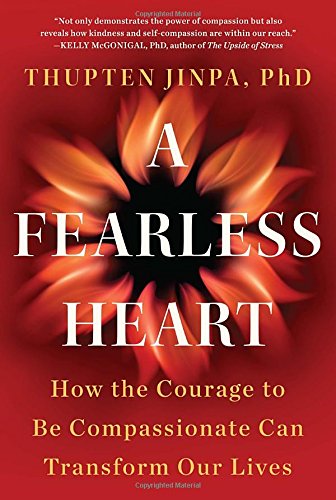
The Buddhist practice of mindfulness caught on in the west when we began to understand the everyday, personal benefits it brought us. Now, in this extraordinary book, the highly acclaimed thought leader and longtime English translator of His Holiness the Dalai Lama shows us that compassion can bring us even more.
Based on the landmark course in compassion training Jinpa helped create at Stanford Medical School, A Fearless Heart shows us that we actually fear compassion. We worry that if we are too compassionate with others we will be taken advantage of, and if we are too compassionate with ourselves we will turn into slackers. Using science, insights from both classical Buddhist and western psychology, and stories both from others and from his own extraordinary life, Jinpa shows us how to train our compassion muscle to relieve stress, fight depression, improve our health, achieve our goals, and change our world.
Practical, spiritual, and immediately relevant, A Fearless Heart will speak to readers of The Art of Happiness and Wherever You Go, There You Are.
Die Inhaltsangabe kann sich auf eine andere Ausgabe dieses Titels beziehen.
Über die Autorinnen und Autoren
A former monk, THUPTEN JINPA holds a PhD from Cambridge University and has been the principal English translator to the Dalai Lama for nearly thirty years. He is an adjunct professor at the Faculty of Religious Studies at McGill University and chairman of the Mind and Life Institute, which is dedicated to promoting dialogues and collaborations between the sciences and contemplative knowledge, especially Buddhism. He lives in Montreal with his wife and daughters.
A former monk, THUPTEN JINPA holds a PhD from Cambridge University and has been the principal English translator to the Dalai Lama for nearly thirty years. He is an adjunct professor at the Faculty of Religious Studies at McGill University and chairman of the Mind and Life Institute, which is dedicated to promoting dialogues and collaborations between the sciences and contemplative knowledge, especially Buddhism. He lives in Montreal with his wife and daughters.
Auszug. © Genehmigter Nachdruck. Alle Rechte vorbehalten.
CONTENTS
INTRODUCTION
I remember walking excitedly next to His Holiness the Dalai Lama, holding his hand and trying to keep up with his pace. I must have been about six when the Dalai Lama visited the Stirling Castle Home for Tibetan Children in Shimla, northern India. I was one of more than two hundred children of Tibetan refugees resident there. The home was set up by the British charity Save the Children in 1962 in two former British colonial homes located on a small hill. We children had been busy preparing for the visit, rehearsing welcoming Tibetan songs while the grown-ups swept the road and decorated it with Tibetan symbols in white lime powder—lotus, infinite knot, vase, two goldfish (facing each other), eight-spoke wheel of dharma, victory banner, parasol, and conch. The day the Dalai Lama came, there were many Indian policemen around the school; I remember playing marbles with a few of them that morning while we waited. When the moment finally arrived it was magical. Thick smoke billowed from a whitewashed incense stove built especially for the occasion. Dressed in our colorful best and holding kata, the traditional Tibetan white scarves of greeting, in our hands, we stood on both sides of the driveway leading up to the school and sang at the top of our lungs.
I had been chosen as one of the students to walk alongside the Dalai Lama as he toured the school. While we walked, I asked him if I could become a monk, to which he replied, “Study well and you can become a monk anytime you wish.” Looking back, I think the only reason I was so precociously attracted to being a monk was because there were two monk teachers at the children’s home. They were the kindest of the adults there and also seemed the most learned. They always looked happy and at peace, even radiant at times. Most important for us children, they told the most interesting stories.
So when the first opportunity came, at the age of eleven—and as it happened, on the first day of Tibetan New Year (toward the end of February, that year)—I became a monk and joined a monastery, despite my father’s protestations. He was upset that I was squandering the opportunity to become the family breadwinner—parents of his generation wished for their children to get an education and work in an office. For nearly a decade afterward, I lived, worked, meditated, chanted, and belonged in the small community of Dzongkar Choede monastery. It was there in the quiet evergreen hills of Dharamsala, northern India, that I practiced my rudimentary English with enlightenment-seeking hippies.
I developed friendships with John and Lars. John was not a hippie. He was an American recluse who lived alone in a nice bungalow he’d rented close to the meditation hut of a revered Tibetan master. I met with John once or twice a week. We would speak and I would read from a Tibetan text, which itself is a translation of an eighth-century Indian Buddhist classic. It was John who introduced me to pancakes and ham.
Lars was a Danish man who lived quite close to the monastery. Often I would visit him to chat and have toast with jam.
In the spring of 1972, the monastery moved to the scorching heat of southern India, where a Tibetan resettlement program had begun. There, like the other monks of my monastery, at the age of thirteen, I joined the resettlement workforce clearing forests, digging ditches, and working in the cornfields. For the first two years, while the settlement was being prepared, we were paid a daily wage of 0.75 Indian rupees, or roughly 1.5 cents.
There was very little formal education at Dzongkar Choede. It’s not the custom for young monks to go to regular secular schools either. By the time our community moved to South India, I had finished memorizing all the liturgical texts that were required. The day’s labor at the settlement finished by four in the afternoon, so I had some free time on my hands and I decided to pick up my English again. However, with no opportunities to practice conversation, I made do with reading comic books. One day, I obtained a cheap used transistor radio, and after that I listened to the BBC World Service and U.S.-based Voice of America every day. In those days, VOA had a unique program “broadcasting in special English,” in which the presenter spoke slowly and repeated every sentence twice. This was immensely helpful, as I had only a very basic grasp of the language at the time.
Since I was the only young boy at the monastery who could speak and read English, rudimentarily though it was at first, it was a source of pride and also a way of individuating myself from the others. Here was a world—figuratively and literally the whole world beyond the refugee community, beyond the monastery—that I alone from my monastic community could enter. Through English I learned to read the globe, which made all the great countries I was hearing about in the news come to life—England, America, Russia, and of course, our beloved Tibet, which had tragically fallen to Communist China.
Around 1976, when I was seventeen or eighteen, I met a remarkable woman who changed my karma with English. Dr. Valentina Stache-Rosen was a German Indologist with expertise in Sanskrit and Chinese texts, living in Bangalore (where her husband headed the Max Muller Institute). Dr. Stache-Rosen took a keen interest in the progress of my English. She introduced me to Western literature and sent me books—Hermann Hesse and Agatha Christie, Edgar Snow’s Red Star over China, and, most helpfully, a large English dictionary with many examples of words used in sentences. And I first learned to use a knife and fork at Dr. Stache-Rosen’s home. We corresponded until her death in 1980. Without her kindness, I can’t imagine how my English would have escaped from where it remained back then, or for that matter, where my life would have taken me.
I also read Trevor Ling’s book The Buddha, a portrayal, written in English, of the life and teachings of the Buddha as a revolutionary, philosopher, and spiritual teacher. In this book in particular, the evocative power of the English language deeply impressed me. There was a liveliness and immediacy that I had never felt with written Tibetan; it was like someone speaking. (The gap between written and spoken language in Tibetan is huge.)
Around the same time, I met the Tibetan teacher who later became one of the most important influences on my classical Buddhist education. Famed for his erudition and poetry, Zemey Rinpoche was the gentlest person I have ever known. He was living a semiretired life then, dedicated to quiet meditative reflection, in another Tibetan settlement about an hour’s bus ride from my monastery. I was already familiar with Rinpoche’s name from the many Tibetan language school textbooks he had edited. Meeting him in person and speaking with him rekindled the enthusiasm for learning that had originally inspired me to become a monk. From our first meeting, Rinpoche recognized my restless intellect and took me under his wing. So, in the summer of 1978, I left my small monastery to join Ganden, a large academic monastery in another part of southern India, about a ten- to twelve-hour bus ride away.
In 1985, while on a visit to Dharamsala, North India, twenty years after I’d hurried to keep up with His Holiness as a small boy, I had the wonderful, if accidental, honor of being asked to interpret at a teaching given by the Dalai Lama when the scheduled English interpreter couldn’t make it on the first day. A few days into the teaching, the Dalai Lama’s office informed me that His Holiness wished to see me. At the appointed time, the secretary ushered me into the audience room that is part of the Dalai Lama’s office...
„Über diesen Titel“ kann sich auf eine andere Ausgabe dieses Titels beziehen.
Suchergebnisse für A Fearless Heart: How the Courage to Be Compassionate...

Beispielbild für diese ISBN
A Fearless Heart: How the Courage to Be Compassionate Can Transform Our Lives
Anbieter: World of Books (was SecondSale), Montgomery, IL, USA
Verkäuferbewertung 5 von 5 Sternen

Hardback. Zustand: Good. The Buddhist practice of mindfulness caught on in the west when we began to understand the everyday, personal benefits it brought us. Now, in this extraordinary book, the highly acclaimed thought leader and longtime English translator of His Holiness the Dalai Lama shows us that compassion can bring us even more. Based on the landmark course in compassion training Jinpa helped create at Stanford Medical School, A Fearless Heart shows us that we actually fear compassion. We worry that if we are too compassionate with others we will be taken advantage of, and if we are too compassionate with ourselves we will turn into slackers. Using science, insights from both classical Buddhist and western psychology, and stories both from others and from his own extraordinary life, Jinpa shows us how to train our compassion muscle to relieve stress, fight depression, improve our health, achieve our goals, and change our world. Practical, spiritual, and immediately relevant, A Fearless Heart will speak to listeners of The Art of Happiness and Wherever You Go, There You Are. Artikel-Nr. 00101080478
Gebraucht kaufen
EUR 6,06
Versand gratis
Versand innerhalb von USA
Versand innerhalb von USA
Anzahl: 3 verfügbar
Beispielbild für diese ISBN
A Fearless Heart: How the Courage to Be Compassionate Can Transform Our Lives
Anbieter: Wonder Book, Frederick, MD, USA
Verkäuferbewertung 5 von 5 Sternen
Zustand: Very Good. Very Good condition. Good dust jacket. A copy that may have a few cosmetic defects. May also contain light spine creasing or a few markings such as an owner's name, short gifter's inscription or light stamp. Artikel-Nr. J10P-00255
Gebraucht kaufen
EUR 6,47
Versand gratis
Versand innerhalb von USA
Versand innerhalb von USA
Anzahl: 1 verfügbar
Beispielbild für diese ISBN
A Fearless Heart: How the Courage to Be Compassionate Can Transform Our Lives
Anbieter: ThriftBooks-Atlanta, AUSTELL, GA, USA
Verkäuferbewertung 5 von 5 Sternen
Hardcover. Zustand: Good. No Jacket. Former library book; Pages can have notes/highlighting. Spine may show signs of wear. ~ ThriftBooks: Read More, Spend Less. Artikel-Nr. G1594632626I3N10
Gebraucht kaufen
EUR 6,48
Versand gratis
Versand innerhalb von USA
Versand innerhalb von USA
Anzahl: 1 verfügbar
Beispielbild für diese ISBN
A Fearless Heart: How the Courage to Be Compassionate Can Transform Our Lives
Anbieter: ThriftBooks-Atlanta, AUSTELL, GA, USA
Verkäuferbewertung 5 von 5 Sternen
Hardcover. Zustand: Fair. No Jacket. Readable copy. Pages may have considerable notes/highlighting. ~ ThriftBooks: Read More, Spend Less. Artikel-Nr. G1594632626I5N00
Gebraucht kaufen
EUR 6,48
Versand gratis
Versand innerhalb von USA
Versand innerhalb von USA
Anzahl: 1 verfügbar
Beispielbild für diese ISBN
A Fearless Heart: How the Courage to Be Compassionate Can Transform Our Lives
Anbieter: ThriftBooks-Dallas, Dallas, TX, USA
Verkäuferbewertung 5 von 5 Sternen
Hardcover. Zustand: Very Good. No Jacket. May have limited writing in cover pages. Pages are unmarked. ~ ThriftBooks: Read More, Spend Less. Artikel-Nr. G1594632626I4N00
Gebraucht kaufen
EUR 6,48
Versand gratis
Versand innerhalb von USA
Versand innerhalb von USA
Anzahl: 1 verfügbar
Beispielbild für diese ISBN
A Fearless Heart: How the Courage to Be Compassionate Can Transform Our Lives
Anbieter: ThriftBooks-Dallas, Dallas, TX, USA
Verkäuferbewertung 5 von 5 Sternen
Hardcover. Zustand: Good. No Jacket. Former library book; Pages can have notes/highlighting. Spine may show signs of wear. ~ ThriftBooks: Read More, Spend Less. Artikel-Nr. G1594632626I3N10
Gebraucht kaufen
EUR 6,48
Versand gratis
Versand innerhalb von USA
Versand innerhalb von USA
Anzahl: 1 verfügbar
Beispielbild für diese ISBN
A Fearless Heart : How the Courage to Be Compassionate Can Transform Our Lives
Verlag:
Penguin Publishing Group, 2015
ISBN 10: 1594632626
ISBN 13: 9781594632624
Gebraucht
Hardcover
Anbieter: Better World Books, Mishawaka, IN, USA
Verkäuferbewertung 5 von 5 Sternen
Zustand: Very Good. Former library copy. Pages intact with possible writing/highlighting. Binding strong with minor wear. Dust jackets/supplements may not be included. Includes library markings. Stock photo provided. Product includes identifying sticker. Better World Books: Buy Books. Do Good. Artikel-Nr. 11141318-6
Gebraucht kaufen
EUR 6,79
Versand gratis
Versand innerhalb von USA
Versand innerhalb von USA
Anzahl: 2 verfügbar
Beispielbild für diese ISBN
A Fearless Heart : How the Courage to Be Compassionate Can Transform Our Lives
Verlag:
Penguin Publishing Group, 2015
ISBN 10: 1594632626
ISBN 13: 9781594632624
Gebraucht
Hardcover
Anbieter: Better World Books, Mishawaka, IN, USA
Verkäuferbewertung 5 von 5 Sternen
Zustand: Good. Former library copy. Pages intact with minimal writing/highlighting. The binding may be loose and creased. Dust jackets/supplements are not included. Includes library markings. Stock photo provided. Product includes identifying sticker. Better World Books: Buy Books. Do Good. Artikel-Nr. 5214066-6
Gebraucht kaufen
EUR 6,79
Versand gratis
Versand innerhalb von USA
Versand innerhalb von USA
Anzahl: 1 verfügbar
Beispielbild für diese ISBN
A Fearless Heart : How the Courage to Be Compassionate Can Transform Our Lives
Verlag:
Penguin Publishing Group, 2015
ISBN 10: 1594632626
ISBN 13: 9781594632624
Gebraucht
Hardcover
Anbieter: Better World Books: West, Reno, NV, USA
Verkäuferbewertung 5 von 5 Sternen
Zustand: Very Good. Former library copy. Pages intact with possible writing/highlighting. Binding strong with minor wear. Dust jackets/supplements may not be included. Includes library markings. Stock photo provided. Product includes identifying sticker. Better World Books: Buy Books. Do Good. Artikel-Nr. 11141318-6
Gebraucht kaufen
EUR 6,79
Versand gratis
Versand innerhalb von USA
Versand innerhalb von USA
Anzahl: 1 verfügbar
Beispielbild für diese ISBN
A Fearless Heart : How the Courage to Be Compassionate Can Transform Our Lives
Verlag:
Penguin Publishing Group, 2015
ISBN 10: 1594632626
ISBN 13: 9781594632624
Gebraucht
Hardcover
Anbieter: Better World Books: West, Reno, NV, USA
Verkäuferbewertung 5 von 5 Sternen
Zustand: Very Good. Pages intact with possible writing/highlighting. Binding strong with minor wear. Dust jackets/supplements may not be included. Stock photo provided. Product includes identifying sticker. Better World Books: Buy Books. Do Good. Artikel-Nr. 12940725-6
Gebraucht kaufen
EUR 6,79
Versand gratis
Versand innerhalb von USA
Versand innerhalb von USA
Anzahl: 1 verfügbar