
Verwandte Artikel zu Future Perfect: The Case For Progress In A Networked...
Inhaltsangabe
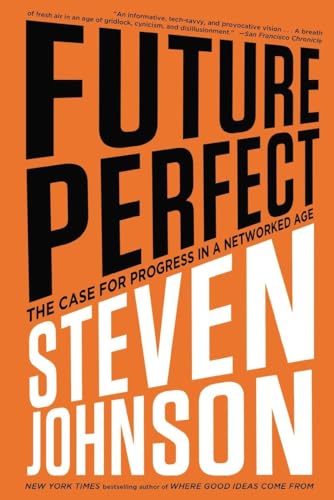
From the New York Times bestselling author of How We Got To Now and Farsighted
Combining the deft social analysis of Where Good Ideas Come From with the optimistic arguments of Everything Bad Is Good for You, bestselling author and one of the most inspiring visionaries of contemporary culture, Steven Johnson, maps the ways a connected world will be both different and better.
Steven Johnson proposes that a new model of political change is on the rise transforming everything from local government to classrooms to health care. It’s a compelling new political worldview that breaks with traditional categories of liberal or conservative thinking. Johnson explores this innovative vision through a series of fascinating narratives: from the “Miracle on the Hudson” to the planning of the French railway system; from the battle against malnutrition in Vietnam to a mysterious outbreak of strange smells in downtown Manhattan; from underground music video artists to the invention of the Internet itself. At a time when the conventional wisdom holds that the political system is hopelessly gridlocked with old ideas, Future Perfect makes the timely and uplifting case that progress is still possible.
Die Inhaltsangabe kann sich auf eine andere Ausgabe dieses Titels beziehen.
Über die Autorin bzw. den Autor
Steven Johnson is the bestselling author of eleven books, including Where Good Ideas Come From, Wonderland, and The Ghost Map. He's the host and co-creator of the Emmy-winning PBS/BBC series How We Got To Now, and the host of the podcast American Innovations. He lives in Brooklyn and Marin County, California with his wife and three sons.
Auszug. © Genehmigter Nachdruck. Alle Rechte vorbehalten.
Commercial airplane crashes are one of the few events guaranteed a place on the front page of every national newspaper. Somewhat less common on the front page, however, is a story about a commercial airplane crash that didn’t happen. But every now and then one of these non-events manages to cross the threshold into newsworthiness. One such unlikely story appeared on page one of the January 12, 2009, edition of USA Today: “Airlines Go Two Years with No Fatalities,” the headline proclaimed. An analysis by the paper had discovered that the U.S. commercial aviation industry had achieved a milestone unprecedented in the history of modern air travel: despite the dramatic increase in flights compared with earlier decades, not a single person had perished in a commercial air accident during the years 2007 and 2008.
A two-year stretch with zero fatalities was, statistically speaking, a remarkable feat. Only four times since 1958 had the industry managed to make it through one year without a fatal accident. But the safety record was part of a long-term trend: in the post-9/11 period, chances of dying on a commercial flight were nineteen in 1 billion; an almost 100 percent improvement over the already excellent odds of flying in the 1990s. According to MIT professor Arnold Barnett, this meant that an American child was more likely to be elected president of the United States in his or her lifetime than to die in a commercial jet flight.
The story caught my eye in part because I had long maintained that news organizations presented a misleading slant on current events—not the conventional slant of the Left-Right political world, but the more subtle bias of being more interested in bad news. “If it bleeds, it leads” might be a good strategy for selling papers, but it necessarily skews our collective sense of how well we are doing as a society. We hear about every threat or catastrophe, but the stories of genuine progress get relegated to the back pages, if they run at all.
But this USA Today article was bucking that trend of negative bias. And so, inspired by its refreshing story of progress, I decided to write a little essay about it, for a website at which I happened to be a guest contributor that week. I summarized the article’s findings, and made the point that we might have fewer people suffering from fear of flying (and thus spending less time on much more dangerous highways) if the media did a better job of reminding us of these genuinely extraordinary achievements.
A more superstitious person might have worried that saying such things in public was tempting fate. In fact, when I had talked about airline safety with friends in the past, I’d often been accused of just that, a criticism that I would inevitably laugh off. Surely fate had better things to do than worry about my monologues.
But within a few hours of publishing my little riff about airline safety, while I was sitting in a television studio waiting to do a book promotion, my phone began buzzing with e-mails and text messages from friends who had seen my piece. A US Airways jet had crash-landed in the icy Hudson. Look what you did, my friends said. I had tempted fate, and fate had slapped me back across the face.
By the time I actually managed to get to a television set to see the live report, it was clear that the plane had in fact survived the landing with minimal structural damage, and a significant number of survivors were clearly visible standing on the wings, waiting for the ferries and police boats that would rescue them. I penned a quick, sheepish entry promising to keep mum about air safety for a while, and mothball that piece I was working on about the planet’s amazing streak of avoiding species-extinguishing asteroid collisions.
Then a funny—and wonderful—thing happened. The world quickly learned that all 155 passengers and crew aboard flight 1549 had survived, with almost no serious injuries. Flight 1549 went from being a devastating rebuke to my optimism about commercial aviation to being a ringing endorsement of it. If you believed in that sort of thing, you might have said that I had tempted fate, and fate had blinked.
Of course, I had nothing to do with the safe landing of US Airways 1549. The question was, Who or what was responsible for that plane managing to lose two engines during takeoff and still keep its cargo secure? The mass media quickly offered up two primary explanations, both of which turned out to be typical interpretations of good news. First there was the hero narrative: Captain Chesley “Sully” Sullenberger, who had indeed brilliantly navigated his plane into the river with great poise under unthinkable pressure. And then there was the quasi-magical rhetoric that quickly became attached to the event, the Miracle on the Hudson. Those were the two options. That plane floating safely in the Hudson could be explained only by superheroes or miracles.
There was no denying Sullenberger’s achievement that day, but the fact is, he was supported by a long history of decisions made by thousands of people over the preceding decades, all of which set up the conditions that made that perfect landing possible. A lesser pilot could have still failed catastrophically in that situation, but as good as Sullenberger was, he was not working alone. It was surprising and thrilling that all 155 people survived the crash, but there was nothing miraculous about it. The plane survived because a dense network of human intelligence had built a plane designed to withstand exactly this kind of failure. It was an individual triumph, to be sure, but it was also, crucially, a triumph of collectively shared ideas, corporate innovation, state-funded research, and government regulation. To ignore those elements in telling the story of the Miracle on the Hudson is not to neglect part of the narrative for dramatic effect. It is to fundamentally misunderstand where progress comes from, and how we can create more of it.
—
Any attempt to explain the confluence of events that came together to allow flight 1549 to land safely in the Hudson has to begin with the chicken gun.
The threat posed by bird-impact strikes to aircraft dates back to the very beginnings of flight. (The Wright brothers recorded bird strikes in their journals during their experimental flights in the early 1900s.) The primary vulnerability in a modern commercial jet lies in birds’ being ingested by the jet engine, and wreaking enough internal damage that the engine itself fails. But there are degrees of failure. An engine can simply flame out and stop functioning. Or it can shatter, sending debris back into the fuselage, potentially destroying the plane in a matter of seconds. The former, it goes without saying, is greatly preferable to the latter. Most bird strikes involve only one engine, leaving the plane perfectly capable of flying on its remaining engines if the main structure of the plane is still intact.
Today’s jet engines are therefore rigorously tested to ensure that they can withstand significant bird impact without catastrophic failure. At Arnold Air Force Base in Tennessee, a team of scientists and engineers use high-pressure helium gas to launch chicken carcasses at high velocity into spinning jet engines. Every make of engine that powers a commercial jet aircraft in the United States has passed the chicken gun test.
The chicken gun, it should be noted, is an exemplary case of government regulation. Those dead birds being shot out of a pneumatic cannon are Your Tax Dollars at Work. For the passengers flying on US Airways 1549, those tax dollars turned out to be very well spent. Because the first lucky break the plane experienced after a flock of Canada geese crashed into both...
„Über diesen Titel“ kann sich auf eine andere Ausgabe dieses Titels beziehen.
Suchergebnisse für Future Perfect: The Case For Progress In A Networked...

Beispielbild für diese ISBN
Future Perfect: The Case For Progress In A Networked Age
Anbieter: World of Books (was SecondSale), Montgomery, IL, USA
Verkäuferbewertung 5 von 5 Sternen

Zustand: Good. Item in good condition. Textbooks may not include supplemental items i.e. CDs, access codes etc. Artikel-Nr. 00096834789
Gebraucht kaufen
EUR 3,99
Versand gratis
Versand innerhalb von USA
Versand innerhalb von USA
Anzahl: 2 verfügbar
Beispielbild für diese ISBN
Future Perfect: The Case For Progress In A Networked Age
Verlag:
Riverhead Books (edition Reprint), 2013
ISBN 10: 1594631840
ISBN 13: 9781594631849
Gebraucht
Paperback
Anbieter: BooksRun, Philadelphia, PA, USA
Verkäuferbewertung 5 von 5 Sternen
Paperback. Zustand: Very Good. Reprint. It's a well-cared-for item that has seen limited use. The item may show minor signs of wear. All the text is legible, with all pages included. It may have slight markings and/or highlighting. Artikel-Nr. 1594631840-11-1
Gebraucht kaufen
EUR 4,85
Versand gratis
Versand innerhalb von USA
Versand innerhalb von USA
Anzahl: 1 verfügbar
Beispielbild für diese ISBN
Future Perfect
Anbieter: BookOutlet, Jefferson City, TN, USA
Verkäuferbewertung 5 von 5 Sternen
Paperback. Zustand: New. Paperback. Publisher overstock, may contain remainder mark on edge. Artikel-Nr. 9781594631849B
Neu kaufen
EUR 3,61
EUR 2,85 Versand
Versand innerhalb von USA
Versand innerhalb von USA
Anzahl: 10 verfügbar
Beispielbild für diese ISBN
Future Perfect : The Case for Progress in a Networked Age
Verlag:
Penguin Publishing Group, 2013
ISBN 10: 1594631840
ISBN 13: 9781594631849
Gebraucht
Softcover
Anbieter: Better World Books, Mishawaka, IN, USA
Verkäuferbewertung 5 von 5 Sternen
Zustand: Very Good. Reprint. Former library copy. Pages intact with possible writing/highlighting. Binding strong with minor wear. Dust jackets/supplements may not be included. Includes library markings. Stock photo provided. Product includes identifying sticker. Better World Books: Buy Books. Do Good. Artikel-Nr. 11424252-75
Gebraucht kaufen
EUR 6,46
Versand gratis
Versand innerhalb von USA
Versand innerhalb von USA
Anzahl: 2 verfügbar
Beispielbild für diese ISBN
Future Perfect : The Case for Progress in a Networked Age
Verlag:
Penguin Publishing Group, 2013
ISBN 10: 1594631840
ISBN 13: 9781594631849
Gebraucht
Softcover
Anbieter: Better World Books, Mishawaka, IN, USA
Verkäuferbewertung 5 von 5 Sternen
Zustand: Fine. Reprint. Used book that is in almost brand-new condition. May contain a remainder mark. Better World Books: Buy Books. Do Good. Artikel-Nr. 7795483-6
Gebraucht kaufen
EUR 6,46
Versand gratis
Versand innerhalb von USA
Versand innerhalb von USA
Anzahl: 1 verfügbar
Beispielbild für diese ISBN
Future Perfect: The Case for Progress in a Networked Age
Anbieter: ThriftBooks-Dallas, Dallas, TX, USA
Verkäuferbewertung 5 von 5 Sternen
Paperback. Zustand: Very Good. No Jacket. May have limited writing in cover pages. Pages are unmarked. ~ ThriftBooks: Read More, Spend Less. Artikel-Nr. G1594631840I4N00
Gebraucht kaufen
EUR 6,58
Versand gratis
Versand innerhalb von USA
Versand innerhalb von USA
Anzahl: 1 verfügbar
Beispielbild für diese ISBN
Future Perfect: The Case for Progress in a Networked Age
Anbieter: WorldofBooks, Goring-By-Sea, WS, Vereinigtes Königreich
Verkäuferbewertung 5 von 5 Sternen
Paperback. Zustand: Very Good. The book has been read, but is in excellent condition. Pages are intact and not marred by notes or highlighting. The spine remains undamaged. Artikel-Nr. GOR009030017
Gebraucht kaufen
EUR 4,45
EUR 6,51 Versand
Versand von Vereinigtes Königreich nach USA
Versand von Vereinigtes Königreich nach USA
Anzahl: 2 verfügbar
Beispielbild für diese ISBN
Future Perfect: The Case for Progress in a Networked Age
Anbieter: Sell Books, Elland, YORKS, Vereinigtes Königreich
Verkäuferbewertung 5 von 5 Sternen
paperback. Zustand: Acceptable. Stains to cover, page edges, and/or pages inside. Please see the condition note after this for details, if this is missing please consider Acceptable to mean poor quality that could include major staining, water damage, writing, missing dustjacket, etc etc. Our books are dispatched from a Yorkshire former cotton mill. We list via barcode/ISBN so please note that the images are stock images and may not be the exact copy you receive, furthermore the details about edition and year might not be accurate as many publishers reuse the same ISBN for multiple editions and as we simply scan a barcode or enter an ISBN we do not check the validity of the edition data when listing. If you're looking for an exact edition please don't order (at least not without checking with us first, although we don't always have time to check). We aim to dispatch prompty, the service used will depend on order value and book size. We can ship to most countries, see our shipping policies. Payment is via Abe only. Artikel-Nr. mon0000124067
Gebraucht kaufen
EUR 11,07
EUR 14,13 Versand
Versand von Vereinigtes Königreich nach USA
Versand von Vereinigtes Königreich nach USA
Anzahl: 1 verfügbar