
Verwandte Artikel zu Clash!: 8 Cultural Conflicts That Make Us Who We Are
Inhaltsangabe
What kind of person are you?
Are you independent—individual, unique, and in control of your world? Are you interdependent—relational, similar to others, and good at adjusting to situations?
Or are you both?
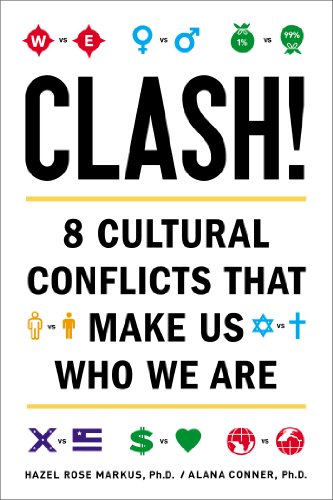
In Clash!, leading cultural psychologists Hazel Rose Markus and Alana Conner show us how our cultural backgrounds create and reflect these two basic ways of being a self, which then shapes everything from how we run our governments to how we raise our children.
Markus and Conner also demonstrate how clashes between independence and interdependence fuel many of today’s most pressing conflicts, including tensions between East and West, the Global North and Global South, men and women, blacks and whites, conservative and liberal, religious groups, rich and poor, and businesses, governments, and nonprofits.
Provocative and entertaining, Clash! offers solutions to many of the problems that plague our workplaces, schools, and relationships. For readers ofThe Culture Code by Clotaire Rapaille and The Wisdom of Crowds by James Surowiecki, it doesn’t just explain who we are, it also envisions who we could become.
Die Inhaltsangabe kann sich auf eine andere Ausgabe dieses Titels beziehen.
Über die Autorin bzw. den Autor
Hazel Rose Markus, Ph.D., is the Davis-Brack Professor in the behavioral sciences at Stanford University.
Alana Conner, Ph.D., is a Stanford-trained cultural psychologist and science writer based in San Francisco.
Auszug. © Genehmigter Nachdruck. Alle Rechte vorbehalten.
Chapter 1
Hearts and Minds, East and West
"Heejung?”
Hazel cold-called the graduate student at the end of the seminar table.
“Do you have something to add?”
Schooled in South Korea, Heejung Kim was now deep into her Ph.D. studies at Stanford. Hazel was her adviser and expected students to chime in during class discussions.
Yet again, Kim shook her head and whispered, “No.”
Slightly peeved, Hazel tried once more: “Heejung, what do you think about this claim that Asian students who sit silently in class and don’t contribute to the discussion aren’t thinking for themselves?” Hazel was referring to a widely publicized news article by a college professor who criticized Asian and Asian-American students for not participating in class. The professor concluded that the students were “freeloading,” and that “to be come independent thinkers, they need to learn to express themselves.”
The other students waved their hands in the air and fidgeted in their chairs. Finally, Kim looked down and quietly asserted, “You know, talking and thinking are not the same thing.”
No one knew what to say, so the class carried on to another point.
Later that day, Kim e-mailed Hazel her response to the weekly class assignment. As usual, her commentary was both deep and succinct. But what really caught Hazel’s eye was Kim’s new e-mail signature: “The empty carriage rattles the loudest.”
For all their interdependence, Asian students don’t talk much. At least that’s the perception many educators wrestle with, including Gail Davidson. Davidson is the principal of Lynbrook High School in Cupertino, California, which serves more than 1,700 students, 80 percent of whom are of Asian heritage. A public school, Lynbrook High is the envy of its competitors, with one of California’s highest academic performance index ratings, a blue ribbon from the U.S. Department of Education, and a gold medal from Newsweek’s rankings of the nation’s high schools.
“Our students are fantastic and achieve at a high level by all objective standards,” Davidson says, “but our teachers are concerned when students don’t speak up in class. Students absolutely need to develop their communication skills to succeed in the wider world.”
East-West clashes, like the one over how much students should speak, cause ripples of contention through schools around the world, ranging from prekindergarten classrooms to postdoctoral lecture halls. In the United States, for example, many teachers see how Asian interdependence can send a kid to Harvard (as it did Chua’s daughter), but they still feel put off by it. “Why do Asian students so seldom talk or get excited?” they ask. “Why do they put their parents’ wishes before their own? Why do they work so hard to fit in?” These are not the sorts of hearts and minds most Western teachers were trained to educate.
Western teachers also worry that their students with Eastern backgrounds are not cultivating the skills they will need in the Real World. Some even see how the independence of Westerners can hold Easterners back, both in the classroom and in the workplace. At the same time, many suspect, as did the op-ed writer, that Eastern students’ way of being is somehow unfair to their Western classmates.
A closer examination of the selves of people with Eastern and Western heritages can help demystify their different ways of doing school. For many East Asians and their children growing up in the West, listening, following the “right” way, fitting in, and keeping calm are not odd classroom behaviors; they are the very route to being a good person—a good interdependent self, Eastern style. But for their Western classmates and teachers, speaking up, choosing your own way, standing out, and getting excited are also ways of being a good person—but in this case, a good independent self, Western style. Understanding the meanings and intentions behind these ways of being can not only dispel bad feelings in school and at work, but also help us harness the strengths of Eastern and Western selves for the betterment of both groups.
Talk or Listen?
After six years in the United States, Heejung Kim was getting irritated with professors needling her to talk. She had been taught that silent contemplation, not half-baked chattering, paved the path to wisdom. As the great Confucian sage Lao Tzu wrote: “He who knows does not speak. He who speaks does not know.”
Kim knew she felt comfortable listening without talking in a way that many of her European-American colleagues did not. And she knew that connecting what she heard with what she already knew was a lot of work. She definitely did not feel she was freeloading.
As a budding cultural psychologist, Kim was learning that irritation was often the bellwether of a good research idea. So she decided to explore why Americans worry so much about silence in the classroom. Hers was a rather revolutionary hypothesis: for European Americans, talking helps thinking, but for Koreans and many other East Asians, talking can actually hinder thinking.
She tested her hunch with Richard, a European-American graduate student from New York. Having logged many hours talking on his high school’s debate team, Richard opined, “Talking really helps clarify what you’re thinking. Sometimes it’s hard to know what you think without talking.”
Kim then consulted with other East-Asian students. Akiko, a graduate student from Japan, shared Kim’s frustration with the American assumption that talking is thinking, and supplied her own set of proverbs: “The mouth is the source of misfortune,” “Guard your mouth as though it were a vase,” “You have two ears and one mouth, to be used in that proportion,” and “The duck that quacks the loudest gets shot.”
Armed with these insights, Kim set out to test her ideas. She first devised a survey with statements that reflected both Eastern beliefs about talking and thinking such as “Only in silence can you have clear thoughts and ideas,” and Western beliefs such as “An articulate person is usually a good thinker.” She then asked people in San Francisco and Seoul how much they agreed with the statements. She found that Americans of many different ages and professions thought that talking is good for thinking. Koreans, in contrast, more readily agreed that talking can impede thinking.
Just because Americans believe that talking helps them think, however, does not mean they are right. Likewise, East Asians may mistakenly believe that talking interferes with thinking. To find out exactly how talking affects thinking for European Americans and East Asians, Kim asked American students who had grown up speaking English to take a nonverbal intelligence test called the Raven Progressive Matrices. Half the students had European backgrounds, and half had East-Asian backgrounds (including Korean, Chinese, Vietnamese, and Japanese). All the students completed half the intelligence test items in silence, and the other half while “thinking out loud,” that is, verbalizing their problem-solving process.
Kim found that the European Americans performed better when they were solving the problems while speaking. In contrast, the Asian Americans performed much worse when they solved the problems while thinking aloud. But when the Asian Americans were allowed to solve problems in silence, they performed better than the European Americans.
For Asian Americans, then, silence is not a sign of checking out....
„Über diesen Titel“ kann sich auf eine andere Ausgabe dieses Titels beziehen.
Suchergebnisse für Clash!: 8 Cultural Conflicts That Make Us Who We Are

Beispielbild für diese ISBN
Clash!: 8 Cultural Conflicts That Make Us Who We Are
Anbieter: World of Books (was SecondSale), Montgomery, IL, USA
Verkäuferbewertung 5 von 5 Sternen

Hardback. Zustand: Fair. Artikel-Nr. 00105073918
Gebraucht kaufen
EUR 5,54
Versand gratis
Versand innerhalb von USA
Versand innerhalb von USA
Anzahl: 1 verfügbar
Beispielbild für diese ISBN
Clash!: 8 Cultural Conflicts That Make Us Who We Are
Anbieter: World of Books (was SecondSale), Montgomery, IL, USA
Verkäuferbewertung 5 von 5 Sternen
Hardback. Zustand: Good. Artikel-Nr. 00093020313
Gebraucht kaufen
EUR 5,54
Versand gratis
Versand innerhalb von USA
Versand innerhalb von USA
Anzahl: 1 verfügbar
Beispielbild für diese ISBN
Clash! : 8 Cultural Conflicts That Make Us Who We Are
Verlag:
Penguin Publishing Group, 2013
ISBN 10: 1594630984
ISBN 13: 9781594630989
Gebraucht
Hardcover
Anbieter: Better World Books: West, Reno, NV, USA
Verkäuferbewertung 5 von 5 Sternen
Zustand: Very Good. Pages intact with possible writing/highlighting. Binding strong with minor wear. Dust jackets/supplements may not be included. Stock photo provided. Product includes identifying sticker. Better World Books: Buy Books. Do Good. Artikel-Nr. 8609404-75
Gebraucht kaufen
EUR 6,26
Versand gratis
Versand innerhalb von USA
Versand innerhalb von USA
Anzahl: 1 verfügbar
Beispielbild für diese ISBN
Clash! : 8 Cultural Conflicts That Make Us Who We Are
Verlag:
Penguin Publishing Group, 2013
ISBN 10: 1594630984
ISBN 13: 9781594630989
Gebraucht
Hardcover
Anbieter: Better World Books, Mishawaka, IN, USA
Verkäuferbewertung 5 von 5 Sternen
Zustand: Good. Former library copy. Pages intact with minimal writing/highlighting. The binding may be loose and creased. Dust jackets/supplements are not included. Includes library markings. Stock photo provided. Product includes identifying sticker. Better World Books: Buy Books. Do Good. Artikel-Nr. 1509040-6
Gebraucht kaufen
EUR 6,26
Versand gratis
Versand innerhalb von USA
Versand innerhalb von USA
Anzahl: 1 verfügbar
Beispielbild für diese ISBN
Clash! : 8 Cultural Conflicts That Make Us Who We Are
Verlag:
Penguin Publishing Group, 2013
ISBN 10: 1594630984
ISBN 13: 9781594630989
Gebraucht
Hardcover
Anbieter: Better World Books: West, Reno, NV, USA
Verkäuferbewertung 5 von 5 Sternen
Zustand: Good. Former library copy. Pages intact with minimal writing/highlighting. The binding may be loose and creased. Dust jackets/supplements are not included. Includes library markings. Stock photo provided. Product includes identifying sticker. Better World Books: Buy Books. Do Good. Artikel-Nr. 1509040-6
Gebraucht kaufen
EUR 6,26
Versand gratis
Versand innerhalb von USA
Versand innerhalb von USA
Anzahl: 2 verfügbar
Beispielbild für diese ISBN
Clash!: 8 Cultural Conflicts That Make Us Who We Are
Anbieter: ThriftBooks-Dallas, Dallas, TX, USA
Verkäuferbewertung 5 von 5 Sternen
Hardcover. Zustand: Very Good. No Jacket. May have limited writing in cover pages. Pages are unmarked. ~ ThriftBooks: Read More, Spend Less. Artikel-Nr. G1594630984I4N00
Gebraucht kaufen
EUR 7,23
Versand gratis
Versand innerhalb von USA
Versand innerhalb von USA
Anzahl: 1 verfügbar
Beispielbild für diese ISBN
Clash!: 8 Cultural Conflicts That Make Us Who We Are
Anbieter: ThriftBooks-Dallas, Dallas, TX, USA
Verkäuferbewertung 5 von 5 Sternen
Hardcover. Zustand: Good. No Jacket. Pages can have notes/highlighting. Spine may show signs of wear. ~ ThriftBooks: Read More, Spend Less. Artikel-Nr. G1594630984I3N00
Gebraucht kaufen
EUR 7,23
Versand gratis
Versand innerhalb von USA
Versand innerhalb von USA
Anzahl: 1 verfügbar
Beispielbild für diese ISBN
Clash!: 8 Cultural Conflicts That Make Us Who We Are
Anbieter: ThriftBooks-Reno, Reno, NV, USA
Verkäuferbewertung 5 von 5 Sternen
Hardcover. Zustand: Good. No Jacket. Missing dust jacket; Pages can have notes/highlighting. Spine may show signs of wear. ~ ThriftBooks: Read More, Spend Less. Artikel-Nr. G1594630984I3N01
Gebraucht kaufen
EUR 7,23
Versand gratis
Versand innerhalb von USA
Versand innerhalb von USA
Anzahl: 1 verfügbar
Beispielbild für diese ISBN
Clash!: 8 Cultural Conflicts That Make Us Who We Are
Anbieter: ThriftBooks-Atlanta, AUSTELL, GA, USA
Verkäuferbewertung 5 von 5 Sternen
Hardcover. Zustand: As New. No Jacket. Pages are clean and are not marred by notes or folds of any kind. ~ ThriftBooks: Read More, Spend Less. Artikel-Nr. G1594630984I2N00
Gebraucht kaufen
EUR 7,23
Versand gratis
Versand innerhalb von USA
Versand innerhalb von USA
Anzahl: 1 verfügbar
Beispielbild für diese ISBN
Clash!: 8 Cultural Conflicts That Make Us Who We Are
Anbieter: ThriftBooks-Reno, Reno, NV, USA
Verkäuferbewertung 5 von 5 Sternen
Hardcover. Zustand: Good. No Jacket. Pages can have notes/highlighting. Spine may show signs of wear. ~ ThriftBooks: Read More, Spend Less. Artikel-Nr. G1594630984I3N00
Gebraucht kaufen
EUR 7,23
Versand gratis
Versand innerhalb von USA
Versand innerhalb von USA
Anzahl: 1 verfügbar