
Verwandte Artikel zu Succeed: How We Can Reach Our Goals
Inhaltsangabe
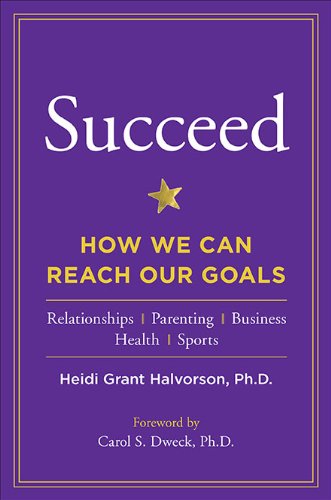
An eminent social psychologist and blogger for Psychology Today offers insight into how goals work and the sources of self-defeating behaviors, in a guide that features strategies for problem solving, achieving resiliency and increasing willpower.
Die Inhaltsangabe kann sich auf eine andere Ausgabe dieses Titels beziehen.
Über die Autorin bzw. den Autor
Heidi Grant Halvorson is a social psychologist, educational consultant, and most recently assistant professor of psychology at Lehigh University. She has received several grants from the National Science Foundation. In addition to her work as author and co-editor of the highly-regarded academic book The Psychology of Goals (Guilford, 2009), she has authored papers in her field’s most prestigious journals.
Dr. Grant Halvorson is a member of the American Psychological Association, the Association for Psychological Science, and the Society for Personality and Social Psychology, and was recently elected to the highly selective Society for Experimental Social Psychology. She received her PhD from Columbia University working with Carol Dweck (author ofMindset: The New Psychology of Success), and her BA in Psychology from the University of Pennsylvania.
Auszug. © Genehmigter Nachdruck. Alle Rechte vorbehalten.
Introduction
Why do we fail to reach our goals? Whether it's wanting to impress our bosses, find a loving relationship, straighten out our finances, or take better care of ourselves—we all feel that there is at least one part of our lives that is in real need of improvement. (And, in reality, it's usually more than just one part.) We want to do better, we even try to do better, but somehow we fall short or miss the mark—sometimes over and over again. So we go looking for something to blame for our failures, and most of the time we blame ourselves. We feel like we just don't have what it takes—whatever that is—to reach our goals. And we could not be more wrong.
As a social psychologist, I've spent years studying achievement. I've carefully observed thousands of research participants pursue goals at work, in the classroom, on the playing field, and in my own laboratory. I've asked people to fill out weeks of daily diary reports, telling me all about the goals they pursue in their everyday lives. I've reviewed hundreds and hundreds of studies on goals and motivation. And I've come to a few conclusions, two of which I'll share with you now.
Most of us blame our failures on the wrong things. Even very smart, accomplished people don't understand why they succeed or fail. Before I started studying this for a living, my intuitions about achievement were no better than anyone else's. I thought that I was good at school and disastrous at sports because I was born that way. I wasn't—actually, no one is simply "born that way." I had a lot to learn.
Another conclusion I've reached after all these years of studying achievement is that anyone can be more successful at reaching his or her goals. Anyone can. I really can't emphasize that enough. But the first step is to put aside your beliefs about why you've succeeded or failed in the past, because they are probably wrong. And the second step is to read this book.
You may not be aware that the government keeps track of this, but on its website www.USA.gov, you can find a list of the most popular perennial New Year's resolutions Americans make. On that list, you probably won't be surprised to find both "lose weight" and "quit smoking." Every January, millions of people—and like me, you may be one of them—have set one of these two goals for themselves, vowing that this is the year that they will finally get healthy, fit into their skinny jeans, or stop spending a small fortune on cigarettes.
According to the latest reports issued by the Centers for Disease Control and Prevention (CDC), two out of three Americans are overweight, and one in three is obese. The majority of these individuals would very much prefer to weigh less. Overweight individuals not only grapple with an increased susceptibility to heart disease and diabetes, but they contend with the self-esteem-crushing consequences of being heavy in a society in which thin is in. And yet, despite an abundance of diet books and plans, and a very real and powerful desire to be slim, relatively few people who set out to lose weight actually manage to lose it and keep it off long-term. We're not getting any thinner, and our skinny jeans are still waiting for us in our closets.
The CDC also keeps track of smokers—today, roughly one in five adult Americans smoke. In its surveys, seven out of ten smokers reported that they wanted to quit smoking completely, and nearly half of those who wanted to quit (over 19 million) had stopped smoking for at least one day in the previous twelve months in an attempt to kick the habit. Only about 3 million manage to make it last—that means that about 85 percent of the people who want to quit, and have actually set themselves the goal of quitting, fail. In spite of all the public awareness of the serious risks to one's health, nearly half a million Americans die every year from smoking-related illnesses. So if you're a smoker and you fail to quit smoking, you may well die as a result of it. And the 85 percent of people who try to quit and fail each year know it.
So, why the high failure rates? It's obviously not that the many who try to lose weight or quit smoking aren't motivated. There aren't many incentives more powerful than knowing "this could kill you." Why then do people fail, over and over again, to achieve goals that are vital to their well-being? The most common answer you'll hear, and probably the one you were thinking when I asked that question, is that it's about willpower. And by "willpower," I mean some innate quality of inner strength that allows those who have it to successfully avoid temptation. Most people believe that it's fundamentally a character issue. Some people have willpower (the thin, nonsmokers—and we admire them for it). Others don't, and we judge them accordingly. Those who don't are simply weaker, less successful people, with less admirable character traits.
Interestingly, that's not only how we describe the failures of others—it's also how we describe our own shortcomings. Countless times I've heard colleagues, students, and friends talk about how they "just can't stop" smoking, "just can't resist" the dessert cart, "just can't get going" on a difficult project. And once you've decided you just don't have the willpower to lose weight or quit smoking or stop procrastinating, why bother trying? What hope is there for you?
Well, the answer is that there is actually plenty of hope for you, because it turns out that willpower is not what you think it is. And it might be helpful to use a less lofty term for it, because what we are really talking about here is plain old self-control. Self-control is the ability to guide your actions in pursuit of a goal—to persevere and stay on course, despite temptations, distractions, and the demands of competing goals. It's really, really important—one of the critical elements necessary for achieving your goals that I'll be talking a lot about in this book. But it doesn't work the way you think it does.
Successful People and the Paradox of Self-Control
First of all, it's simply not the case that some people have it and others don't. If that were true, then you'd expect all the people in the world to break down very clearly into "winners" and "losers." Because they are in possession of the mighty power of self-control, successful people would be successful all the time, winning at everything they do. And unsuccessful people, the ones utterly lacking in this critical ability, would pretty much stink at everything they tried. Why, without any self-control, these people would find it nearly impossible just to get out of bed in the morning!
It's obvious that none of that is actually true. Winners don't win at everything, and no one is so lacking in self-control that they can't accomplish anything. It's true that some people may have more self-control than others, but everyone has some. And as it turns out, even people with a lot of self-control sometimes run out. To vividly illustrate this point, all you need to do is think about all the very successful people—people who have risen to the very top of their game—who have struggled publicly with one of these two difficult New Year's resolutions.
Celebrities who have talked openly about their many attempts to lose weight and keep it off include Grammy-winning musicians (Janet Jackson, Wynonna Judd) and Oscar or Emmy-winning actors (Oprah Winfrey, Roseanne...
„Über diesen Titel“ kann sich auf eine andere Ausgabe dieses Titels beziehen.
Suchergebnisse für Succeed: How We Can Reach Our Goals

Beispielbild für diese ISBN
Succeed: How We Can Reach Our Goals
Anbieter: World of Books (was SecondSale), Montgomery, IL, USA
Verkäuferbewertung 5 von 5 Sternen

Hardback. Zustand: Good. Whether it's wanting to impress our bosses, find a loving relationship, straighten out our finances, or take better care of ourselves, we all feel that there is at least one part of our lives that is in real need of improvement. We want to do better, but somehow we fall short and end up feeling like we don't have what it takes to reach our goals. And we could not be more wrong. Most of us have no idea why we fail to reach our goals. Now eminent social psychologist Heidi Grant Halvorson shows us how we can finally win by revealing how goals really work--and by showing us how to avoid what typically goes wrong. Dr. Grant Halvorson offers insights--many surprising--that listeners can use immediately, including how to: - Set a goal so that you will persist even in the face of adversity; - Build willpower, which can be strengthened like a muscle; - Avoid the kind of positive thinking that makes people fail. The strategies outlined in this book will not only help everyone reach their own goals but will also prove invaluable to parents, teachers, coaches, and employers. Dr. Grant Halvorson shows listeners a new approach to problem solving that will change the way they approach their entire lives. Artikel-Nr. 00096974482
Gebraucht kaufen
EUR 4,75
Versand gratis
Versand innerhalb von USA
Versand innerhalb von USA
Anzahl: 6 verfügbar
Beispielbild für diese ISBN
Succeed : How We Can Reach Our Goals
Verlag:
Penguin Publishing Group, 2010
ISBN 10: 1594630739
ISBN 13: 9781594630736
Gebraucht
Hardcover
Anbieter: Better World Books, Mishawaka, IN, USA
Verkäuferbewertung 5 von 5 Sternen
Zustand: Good. Former library copy. Pages intact with minimal writing/highlighting. The binding may be loose and creased. Dust jackets/supplements are not included. Includes library markings. Stock photo provided. Product includes identifying sticker. Better World Books: Buy Books. Do Good. Artikel-Nr. 4599872-75
Gebraucht kaufen
EUR 6,37
Versand gratis
Versand innerhalb von USA
Versand innerhalb von USA
Anzahl: 2 verfügbar
Beispielbild für diese ISBN
Succeed: How We Can Reach Our Goals
Anbieter: ThriftBooks-Dallas, Dallas, TX, USA
Verkäuferbewertung 5 von 5 Sternen
Hardcover. Zustand: Very Good. No Jacket. Former library book; May have limited writing in cover pages. Pages are unmarked. ~ ThriftBooks: Read More, Spend Less. Artikel-Nr. G1594630739I4N10
Gebraucht kaufen
EUR 6,73
Versand gratis
Versand innerhalb von USA
Versand innerhalb von USA
Anzahl: 1 verfügbar
Beispielbild für diese ISBN
Succeed: How We Can Reach Our Goals
Anbieter: ThriftBooks-Atlanta, AUSTELL, GA, USA
Verkäuferbewertung 5 von 5 Sternen
Hardcover. Zustand: Very Good. No Jacket. Missing dust jacket; May have limited writing in cover pages. Pages are unmarked. ~ ThriftBooks: Read More, Spend Less. Artikel-Nr. G1594630739I4N01
Gebraucht kaufen
EUR 6,73
Versand gratis
Versand innerhalb von USA
Versand innerhalb von USA
Anzahl: 1 verfügbar
Beispielbild für diese ISBN
Succeed: How We Can Reach Our Goals
Anbieter: ThriftBooks-Atlanta, AUSTELL, GA, USA
Verkäuferbewertung 5 von 5 Sternen
Hardcover. Zustand: Very Good. No Jacket. May have limited writing in cover pages. Pages are unmarked. ~ ThriftBooks: Read More, Spend Less. Artikel-Nr. G1594630739I4N00
Gebraucht kaufen
EUR 6,73
Versand gratis
Versand innerhalb von USA
Versand innerhalb von USA
Anzahl: 1 verfügbar
Beispielbild für diese ISBN
Succeed: How We Can Reach Our Goals
Anbieter: ThriftBooks-Dallas, Dallas, TX, USA
Verkäuferbewertung 5 von 5 Sternen
Hardcover. Zustand: Fair. No Jacket. Missing dust jacket; Readable copy. Pages may have considerable notes/highlighting. ~ ThriftBooks: Read More, Spend Less. Artikel-Nr. G1594630739I5N01
Gebraucht kaufen
EUR 6,73
Versand gratis
Versand innerhalb von USA
Versand innerhalb von USA
Anzahl: 1 verfügbar
Beispielbild für diese ISBN
Succeed: How We Can Reach Our Goals
Anbieter: ThriftBooks-Dallas, Dallas, TX, USA
Verkäuferbewertung 5 von 5 Sternen
Hardcover. Zustand: Very Good. No Jacket. May have limited writing in cover pages. Pages are unmarked. ~ ThriftBooks: Read More, Spend Less. Artikel-Nr. G1594630739I4N00
Gebraucht kaufen
EUR 6,73
Versand gratis
Versand innerhalb von USA
Versand innerhalb von USA
Anzahl: 1 verfügbar
Beispielbild für diese ISBN
Succeed: How We Can Reach Our Goals
Anbieter: Revaluation Books, Exeter, Vereinigtes Königreich
Verkäuferbewertung 5 von 5 Sternen
Hardcover. Zustand: Brand New. 288 pages. 9.50x6.25x1.00 inches. In Stock. Artikel-Nr. 1594630739
Neu kaufen
EUR 37,12
EUR 14,93 Versand
Versand von Vereinigtes Königreich nach USA
Versand von Vereinigtes Königreich nach USA
Anzahl: 1 verfügbar