
Verwandte Artikel zu Future Perfect: The Case For Progress In A Networked...
Inhaltsangabe
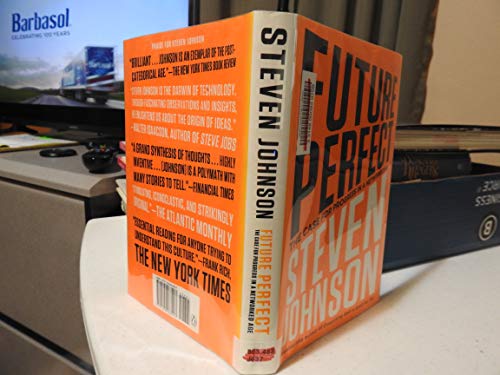
Combining the deft social analysis of Where Good Ideas Come From with the optimistic arguments of Everything Bad Is Good For You , New York Times bestselling author Steven Johnson's Future Perfect makes the case that a new model of political change is on the rise, transforming everything from local governments to classrooms, from protest movements to health care. Johnson paints a compelling portrait of this new political worldview -- influenced by the success and interconnectedness of the Internet, by peer networks, but not dependent on high-tech solutions -- that breaks with the conventional categories of liberal or conservative, public vs. private thinking.
With his acclaimed gift for multi-disciplinary storytelling and big idea books, Johnson explores this new vision of progress through a series of fascinating narratives: from the "miracle on the Hudson" to the planning of the French railway system; from the battle against malnutrition in Vietnam to a mysterious outbreak of strange smells in downtown Manhattan; from underground music video artists to the invention of the Internet itself.
At a time when the conventional wisdom holds that the political system is hopelessly gridlocked with old ideas, Future Perfect makes the timely and inspiring case that progress is still possible, and that innovative strategies are on the rise. This is a hopeful, affirmative outlook for the future, from one of the most brilliant and inspiring visionaries of contemporary culture.
Die Inhaltsangabe kann sich auf eine andere Ausgabe dieses Titels beziehen.
Über die Autorin bzw. den Autor
Steven Johnson is the author of seven bestsellers, including Where Good Ideas Come From,The Invention of Air, The Ghost Map, and Everything Bad Is Good for You, and is the editor of the anthologyThe Innovator’s Cookbook. He is the founder of a variety of influential websitesmost recently, outside.inand writes forTime, Wired, The New York Times, and The Wall Street Journal. He lives in Marin County, California, with his wife and three sons.
Auszug. © Genehmigter Nachdruck. Alle Rechte vorbehalten.
Commercial airplane crashes are one of the few events guaranteed a place on the front page of every national newspaper. Somewhat less common on the front page, however, is a story about a commercial airplane crash that didn't happen. But every now and then one of these non-events manages to cross the threshold into newsworthiness. One such unlikely story appeared on page one of the January 12, 2009, edition of USA Today : "Airlines Go Two Years with No Fatalities," the headline proclaimed. An analysis by the paper had discovered that the U.S. commercial aviation industry had achieved a milestone unprecedented in the history of modern air travel: despite the dramatic increase in flights compared with earlier decades, not a single person had perished in a commercial air accident during the years 2007 and 2008.
A two-year stretch with zero fatalities was, statistically speaking, a remarkable feat. Only four times since 1958 had the industry managed to make it through one year without a fatal accident. But the safety record was part of a long-term trend: in the post-9/11 period, chances of dying on a commercial flight were nineteen in 1 billion; an almost 100 percent improvement over the already excellent odds of flying in the 1990s. According to MIT professor Arnold Barnett, this meant that an American child was more likely to be elected president of the United States in his or her lifetime than to die in a commercial jet flight.
The story caught my eye in part because I had long maintained that news organizations presented a misleading slant on current events-not the conventional slant of the Left-Right political world, but the more subtle bias of being more interested in bad news. "If it bleeds, it leads" might be a good strategy for selling papers, but it necessarily skews our collective sense of how well we are doing as a society. We hear about every threat or catastrophe, but the stories of genuine progress get relegated to the back pages, if they run at all.
But this USA Today article was bucking that trend of negative bias. And so, inspired by its refreshing story of progress, I decided to write a little essay about it, for a website at which I happened to be a guest contributor that week. I summarized the article's findings, and made the point that we might have fewer people suffering from fear of flying (and thus spending less time on much more dangerous highways) if the media did a better job of reminding us of these genuinely extraordinary achievements.
A more superstitious person might have worried that saying such things in public was tempting fate. In fact, when I had talked about airline safety with friends in the past, I'd often been accused of just that, a criticism that I would inevitably laugh off. Surely fate had better things to do than worry about my monologues.
But within a few hours of publishing my little riff about airline safety, while I was sitting in a television studio waiting to do a book promotion, my phone began buzzing with e-mails and text messages from friends who had seen my piece. A US Airways jet had crash-landed in the icy Hudson. Look what you did, my friends said. I had tempted fate, and fate had slapped me back across the face.
By the time I actually managed to get to a television set to see the live report, it was clear that the plane had in fact survived the landing with minimal structural damage, and a significant number of survivors were clearly visible standing on the wings, waiting for the ferries and police boats that would rescue them. I penned a quick, sheepish entry promising to keep mum about air safety for a while, and mothball that piece I was working on about the planet's amazing streak of avoiding species-extinguishing asteroid collisions.
Then a funny-and wonderful-thing happened. The world quickly learned that all 155 passengers and crew aboard flight 1549 had surviv
„Über diesen Titel“ kann sich auf eine andere Ausgabe dieses Titels beziehen.
Suchergebnisse für Future Perfect: The Case For Progress In A Networked...

Beispielbild für diese ISBN
Future Perfect: The Case for Progress in a Networked Age
Anbieter: World of Books (was SecondSale), Montgomery, IL, USA
Verkäuferbewertung 5 von 5 Sternen

Hardback. Zustand: Very Good. Combining the deft social analysis of Where Good Ideas Come From with the optimistic arguments of Everything Bad Is Good for You, New York Times bestselling author and one of the most inspiring visionaries of contemporary culture, Steven Johnson, maps the ways a connected world will be both different and better. Steven Johnson proposes that a new model of political change is on the rise transforming everything from local government to classrooms to health care. It's a compelling new political worldview that breaks with traditional categories of liberal or conservative thinking. Johnson explores this innovative vision through a series of fascinating narratives: from the Miracle on the Hudson to the planning of the French railway system; from the battle against malnutrition in Vietnam to a mysterious outbreak of strange smells in downtown Manhattan; from underground music video artists to the invention of the Internet itself. At a time when the conventional wisdom holds that the political system is hopelessly gridlocked with old ideas, Future Perfect makes the timely and uplifting case that progress is still possible. Artikel-Nr. 00108249702
Gebraucht kaufen
EUR 4,44
Versand gratis
Versand innerhalb von USA
Versand innerhalb von USA
Anzahl: 2 verfügbar
Beispielbild für diese ISBN
Future Perfect: The Case For Progress In A Networked Age
Anbieter: World of Books (was SecondSale), Montgomery, IL, USA
Verkäuferbewertung 5 von 5 Sternen
Zustand: Good. Item in good condition. Textbooks may not include supplemental items i.e. CDs, access codes etc. Artikel-Nr. 00088660891
Gebraucht kaufen
EUR 4,44
Versand gratis
Versand innerhalb von USA
Versand innerhalb von USA
Anzahl: 5 verfügbar
Beispielbild für diese ISBN
Future Perfect: The Case For Progress In A Networked Age
Verlag:
Riverhead Books (edition First Edition), 2012
ISBN 10: 1594488207
ISBN 13: 9781594488207
Gebraucht
Hardcover
Erstausgabe
Anbieter: BooksRun, Philadelphia, PA, USA
Verkäuferbewertung 5 von 5 Sternen
Hardcover. Zustand: Very Good. First Edition. With dust jacket. It's a well-cared-for item that has seen limited use. The item may show minor signs of wear. All the text is legible, with all pages included. It may have slight markings and/or highlighting. Artikel-Nr. 1594488207-8-18-29
Gebraucht kaufen
EUR 4,91
Versand gratis
Versand innerhalb von USA
Versand innerhalb von USA
Anzahl: 1 verfügbar
Beispielbild für diese ISBN
Future Perfect : The Case for Progress in a Networked Age
Verlag:
Penguin Publishing Group, 2012
ISBN 10: 1594488207
ISBN 13: 9781594488207
Gebraucht
Hardcover
Erstausgabe
Anbieter: Better World Books, Mishawaka, IN, USA
Verkäuferbewertung 5 von 5 Sternen
Zustand: Very Good. First Edition. Former library copy. Pages intact with possible writing/highlighting. Binding strong with minor wear. Dust jackets/supplements may not be included. Includes library markings. Stock photo provided. Product includes identifying sticker. Better World Books: Buy Books. Do Good. Artikel-Nr. GRP79661098
Gebraucht kaufen
EUR 6,08
Versand gratis
Versand innerhalb von USA
Versand innerhalb von USA
Anzahl: 2 verfügbar
Beispielbild für diese ISBN
Future Perfect: The Case For Progress In A Networked Age
Anbieter: ThriftBooks-Dallas, Dallas, TX, USA
Verkäuferbewertung 5 von 5 Sternen
Hardcover. Zustand: As New. No Jacket. Pages are clean and are not marred by notes or folds of any kind. ~ ThriftBooks: Read More, Spend Less. Artikel-Nr. G1594488207I2N00
Gebraucht kaufen
EUR 6,26
Versand gratis
Versand innerhalb von USA
Versand innerhalb von USA
Anzahl: 1 verfügbar
Beispielbild für diese ISBN
Future Perfect: The Case For Progress In A Networked Age
Anbieter: Wonder Book, Frederick, MD, USA
Verkäuferbewertung 5 von 5 Sternen
Zustand: Very Good. Very Good condition. Like New dust jacket. A copy that may have a few cosmetic defects. May also contain light spine creasing or a few markings such as an owner's name, short gifter's inscription or light stamp. Bundled media such as CDs, DVDs, floppy disks or access codes may not be included. Artikel-Nr. Q11M-00547
Gebraucht kaufen
EUR 6,32
Versand gratis
Versand innerhalb von USA
Versand innerhalb von USA
Anzahl: 1 verfügbar
Beispielbild für diese ISBN
Future Perfect: The Case For Progress In A Networked Age
Anbieter: Wonder Book, Frederick, MD, USA
Verkäuferbewertung 5 von 5 Sternen
Zustand: As New. Like New condition. Like New dust jacket. A near perfect copy that may have very minor cosmetic defects. Artikel-Nr. J05Q-01422
Gebraucht kaufen
EUR 6,32
Versand gratis
Versand innerhalb von USA
Versand innerhalb von USA
Anzahl: 1 verfügbar
Foto des Verkäufers
Future Perfect: The Case For Progress In A Network
Verlag:
Riverhead Books, 2012
ISBN 10: 1594488207
ISBN 13: 9781594488207
Gebraucht
Hardcover
Erstausgabe
Anbieter: Southampton Books, Sag Harbor, NY, USA
Verkäuferbewertung 5 von 5 Sternen
Hardcover. Zustand: Like New. First Edition. First Edition, First Printing. Not price-clipped. Published by Riverhead Books, 2012. Octavo. Hardcover. Book is like new. Dust jacket is like new.100% positive feedback. 30 day money back guarantee. NEXT DAY SHIPPING! Excellent customer service. Please email with any questions. All books packed carefully and ship with free delivery confirmation/tracking. All books come with free bookmarks. Ships from Sag Harbor, New York. Artikel-Nr. 463136
Gebraucht kaufen
EUR 9,04
EUR 4,38 Versand
Versand innerhalb von USA
Versand innerhalb von USA
Anzahl: 1 verfügbar
Foto des Verkäufers
Future Perfect: The Case For Progress In A Networked Age
Verlag:
Riverhead Books, 2012
ISBN 10: 1594488207
ISBN 13: 9781594488207
Gebraucht
Hardcover
Erstausgabe
Anbieter: Southampton Books, Sag Harbor, NY, USA
Verkäuferbewertung 5 von 5 Sternen
Hardcover. Zustand: Like New. First Edition. First Edition, First Printing. Not price-clipped. Published by Riverhead Books, 2012. Octavo. Hardcover. Book is like new. Dust jacket is like new.100% positive feedback. 30 day money back guarantee. NEXT DAY SHIPPING! Excellent customer service. Please email with any questions. All books packed carefully and ship with free delivery confirmation/tracking. All books come with free bookmarks. Ships from Sag Harbor, New York. Artikel-Nr. 404757
Gebraucht kaufen
EUR 18,08
EUR 4,38 Versand
Versand innerhalb von USA
Versand innerhalb von USA
Anzahl: 1 verfügbar
Beispielbild für diese ISBN
Future Perfect: The Case For Progress In A Networked Age
Anbieter: medimops, Berlin, Deutschland
Verkäuferbewertung 5 von 5 Sternen
Zustand: good. Befriedigend/Good: Durchschnittlich erhaltenes Buch bzw. Schutzumschlag mit Gebrauchsspuren, aber vollständigen Seiten. / Describes the average WORN book or dust jacket that has all the pages present. Artikel-Nr. M01594488207-G
Gebraucht kaufen
EUR 15,26
EUR 10,00 Versand
Versand von Deutschland nach USA
Versand von Deutschland nach USA
Anzahl: 1 verfügbar