
Verwandte Artikel zu The Ghost Map: The Story of London's Most Terrifying...
The Ghost Map: The Story of London's Most Terrifying Epidemic--and How It Changed Science, Cities, and the Modern World - Softcover
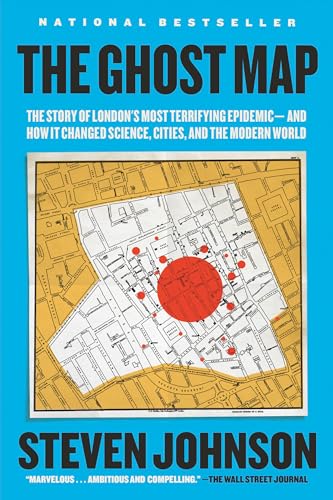
Inhaltsangabe
A National Bestseller, a New York Times Notable Book, and an Entertainment Weekly Best Book of the Year from the author of Extra Life
“By turns a medical thriller, detective story, and paean to city life, Johnson's account of the outbreak and its modern implications is a true page-turner.” —The Washington Post
“Thought-provoking.” —Entertainment Weekly
It's the summer of 1854, and London is just emerging as one of the first modern cities in the world. But lacking the infrastructure-garbage removal, clean water, sewers-necessary to support its rapidly expanding population, the city has become the perfect breeding ground for a terrifying disease no one knows how to cure. As the cholera outbreak takes hold, a physician and a local curate are spurred to action-and ultimately solve the most pressing medical riddle of their time.
In a triumph of multidisciplinary thinking, Johnson illuminates the intertwined histories of the spread of disease, the rise of cities, and the nature of scientific inquiry, offering both a riveting history and a powerful explanation of how it has shaped the world we live in.
Die Inhaltsangabe kann sich auf eine andere Ausgabe dieses Titels beziehen.
Über die Autorin bzw. den Autor
Steven Johnson is the bestselling author of eleven books, including Where Good Ideas Come From, Wonderland, and Extra Life. He's the host and co-creator of the Emmy-winning PBS/BBC series How We Got To Now, and the host of the podcast American Innovations. He lives in Brooklyn and Marin County, California with his wife and three sons.
Auszug. © Genehmigter Nachdruck. Alle Rechte vorbehalten.
Monday, August 28
THE NIGHT-SOIL MEN
IT IS AUGUST 1854, AND LONDON IS A CITY OF SCAVENGERS. Just the names alone read now like some kind of exotic zoological catalogue: bone-pickers, rag-gatherers, pure-finders, dredgermen, mud-larks, sewer-hunters, dustmen, night-soil men, bunters, toshers, shoremen. These were the London underclasses, at least a hundred thousand strong. So immense were their numbers that had the scavengers broken off and formed their own city, it would have been the fifth-largest in all of England. But the diversity and precision of their routines were more remarkable than their sheer number. Early risers strolling along the Thames would see the toshers wading through the muck of low tide, dressed almost comically in flowing velveteen coats, their oversized pockets filled with stray bits of copper recovered from the water’s edge. The toshers walked with a lantern strapped to their chest to help them see in the predawn gloom, and carried an eight-foot-long pole that they used to test the ground in front of them, and to pull themselves out when they stumbled into a quagmire. The pole and the eerie glow of the lantern through the robes gave them the look of ragged wizards, scouring the foul river’s edge for magic coins. Beside them fluttered the mud-larks, often children, dressed in tatters and content to scavenge all the waste that the toshers rejected as below their standards: lumps of coal, old wood, scraps of rope.
Above the river, in the streets of the city, the pure-finders eked out a living by collecting dog shit (colloquially called “pure”) while the bone-pickers foraged for carcasses of any stripe. Below ground, in the cramped but growing network of tunnels beneath London’s streets, the sewer-hunters slogged through the flowing waste of the metropolis. Every few months, an unusually dense pocket of methane gas would be ignited by one of their kerosene lamps and the hapless soul would be incinerated twenty feet below ground, in a river of raw sewage.
The scavengers, in other words, lived in a world of excrement and death. Dickens began his last great novel, Our Mutual Friend, with a father-daughter team of toshers stumbling across a corpse floating in the Thames, whose coins they solemnly pocket. “What world does a dead man belong to?” the father asks rhetorically, when chided by a fellow tosher for stealing from a corpse. “’Tother world. What world does money belong to? This world.” Dickens’ unspoken point is that the two worlds, the dead and the living, have begun to coexist in these marginal spaces. The bustling commerce of the great city has conjured up its opposite, a ghost class that somehow mimics the status markers and value calculations of the material world. Consider the haunting precision of the bone-pickers’ daily routine, as captured in Henry Mayhew’s pioneering 1844 work, London Labour and the London Poor:
It usually takes the bone-picker from seven to nine hours to go over his rounds, during which time he travels from 20 to 30 miles with a quarter to a half hundredweight on his back. In the summer he usually reaches home about eleven of the day, and in the winter about one or two. On his return home he proceeds to sort the contents of his bag. He separates the rags from the bones, and these again from the old metal (if he be luckly enough to have found any). He divides the rags into various lots, according as they are white or coloured; and if he have picked up any pieces of canvas or sacking, he makes these also into a separate parcel. When he has finished the sorting he takes his several lots to the ragshop or the marine-store dealer, and realizes upon them whatever they may be worth. For the white rags he gets from 2d. to 3d. per pound, according as they are clean or soiled. The white rags are very difficult to be found; they are mostly very dirty, and are therefore sold with the coloured ones at the rate of about 5 lbs. for 2d.
The homeless continue to haunt today’s postindustrial cities, but they rarely display the professional clarity of the bone-picker’s impromptu trade, for two primary reasons. First, minimum wages and government assistance are now substantial enough that it no longer makes economic sense to eke out a living as a scavenger. (Where wages remain depressed, scavenging remains a vital occupation; witness the perpendadores of Mexico City.) The bone collector’s trade has also declined because most modern cities possess elaborate systems for managing the waste generated by their inhabitants. (In fact, the closest American equivalent to the Victorian scavengers—the aluminum-can collectors you sometimes see hovering outside supermarkets—rely on precisely those waste-management systems for their paycheck.) But London in 1854 was a Victorian metropolis trying to make do with an Elizabethan public infrastructure. The city was vast even by today’s standards, with two and a half million people crammed inside a thirty-mile circumference. But most of the techniques for managing that kind of population density that we now take for granted—recycling centers, public-health departments, safe sewage removal—hadn’t been invented yet.
And so the city itself improvised a response—an unplanned, organic response, to be sure, but at the same time a response that was precisely contoured to the community’s waste-removal needs. As the garbage and excrement grew, an underground market for refuse developed, with hooks into established trades. Specialists emerged, each dutifully carting goods to the appropriate site in the official market: the bone collectors selling their goods to the bone-boilers, the pure-finders selling their dog shit to tanners, who used the “pure” to rid their leather goods of the lime they had soaked in for weeks to remove animal hair. (A process widely considered to be, as one tanner put it, “the most disagreeable in the whole range of manufacture.”)
We’re naturally inclined to consider these scavengers tragic figures, and to fulminate against a system that allowed so many thousands to eke out a living by foraging through human waste. In many ways, this is the correct response. (It was, to be sure, the response of the great crusaders of the age, among them Dickens and Mayhew.) But such social outrage should be accompanied by a measure of wonder and respect: without any central planner coordinating their actions, without any education at all, this itinerant underclass managed to conjure up an entire system for processing and sorting the waste generated by two million people. The great contribution usually ascribed to Mayhew’s London Labour is simply his willingness to see and record the details of these impoverished lives. But just as valuable was the insight that came out of that bookkeeping, once he had run the numbers: far from being unproductive vagabonds, Mayhew discovered, these people were actually performing an essential function for their community. “The removal of the refuse of a large town,” he wrote, “is, perhaps, one of the most important of social operations.” And the scavengers of Victorian London weren’t just getting rid of that refuse—they were recycling it.
WASTE RECYCLING IS USUALLY ASSUMED TO BE AN INVENTION of the environmental movement, as modern as the blue plastic bags we now fill with detergent bottles and soda cans. But it is an ancient art. Composting pits were used by the citizens of Knossos in Crete four thousand years ago. Much of medieval Rome was built out of materials pilfered from the crumbling ruins of the imperial city. (Before it was a tourist landmark, the Colosseum served as a de facto quarry.) Waste recycling—in...
„Über diesen Titel“ kann sich auf eine andere Ausgabe dieses Titels beziehen.
Suchergebnisse für The Ghost Map: The Story of London's Most Terrifying...

Beispielbild für diese ISBN
The Ghost Map: The Story of London's Most Terrifying Epidemic--and How It Changed Science, Cities, and the Modern World
Anbieter: World of Books (was SecondSale), Montgomery, IL, USA
Verkäuferbewertung 5 von 5 Sternen

Paperback. Zustand: Good. A thrilling historical account of the worst cholera outbreak in Victorian London-and a brilliant exploration of how Dr. John Snow's solution revolutionized the way we think about disease, cities, science, and the modern world. From the dynamic thinker routinely compared to Malcolm Gladwell, E. O. Wilson, and James Gleick, The Ghost Map is a riveting page-turner with a real-life historical hero that brilliantly illuminates the intertwined histories of the spread of viruses, rise of cities, and the nature of scientific inquiry. These are topics that have long obsessed Steven Johnson, and The Ghost Map is a true triumph of the kind of multidisciplinary thinking for which he's become famous-a book that, like the work of Jared Diamond, presents both vivid history and a powerful and provocative explanation of what it means for the world we live in. The Ghost Map takes place in the summer of 1854. A devastating cholera outbreak seizes London just as it is emerging as a modern city: more than 2 million people packed into a ten-mile circumference, a hub of travel and commerce, teeming with people from all over the world, continually pushing the limits of infrastructure that's outdated as soon as it's updated. Dr. John Snow-whose ideas about contagion had been dismissed by the scientific community-is spurred to intense action when the people in his neighborhood begin dying. With enthralling suspense, Johnson chronicles Snow's day-by-day efforts, as he risks his own life to prove how the epidemic is being spread. When he creates the map that traces the pattern of outbreak back to its source, Dr. Snow didn't just solve the most pressing medical riddle of his time. He ultimately established a precedent for the way modern city-dwellers, city planners, physicians, and public officials think about the spread of disease and the development of the modern urban environment. The Ghost Map is an endlessly compelling and utterly gripping account of that London summer of 1854, from the microbial level to the macrourban-theory level-including, most important, the human level. Artikel-Nr. 00109257939
Gebraucht kaufen
EUR 3,79
Versand gratis
Versand innerhalb von USA
Versand innerhalb von USA
Anzahl: Mehr als 20 verfügbar
Beispielbild für diese ISBN
The Ghost Map: The Story of London's Most Terrifying Epidemic--and How It Changed Science, Cities, and the Modern World
Anbieter: World of Books (was SecondSale), Montgomery, IL, USA
Verkäuferbewertung 5 von 5 Sternen
Paperback. Zustand: Very Good. A thrilling historical account of the worst cholera outbreak in Victorian London-and a brilliant exploration of how Dr. John Snow's solution revolutionized the way we think about disease, cities, science, and the modern world. From the dynamic thinker routinely compared to Malcolm Gladwell, E. O. Wilson, and James Gleick, The Ghost Map is a riveting page-turner with a real-life historical hero that brilliantly illuminates the intertwined histories of the spread of viruses, rise of cities, and the nature of scientific inquiry. These are topics that have long obsessed Steven Johnson, and The Ghost Map is a true triumph of the kind of multidisciplinary thinking for which he's become famous-a book that, like the work of Jared Diamond, presents both vivid history and a powerful and provocative explanation of what it means for the world we live in. The Ghost Map takes place in the summer of 1854. A devastating cholera outbreak seizes London just as it is emerging as a modern city: more than 2 million people packed into a ten-mile circumference, a hub of travel and commerce, teeming with people from all over the world, continually pushing the limits of infrastructure that's outdated as soon as it's updated. Dr. John Snow-whose ideas about contagion had been dismissed by the scientific community-is spurred to intense action when the people in his neighborhood begin dying. With enthralling suspense, Johnson chronicles Snow's day-by-day efforts, as he risks his own life to prove how the epidemic is being spread. When he creates the map that traces the pattern of outbreak back to its source, Dr. Snow didn't just solve the most pressing medical riddle of his time. He ultimately established a precedent for the way modern city-dwellers, city planners, physicians, and public officials think about the spread of disease and the development of the modern urban environment. The Ghost Map is an endlessly compelling and utterly gripping account of that London summer of 1854, from the microbial level to the macrourban-theory level-including, most important, the human level. Artikel-Nr. 00109710418
Gebraucht kaufen
EUR 3,79
Versand gratis
Versand innerhalb von USA
Versand innerhalb von USA
Anzahl: 5 verfügbar
Beispielbild für diese ISBN
The Ghost Map: The Story of London's Most Terrifying Epidemic--and How It Changed Science, Cities, and the Modern World
Anbieter: World of Books (was SecondSale), Montgomery, IL, USA
Verkäuferbewertung 5 von 5 Sternen
Paperback. Zustand: Fair. A thrilling historical account of the worst cholera outbreak in Victorian London-and a brilliant exploration of how Dr. John Snow's solution revolutionized the way we think about disease, cities, science, and the modern world. From the dynamic thinker routinely compared to Malcolm Gladwell, E. O. Wilson, and James Gleick, The Ghost Map is a riveting page-turner with a real-life historical hero that brilliantly illuminates the intertwined histories of the spread of viruses, rise of cities, and the nature of scientific inquiry. These are topics that have long obsessed Steven Johnson, and The Ghost Map is a true triumph of the kind of multidisciplinary thinking for which he's become famous-a book that, like the work of Jared Diamond, presents both vivid history and a powerful and provocative explanation of what it means for the world we live in. The Ghost Map takes place in the summer of 1854. A devastating cholera outbreak seizes London just as it is emerging as a modern city: more than 2 million people packed into a ten-mile circumference, a hub of travel and commerce, teeming with people from all over the world, continually pushing the limits of infrastructure that's outdated as soon as it's updated. Dr. John Snow-whose ideas about contagion had been dismissed by the scientific community-is spurred to intense action when the people in his neighborhood begin dying. With enthralling suspense, Johnson chronicles Snow's day-by-day efforts, as he risks his own life to prove how the epidemic is being spread. When he creates the map that traces the pattern of outbreak back to its source, Dr. Snow didn't just solve the most pressing medical riddle of his time. He ultimately established a precedent for the way modern city-dwellers, city planners, physicians, and public officials think about the spread of disease and the development of the modern urban environment. The Ghost Map is an endlessly compelling and utterly gripping account of that London summer of 1854, from the microbial level to the macrourban-theory level-including, most important, the human level. Artikel-Nr. 00110727496
Gebraucht kaufen
EUR 3,79
Versand gratis
Versand innerhalb von USA
Versand innerhalb von USA
Anzahl: 4 verfügbar
Foto des Verkäufers
The Ghost Map: The Story of London's Most Terrifying Epidemic--and How It Changed Science, Cities, and the Modern World
Anbieter: Dream Books Co., Denver, CO, USA
Verkäuferbewertung 5 von 5 Sternen
Zustand: acceptable. This copy has clearly been enjoyedâ"expect noticeable shelf wear and some minor creases to the cover. Binding is strong, and all pages are legible. May contain previous library markings or stamps. Artikel-Nr. DBV.1594482691.A
Gebraucht kaufen
EUR 3,81
Versand gratis
Versand innerhalb von USA
Versand innerhalb von USA
Anzahl: 2 verfügbar
Beispielbild für diese ISBN
The Ghost Map: The Story of London's Most Terrifying Epidemic--And How It Changed Science, Cities, and the Modern World
Anbieter: ThriftBooks-Dallas, Dallas, TX, USA
Verkäuferbewertung 5 von 5 Sternen
Paperback. Zustand: Very Good. No Jacket. May have limited writing in cover pages. Pages are unmarked. ~ ThriftBooks: Read More, Spend Less. Artikel-Nr. G1594482691I4N00
Gebraucht kaufen
EUR 5,98
Versand gratis
Versand innerhalb von USA
Versand innerhalb von USA
Anzahl: 3 verfügbar
Beispielbild für diese ISBN
The Ghost Map: The Story of London's Most Terrifying Epidemic--And How It Changed Science, Cities, and the Modern World
Anbieter: ThriftBooks-Atlanta, AUSTELL, GA, USA
Verkäuferbewertung 5 von 5 Sternen
Paperback. Zustand: Fair. No Jacket. Former library book; Readable copy. Pages may have considerable notes/highlighting. ~ ThriftBooks: Read More, Spend Less. Artikel-Nr. G1594482691I5N10
Gebraucht kaufen
EUR 5,98
Versand gratis
Versand innerhalb von USA
Versand innerhalb von USA
Anzahl: 1 verfügbar
Beispielbild für diese ISBN
The Ghost Map: The Story of London's Most Terrifying Epidemic--And How It Changed Science, Cities, and the Modern World
Anbieter: ThriftBooks-Reno, Reno, NV, USA
Verkäuferbewertung 5 von 5 Sternen
Paperback. Zustand: Fair. No Jacket. Former library book; Readable copy. Pages may have considerable notes/highlighting. ~ ThriftBooks: Read More, Spend Less. Artikel-Nr. G1594482691I5N10
Gebraucht kaufen
EUR 5,98
Versand gratis
Versand innerhalb von USA
Versand innerhalb von USA
Anzahl: 1 verfügbar
Beispielbild für diese ISBN
The Ghost Map: The Story of London's Most Terrifying Epidemic--And How It Changed Science, Cities, and the Modern World
Anbieter: ThriftBooks-Reno, Reno, NV, USA
Verkäuferbewertung 5 von 5 Sternen
Paperback. Zustand: Good. No Jacket. Pages can have notes/highlighting. Spine may show signs of wear. ~ ThriftBooks: Read More, Spend Less. Artikel-Nr. G1594482691I3N00
Gebraucht kaufen
EUR 5,98
Versand gratis
Versand innerhalb von USA
Versand innerhalb von USA
Anzahl: 14 verfügbar
Beispielbild für diese ISBN
The Ghost Map: The Story of London's Most Terrifying Epidemic--And How It Changed Science, Cities, and the Modern World
Anbieter: ThriftBooks-Atlanta, AUSTELL, GA, USA
Verkäuferbewertung 5 von 5 Sternen
Paperback. Zustand: Fair. No Jacket. Readable copy. Pages may have considerable notes/highlighting. ~ ThriftBooks: Read More, Spend Less. Artikel-Nr. G1594482691I5N00
Gebraucht kaufen
EUR 5,98
Versand gratis
Versand innerhalb von USA
Versand innerhalb von USA
Anzahl: 9 verfügbar
Beispielbild für diese ISBN
The Ghost Map: The Story of London's Most Terrifying Epidemic--And How It Changed Science, Cities, and the Modern World
Anbieter: ThriftBooks-Phoenix, Phoenix, AZ, USA
Verkäuferbewertung 5 von 5 Sternen
Paperback. Zustand: Fair. No Jacket. Missing dust jacket; Readable copy. Pages may have considerable notes/highlighting. ~ ThriftBooks: Read More, Spend Less. Artikel-Nr. G1594482691I5N01
Gebraucht kaufen
EUR 5,98
Versand gratis
Versand innerhalb von USA
Versand innerhalb von USA
Anzahl: 1 verfügbar