
Verwandte Artikel zu Embattled Rebel: Jefferson Davis As Commander in Chief
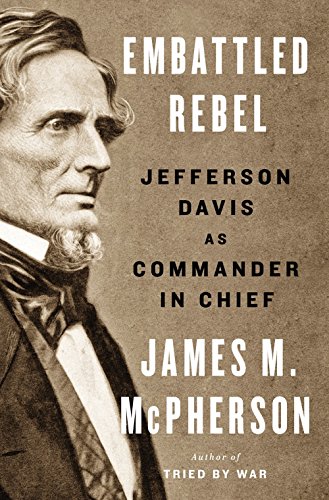
Inhaltsangabe
From the Pulitzer Prizewinning author of Battle Cry of Freedom, a powerful new reckoning with Jefferson Davis as military commander of the Confederacy
History has not been kind to Jefferson Davis. His cause went down in disastrous defeat and left the South impoverished for generations. If that cause had succeeded, it would have torn the United States in two and preserved the institution of slavery. Many Americans in Davis’s own time and in later generations considered him an incompetent leader, if not a traitor. Not so, argues James M. McPherson. InEmbattled Rebel, McPherson shows us that Davis might have been on the wrong side of history, but it is too easy to diminish him because of his cause’s failure. In order to understand the Civil War and its outcome, it is essential to give Davis his due as a military leader and as the president of an aspiring Confederate nation.
Davis did not make it easy on himself. His subordinates and enemies alike considered him difficult, egotistical, and cold. He was gravely ill throughout much of the war, often working from home and even from his sickbed. Nonetheless, McPherson argues, Davis shaped and articulated the principal policy of the Confederacy with clarity and force: the quest for independent nationhood. Although he had not been a fire-breathing secessionist, once he committed himself to a Confederate nation he never deviated from this goal. In a sense, Davis was the last Confederate left standing in 1865.
As president of the Confederacy, Davis devoted most of his waking hours to military strategy and operations, along with Commander Robert E. Lee, and delegated the economic and diplomatic functions of strategy to his subordinates. Davis was present on several battlefields with Lee and even took part in some tactical planning; indeed, their close relationship stands as one of the great military-civilian partnerships in history.
Most critical appraisals of Davis emphasize his choices in and management of generals rather than his strategies, but no other chief executive in American history exercised such tenacious hands-on influence in the shaping of military strategy. And while he was imprisoned for two years after the Confederacy’s surrender awaiting a trial for treason that never came, and lived for another twenty-four years, he never once recanted the cause for which he had fought and lost. McPherson gives us Jefferson Davis as the commander in chief he really was, showing persuasively that while Davis did not win the war for the South, he was scarcely responsible for losing it.
Die Inhaltsangabe kann sich auf eine andere Ausgabe dieses Titels beziehen.
Über die Autorinnen und Autoren
James M. McPherson is the George Henry Davis ’86 Professor of History Emeritus at Princeton University. He is the bestselling author of numerous books on the Civil War, includingBattle Cry of Freedom, which won the Pulitzer Prize, Tried by War, andFor Cause and Comrades, both of which won the Lincoln Prize.
James M. McPherson is the George Henry Davis ’86 Professor of History Emeritus at Princeton University. He is the bestselling author of numerous books on the Civil War, includingBattle Cry of Freedom, which won the Pulitzer Prize, Tried by War, andFor Cause and Comrades, both of which won the Lincoln Prize.
Auszug. © Genehmigter Nachdruck. Alle Rechte vorbehalten.
Tried by War
The Struggle for Equality
The Abolitionist Legacy
Ordeal by Fire
Battle Cry of Freedom
Abraham Lincoln and the
Second American Revolution
What They Fought For, 1861–1865
Drawn with the Sword
For Cause and Comrades
Crossroads of Freedom
Hallowed Ground
This Mighty Scourge
War on the Waters
Published by the Penguin Group
Penguin Group (USA) LLC
375 Hudson Street
New York, New York 10014
USA • Canada • UK • Ireland • Australia New Zealand • India • South Africa • China
penguin.com
A Penguin Random House Company
First published by The Penguin Press, a member of Penguin Group (USA) LLC, 2014
Copyright © 2014 by James M. McPherson
Penguin supports copyright. Copyright fuels creativity, encourages diverse voices, promotes free speech, and creates a vibrant culture. Thank you for buying an authorized edition of this book and for complying with copyright laws by not reproducing, scanning, or distributing any part of it in any form without permission. You are supporting writers and allowing Penguin to continue to publish books for every reader.
Image credits appear here.
LIBRARY OF CONGRESS CATALOGING-IN-PUBLICATION DATA
McPherson, James M.
Embattled rebel : Jefferson Davis as commander in chief / James M. McPherson.
pages cm
Includes bibliographical references and index.
ISBN 978-0-698-17634-8
1. Davis, Jefferson, 1808–1889—Military leadership. 2. United States—History—Civil War, 1861–1865—Campaigns. 3. Confederate States of America—Politics and government. 4. Presidents—Confederate States of America—Biography. 5. United States— History—Civil War, 1861–1865—Biography. I. Title.
E467.1.D26M26 2014
973.713092—dc23
2014005403
Also by James M. Mcpherson
Title Page
Copyright
Dedication
List of Illustrations
List of Maps
INTRODUCTION
1. WE MUST PREPARE FOR A LONG WAR
2. WINTER OF DISCONTENT
3. WAR SO GIGANTIC
4. THE CLOUDS ARE DARK OVER US
5. WE SHOULD TAKE THE INITIATIVE
6. WE MUST BEAT SHERMAN
7. THE LAST RESORT
CODA
Acknowledgments
Notes
Illustration Credits
Index
ILLUSTRATIONS
MAPS
INTRODUCTION
History has not been kind to Jefferson Davis. As president of the Confederate States of America, he led a cause that went down to a disastrous defeat and left the South in poverty for generations. If that cause had succeeded, it would have broken the United States in two and preserved slavery in the South for untold years. Many Americans of his own time and in later generations considered him a traitor. Some of his Confederate compatriots turned against Davis and blamed him for sins of ineptitude that lost the war. Several of Davis’s adversaries on the Union side agreed with this assessment. Writing twenty years after the Civil War, General Ulysses S. Grant claimed that “Davis had an exalted opinion of his own military genius. . . . On several occasions during the war he came to the relief of the Union army by means of his superior military genius.” A number of historians have concurred with this harsh judgment. On the centennial anniversary of the Civil War, David M. Potter famously declared that as commander in chief, Davis compiled “a record of personal failure significant enough to have had a bearing on the course of the war. . . . If the Union and Confederacy had exchanged presidents with one another, the Confederacy might have won its independence.”1
Comparisons of Abraham Lincoln and Davis as commanders in chief usually favor Lincoln, though rarely to the extent suggested by Potter. The one undeniable truth in such comparisons is that Lincoln’s side won the war. But that fact does not necessarily mean that Davis was responsible for losing it. Many factors help explain the ultimate Union victory, including the North’s greater population and resources, a stronger economy, a powerful navy, resourceful military leadership, and battlefield victories that blunted Confederate momentum at key points and prolonged the conflict until the weak economic infrastructure that underpinned the Southern war effort collapsed. Lincoln’s evolving skills as commander in chief may also help explain Northern victory. I have written about that subject elsewhere.2 But whether Lincoln was superior to Davis in this respect is impossible to say in the categorical manner stated by David Potter. Comparing Lincoln and Davis as commanders in chief is like trying to compare apples and oranges. They confronted different challenges with different resources and personnel. In the chapters that follow I have tried to avoid the temptation to compare the two leaders. I attempt to describe and analyze Davis’s conception and execution of his duty as commander in chief on its own terms and merits, without reference to Lincoln.
Full disclosure is necessary. My sympathies lie with the Union side in the Civil War. The Confederacy fought to break up the United States and to sustain slavery. I consider those goals tragically wrong. Yet I have sought to transcend my convictions and to understand Jefferson Davis as a product of his time and circumstances. After spending many research hours with both Lincoln and Davis, I must also confess that I find Lincoln more congenial, interesting, and admirable. That is another reason to avoid comparisons between the two men in a book about Davis as commander in chief. I wish not to be influenced by personal likes or dislikes. But in fact I found myself becoming less inimical toward Davis than I expected when I began this project. He comes off better than some of his fellow Confederates of large ego and small talents who were among his chief critics. I had perhaps been too much influenced by the negative depictions of Davis’s personality that have come down to us from those contemporaries who often had self-serving motives for their hostility.
Many of those contemporaries were officials in the Confederate government and officers in its army. They echoed a Southern journalist who described Davis as “cold, haughty, peevish, narrow-minded, pig-headed, malignant.”3 Robert Toombs of Georgia, who never got over the selection of Davis rather than himself as president of the Confederacy, denigrated his rival as a “false and hypocritical . . . wretch.”4 Another influential Georgia politician, Linton Stephens, brother of the Confederate vice president, sneered at Davis as “a little, conceited, hypocritical, snivelling, canting, malicious, ambitious, dogged knave and fool.”5 General Pierre G. T. Beauregard, whom Davis had removed from command of the Army of Tennessee in June 1862, wrote, “I thank my creator that I am not the essence of egotism, vanity, obstinacy, perversity, and vindictiveness” that he considered Davis to be.6 In truth, Beauregard was more accurately describing himself. The same might be said of Toombs, Stephens, and others who denounced the Confederate president as hypocritical and malicious. The hostility that developed between Davis and certain generals and political leaders—whether the chief fault was theirs or his—impaired his ability to function effectively as commander in chief.
To be sure, there was some substance underlying the stereotypes of Davis’s disagreeable personality. He did not suffer fools gladly, and he let them know it. He did not...
„Über diesen Titel“ kann sich auf eine andere Ausgabe dieses Titels beziehen.
Suchergebnisse für Embattled Rebel: Jefferson Davis As Commander in Chief

Beispielbild für diese ISBN
Embattled Rebel: Jefferson Davis As Commander In Chief
Anbieter: World of Books (was SecondSale), Montgomery, IL, USA
Verkäuferbewertung 5 von 5 Sternen

Hardback. Zustand: Good. From the Pulitzer Prize-winning author of Battle Cry of Freedom, a powerful new reckoning with Jefferson Davis as military commander of the Confederacy The best concise book we have on the subject. McPherson is. our most distinguished scholar of the Civil War era. --The New York Times Book Review History has not been kind to Jefferson Davis. Many Americans of his own time and in later generations considered him an incompetent leader, not to mention a traitor. Not so, argues James M. McPherson. In Embattled Rebel, McPherson shows us that Davis might have been on the wrong side of history, but that it is too easy to diminish him because of his cause's failure. Gravely ill throughout much of the Civil War, Davis nevertheless shaped and articulated the principal policy of the Confederacy--the quest for independent nationhood--with clarity and force. He exercised a tenacious hands-on influence in the shaping of military strategy, and his close relationship with Robert E. Lee was one of the most effective military-civilian partnerships in history. Lucid and concise, Embattled Rebel presents a fresh perspective on the Civil War as seen from the desk of the South's commander in chief. Artikel-Nr. 00103817684
Gebraucht kaufen
EUR 4,04
Versand gratis
Versand innerhalb von USA
Versand innerhalb von USA
Anzahl: 5 verfügbar
Beispielbild für diese ISBN
Embattled Rebel: Jefferson Davis as Commander in Chief
Verlag:
Penguin Press (edition First Edition), 2014
ISBN 10: 1594204977
ISBN 13: 9781594204975
Gebraucht
Hardcover
Erstausgabe
Anbieter: BooksRun, Philadelphia, PA, USA
Verkäuferbewertung 5 von 5 Sternen
Hardcover. Zustand: Very Good. First Edition. With dust jacket. It's a well-cared-for item that has seen limited use. The item may show minor signs of wear. All the text is legible, with all pages included. It may have slight markings and/or highlighting. Artikel-Nr. 1594204977-11-18-29
Gebraucht kaufen
EUR 5,63
Versand gratis
Versand innerhalb von USA
Versand innerhalb von USA
Anzahl: 1 verfügbar
Beispielbild für diese ISBN
Embattled Rebel: Jefferson Davis as Commander in Chief
Anbieter: ThriftBooks-Atlanta, AUSTELL, GA, USA
Verkäuferbewertung 5 von 5 Sternen
Hardcover. Zustand: Very Good. No Jacket. Former library book; May have limited writing in cover pages. Pages are unmarked. ~ ThriftBooks: Read More, Spend Less. Artikel-Nr. G1594204977I4N10
Gebraucht kaufen
EUR 6,32
Versand gratis
Versand innerhalb von USA
Versand innerhalb von USA
Anzahl: 1 verfügbar
Beispielbild für diese ISBN
Embattled Rebel: Jefferson Davis as Commander in Chief
Anbieter: ThriftBooks-Atlanta, AUSTELL, GA, USA
Verkäuferbewertung 5 von 5 Sternen
Hardcover. Zustand: Very Good. No Jacket. Missing dust jacket; May have limited writing in cover pages. Pages are unmarked. ~ ThriftBooks: Read More, Spend Less. Artikel-Nr. G1594204977I4N01
Gebraucht kaufen
EUR 6,32
Versand gratis
Versand innerhalb von USA
Versand innerhalb von USA
Anzahl: 1 verfügbar
Beispielbild für diese ISBN
Embattled Rebel: Jefferson Davis as Commander in Chief
Anbieter: ThriftBooks-Dallas, Dallas, TX, USA
Verkäuferbewertung 5 von 5 Sternen
Hardcover. Zustand: Good. No Jacket. Missing dust jacket; Pages can have notes/highlighting. Spine may show signs of wear. ~ ThriftBooks: Read More, Spend Less. Artikel-Nr. G1594204977I3N01
Gebraucht kaufen
EUR 6,32
Versand gratis
Versand innerhalb von USA
Versand innerhalb von USA
Anzahl: 1 verfügbar
Beispielbild für diese ISBN
Embattled Rebel: Jefferson Davis as Commander in Chief
Anbieter: ThriftBooks-Dallas, Dallas, TX, USA
Verkäuferbewertung 5 von 5 Sternen
Hardcover. Zustand: Very Good. No Jacket. Former library book; May have limited writing in cover pages. Pages are unmarked. ~ ThriftBooks: Read More, Spend Less. Artikel-Nr. G1594204977I4N10
Gebraucht kaufen
EUR 6,32
Versand gratis
Versand innerhalb von USA
Versand innerhalb von USA
Anzahl: 1 verfügbar
Beispielbild für diese ISBN
Embattled Rebel: Jefferson Davis as Commander in Chief
Anbieter: Wonder Book, Frederick, MD, USA
Verkäuferbewertung 5 von 5 Sternen
Zustand: Very Good. Very Good condition. Very Good dust jacket. A copy that may have a few cosmetic defects. May also contain light spine creasing or a few markings such as an owner's name, short gifter's inscription or light stamp. Artikel-Nr. H19A-02332
Gebraucht kaufen
EUR 6,41
Versand gratis
Versand innerhalb von USA
Versand innerhalb von USA
Anzahl: 3 verfügbar
Beispielbild für diese ISBN
Embattled Rebel: Jefferson Davis as Commander in Chief
Anbieter: Wonder Book, Frederick, MD, USA
Verkäuferbewertung 5 von 5 Sternen
Zustand: Good. Good condition. Good dust jacket. A copy that has been read but remains intact. May contain markings such as bookplates, stamps, limited notes and highlighting, or a few light stains. Artikel-Nr. E17D-01594
Gebraucht kaufen
EUR 6,41
Versand gratis
Versand innerhalb von USA
Versand innerhalb von USA
Anzahl: 1 verfügbar
Beispielbild für diese ISBN
Embattled Rebel: Jefferson Davis as Commander in Chief
Anbieter: Wonder Book, Frederick, MD, USA
Verkäuferbewertung 5 von 5 Sternen
Zustand: As New. Like New condition. Like New dust jacket. A near perfect copy that may have very minor cosmetic defects. Artikel-Nr. K04L-00849
Gebraucht kaufen
EUR 6,41
Versand gratis
Versand innerhalb von USA
Versand innerhalb von USA
Anzahl: 1 verfügbar